Rosemarie Alexander

90 days and counting

The second session of the 27th Alaska State Legislature begins Tuesday. The House of Representatives will gavel in at 1 p.m. The Senate comes in at 1:30.

Juneau will formally welcome legislators Wednesday at a Centennial Hall reception from 5 to 6:30 p.m. At 7 p.m., Gov. Sean Parnell will deliver his annual State of the State Address.

Juneau Republican Rep. Cathy Munoz says she’s glad to be back to work.

“Looking forward to having everybody back in town,” she says. “We’ve developed really good camaraderie with people from all over the state and I’m really looking forward to seeing them again.”

Munoz, Rep. Beth Kerttula, and Sen. Dennis Egan, both Democrats, work well together. At the start of the session, Kerttula says, they have a lot of optimism.

“It’s one of the great things about Juneau and one of the great things about the beginning of session,” she says. “Everybody does come in, I think, with a sense of optimism for the next year. You know that we really can join together to do good things for the people.”

Kerttula is beginning her sixth year as leader of the House Democratic Minority. She expects oil and gas and retirement issues will be major policy arguments this session.

Kerttula has introduced one bill – HB 257 – which would give the Violent Crimes Compensation Board more flexibility to help cold case victims.

“That kind of pain doesn’t go away and it shouldn’t matter whether the case gets resolved one week after the crime has happened, or 10 or 20 years later,” she says. “It’s still important that the state and Violent Crimes Compensation Board can be there to help victims.”

Kerttula says she was inspired to sponsor the bill after getting to know the mother of a victim of a case that was not resolved for many years.

Munoz also has introduced legislation this session inspired by Alaskans – naturopaths, pharmacists, realtors and homebuilders.

One bill sounds like it was written expressly for Juneau, with its lack of affordable housing. Munoz says HB 264 would let municipalities defer property tax increases after lots are subdivided.

“Once a developer comes in and subdivides land and puts in all the improvements – the sidewalks, water and sewer, — the city then reassesses that land at fair market value, according to state law,” she explains.

Munoz calls that a disincentive. “The developer is taxed with this higher assessment immediately, even before the lots have sold,” she says.

She believes if cities could defer the tax, it would encourage housing development.

Munoz and Kerttula’s bills are among those filed prior to the start of the session and will be assigned to committees today.

Lawmakers now have 90 days to complete their work.

Petition drive nets 30,000 signatures

Organizers of a citizen’s ballot initiative to restore Alaska’s coastal management program have well over the number of signatures required to put it on the statewide ballot.

“We’ve exceeded 30,000 and in terms of overall numbers it’s approaching my level of comfort,” Juneau Mayor Bruce Botelho says.

Twenty-six thousand are required. Volunteers started gathering signatures less than a month ago. The signatures must be filed with the Alaska Division of Elections today.

Botelho says volunteers stopped the petition drive at 6 p.m. Monday to determine if they have the required district distribution, which is 7 percent of registered voters who voted in the last election in each of 30 of 40 house districts.

Botelho and Kodiak Island Borough Mayor Jerome Selby are among several local officials who formed the Alaska Sea Party to bring back a coastal management program. The Parnell administration shut down the program last summer, after the legislature and governor’s office failed to reach a compromise to renew it.

Sea Party organizers will hold a news conference today to update the initiative’s progress.

If the Legislature enacts substantially similar legislation this session, the initiative would not appear on the statewide ballot this fall.

Juneau Representative Beth Kerttula believes the Legislature will take it up. She says collecting more than 26,000 signatures in record time is a powerful message.

“Legislators will sit up and take notice that the state’s pretty much spoken on it and we need to get back to work and get our program back,” she says. “We lost it by one vote last session and now we’re the only coastal state in the union not to have a coastal zone program.”

Alaska has nearly 40 percent of the entire coastline of the United States and has no program to coordinate management.

Juneau airport body scanners start Jan. 23

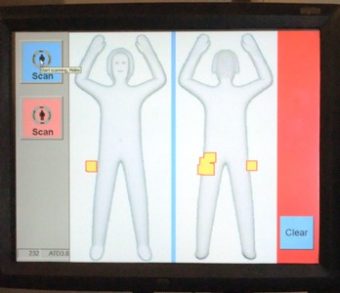
This passenger would require a pat down of yellow area. Photo by Rosemarie Alexander

TSA will begin using Advanced Imaging Technology at the Juneau International Airport on January 23rd.


Transportation Security Administration officials demonstrated the newly installed machine Thursday. It began with a TSA officer giving these instructions to some would-be passengers:

“You guys want to make sure you take everything out of your pockets.”

Like the current system, passengers must take off their shoes, belts, coats and unload their pockets; all that stuff goes through the standard security x-ray.

Then the person walks into the circular unit and is told to raise arms above the head. The TSA officer presses a pink or blue button, depending on the gender, then gives these directions:

“You’ll face this direction. Look at the photo on the wall and assume that stance. Hold it until I ask you to release it. Go ahead and release. Step this way,” and the passenger exits.

To demonstrate the unit, TSA employees role-played passengers for the media. The officers are already going through training to learn how to use the Advanced Imaging Technology unit and Automated Target Response software.

Lorie Dankers is the spokeswoman for the TSA in Alaska.

“The units at this airport use what is called millimeter-save technology, which bounces harmless electromagnetic waves, essentially radio waves, off the body during the screening process,” she explains. “This is not an x-ray.”

The results are real time and the passenger sees it at the same time as the TSA officer. The computer-generated outline of a person on the screen is identical for all passengers. No body parts can be seen.

“So if a person has had a hip replacement or knee implants of some sort, it won’t detect that because it’s only looking at items on the outside of the body,” she says.

If the underwear bomber is carrying explosives in his shorts, the package will show up as a yellow image on the screen and the officer would follow-up with a targeted pat down.

“It’s not the machine’s job to tell us what the item is, it’s just to cue us that there’s something that needs to be followed up on. And so it’s not going to look different from one item over another,” Dankers says.

Advanced Imaging Technology is already in use at Anchorage and Fairbanks airports and will be installed in Ketchikan at the end of the month.

More than 540 AIT units are in airports across the U.S., but older full-body x-ray type scanners are used at other airports, including Seattle.

Federal security director for Southeast Alaska Ray Culbreath says the AIT scanners will not displace any TSA officers; Juneau currently has 54.

In addition to being the capital city and Alaska’s gateway city, Juneau and Ketchikan have been selected for Advanced Imaging Technology due to the high volume of tourists that come through their airports every summer, Culbreath says. In Juneau…

“This time of year we’re averaging between 650 and 750 passengers a day and during the summer months that more than triples,” he says.

According to Culbreath, an average of 275,000 passengers depart from the Juneau International Airport annually.


Juneau girl dies in Seattle gunfire

Seattle Police are investigating the January 3rd death of a young Juneau woman, apparently the victim of a parking lot shooting in the Rainier Beach area.

Twenty-two-year old Ashton Reyes was one of two people shot in the parking lot of a fast-food restaurant in the 9300 block of Rainier Avenue South. Officers responded to calls of “shots fired” about 10 p.m. on January 3rd, and said people were running from the restaurant’s parking lot when they arrived.

Police found the wounded Reyes lying in the parking lot. She was rushed to Harborview Medical Center, where she died about 75 minutes later. According to the King County Medical Examiner, Reyes died from a gunshot wound to the torso.

Police said they found an adult male victim in another parking lot across the street; his injuries were not life-threatening.

Police are investigating the incident as a homicide. Reyes had recently completed a dental assistant program in Seattle and was working as an intern in a dentist’s office.

She graduated from Yaakoosge’ Daakahidi Alternative High School in 2008 and was the daughter of Rick Reyes of Juneau and Terri Reyes of Oregon.

Too much snow to ski

This machine melts the snow and the water is dumped down storm drains. Photo courtesy Nick Barshay. Click to enlarge.

The snowed-clogged town of Cordova had rain Wednesday, adding pounds to the snow, increasing avalanche danger, and complicating the cleanup. The forecast calls for more snow over the next two days, then some sun.

The town needs the sun, says former Cordova Mayor Tim Joyce. He’s the new information officer for the small Prince William Sound community. The job didn’t exist until the world found out about Cordova’s 15-plus feet of snow.

Joyce volunteered to answer all those media phone calls coming into city hall.

He says the warmer temperatures and rain have helped somewhat, but it’s also made all that snow a lot heavier. Residents were evacuated from one apartment building earlier this week when the roof started to sag, jamming doors and windows. It’s one of the many roofs yet to be shoveled by residents and others who’ve come to the town to help.

Joyce says the Copper River Highway to the airport also has been closed due to high avalanche danger.

“During daylight hours, people are being escorted through by police, a little like a convoy kind of thing around the avalanche zones,” he says.

Large, scoop-type shovels – capable of moving a cubic foot of snow at a time — are expected in town by Friday. Joyce also describes a wonderful piece of equipment that came in from Anchorage.

“Basically, it’s a snow melter and it’s here!” he says. “We’ve been working on some of the snow that we’re pulling off the roads and got no place to put. We have like three backhoes feeding this thing as fast as they can. And it melts the snow and turns it into water. The only thing you have to do is make sure the drains are open so it has some place to go,” he says.

Sixty Alaska National Guard members have been helping state transportation crews, city workers and residents dig out those drains, shovel the roofs, and a myriad of other chores. Joyce sends a shout out to the guardsmen’s home towns.

“They all had jobs and their employers let them go to be able to come down and do this. And we really want to thank those employers wherever they might be in Alaska to let these guys come down here to help us,” he says.

Twenty-two crew members from the Coast Guard Cutter Sycamore have been working in the harbor, including shoveling floats, some of which had started to sink.

“They’ve also been really good because they had six mechanics assigned to us to help maintain some our heavy equipment, you know loaders and graders and stuff,” he says. “That’s been real useful.”

Too much snow to ski

Cordova is on Orca Inlet at the base of Mount Eyak. Two weeks ago, Joyce says, the Mount Eyak Ski Area had some of the best skiing Cordova has ever had.

“You know with two feet of powder, it was phenomenal skiing,” he says. “After our storm we have no skiing because the chairlifts are buried.”

Jan. 9, 2012. More snow has fallen since. Courtesy Mt. Eyak Ski Area. Click to enlarge.

The Mount Eyak Ski Area, elevation 1,230 feet, is operated by the Sheridan Alpine Association. Dave Branshaw is general manager.

“We had 15 feet at the snow stake, but that was a week and a half ago,” he says. “It’s snowed quite a bit since then, and it’s still snowing up there.”

Branshaw says even the 30-foot O tower close to the top of the mountain is nearly buried.

Here’s the message he put on the Mount Eyak Ski Area hotline earlier this week:

“After this storm blows through we’re going to start and it’s going to take us probably about a week to dig it out, depending on how much help we get.”

Mount Eyak’s historical chairlift dates back to Sun Valley, Idaho’s Mount Baldy, where it was first installed in 1936. It was moved to Cordova in 1974, and is one of only two single chair lifts still in operation in the U.S. The other, by the way is in Mad River Glen, Waitsfield, Vermont, which remains closed for lack of snow.

Branshaw says a crew started shoveling a path to Mount Eyak’s base buildings and shop on Wednesday. They still have to uncover the rope tow, the base of the chair lift, and midway station. Then they’ll tackle the top.

But first there’s the town to dig out. Branshaw says it’s like a job:

“Every day we’re starting with a shovel plan and we get our gear together and head out there and keep scoopin’,” he says. “We usually put in a solid eight hours every day.”

Valdez also breaks snow records

Another Prince William Sound community is struggling with more snow than it can handle.

Valdez normally has about 150 inches by this time of the year, but the National Weather Service says snowfall is up to 318 inches, or 168 inches more than usual.

Even so, the city is holding off on declaring a state of emergency.

The Valdez City School District earlier this week closed Hermon Hutchens Elementary School, because the roof had exceeded its snow load capacity. Then the high school roof exceeded its capacity, so the Valdez district has shut down schools for the rest of the week.

Site notifications
Update notification options
Subscribe to notifications