Rosemarie Alexander

JSD negotiations underway; 2013 spring break in question

The Juneau School district is negotiating two contracts this year, representing the vast majority of district employees.

The Juneau Education Support Staff presented its proposal yesterday (Tuesday), calling for a new three-year contract as well as increases in wages and health benefits.

JESS is represented by the American Federation of Teachers. Spokesman Pete Ford says the 300 members of JESS are the lowest paid in the district. The union is asking for a 15 percent wage increase over three years, beginning with 4 percent in July of this year, 5 percent next year, and 6 percent in 2014.

Ford says the union realizes the district expects to be facing less revenue from the state and could propose options, particularly annual leave.

“We did propose to open those articles in the event we are persuaded that we are really are looking at a bad money situation, to perhaps offset a lack of raises with more benefits in the area of paid time off,” Ford says.

He says the union is also concerned about what he calls the “McDonaldization” of support staff positions. He says members want assurance the district will protect JESS positions “from being reduced in hours, protect our positions from being filled by hourly non-bargaining unit positions, protect our positions from just being eroded as we feel has been happening to some degree over the last several years.”

JESS includes such jobs as administrative and office assistants, classroom aides, technology specialists, and custodial staff. The current contract expires on June 30th.

District Human Resources Director Phil Bedford says the district will present its counter proposal the next time the two sides meet, early next month.

The Juneau teachers’ contract also expires this year. Bedford says bargaining begins January 19th with the Juneau Education Association, which represents more than four hundred teachers.

“We’ve met a couple times to set dates and establish ground rules, but we’ll actually begin negotiations on the 19th,” he says.

Meanwhile, the Juneau school board is considering a proposal to do away with the March spring break next year.

The district calendar for the 2012-13 school year shows two options: eliminating the week-long spring break, which would add 25 hours of instruction prior to the standardized tests students take each spring. That’s option B and it calls for getting out of school a week earlier, on May 17.

Option A includes the traditional spring break, with school ending on May 24.

The proposals can be found at juneaschools.org.

The school board is taking public comments on the options. They can be emailed to calendar@jsd.k12.ak.us. The board will not vote on the proposal until next month.

Young Alaskans eye state’s future

COYA will air on 360 North television beginning Wednesday.

Reinstate Alaska’s coastal management program and maintain the current oil structure — two of many recommendations from last week’s Conference of Young Alaskans meeting in Juneau.


Fifty-five delegates from 28 Alaska communities, all under the age of 25, plan to present their vision of the state to the Alaska Legislature in the spring.

As the 2012 conference came to a close Saturday, delegates proudly patted their peers on the back, congratulating each other on the final document they produced.
The phrases awe-inspiring, empowering, honored, and eye-opening were used countless times to describe the three-day conference. Every delegate seemed positively affected by the conference, including 18-year-old Brad Gusty from Stony River.

“I now know issues for other people in Alaska, like other communities and what they want,” he said.

COYA delegates bonded over their passion for Alaska as they discussed issues pertinent to the state. The final result of their discussion and debate was a document that represents the consensus of the group on five topics – economic resilience and fiscal policy, education, workforce development, energy, and living harmoniously. In addition to oil and coastal management, recommendations include, among other things, reinstating a state income tax, mandating that all utilities use net metering at competitive rates, and repealing Article 1, Section 25 of the Alaska Constitution, which describes marriage as between a man and a woman.

Twenty-year-old Leyonty Williams is one of several delegates selected to present the document to the legislature in March.

“We set aside our differences and just came together for something greater,” Williams said. “It was kind of funny because a lot of us were pretty upset when there was only like 98 percent (agreement). That just shows what high expectations we have for this and how unified we feel.”

In the final report, the delegates leave Alaskan leaders with this challenge: “Just as our predecessors challenged us, we challenge you to help others to love and cherish our homeland and lead Alaska forward.”

The final report will be available at youngalaskans.org later this month.

The entire 2012 Conference of Young Alaskans can be seen on statewide television, 360 North, beginning Wednesday at 8 a.m.

Lots of dogs for adoption at GHS

Berkeley the Boxer. Courtesy GHS

It’s a full and noisy house at the Gastineau Humane Society. The animal shelter over the weekend had more than 20 dogs up for adoption, including 11 puppies that have been in foster care.
Shelter director Chava Lee said Friday most of the dogs came into the shelter last week.

“You know every morning I’d hear, ‘Oh, we got two more dogs last night; well, we got another dog; well, we got three dogs today,’ ” she said. “And you know those added up to ‘What do you mean we have 22 dogs at the shelter?’ ”

Lee said the dogs are not Christmas rejects; she expects those to begin coming in next month.

And while the dogs have not been “dumped,” she said the shelter does have more than usual. She said they all came from people moving out of town who could not take their dog, or from homes where for one reason or another, families could no longer care for them.

Gastineau Humane Society maintains a list of foster families, who care for animals in their homes until permanent homes can be found. That was the case of the 11 puppies, born to a dog rescued from a Southeast village. She said the foster family had its hands full.

“They had to feed these pups by bottle every few hours and they did it,” Lee said. “They have small children and the small children have friends, so these pups have been around a lot of kids and they are just incredibly well-socialized, sweet dogs.”

She said the foster-to adopt puppies are a Rottweiler and possibly Lab mix.

Lee said the shelter also has 16 pups from two litters “waiting in the wings,” to be prepared for adoption.

Record holidays at Eaglecrest

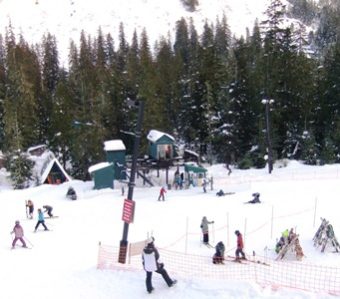
Hooter lift at Eaglecrest base.Photo by Rosemarie Alexander.

Not only does Eaglecrest have record amounts of snow for this time of year, it also did record business over the two-week Christmas and New Year’s holidays.

Now that the accounting is done, General Manager Matt Lillard says sales were up in all departments, from the number of day tickets sold to equipment rentals, ski and snowboard lessons, and the cafeteria.

“Percentage-wise we’re looking at over a 42 percent increase over the highest two-week period that I can track. We also had our busiest day on Saturday, December 31st, with approximately 15-hundred skiers (and snowboarders) up at the mountain,” he says.

He says the city-owned ski area also has had record season-pass sales in terms of revenue.

“Season pass sales to date are 778-thousand dollars, surpassing the record that was set in 2009 and 2010,” Lillard says. “Between the online sales and what actually takes place here (Eaglecrest office) it’s going to be probably around the 21-hundred, 22-hundred mark (individual season passes).”

Most ski areas make more money from daily ticket sales, while Eaglecrest has historically brought in most of its ticket revenue through season passes.

Eaglecrest opened the day after Thanksgiving for weekends only, then on December 16th it began operating every day through Monday, January 2nd. The holiday period is important to all ski areas, which stand to make 10 to 20 percent or more of season revenue. But across the U.S., many ski resorts had little or no snow last month.

According to skicentral.com, a database of North American ski resorts, 347 or 471 U.S. and Canadian areas are now open. Eaglecrest still has more snow than any other ski area in North America.

Eaglecrest is back on its normal operating schedule, open Thursday through Monday; closed Tuesday and Wednesday.

Tanoa Bowl showcases Alaska athletes

JDHS QB Philip Fenumiai holds his Offensive Player of the Game trophy from the 2011 Tanoa Bowl in Auburn, WA. (Photo courtesy Dirk Knudsen. Click to enlarge)

Team Alaska left Team Oregon scoreless in the second annual Tanoa Bowl over the New Year’s weekend.

The football bowl game started in late 2010, designed to showcase high school players in Washington and Alaska and introduce them to college football coaches. This year the bowl game expanded to include teams from Oregon and Utah.

It was played on New Year’s Eve at Auburn Memorial Stadium, south of Seattle. Alaska beat Oregon 40-0, to a crowd of family, friends, and college football recruiters, mostly from division two and division three schools.

Team Alaska head coach Numi Ilalio says many college coaches don’t pay much attention to Alaska high school football teams.

Ilalio coaches at Service High School in Anchorage. The Alaska football season ends in early October, a month earlier than the Lower 48. It took dedication, and money, for some of the players selected to get to Anchorage for practice, but kids from Juneau, the MatSu and Anchorage managed to practice 18 days before the big game.

Thirty-seven players – sophomores, juniors, and seniors — from the Cook Inlet and Railbelt conferences were hand-picked, based on what Ilalio calls the Three-A’s, utilized by college athletic recruiters.

“The first A is Academic,” Ilalio says. “They have to have the academics, otherwise it would be useless for them to be on this team and not be able to qualify to go to college.”

The second A is Attitude. Ilalio says recruiters are looking for a good attitude and dedication to the sport, because the university will be making an investment in each player they select.

“The one thing that college coaches told me a long time ago is you have to put yourself in their shoes,” he says, “and ask yourself ‘am I going to put my life, my paycheck on the line for an 18-year-old kid, when I don’t know if he has the character, the ability and the academics to play?’ ”

The third A is Ability to play at the college level.

“I looked at the best players in the state of Alaska who made the All-Conference, made the All-State list and then selected from there,” Ilalio says.

Three were Juneau-Douglas Crimson Bears – Quarterback Phillip Fenumiai, linebacker Lah Fafita and Enele “Bubbles” Velopoto. Three players came from Wasilla and the rest from eight Anchorage-area high schools.

Each player goes to the Tanoa Bowl with a file on their high school football career, academic transcripts and a DVD of their play.

Fenumiai was one of three quarterbacks on the team, along with Conor Feckley from West High School and Zach Lujan from South.

“Right from the get-go we set the tempo with a big hit from one of our safeties on kick off,” Fenumiai says. “From there we just put the pedal to the metal and just let everything loose and we just had control over the whole game.”

Then they got to watch Team Utah beat Team Washington, 45-24.

“Utah had a very good team. We scrimmaged them and they had a lot of good athletes on their team,” Fenumiai says.

After the games, Tanoa Bowl staff – separate from the teams’ coaching staff – selected MVPs for each team.

Service HS's Matthew Ilalio accepts his MVP trophy for the 2011 Tanoa Bowl in Auburn, WA. (Photo courtesy Dirk Knudsen. Click to enlarge)

Fenumiai was the offensive player of the game and Matthew Ilialio of Service was most valuable player for Team Alaska.

The Tanao Bowl has Polynesian roots, but being Polynesian is not a criteria for selection to the teams. Ilalio, who is Samoan, says it symbolizes the importance of family, culture and team. The players do not have to be Polynesian

“To come together as a football family and help get these kids noticed and recruited by colleges,” he says.

In addition to Ilalio, the coaching roster was sort of a who’s who of coaches for large Alaska high schools, including Chugiak head coach Duncan Shackelford, West High School head coach Tim Davis as well as South quarterback coach Gabby Lujan and Juneau-Douglas Crimson Bears Defensive Coordinator Al Fenumiai – 10 coaches in all.

The football recruiting program is part of the Alaska Athletic Alliance. For more information, go to alaskaalthelticalliance.org.

Taku River task force begins work

Sen. Dennis Egan and Rep. Cathy Munoz open first meeting. Rep. Beth Kerttula was on teleconference.
Standing room only marked Thursday night’s meeting of the Taku River task force. About 45 cabin and lodge owners, commercial fishermen, charter operators and others packed the House Finance Chambers in the state capitol to hear about Taku River habitat and its abundant fish stocks.

It was the first of a series of meetings to gather facts about the transboundary river. The task force was created by Juneau legislators in response to community concerns about proposed resource development on both the U.S. and Canadian side.

The most immediate project is Tulsequah Chief Mine at the headwaters of the Taku River. Canadian company Chieftain Metals plans to re-open the mine in 2014, and is barging equipment and supplies from Juneau to the mine. Alaska has no jurisdiction over the Canadian mine, nor does the state require a permit to barge up and down the river.

The eight-member task force will be learning about the health of the river, the agencies responsible for industrial traffic and spill response, and the effectiveness of state and federal laws and regulations. The group will be writing a report to Juneau lawmakers, who will make recommendations on river protections to the state legislature.

The second meeting of the Taku River Fact-Finding Task Force is Saturday, from 9 a.m. to noon in room 519 of the state capitol.

Site notifications
Update notification options
Subscribe to notifications