Rosemarie Alexander

Taku River meetings to begin

Tulsequah Chief Mine officials are expected to be part of a Taku River task force meeting later this week.

The fact-finding group meets Thursday evening for the first time since Juneau legislators created it in September. A second meeting is scheduled for Saturday.

The eight-member task force will primarily gather facts about the salmon-producing Taku River. One catalyst is mine redevelopment on the Canadian side. The Tulsequah Chief closed down in the 1950s, and acid mine drainage has been a concern since. Mine owners Chieftain Metals installed a treatment plant at the site this fall, and water coming out of the old mine is now being treated.

Chieftain Metals moved water treatment plant and other equipment by barge from Juneau to the mine last summer. Courtesy Chieftain Metals.

The issue that seems to have Juneau most anxious is barging. Former Tulsequah owner Redfern Resources proposed an air-cushion, or Hover barge, towed up the Taku River by an amphibious vehicle. But Redfern went bankrupt and Chieftain Metals announced last year that they want year round road access to the mine. Chief Operating Officer Keith Boyle says even traditional barging up the Taku – as the company did last summer – is difficult.


“Our preference is the overland route, just simply because it’s a much lower risk alternative for the operation. We’ve seen a huge variability in what Mother Nature has dealt in terms of river levels and the ability to barge,” Boyle says. “The financial communities are nervous when they see you can’t get your product to market in a consistent manner.”

Chieftain last year struck an agreement with Taku River Tlingit First Nation that covered mine exploration, water treatment and employment. But the company is still negotiating on a road through First Nation territory. It could be years before a road is ever built.

Chris Zimmer is Alaska Director for Rivers without Borders. He says the state must make sure barging doesn’t harm the river and salmon resource.

“It raises all kinds of issues about spills, of diesel fuel and toxic materials and groundings and damage to habitat, so we really want to see the task force take this on, and understand that barging will happen for the next few years and very likely beyond that,” Zimmer says. “That’s something Alaska doesn’t really have a regulatory or permitting handle on.”

The task force is an outgrowth of an effort last year to create a legislative group to study Taku River issues. Meetings between sport and commercial fishermen, and property owners, proved to be very contentious. Juneau legislators said it was clear everyone needed more information and less opinion before any new river protections could be considered.

Task force facilitator Kevin Ritchie says the group will hear about river habitat and salmon stocks as well as current regulatory protections, which are not clear.

“So this is going to be a very valuable process of determining exactly the types of things that will occur if there are specific industrial or other types of issues that involve the Taku River,” Ritchie says.

Chieftain Metals C-O-O Boyle is expected to participate by teleconference in Saturday’s task force meeting. The company is headquartered in Toronto, Ontario, Canada, and has offices in Vancouver and Atlin, British Columbia.

The Taku River Fact-Finding Task Force will meet Thursday from 5 p.m. to 8 p.m., and Saturday, from 9 a.m. to noon, in House Finance chambers at the state capitol.

JDHS Theatre selected for International Fringe Festival

The Juneau Douglas High School Drama Department has been selected to perform next year at the prestigious International Fringe Theatre Festival in Edinburgh, Scotland.

JDHS also has been voted one of the best high school theatre programs in the U.S. by the American High School Theatre Festival.

High school theatre groups must be nominated by a college theatre program to begin the application process. Theatre Department Director Micaela Moore says she doesn’t know who recommended JDHS, but she was notified last September, which began the formal application process. In December a panel of judges from the American High School Theatre Festival selected JDHS to attend the 2013 festival.

Moore says between 20 and 30 “hard working” theatre students will participate.

“You know it needs to be the kids who have been working hard in the department and who are the committed members of our team,” she says.

The JDHS program has a year to prepare and raise funds. Moore estimates it will cost $6,000 per student for travel and the festival.

“Different colleges, different professional groups, and then high schools who have been accepted for this honor, perform their plays every night and they get feedback, I believe, from judges. It’s a two-week program and the kids get to go to a lot of workshops, too,” she says.

Moore doesn’t know yet what play the students will perform. She expects to select a large ensemble where a lot of characters have big parts, but minimal set requirements, because the theatre group will have to ship the set and props.

She says the students will be at the International Fringe Theatre Festival for about two weeks in August 2013. The cost includes air fare, housing, meals, the workshops and some travel in Great Britain that will take the students to professional theatre performances in London.

Moore hopes the theatre students will be able to raise most of the funds from their shows. The next JDHS play is a modern version of Cole Porter’s Kiss Me Kate. It begins February 10th.

New Year’s Day babies

Sophie Mae Babcock. Courtesy Bartlett Regional Hospital
The first baby of the year was born to a Bartlett Regional Hospital obstetrics nurse, who was on duty when she went into labor.

Sophie Mae Babcock was born at 2:55 p.m., New Year’s Day. Her mother is nurse Angela Babcock, and her father is Danny Babcock, a firefighter for Capital City Fire and Rescue.

Sophie Mae weighed 6 pounds, 7 ounces, and was 20 inches long.

Raymond Glen Hand. Courtesy Bartlett Regional Hospital
The second baby of the new year was born at 8:36 p.m. to Deena and Daniel Hand. Raymond Glen Hand came into the world at 8 pounds, 14 ounces and 21 inches.

Holiday Cup is Juneau tradition

Six teams with some strange names are the champions of Juneau’s 19th Holiday Cup soccer tournament, which ended Saturday.

The youngest players — the Reindeer Rampage – won the elementary school division, the Swaggalicious took the middle school spot, junior and senior winners are the Purple Cobras and Wolf Pack, while the Hot Cocoas and Crunch Enhancers won the adult divisions. 

The coed indoor soccer tournament has become a tradition for soccer enthusiasts during Juneau’s holiday school break.  KTOO intern Alice Ottoson-McKeen reports.

National chain stores to open in 2012

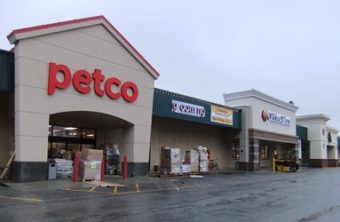
Photo by Rosemarie Alexander. Click to enlarge.

Two new major chain stores will open in Juneau in the New Year.

Office Max has a target date of February; Petco expects a noon opening on Monday, Jan. 2nd. Both stores are located at the Mallard Street end of Nugget Mall.

Petco is expanding in Alaska, under this philosophy:

“We no longer really have pets, we have family members now that just happen to have four legs,” says General Manager Barry Goodson, who says he started at the company about a decade ago when he was looking for a career change.

“They were building a new Petco. There was a hiring-now banner. I went in and sat down and talked to them. Started as a part-time freight guy and worked my way through every job inside the store until I got this job as general manager,” he says.

Goodson was managing a Petco in the Spokane area when he was tapped to manage the new Juneau store. He’s one of two managers the corporation has imported. Goodson hired the other 23 employees from the capital city.

Petco started as a mail-order veterinary supply business 56 years ago. A privately held corporation, it now has more than one-thousand stores in all 50 states, including two in Anchorage and one in Fairbanks. Construction begins next summer on a Petco in Soldotna, according to retail consultant David Irwin. He says the company is also studying Wasilla.

“They look at the pets population and they look at what exists for pet supply stores and they figured it was ripe for Petco,” Irwin says.

Juneau’s dog population is probably about 7,000, according to CBJ Animal Control, though only half of those are licensed, as required by law. No estimate of cats and other pets; they don’t need to be licensed.

Consultant Irwin says the corporation figures this small town of about 31,275 people has plenty of pets and with only one store dedicated to them, Juneau is an underserved market.

But Southeast Alaska is losing population and the capital city’s growth has been miniscule. The government sector keeps Juneau stable, says Dan Robinson, chief of the Research and Analysis section for the Alaska Department of Labor and Workforce Development.

“It’s not growing much,” he says, “but it may be that it shows up on the matrix as an underserved retail market.”

Juneau’s history with national chain stores has been sketchy. Sort of here today, gone in just a few years. Robinson says one factor is Juneau’s work force. Large stores here are often hiring due to employee turnover.

“That’s kind of a constant in Juneau. We don’t have a big supply of workers who can afford to live here on lower than average wages, which retail jobs tend to be,” Robinson says.

Petco manager Goodson says the company pays a little better than minimum wage and offers benefits to employees who work at least 20 hours a week. He says he’s tried to hire people who will stay with the company.

The new Petco has what Goodson calls 8,200 shopable square feet. The rest of the more than 11,000 square-foot space is storeroom and grooming.

The only animals the store will carry are reptiles, fresh and salt water fish, some birds and small furry mammals. Though it does not sell dogs and cats, it carries all sorts of canine and feline supplies, will offer dog training and has a grooming salon, staffed by local professionals.

Part-time employee Carty Neill was stocking dog shampoos, conditioners and deodorizers the day I visited the store. When it opens, she’ll be using some of the products in her training to become a professional groomer, something she says she’s done for years as an amateur.

“I feel so fortunate to have this opportunity to do something I love and get paid for it too,” Neill says.

Retail expert Irwin has been a consultant for Nugget Mall and Petco. He says PetSmart also was looking at the Juneau market.

“And it’s first guy in wins,” he says.

Irwin says Petco and Office Max will be the last big stores to move to Juneau for a while.

State labor economist Neal Fried says national chains most often move geographically; Alaska is a big stretch.

“It’s a logistical leap,” Fried says. “You know you can’t just drive in a truck and open a new store and supply it.”

Photo by Rosemarie Alexander. Click to enlarge.

The Juneau Petco will have higher shipping costs than its other stores, even those on Alaska’s road system. Irwin predicts Juneau shoppers will see it in price.

“I’m sure that the average price of things will be more expensive in Juneau simply because of shipping,” Irwin says.

Petco is a mega store by comparison to Juneau’s only current pet shop. Wee Fishie is just across the Nugget Mall parking lot.

It’s been in business for two decades and is currently owned by Andrew Nelson and Emiliano Ruiz. While Ruiz declined to talk on tape, he has said he’ll weather whatever storm the competition might bring.

Petco’s Goodson says he expects to be a good neighbor.

“Hope it goes well, because I really believe there’s a niche for both of us here,” he says.

Goodson says the corporation prides itself on being community-oriented and plans to be involved in Juneau. He’s been in town about a month now and will soon be settling into a home with a boxer, a cat and fish.

Taku River Task Force schedules first meeting

After a three-month delay, the Taku River Fact-Finding Task Force will meet next week for the first time. The task force was created in September by Juneau’s legislative delegation to gather facts about the river and possible impacts of Tulsequah Chief Mine redevelopment on the Canadian side of the Taku River watershed.

The Taku River is the most abundant salmon-producer in Southeast Alaska.

Scheduling difficulties prevented task force members from meeting with Fish and Game, Natural Resources, and other agency experts until January 5th, about three weeks after a report to Juneau legislators was due.

Facilitator Kevin Ritchie says the first two meetings will chart the course of the task force. No formal deadline has been set for the report.

He emphasizes the task force’s fact-finding mission:

“It’s not out there to make decisions, or recommendations, or to propose legislation or anything like that, but to provide the community, legislators and other folks information about what the issues area, what kind of things the state can do and so on,” Ritchie says.

Task Force members represent the Alaska Native community, commercial and private property owners, commercial fishing and fish processors, sport fish and charter boat operators, and include a retired biologist.

Ritchie says they will review the biological health of Taku River fish stocks, habitat, and game; determine the agencies responsible for monitoring industrial river traffic, vessel safety and spill response; and also assess the effectiveness of current state and federal statutes and regulations.

Ritchie says Tulsequah Mine developers Chieftain Metals have been invited to the task force meetings.

Construction on the multi-metal mine is to begin sometime next year. Chieftain recently reached agreement with Denver-based Royal Gold to pay up to $60 million for the right to gold and silver produced from the mine. Royal Gold has pledged a $10-million advance payment at closing of the deal, and an additional $50 million mine construction.

Site notifications
Update notification options
Subscribe to notifications