Rosemarie Alexander

Update: Local union steward dies unexpectedly

Stephen Wright, president of the Juneau chapter of the Alaska State Employees Association, has died. He was 58 years old.

Wright worked for the state Department of Fish and Game in the Commercial Fisheries Division, coordinating federal grants and contracts. He previously worked for Environmental Conservation and Governmental Coordination. He’d worked for Fish and Game for about a decade.

Wright was a union steward for ASEA, which represents the General Government Bargaining Unit.

He was known statewide for his work on behalf of GGU members. He was a long-time president of the Juneau chapter, which has about 18-hundred members.

He also represented Juneau GGU members on the ASEA State Executive Board, which sets policies for the union and employs the business manager.

Wright came to Alaska to earn a degree in fisheries biology at the University of Alaska Fairbanks.

Commercial Fisheries Assistant Director Geron Bruce says Wright had various experiences in the fishing industry, including working in processing and as a fisheries observer in the Bering Sea.

Wright was well-known and well-liked at Fish and Game headquarters.

“He was always one to contribute to the sense of community around the office. Whatever it was, if it was something going on and people were getting together he was part of it and was always cheerful and brought a sense of collegial good feeling,” Bruce says. “Whether it was working on editing a report, some kind of meeting, or a social event, he always had that kind of cheerful, collegial attitude.”

Wright was also an officer of the Mt. Juneau-Gastineaux Lodge of the Masons.

He died Sunday from unknown causes. Juneau police spokeswoman Cindee Brown-Mills says Wright’s body was found by cleaning staff in a Breakwater Inn hotel room. Pollice were notified about 1:30 p.m.

Brown-Mills says police do not suspect foul play. The state medical examiner will perform an autopsy. It could be as long as two months before the cause of Wright’s death is known.

New Treadwell Mine Historic Park in Douglas

Douglas has a new Treadwell Mine Historic Park.

The City and Borough Assembly Monday night named the historic district within Savviko Park after the old mine. The district begins at the southern end of Sandy Beach and ends just north of the 1917 Treadwell Mine cave-in site.
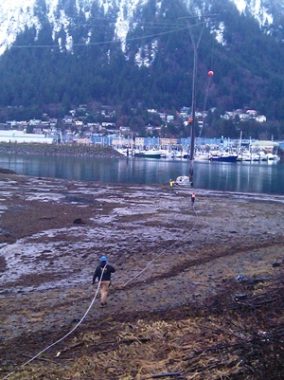
The Savviko Park master plan has a recreation zone, including the ball fields, as well as Sandy Beach and the Treadwell Historic District. The CBJ Parks and Recreation Advisory Committee previously recommended the district become a historic park.

The Treadwell Historic Preservation and Restoration Society plans to put up interpretive historical signs in the area, and protect the Treadwell stamp mill and other town-site structures.

Aviation marker wears through transmission line

Crews work on transmission line Monday. Courtesy AELP

It appears an aviation marker ball is to blame for Sunday night’s power outage in downtown Juneau.


The red ball wore through a transmission line and it broke, knocking out power to about 3,800 customers between 6 and 8 p.m.

Alaska Electric Light and Power crews were able to restore electricity in less than two hours by rerouting energy through a distribution cable that runs along the Juneau-Douglas Bridge.

Crews Monday figured out the cause and will analyze the transmission line more closely, says A-E-L & P spokeswoman Deb Ferreira.

“The amount of wind that’s in that channel certainly could cause the ball to move, wearing through the line,” Ferreira says. “But we’ll know better when we actually have it here and we’re able to look at it.”

She says a new transmission line will be installed this morning.

“They’re running a brand new transmission line, and then there’ll be some splicing and tensioning to get it to where it needs to be and at that point they will be able to re-energize the line. But they expect they’ll be able to finish all of that by noon,” she says.

Ferreira says A-E-L and P did not burn any diesel during the outage.

Perfect storm hits CBJ snow budget

Winter officially begins Thursday, and the CBJ Streets Department has spent about 62 percent of its snow-hauling budget.

“Moving all the snow that we blow is $120,000 and we spent $75,000 of that already this year,” CBJ Public Works Director Kirk Duncan recently told the Assembly Public Works and Facilities Committee.

This year the city has a contract with a private company to haul away the plowed and blown snow. It’s dumped at the tourist bus parking lot near the Mendenhall Glacier Visitors Center.

December’s mild temperatures and little snow haven’t clouded the memory of November’s “Perfect Storm,” as it’s being called, when Juneau got 49 inches of snow in just a couple of big dumps. But it could have been — and yet could be — worse, Duncan said.

“It’s interesting to note that back in that big snow year, FY ’07, we spent a $110,000 in overtime,” he said.

Just over 8 percent of the CBJ budget goes to streets. Duncan said the winter snow-plowing payroll totals $1.2 million this year, with $61,000 of that for overtime. Streets had to dip into the overtime account for November’s clean up, though it’s not clear yet just how much was spent. So far, December’s skies haven’t deposited enough snow to plow.

Duncan said it’d be nice if Mother Nature would dump the white stuff on the city’s schedule, when most vehicles are off the roads.

“If we get snowfall at 11 o’clock at night, life is really good. If we get snowfall at 11 o’clock in the morning, life is really bad. We have a lot of people on the road. We can do a lot of snow cleanup at night but if it starts in the daytime it’s really problematic for us,” Duncan said.

The CBJ Streets Department has a downtown and Mendenhall Valley division. Six operators are scheduled each day in the valley and three at night. Five operators cover downtown, West Juneau and Douglas during the day, while four work the night shift. That’s a reduction from last year and Duncan expects another cut next year, due to the city’s shrinking budget.

The state of Alaska is responsible for plowing Egan Drive and North Douglas Highway.

Legislators: Parnell budget invests in Juneau

Governor Parnell’s budget proposal includes $9.2 million to upgrade the Douglas Island Office Building. It’s the first of three phases of renovation for the building, which has been called the administration’s top priority to address capital city state office needs.
The administration had plans to build a new facility to house about 500 employees from various departments, but dropped the idea in October in favor of remodeling the Douglas building.

At the same time the administration is doing an analysis of capital city office space. Juneau Sen. Dennis Egan says Parnell’s investment in the Douglas building does not preclude a new office building in Juneau at a later date.

“When the site survey and all this stuff are complete, I think we still have a chance for a building that is scaled down,” Egan says. “But I’m really happy that the Department of Administration is investing money in refurbishing the Douglas Island complex, which means there will still be a state facility on the island.”

Before the administration dropped the idea of a new building, it was searching for a spot for it.

Rep. Cathy Munoz says the preferred site was atop the current State Office Building parking garage on Whittier Street. The facility is in need of major repairs – and Parnell has $2.5 million in his budget for the project.

“And that’s part of a total project of about 7 and a half million,” Munoz says. “And it’s my hope that they’re (the administration) looking at those upgrades as a means of possibly expanding at that site at a future time.”

The budget also contains $10 million in federal funds for Glacier Highway reconstruction from Fritz Cove Road to Seaview Avenue. $1.5 million is slated for pavement rehabilitation for Yandukin and Shell Simmons drives, $2 million for dust control on Mendenhall Valley streets, and $2 million for Juneau’s Capital Transit bus service.

Sealaska and tribe sign land agreement

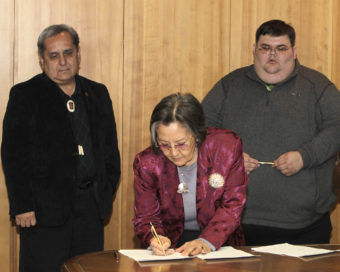
Albert Kookesh, Rosita Worl and Richard Peterson sign MOA. Photo by Brian Wallace, courtesy of Sealaska Corp.
Sealaska Corporation and the Organized Village of Kasaan have signed an agreement to allow the village to manage its cultural properties.

It’s the first of many agreements to be made with Southeast tribes to preserve and protect cemetery, shamanic, historic, sacred and archaeological sites within their territory, says Sealaska Board President Albert Kookesh.

Only the regional corporation has title to the lands under the 1971 Alaska Native Claims Settlement Act.

“The only choice we had as a corporation was to select those sites and to protect them ourselves,” Kookesh says. “We’re the only train left at the station. Nobody else has an entitlement in Southeast Alaska among the Native community where they could get title to these sites and protect them.”

Kookesh says the corporation and its board of directors have made a conscientious effort to identify some Sealaska economic lands as cultural sites for protection.

Under the agreement, Kasaan will work with Sealaska Heritage Institute to develop a preservation program and ensure that uses will not compromise historical and cultural integrity of the sites.

Sealaska Heritage President Rosita Worl says the most sacred thing to Native people is their land. She says the agreement will extend to lands in the Kasaan territory yet to be identified.

“It’s not only these particular historic sites, but it will be the yet undiscovered shamanic sites that we know are out there but our ancestors did not want to put on the map,” Worl says. “They did not want to put that on the map because they were fearful that people would come and desecrate those lands.”

The agreement was signed yesterday (Wednesday) by Kookesh, Worl, and Richard Peterson, president of the Organized Village of Kasaan.

Peterson says the Memorandum of Agreement between Sealaska Corporation, the Heritage Institute and Kasaan is very significant to the small tribe, and a testament that tribes and regional corporation can work together.

He says the tribe will be managing land it still uses.

“It’s important to not only mention that these are our ancestral homes, but that we still utilize these areas. Today we are still our own people,” Peterson says. “We live our lives as traditional people we still gather the foods, medicines, resources we need to survive as Haida, Tlingit, as Tshimian.”

Under ANCSA, the only way to put lands in Native ownership is through Sealaska Corporation’s remaining entitlement, or through the federal historical site program, which Worl calls a difficult process that takes years to complete.

The Sealaska Lands legislation currently before Congress includes a portion of Sealaska’s remaining entitlement to be used for cemetery and historical properties.

Site notifications
Update notification options
Subscribe to notifications