Rosemarie Alexander

USPS delays post office closures

Alaska post offices slated to close have been given a five-month reprieve, including Douglas.

The U.S. Postal Service yesterday (Tuesday) announced the moratorium. But Ernie Swanson, USPS spokesman for Washington state and Alaska, says the post offices on the closure or consolidation list are not yet out of the woods.

“It gives them a reprieve for a while, but it doesn’t mean we’re not going to proceed with our studies on those projects and be ready to make a decision probably by the time the five-month period is over,” he says.

The moratorium expires on May 15th. Swanson says it’s prompted by congressional debates on postal service legislation.

Alaska U.S. Senator Mark Begich is among the senators taking credit for the decision. They met yesterday with U.S. Postmaster General Patrick Donahoe and Postal Service Board of Governors Chairman Thurgood Marshall, Jr. to encourage the delay.

Both Begich and U.S. Senator Lisa Murkowski have been educating postal authorities about the uniqueness of the postal service in Alaska; earlier this fall, 31 rural post offices were taken off the closure list.

Five remain: Douglas, the Anchorage Postal Store, and postal stations at Elmendorf and Eielson Air Force bases, and Fort Wainwright.

The financially strapped USPS in September proposed closing 3,700 postal stations across the country, due to its growing debt. Several bills to help the agency are now before Congress. The postal service can’t lobby Congress, and Swanson says none of the bills resolve the issues “including the prefunding of health benefits that costs us over 5-billion dollars a year. None of the proposed legislation that I’m aware of addresses all the legislation that we’d like to see done.”

Congress started requiring prepayment of postal service employee benefits in 2006. The payments, as well as declining business, competition from other delivery services, and the Internet, are factors in about a $10-billion loss for the fiscal year that ended in October.

“We didn’t make our payment at the end of the fiscal year, because we simply didn’t have the money,” Swanson says. “Congress gave us one extension into November and now there’s another extension that expires this weekend…and we don’t have the money. We’re hoping Congress does something to give us some relief.”

The Postal Service receives no tax dollars; rather, operations rely on the sale of postage, products and services.

Mental exam ordered for teens in Thornton case

Three Arkansas teenagers, charged with the murder of Kevin Thornton, of Juneau, will undergo psychiatric evaluations to determine if they are competent to stand trial.
During a hearing Monday in Hot Spring County District Court, Judge Phillip H. Shirron ordered the mental examinations for Richard Shelby Whybark and Timothy Tyler Norwood, both age 17, and 16-year-old Clinton Lavon Ross.

The teens were charged in August with second degree murder and violent group activity in a single case in adult court. They’re accused of beating Kevin Thornton when he was walking with a friend down a Malvern-area road on July 20th. He died seven days later.

Steve Good is a reporter for the Malvern Daily Record. He was in the courtroom Monday when Hot Spring County Chief Deputy Prosecutor Richard Garrett told the court that “this person was simply walking down the road in the wrong place at the wrong time.”

Monday’s hearing was originally scheduled to address motions to dismiss or transfer the case to juvenile court, and separate it, so each defendant can be tried individually.

Good says those motions will now be taken up after the mental evaluations are complete, no later than 60 days.

“The judge stated it was his intention to maintain this trial on a fast track and not let it get bogged down,” Good says.

Judge Phillip Shirron did not grant a motion to suppress certain testimony, particularly a statement that one of the defendants laughed during a police interview when he learned that Thornton had died from his injuries.

Good says Shirron also quickly shot down the notion that the case should have been filed in juvenile court. The defense attorneys’ motion called it unconstitutional to file in adult court.

“Their contention was it should have gone to juvenile court first and the hearing held in juvenile court then transferred to adult court,” Good says.

Arkansas law outlines 10 criteria for trying juveniles as adults.

“It has to do with the severity of the crime, the aggressiveness of the crime,” Good says. “The prosecutor stated in his argument they met eight of the ten criteria and that’s why they decided to file it directly.”

Good says Whybark, Ross, and Norwood sat together at Monday’s hearing. They spoke with each other and their lawyers. They were not allowed to have any contact with family members.

The judge also conducted a bond hearing for Whybark, who has been held at Jefferson County Juvenile Justice Complex since August. Good says Judge Shirron set a $40,000 dollar professional cash bond.

“He also set a $15,000 bond as an alternative with the condition that Whybark be monitored electronically,” Good says. “Whybark has no prior juvenile criminal history, according to court testimony that was presented today (Monday).”

Whybark could be released to his family, but confined to his residence. He would not be allowed to have any contact with the other defendants.

“The judge made a condition that he would continue his education and left it open to them with what they could arrange,” Good says. “But he expects him to be being educated during this time.”

He says Whybark has been working on his GED while in custody.

Ross and Norwood have been detained since by the Arkansas Department of Youth Services. If requested by their attorneys, the judge indicated the court could extend bond hearings to the boys once they are released from youth services, sometime next year.

Kenin Thornton was 19 when he died. He was a 2010 graduate of Thunder Mountain High School. His parents, Bill and Darlene Thornton, of Juneau, attended Monday’s hearing in Malvern. Good says they declined to address the court. He says the Thornton’s are to meet with prosecutors before they leave Malvern on Wednesday.

Hilary Lindh Season Pass Scholarship winners

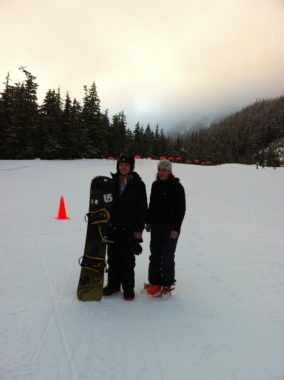
Ella Goldstein & Hilary Lindh. Photo by Dave Audet.
Four Juneau youth are the winners of the Hilary Lindh Season Pass Scholarship at Eaglecrest. And this year, the Olympic ski racer was hand to award it.

Since 1992, the ski area board of directors has given four passes each season to Juneau students in recognition of Lindh’s silver medal in the 1992 Albertville Winter Olympics as well her dedication to ski racing.

This year second grader Ella Goldstein, third grader Isaak Avenson, eighth grader Briana Sievenpiper, and freshman Preston Perfors won the pass out of a field of 29 applicants. Each receives a lift ticket and equipment rental on the days they are skiing or snowboarding. Their applications are judged on their academic achievement, competitive spirit and financial need.

Two of the winners were at Eaglecrest on Saturday to receive their pass. This is the first time Lindh has been in Juneau to make the award. She recently moved back to Juneau and can be seen most weekends skiing with her five-year-old daughter at Eaglecrest, where Lindh got her start in ski racing.

Ella Goldstein has been skiing since she was four-years old. She told Lindh she likes jumps and going fast.

“I like the jumps because it’s like you’re flying when you go down,” she said, and “because the wind blows.”

After a long career as a ski racer, Lindh knows exactly the feeling.

“The wind blows in your face,” Lindh said. “It’s a good feeling isn’t it?”

She had some advice for the young skier. “What I’ve been working on with my daughter is getting forward on her skis, so she’s not sitting on her tails, because you have a lot more control of your skis when you’re forward on them.”

Preston Perfors & Hilary Lindh. Photo by Dave Audet.
Preston Perfors recently moved to Juneau from Oklahoma. He’s never been on skis or a snowboard before, but says skateboarding will probably help.

“I can ride like four different types of skate boards so I figured I might have an advantage to it. And I thought it’d just be fun,” he said.

Lindh also had some advice for the snowboard winners.

“I’d just say take advantage of having the pass for the year and get out here. It doesn’t make any difference if it’s raining or frozen or anything else,” she said. “Just get out here and have fun.”

All the winners say they plan to do just that. Ella Goldstein wants to join the Mighty Mite ski racing program. Preston Perfors plans to ski and snowboard at least once a week during the season. Isaak Avenson says he want to improve his snowboarding skills as well as learn to ski. He hopes to bring his whole family to Eaglecrest. Briana Sievenpiper says she just “loves skiing.”

Arkansas judge to hear motions in Thornton case

Attorneys for three Arkansas teenagers accused of killing a Juneau man will argue motions Monday to dismiss the case or transfer it to juvenile court, and try each boy individually.

Seventeen-year-old Richard Shelby Whybark and Timothy Tyler Norwood, and 16-year-old Clinton Lavon Ross are charged with second degree murder in connection with the death of Kevin Thornton, of Juneau. The teens also face an aggravating charge of violent group activity.

The Malvern, Arkansas boys have been charged in a single case in adult criminal court. Earlier this fall their attorneys filed the motions to separate the trials, saying a joint trial would violate their rights of due process and fair trial. They also moved to dismiss the case, or at least transfer the youth to juvenile court.

Monday’s arguments will be heard by Hot Spring District Court Judge Phillip Shirron, who recently announced his retirement at the end of the month, so the case will soon be moved to another judge.

Thornton was allegedly beaten on July 20th while he and another man were walking along a Malvern-area road. The 19-year-old Thornton died of his injuries on July 27th. Hot Spring County sheriff’s investigators have called it completely random violence. Thornton, a 2010 graduate of Thunder Mountain High School, had been visiting friends in Arkansas.

UA to expand emergency training

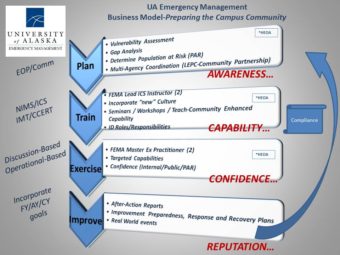
The University of Alaska Southeast will hire an emergency program manager next year for all three Southeast campuses to coordinate crisis response.

UAS Juneau has had a Campus Community Emergency Response Team since 2010. Hiring a manager for all three campuses is an outgrowth of last year’s mock shooting that tested the team’s response and coordination with capital city first responders.

Since then the groups have continued to train together, including last week at the UAS Recreational /Alaska National Guard Readiness Center.

Rick Forkel is Director or Emergency Management for the statewide university system and organized the class.

“If we train together and exercise together, when and if we have to respond to a significant event it will be a seamless coordination of resources and getting what is needed to the scene,” Forkel says. That allows a quicker recovery from any potential hazard, he says.

The Fairbanks and Anchorage campuses have fire, police and emergency program managers. Headquartered at UAF, Forkel has been working with the Juneau campus response team. He says it’s now time to have boots on the ground in Southeast. The future UAS manager would coordinate emergency response for the Juneau, Sitka and Ketchikan campuses.

Campus teams would work with community responders in each town – like those in the Incident Command System 300 class – who came from Juneau public works, transportation, fire and rescue, and Bartlett Regional Hospital as well as the Alaska National Guard, U.S. Coast Guard, and National Weather Service.

Forkel says coordination and self-sufficiency are crucial, because eight of 15 University of Alaska sites can only be reached by plane or boat.

“Disasters will come and go, people will be hurt and property damaged, but if you have that training in place, it makes a huge positive impact on the outcomes of those events,” Forkel says.

While emergency preparedness is nothing new, CBJ Emergency Programs Manager Tom Mattice says UA’s statewide resources and facilities make it an important partner.

“It’s just really been an exponential way to grow this community preparedness,” he says.

Mattice and others at ICS 300 also train with public safety responders throughout
Southeast Alaska, where there are eight disaster shelters with eight medical caches and eight responder teams ready to deploy to support other communities.

“That’s what we’re trying to build not only at the local level but at the regional and state level,” Mattice says.

University of Alaska Anchorage Police Lt. Ron Swartz is an ICS instructor, certified by the Federal Emergency Management Agency.

He says UA plans to take the training to all 15 campus sites so each one will be ready to respond to any community crisis, whether it’s last month’s storm that hit western Alaska, fire, earthquake, tsunami, or a search for a missing athlete.

UAA and Anchorage responders worked together on the recent search for cross-country runner Marko Cheseto. The 28-year-old Kenyan was missing for three days in the cold and snow. With little to go on, Swartz coordinated a ground and air search. He says it’s a good example of the need for continuous training.

“The training and the coordination had already been practiced in advance. All we had to do was ask them to show up,” he says. “We gave them a task and a set of objectives and they went out and did it.”

A statewide exercise, called Alaska Shield 2012, is scheduled for February. It will be a mock weather event that creates different hazards in each region, ranging from tremendous cold in the Interior to heavy snow then rain and avalanches in Juneau.

SEARHC hires new president

Courtesy SEARHC
SEARHC has a new president.

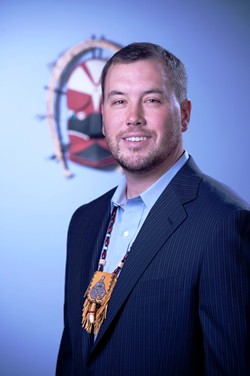
The SouthEast Alaska Regional Health Consortium has hired Charles Clement as its new President and Chief Executive Officer.

Clement replaces Roald Helgesen, who leaves at the end of the month to become CEO of the Alaska Native Tribal Health Consortium.

Clement will start the job in February and will be based at the SEARHC campus in Juneau, but he’ll oversee the entire consortium, which includes Mt. Edgecumbe Hospital in Sitka.

SEARHC General Counsel Ken Truitt will serve as interim president between Helgesen’s departure and Clement’s arrival.

The SEARHC Board of Directors announced the hire late Thursday afternoon.

Clement is currently vice president of operations and the chief operating officer for the Southcentral Foundation in Anchorage. The Foundation and Tribal Health Consortium jointly own and manage the Alaska Native Medical Center.

Clement is Tsimshian and Athabascan. He graduated from Metlakatla High School, completed his bachelor’s in economics and political science at Northern Arizona University, and has a Masters of Public Administration from the University of Alaska Anchorage.

In a SEARHC news release, Clement says he’s looking forward to moving back to Southeast Alaska.

Site notifications
Update notification options
Subscribe to notifications