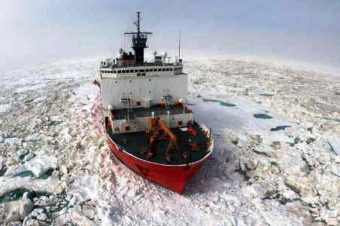
Rear Admiral Thomas Ostebo speaks to Juneau Chamber of CommerceAn icebreaker in the Arctic is key to the United States’ position as an Arctic nation, according to the Commander of the 17th Coast Guard District in Alaska.
But Rear Admiral Thomas Ostebo said even if funding were available now, it would be 10 years before a Coast Guard icebreaker could be operating in the Arctic.
In a speech to the Juneau Chamber of Commerce Thursday, Ostebo said an ice breaker in the region may be even more important as ice recedes.
“Less ice in the Arctic, or an open Arctic, does not mean an ice-free Arctic. In fact you could make the argument that you really need more ice breakers now than ever, because you don’t know when the ice is coming in and out,” he said. “Every time you go up there you have the opportunity to run into ice that has broken off from somewhere else. The margins of the season up there are always going to be in flux and the opportunity for somebody to get stuck in the ice is there.”
As more traffic moves into the Arctic, requiring a greater Coast Guard presence, Ostebo said an icebreaker has to be part of the solution. He said he’s often asked if the Coast Guard should build an air station and a port in the region.
“My answer to that is if I have an icebreaker I almost don’t have to do that. Why? Because if I have an icebreaker with a flight deck, I can put helicopters on it. I don’t need a port if I have a place where I can take care of a whole lot of our folks. If I have the ability to respond from offshore and move that response capability around, that may actually be better,” he said.
Ostebo said the Northern Sea Route into the Bering Strait seems to be getting the most traffic. He called it a very busy area with poorly charted waters and no formal vessel traffic separation schemes to manage the traffic.
He said some of the largest ore and chemical vessels he’s ever seen are transiting the passage. Some are carrying more than a million gallons of fuel and would pose huge problems if there were ever a collision or grounding, he said.
Courtesy U.S. Coast GuardAlaska’s Lieutenant Governor pressed Congress Thursday for new icebreaker ships to operate in the Arctic. The issue became more immediate as Mead Treadwell and others pointed to Nome’s trouble getting fuel this year. APRN’s Libby Casey reports from Washington.
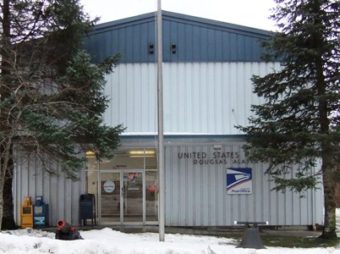
Douglas Post Office. (Photo by Rosemarie Alexander/KTOO)
The clock is ticking toward a decision on the fate of the Douglas Post Office. The 60-day public comment period ended last week on the U.S. Postal Service proposal to close it.

Blesilda Lochmann is acting Marketing Director at the Alaska Postal District Office in Anchorage. She has the job of reading every comment.
“I’d stopped counting,” she says with a laugh. “I have a pile that I have to go through and I have to read each one. Actually I have to enter them into the system and they will become part of our docket.”
Lochmann is one of the Alaska district staff who will recommend the Douglas Post Office close or remain open. One of the last letters she received came from the Juneau legislative delegation, concerned postal officials may not have all the facts.
They say the analysis should look at the space available at alternative post offices. The closest is in the downtown federal building.
Rep. Cathy Munoz says they’re told that closing Douglas may create a whole new problem for the postal service:
“The alternative site, the downtown site, already has a long waiting list for box holders, and we’re not even sure if the box holders from the Douglas facility will be able to be accommodated at the downtown facility,” she says.
Five-hundred sixty-eight box holders would be displaced if the Douglas station closes. They would have to rent a box at another Juneau post office, or get home delivery. Juneau Postmaster Susan Johnson says there is no waiting list at the federal building and there are more than enough vacant boxes to accommodate the Douglas box holders.
All Juneau mail is processed at the Mendenhall Valley Post Office.
The lawmakers’ letter also notes the postal service should consider finding ways to reduce costs at the Douglas Post Office so it could stay open. For example, renegotiating the lease or moving to another Douglas location, or reducing the number of hours the post office is open to save personnel costs.
Lochmann, of the Alaska Postal District, says such changes could be part of the recommendation for Douglas.
That recommendation will be considered by the USPS Western Area Office in Denver. If the station is to close, the public will have 30 days to appeal to the Postal Regulatory Commission.
If a shutdown is the final decision, Lochmann says, it wouldn’t happen until February.
Four other Alaska post offices are still on the USPS list for possible closure. They include the Postal Store and the post office at Elmendorf Air Force Base in Anchorage as well as the facilities at Fort Wainwright Military Base and Eielson Air Force Base in Fairbanks.
Photos courtesy of Temple JoannaShed some of those holiday calories by learning to swing dance. For five months now, community art studio The Canvas has been holding swing dancing lessons, organized by a group called Southeast Swing, an online community of dance enthusiasts in Juneau.
KTOO Intern Danny Peterson reports from the dance floor.
Lineman Eric Nielsen climbs the leaning tower. Courtesy AEL&PAlaska Electric Light and Power says the cost of the diesel fuel burned during last week’s Snettisham outage is about $430,000, or one-half cent per kilowatt hour.
The hydroelectric project went off line Thursday morning and was back on Saturday afternoon. During that time, AEL&P supplemented with diesel, burning 130,000 gallons, says generation engineer Scott Willis.
Beginning in January, the cost will be spread across commercial and residential consumers in the routine quarterly Cost of Power Adjustment. At an average residential use of 750 kilowatt hours of electricity a month, Willis says the increase will be about $3.75 each month for the first three months of 2012.
Without the Lake Dorothy project, the two and a half-day outage would have cost users even more, Willis says. The company generated about 50 percent of Juneau’s electricity from hydro and the other 50 percent from diesel. Lake Dorothy mainly serves the Greens Creek Mine, until it’s needed in town.
“As soon as Snettisham tripped off line, Greens Creek tripped off line and we did not bring them back on until Snettisham power was restored,” Willis says. That was the same situation with AEL&P’s dual fuel customers, he says.
“All of our hydro was devoted to our firm customers in town. And that saved us about 70,000 gallons of diesel fuel, which saved the community about $250,000,” he says. Lineman Don Meiners tensions a guy wire. Courtesy AEL&P.
The anchor bolts for two guy wires failed, causing one pole of a three-pole structure to lean into the center pole. Willis says the company is still investigating the cause of the broken anchors. He says crews added a level of security during the fix.
“So there’s three anchors and guy wires holding the tower, where before there was two. We’ve tried to improve the situation so there won’t be as much stress on the existing anchors,” he said.
Willis says additional work will be done next summer to drill new anchors.
Dirty snow clogs a downtown sidewalk. Rosemarie Alexander photo.Juneau has received nearly 50 inches of snow since Nov. 1st. While normal snowfall is 12 inches, last year we got less than two inches for the month.
It’s no wonder city officials have been hearing a lot of complaints about snow removal in the past few days. The topic opened Monday night’s CBJ Assembly meeting.
“I’m telling people on the street if they fall and hurt themselves on them sidewalks, sue the city,” Patrick Owen told the Assembly. He lives in downtown Juneau and has been watching the old, young and in-between unable to navigate the sidewalks.
“Keep that snow off so people can walk on them sidewalks. That’s what them sidewalks are for,” he said.
Dennis Harris lives downtown, but drives taxi throughout the city and borough.
“If you want to ask someone the opinion of how (CBJ) Public Works takes care of our streets, just ask a taxi driver,” he said.
Harris lives on 12th Street in the area known as “The Flats.” He’s watched children walking in the street on their way to Harborview Elementary School, because the sidewalks are plugged with snow.
“Snow removal is not rocket science and it’s not pushing snow around,” he said. “It’s snow removal.”
Owen and Harris echoed many of the emails and phone calls Assembly members have been getting since the snow storms started.
Public Works Director Kirk Duncan also has been hearing about and seeing the problems. He told the Assembly he was really concerned about The Flats, between 9th and 12th streets. “The snow in there is just horrendous,” he said.
Duncan outlined the strategy for clearing Juneau streets:
“We go after all the majors first and then the neighborhoods. We continually hit the main arterials and get to the neighborhoods as we can get to them,” he said.
Property owners are responsible for clearing the snow off sidewalks in front of their businesses and residences.
Both Duncan and City Manager Rod Swope say city street clearing crews are doing the best they can with the resources they have. Swope says the borough is responsible for plowing 110 miles of road, so it’s not going to be perfect.
“The state will plow, we’ll come in and shovel it off and then the state will come back and plow it again.” He said the same thing happens in residential areas.
“People will get out and shovel; city will come back through and plow and there’s another amount of snow on the sidewalk. Folks, there’s just no other way of dealing with it in a community like this,” he said.
Several Assembly members said sidewalks should be a priority. Karen Crane described what she saw on Sunday as she was driving past the downtown Juneau Arts and Culture Center.
“There was no clear sidewalk there. There was an older person trying to walk down that sidewalk and slipped and fell into Egan,” she recounted. “I understand the comments about the sidewalks, but especially where they’re a borough responsibility, like in front of Centennial Hall and along the highway, those sidewalks need to be a priority.”
Assembly member Randy Wanamaker has been hearing a lot from parents whose kids have had to walk in the street on their way to school. He asked whether it’s the responsibility of the school district or the city to clear the walks near school buildings.
“Parents wonder why the city hasn’t been taking care of the sidewalks where children are walking on their way to school at Riverbend, or on their way to Harborview. Whose responsibility is it to clear those streets?”
Kirk Duncan couldn’t answer the question. He took over the CBJ Public Works Department last summer, after six years as manager of Eaglecrest Ski Area, where snow is a precious commodity. He admits he’s still learning the winter part of his new job.
“I’m not giving you a really good answer because, quite frankly, I don’t know.” Duncan promised to have more answers for the Assembly at the Public Works and Facilities Committee meeting on Dec. 12th.
In the meantime, the snow has turned to rain and more is in the forecast. Now it’s semi-frozen slush that’s clogging up the sidewalks and thoroughfares; drains are plugged and water is standing in the streets. And it’s only November.
Close
Update notification options
Subscribe to notifications
Subscribe
Get notifications about news related to the topics you care about. You can unsubscribe anytime.