The final enrollment count for the Juneau School District shows 99 fewer students than projected. It means the district will receive about $700,000 less in revenue for this school year.
The numbers were submitted to the Alaska Department of Education on Friday. School operating funds come from the state, based on an amount per student. Schools are required to forecast the number of students several months in advance of the school year.
Officials knew earlier this fall that enrollment was lower than projections, but the final count turned out to be better than anticipated. The number of students with intensive needs also was higher than estimated.
The district had expected a loss of more than a million dollars.
Superintendent Glenn Gelbrich told the school board last night (Tuesday) that the shortfall will be offset by a carry-over in funds from last year’s budget. The approximate $750,000 fund balance resulted from unspent areas of the budget and some unexpected revenue.
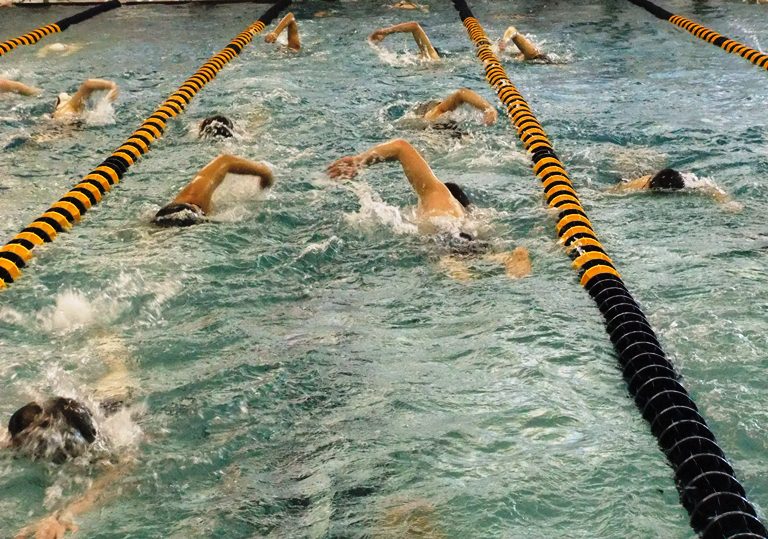
Swimmers practice at Dimond Park Aquatic Center for the Alaska Swim-Dive Championships held in Juneau Nov. 8 & 9. Photo by Rosemarie Alexander.
When Juneau’s new Dimond Park Aquatic Center was still in the formative stages, the ability to host state high school statewide swimming and diving meets was a major selling point.
Pool requirements are different than the last time Kodiak High School swim coach John Lindquist was in the capital city for a swim meet.
“My last state meet was in Juneau in 1980,” when Lindquist was in high school.
That was at Augustus Brown pool downtown. It is too small to host a state meet now, because pools must have at least 8 lanes, a deck and audience seating. Until Juneau’s new Dimond Park Aquatic Center opened in 2011, Bartlett High School in Anchorage had the only pool big enough to accommodate a state championship. (Ketchikan recently opened an 8-lane pool.)
The Alaska School Activities Association accepted Juneau’s bid for the 2013 Swim-Dive State Championship in January. But planning started when the new pool was still in the development stage. In fact, Glacier Swim Club’s Max Mertz spent years working on the pool project. The ability to host such a meet was always a top selling point.
“Really it started back in 2006-2007. We told everybody we’d work to get the meet here. We started in earnest probably about two years ago. We wrote a proposal, presented it about a year ago to the ASAA board. They bought off on it, decided to let us host it, so we’ve been kind of working it for the last year to put it on,” Mertz said.
More than 300 swimmers and divers, representing 25 Alaska high schools, came to Juneau for the state championship. An estimated 200 parents and volunteers were here, too.
Isaiah Vreeman is state championships director for the Alaska School Activities Association. He called it exciting to be able to hold the meet outside Anchorage. Not only does a pool have to have eight lanes, “it has to have adequate deck space. That’s why Max and some of his crew put together this platform that you see on the deck, which is phenomenal. It has to have a lot of seating,” Vreeman said.
Home pool
Thunder Mountain High School swimmer Trevor Jones appreciated the home pool advantage.
“Whenever we travel to Anchorage there’s more than six teams from Anchorage and numerous teams in the Anchorage area where they don’t have to go and stay in a hotel and be roomed out. They can just sleep in their own bed and have homecooked meals. When you have home-field advantage that comes all to us, so that’s just a huge deal for Juneau swimmers,” Jones said.
(L to R) Kenny Fox, Trevor Jones, and Thane Reishus-O’Brien placed second in the 200 Medley Relay. Photo by Rosemarie Alexander/ KTOO.
It did pay off for Juneau swimmers. Juneau Douglas High School girls edged out an Anchorage team, Dimond High School, by three points to win the meet.
Jones and other Thunder Mountain swimmers Kenny Fox, Thane O’Brien, and Josiah Loseby placed second in the 200 Medley Relay. The entire THMS boys team placed fourth in the meet.
A number of swimmers from both Juneau high schools had personal bests.
Training
When it comes to training, all the athletes spend hours in the pool each day.
“About 4 hours a day,” said Tahna Lindquist. She and Ila Hughes swim for Kodiak High School.
“In the morning we swim and then after school,” Hughes said. The swimmers get to the pool at 6:15 a.m.
Jason Wilson coaches the Thunder Mountain swim team.
“You know what, people don’t understand the type of work that swimmers and divers put in,” he said. “We swim everyday six days a week.”
Then there’s cross-training after school every day.
“Sprints, squats, push-ups, sit ups and core work,” Wilson said.
And weight lifting. “On Saturdays we lift from 10 to 11,” THMS swimmer Trevor Jones said.
Like most of the youth at the statewide meet, the 16 year-old has been swimming competitively for ten years. He believes the hard work is worth it.
“Just the thrill of being in the pool and racing with other people and getting good times. Everything about it is just a great essence.”
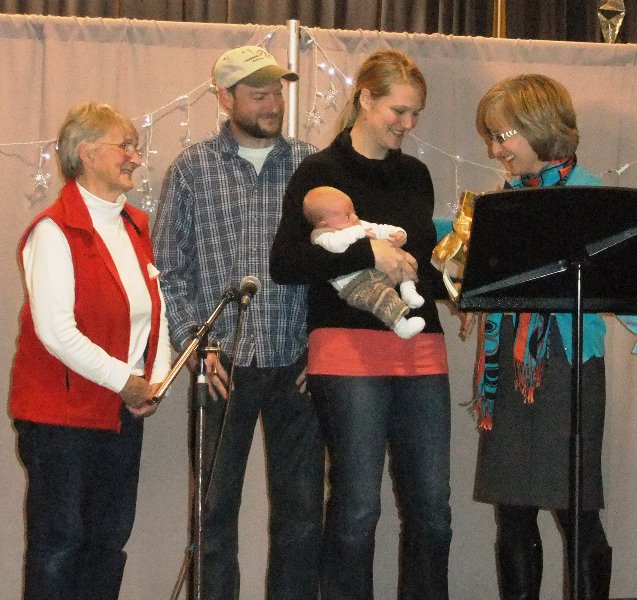
First Lady Sandy Parnell presents the 100,000th Imagination Library book to Alden Scott Talbot and his family. Photo by Rosemarie Alexander/KTOO.
A young Juneau family has received the 100,000th book from the Southeast Alaska Dolly Parton Imagination Library.
First Lady Sandy Parnell on Friday presented the “Little Engine that Could” to Alden Scott Talbot, his mother, Marlowe Dunker, and father, Tony Talbot. Alden was born Oct. 10th and is already enrolled in the Imagination Library through the Association for the Education of Young Children – Southeast Alaska.
“I think that nothing really says I love you quite the way that cuddling up together and reading a good book does,” Parnell told the crowd gathered at the Juneau Arts and Culture Center.
The Imagination Library sends free books to children from birth to age 5. It was started by the Country-Western singer in 1996 in her home state of Tennessee. It is now nationwide as well as in Canada, the United Kingdom and Australia, and depends primarily on local funds.
Friday’s event was a kick off to raise $15,000, which would provide books to one thousand Southeast Alaska pre-school children for five years. Program costs are $30 per child per year, or $150 for one child for the entire five years.
More than 2,000 Southeast children are currently enrolled in the program, which started in the region in 2006.
Best Beginnings, a public-private partnership that advocates statewide for pre-school programs, helps Alaska communities start the Imagination Library program. Best Beginnings is based in Anchorage.
Mayor Merrill Sanford, and Madeline and Dori Germain read a proclamation for Imagination Library Week in Juneau. A cardboard Dolly Parton looks on.
Barbara Brown is Best Beginnings’ Imagination Library project manager. She brought a life-sized cardboard Dolly Parton to Juneau, which stood on the stage for the event.
“Flat Dolly has been to the glacier and the governor’s mansion, and the legislature. Flat Dolly is really covering a lot of ground,” she quipped. She said the real Dolly Parton has promised to visit the state sometime to promote the program.
Brown says communities that decide they want to start an Imagination Library will get support from the organization to start and maintain the program.
“And we tell people this is not just a book delivery program. It is ‘a get the whole community excited about reading to our children’ program,” she said.
Brown said more than 21,000 children in 110 Alaska communities get a free book each month from the Imagination Library.
Nov. 10 to 16 is Dolly Parton Imagination Library Week, as proclaimed by Juneau Mayor Merrill Sanford. The mayor and two Imagination Library “graduates,” Madeline and Dori Germain, read the proclamation at the book presentation.
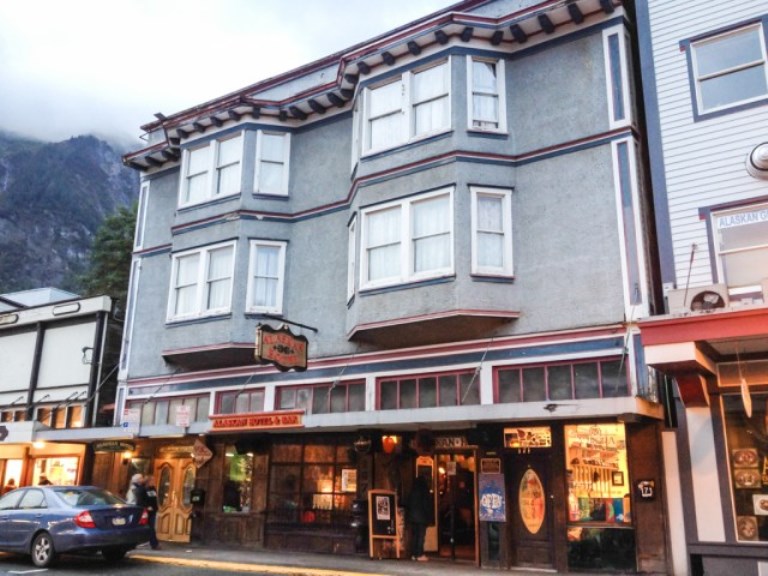
Alaskan Hotel, 167 South Franklin Street. (Photo by Lisa Phu/KTOO)
An early morning fire at the Alaskan Hotel on Saturday caused about $2,500 in damage, according to Juneau Fire Chief Rich Etheridge. Hotel guests were evacuated, but allowed to return in about an hour.
Etheridge says the fire was caused by carelessly discarded smoking materials.
A little after 1 a.m., Capital City Fire and Rescue responded to a report of smoke in the 100-year-old hotel at 167 South Franklin Street in downtown Juneau. Etheridge says fire crews from all CCFR districts responded.
He says the fire was found in the concealed wall spaces and support structure at the front of the building.
Fire crews opened up the wall from the basement and building exterior, put out the fire and removed the charred wood.
He says the 45-room wood-framed hotel has a number of void spaces, where fires can travel throughout the building undetected. He says Saturday morning’s fire was very similar to one that occurred on Nov. 11, 2002, which was also caused by discarded smoking materials.
Swimmers practice Friday morning at Dimond Park Aquatic Center for the Alaska Swim-Dive Championships. Photo by Rosemarie Alexander.
Juneau-Douglas High School girls are the winners of the swimming and diving state championships held Friday and Saturday at the Dimond Park Aquatic Center. They edged Anchorage’s Dimond High School by three points.
On the boys’ side, Dimond High swimmers are repeat state champions, with Sitka High School coming in three points behind to take second.
Both competitions came down to the last race – the 400 freestyle relay.
More than 300 high school athletes, representing 25 high schools competed in Juneau this weekend in the statewide championships for swimming and diving.
Juneau’s new 8-lane, Olympic-size pool at the Dimond Park Aquatic Center made it possible for the capital city to hold a state meet, traditionally held at Bartlett High School in Anchorage.
Isaiah Vreeman is the State Championships Director for the Alaska School Activities Association.
Bartlett’s been the only facility in the state to be able to host state championship swimming ever, so to have another facility to come on line, being in Juneau, it’s very exciting.
Juneau has approximately $275 million invested in its water and sewer system, and some of the pipes and plants are very old.
Every ten years, the city conducts a detailed study of the system; one is now underway.
As Rosemarie Alexander reports, this year’s study is different, because it reaches out to the public.
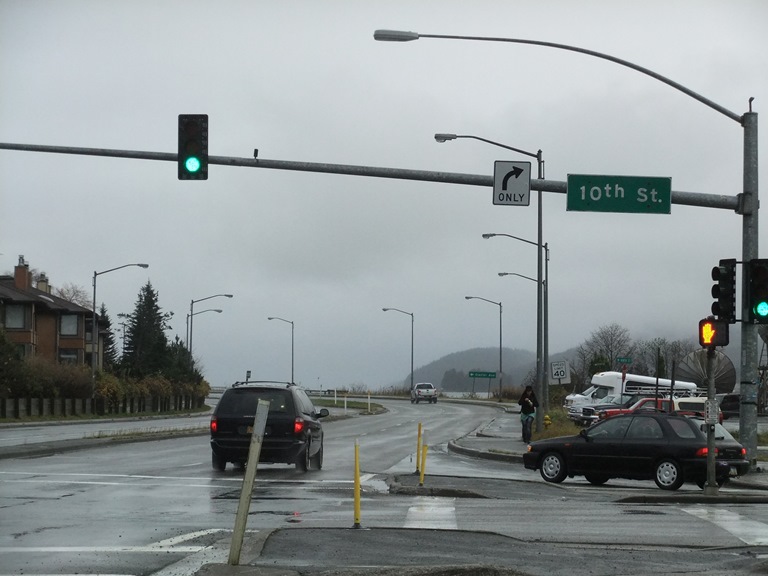
The state Transportation Department will repave Juneau’s Egan Drive from 10th Street to Main Street next year, a good time to replace city utility lines. Photo by Rosemarie Alexander/KTOO.
CBJ Public Works Director Kirk Duncan says cities all over the nation have a similar problem:
EPA estimates there’s about 4 trillion dollars’ worth of improvements needed for the water and wastewater systems.
Juneau has two major water sources and about 180 miles of water mains.
In a town our size, we would have about one reservoir for 31,00 people. We have eight.
Juneau also has three wastewater treatment plants.
A town our size would normally have one treatment plant, but because of our long linear nature, we have three treatment plants. We have 46 lift stations that support those treatment plants.
Last year the Twin Lakes lift station needed a rebuild, “and that cost a million dollars to update that system,” Duncan said.
In the next year, Duncan expects $4.5 million in water and wastewater projects, “and we generate 13 and a half million dollars a year.”
A lot of upgrades to Juneau’s water and sewer are coming due, but Duncan said the city doesn’t have a good plan. Asset management is part of the utility study.
Public meetings
Duncan and consultant Karyn Johnson explained the rate study Thursday to three different audiences – the Chamber of Commerce, Juneau’s top 50 water and sewer users, and the rest of the public.
He said the study will result in a new rate model to take the system to 2024.
“The rate model is intended to make sure that we generate enough money to cover our operating expenses as well as make needed changes to the system,” he said.
The last study was done in 2003. As the main consultant then and now, Johnson, of FCS Group, is intimately familiar with Juneau’s water and sewer system.
Johnson said a successful rate study first defines the revenue needed to operate and maintain each utility. The second phase is a cost of service analysis.
“How you would take those costs of each utility and allocate them to the different types of customers you have on your system, whether they be residential, commercial, industrial and so forth,” she said.
Then different types of customers are grouped together based on how they use water and sewer. Finally, the rate design will answer these questions: How much revenue is required from each customer class? How will it be collected?
Johnson said the study will be done about May. Then it will go to CBJ leaders and finally to the Assembly.
Sticking with a plan
The last utility study resulted in a series of rate increases stretched out over a number of years. But Johnson said there wasn’t the political will to implement the entire recommended rate hike.
“So it represents about a 32 percent difference in what was proposed versus what was implemented for water,” she said.
The Mendenhall Wastewater Treatment plant is the second-largest user of electricity in the city and borough. Like all parts of the water and sewer system, it needs constant maintenance. Photo by Rosemarie Alexander/KTOO.
Sewer rate increases went the same way, so the city collected about 30 percent less revenue than the study proposed.
Johnson said an annual rate adjustment would avoid that problem.
But generating enough revenue to operate, maintain and update the utility system won’t all fall on customers.
“Your rate revenues typically pay for your operating type expenditures, whereas capital can be paid for with grants as they’re available, with debt financing , with other outside sources, general fund supplements as needed,” she explained.
The utility study also will look at how Juneau’s rate policies compare to those in similar cities around the nation and some in Alaska.
In December, Duncan and Johnson will hold more meetings to explain the amount of revenue the water and sewer systems will need for the next ten years. In February, they expect to be able to tell residents how that will impact their rates.
(Disclosure: CBJ Public Works Director Kirk Duncan is also a member of the KTOO Board of Directors)
Close
Update notification options
Subscribe to notifications
Subscribe
Get notifications about news related to the topics you care about. You can unsubscribe anytime.