The Alaska Supreme Court rules to uphold Bart LeBon’s victory in a pivotal election recount case,
seven people have applied for Jesse Kiehl’s soon-to-be vacant Juneau Assembly seat,
up to 40,000 acres of land in and around Southeast communities will change hands between the Alaska Mental Health Trust and the U.S. Forest Service,
Sen. Lisa Murkowski and another senator have proposed legislation that would give federal aid to help Alaska residents replace inefficient wood stoves, and
Alaska has begun issuing licenses compliant with national proof-of-identity standards.
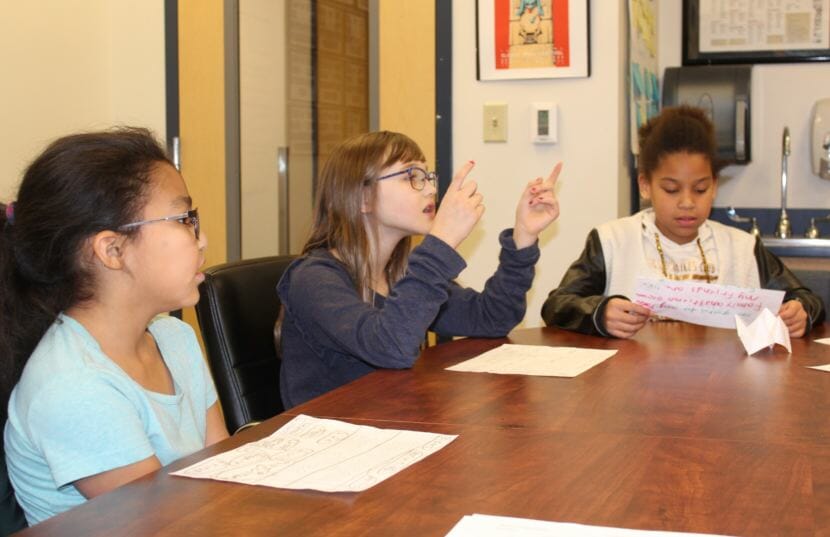
Harborview Elementary School students enrolled in the Tlingit Culture Language and Literacy Program sing “Jingle Bells” in the Tlingit language. (Photo by Ryan Cunningham/KTOO)
Ask a group of Harborview Elementary School kids what they like to eat on Thanksgiving, and you’ll hear things like grandma’s apple pie or mom’s cranberry sauce. Or something called “hot dog surprise,” a delicacy prepared by second-grader Malina’s grandfather.
“A hot dog surprise is, you have hot dogs, and you cut them, and then you take green beans, and then you take tomatoes, and then you can take some onions, and you chop them up. And it’s hot dog surprise,” she explained.
Thanksgiving is a fun time of year for most kids — fun, at least in part, because they get four days off of school. But for the kids in Harborview’s Tlingit Culture Language and Literacy Program, language specialist Jessica Chester uses the holiday to broaden their Tlingit vocabulary.
For instance, students learn the phrase, “Sh tóog̲aa x̲at ditee,” which translates to “I am grateful” in English.
And then there’s “lug̲eitl’,” the word for “turkey.” But that one’s a little tricky.
“That’s the word we used a lot in the past,” Chester said, “and some elders aren’t very fond of it because literally it’s talking about the thing that hangs down, and lug̲eitl’ is your snot.”
In addition to teaching Thanksgiving-related words, Chester said teachers in the Tlingit program have students talk about what they’re grateful for.
In recent years, they’ve also brought to light the struggles of the Wampanoag, the Native Americans who convened with the pilgrims at the first Thanksgiving in 1621. Chester noted that the Wampanoag have struggled to keep their language alive, given the scarcity of fluent speakers.
“The connection to the kids was, ‘Well, we still have fluent speakers of our language, and we need to keep seeking those fluent speakers out and learn as much as we can while they’re still here.’”
Harborview Elementary students will have a long Thanksgiving weekend to eat, hang out with family, and practice their Tlingit language skills. And for that, they are grateful.
Close
Update notification options
Subscribe to notifications
Subscribe
Get notifications about news related to the topics you care about. You can unsubscribe anytime.