Ryan Cunningham, KTOO

False alarm sounds off at Juneau’s Salmon Creek dam

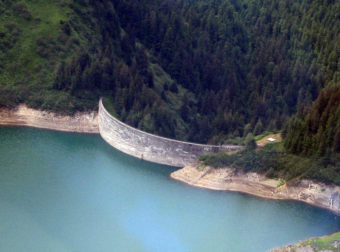
The Salmon Creek Dam, pictured here in July 2010, was built in 1914. It was the first of its kind in the world and still generates electricity for Juneau.
The Salmon Creek Dam, pictured here in July 2010, was built in 1914. It was the first of its kind in the world and still generates electricity for Juneau. (Creative Commons photo by Nvvchar)

An audible siren went off Friday at the Salmon Creek dam, but local authorities say it was a false alarm.

The Alaska Electric Light and Power Co. has stated on social media that the siren was a false alarm.

The Juneau utility company says crews are responding, and there’s no need to evacuate the area.


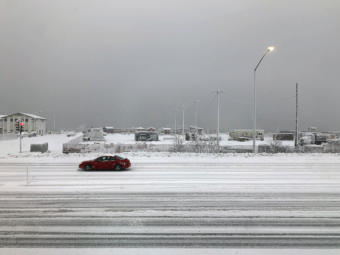
Winter storm could bring up to a foot of snow in Juneau

A man crosses Willoughby Avenue on Jan. 30, 2019, in Juneau. Juneau and other parts of the northern Panhandle are under a winter storm watch. (Photo by Rashah McChesney/KTOO)

The northern Panhandle woke up to a snowstorm Thursday morning.

The National Weather Service has issued a winter storm warning. They say up to 8 inches of snow are expected throughout the day, with an additional 2-4 inches expected overnight.
“The snow is going to start tapering off a little bit later tonight and into Friday, but we’re going to continue to get some snow showers Friday and Saturday,” said Pete Boyd, a meteorologist with the weather service.

Heavy snowfall is also expected in Pelican, Gustavus, Hoonah and Haines.

The storm is creating slippery conditions on the roads.

“This is heavy snow,” Boyd said. “These are going to be slick roads, low visibility. So take your time, slow down driving.”

Skiers and backcountry recreationists should also take caution. A combination of gusty winds and wet, heavy snow means a risk of avalanche is “high,” according to the Juneau Urban Avalanche Advisory.

Alaska Airlines spokesperson Tim Thompson said there have been nine cancellations throughout Southeast since Thursday morning. He said there are flight delays in and out of Juneau due to weather.

Thompson said travelers can check the Alaska Airlines mobile app or website, or call customer service for the latest flight information.

Several Juneau bus routes have changed because of the snow. If you’re taking the bus Thursday, check with Capital Transit before you head out.

https://www.facebook.com/cbjuneau/posts/2211794362458118

The Juneau School District has canceled most after-school activities on Thursday. As of early Thursday afternoon, school officials hadn’t made a decision about Friday cancellations.

KTOO’s Matt Miller and Adelyn Baxter contributed to this report.

This story has been updated.

For Alaska Native cultural tour guides, the job is to carry the weight of the world

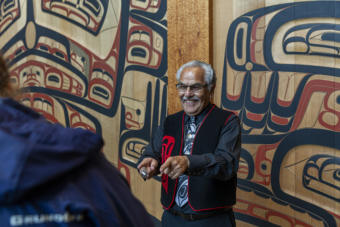
Sealaska Heritage Institute cultural interpreter John Lawrence talks to visitors at the institute’s Walter Soboleff Building in downtown Juneau, Sept. 5, 2019. (Photo by Rashah McChesney/KTOO)

This story was adapted from an episode of KTOO’s podcast “Cruise Town,” which is out now. You can listen and subscribe to the podcast here.

‘He who holds up the earth’

I want to tell you a story. It’s not really my story to tell, but I ran it by a few folks who know it a lot better than I do and know a couple different versions of it.

This version is told by the Tsimshian people — other Southeast Alaska clans tell slightly different versions. It’s about a strong man. A very strong man. I met him in downtown Juneau, and there’s a good chance you’d meet him too if you stop by.

Am’ala is the youngest of four brothers, and the other three brothers never held him in much regard growing up. They made fun of him for being weak and lazy, and for sleeping in a dirty bed of ashes under the clan house’s smokehole. Even his name, Am’ala, is a snide insult from his brothers — “alaa” means “smokehole” in Sm’algyax, the Tsimshian language.

Am’ala often felt humiliated. He didn’t want to be seen as weak and lazy and dirty. He wanted to be handsome and strong. In fact, he wanted to be the strongest person in the world.

One day, Am’ala met a supernatural being in the woods. That supernatural being gave him a series of instructions for how to earn the strength he so badly wanted. By following those instructions, along with a relentless work ethic, Am’ala became stronger than his brothers, then stronger than the strongest warriors. Then when humans weren’t enough for his might, he took on animals — a sea lion, a black bear, a brown bear, a thunderbird. And he defeated all of them. Easily.

But as the story was explained to me, Am’ala still wasn’t done. He picked a fight with a mountain — yeah, a mountain! The mountain told Am’ala that if he beat him in a fight to the death, he would grant Am’ala eternal life. So they fought, and guess who won? Yep: Am’ala. The undisputed champion of the world.

But with great power comes great responsibility. One day, Am’ala got word that a chief was dying and requested his presence. Am’ala went to the chief and found him balancing a pole on his chest. The pole, the chief said, holds the entire world up.

“I am dying, and without someone to hold it up, the world will end,” the chief said. “I have heard that you are a powerful man with strength from a supernatural being and from the strong mountain. Lie down by my side and bear this responsibility so that I may rest.”

Am’ala, once a weak young man, and now an immortal being of invincible strength, has taken the chief’s place as the holder of the entire Earth — under the smokehole of a clan house.

Sealaska Heritage Institute — an organization that promotes Southeast Alaska Native culture — puts Am’ala front and center at their visitor center in Juneau, which is why I took the time to tell his story just now. In fact, when you visit SHI’s Walter Soboleff Building, where the visitor center is housed, it’s sort of hard to miss Am’ala.

Just ask John Lawrence to introduce you.

Sealaska Heritage Institute cultural interpreter John Lawrence tells visitors about the clan house front carving at Sealaska Heritage Institute’s Walter Soboleff Building in downtown Juneau, July 1, 2019. As he speaks, he points to the carving’s depiction of Am’ala. (Photo by Ryan Cunningham/KTOO)

Before Juneau was Juneau

John Lawrence is a cultural interpreter for the SHI visitor center. His father was Tlingit, and his mother was Haida. Those two groups, along with the Tsimshian people, make up the three major Alaska Native groups of Southeast Alaska.

As a cultural interpreter, Lawrence tries to answer any questions visitors might have. Questions like, “What’s that thing on the wall?” or, “What kind of paint did they use on that thing?”

“Number one is about the paint,” Lawrence said. “You know, ‘How did they get the paint back in the olden days?’”

When visitors arrive, Lawrence starts by telling them about the scale-model, 1800s-style clan house nested inside the building. Traditionally, clan houses were communal living spaces for Tlingit, Haida, and Tsimshian people. Today, clan houses are mostly used for meetings and ceremonies, including this one.

Sealaska Heritage Institute cultural interpreter John Lawrence stands in the clan house at Sealaska Heritage Institute’s Walter Soboleff Building in downtown Juneau, July 1, 2019. (Photo by Ryan Cunningham/KTOO)

Lawrence points visitors to the ornately-decorated front wall of the clan house, featured prominently in the main lobby. He explains that it was carved — and yes, painted, in stark tones of black and red — by Tsimshian artists David A. Boxley and David R. Boxley, a father-son duo. The big tableau was done in Northwest Coast-style formline design, a sophisticated art form used by Southeast Alaska Native artists. It has strict conventions that incorporate flowing, symmetrical, geometric patterns and designs, and it’s packed with symbolic images.

In this carving, there are four animals representing the four Tsimshian clans.

“I always start off with the eagle, the wolf, the raven and the killer whale,” Lawrence said, pointing to each crest as he listed them off. “And when you go inside the clan house, you’re going to hear a recording about this gentleman here.”

Lawrence pointed to a human-looking figure at the bottom of the carving: “Am’ala, he who holds the Earth up.”

Am’ala is actually kinda small in the grand scheme of the carving. He’s crouched down in the middle with his hands raised, holding up the entire world and all his ancestors above it. Even for the strongest person ever, that’s a lot of weight to carry.

Next door to the clan house is a museum. There’s a map of Southeast Alaska right at the entrance.

“When I’m not busy, I always like to tell this story,” Lawrence said as he approached the map on the wall. “This is called Haida Gwaii, down here in Canada. Back in the 1800s, there was 30,000 Haidas there. Smallpox came in and wiped from 30,000 down to 600. And that’s when my mother’s great great grandparents moved up here.”

The map shows the traditional territories of the Tsimshian, Tlingit and Haida tribes in Southeast Alaska. For the record, where Juneau is — where Cruise Town is — is on Tlingit land. The Tlingit people — specifically, a Tlingit group called the Aak’w Kwáan — were here in Juneau before Juneau was Juneau.

“Hydaburg is a little village over here.” Lawrence pointed near the southern tip of the Alaska Panhandle. “I always tell everybody I was born in 1949, and I lived in Hydaburg, and I wouldn’t trade that childhood for nothing. Electricity went off at midnight. We had no phone, no TV. My dad had a sense of humor, and he made a two-seater outhouse.”

If you follow Lawrence around long enough, you start to realize that he’s a gifted conversationalist. He has an ostensibly spotless memory of all 70 years of his life, and he so seamlessly weaves his personal experiences with historical and cultural knowledge that you start to lose track of which one is which.

On top of that, he’s a good listener, he has a good sense of humor and he knows how to connect with just about anyone. When he meets military veterans, he’ll chat them up about his experiences in the U.S. Navy. (Lawrence said he served three tours of duty in the Vietnam War.) When he meets New Yorkers, the proud Boston Red Sox fan likes to playfully taunt them by flashing his Red Sox World Series championship ring.

In a manner of speaking, Lawrence knows how to speak the visitors’ language. Like Am’ala the strongman, John Lawrence is holding up the world and all his ancestors and saying, “Hey, take a look at our history. Take a look at me, at my history.” And he said it’s one of his favorite jobs he’s ever had.

In fact, he really only has one complaint about his summer gig.

“Standing on my feet all day, my feet are barking right now,” he said. “That’s the only part I don’t like.”

‘So, how long have you been Native?’

There’s a special dynamic at play when a cultural interpreter like Lawrence interacts with tourists. He greets them warmly and welcomes them into his space, almost like they’re close friends — except they’re friends who paid admission to visit his house.

“Everybody’s agreeing to play this fake game of what our relationship is to each other, which is kind of a subculture in itself,” said researcher Alexis Bunten. “And once you do it day after day, there’s kind of like these routines and scripts that are unwritten, but everybody knows how to play them.”

Bunten holds a Ph.D. in cultural anthropology and conducts independent research for tribes and Native organizations, in addition to co-directing the Indigeneity program for Bioneers. She worked briefly for SHI as an administrative assistant, but that was before the institute had the Walter Soboleff Building, along with its exhibits and cultural interpreters who field questions about paint.

But for two summers, Bunten was a cultural tour guide for Tribal Tours of Sitka. She wrote a book about that experience called “So, How Long Have You Been Native?: Life as an Alaska Native Tour Guide.”

The title refers to an actual question Bunten got from a tourist. (By the way, Bunten is Aleut and Yup’ik, and she’s been Alaska Native her whole life.) Questions like that aren’t out of the ordinary for Alaska Native tour guides.

“You have to continue to remain pleasant and warm and kind, and answer their questions with empathy,” Bunten said. “But obviously, over time and over a tourist season, this can wear down on you. And it can be really, really emotionally exhausting.”

And it doesn’t get easier to deal with. You have to be sort of an emotional Am’ala: a psychological strongman, carrying the weight of your world — and the weight of every non-Native tourist’s world too.

“So while the good side of working in the business is getting to share your culture and get paid to be you,” Bunten said, “the very, very difficult side is that emotional labor that you have to put out, because you’re constantly being reminded of negative stereotypes about what it means to be Native, and it hurts.”

Haida artist Robert Davidson's metal panel "Greatest Echo" adorns the front of the Walter Soboleff Building. (Photo by Elizabeth Jenkins/KTOO)
Sealaska Heritage Institute’s Walter Soboleff Building in downtown Juneau. (Photo by Elizabeth Jenkins/KTOO)

Sealaska Heritage Institute opened its new cultural facility in downtown Juneau about four years ago. More and more curious cruise ship tourists started to wander in, meaning they needed more people on hand to help explain things.

“People like John Lawrence, who are knowledgeable about our culture, greeting people at the door,” said SHI President Dr. Rosita Worl. She’s Tlingit, belonging to the Eagle moiety of the Thunderbird clan.

But how do these interpreters, as knowledgeable and as friendly as they can be, deal with an outsider’s ignorance?

“I remember somebody asking me once, you know, ‘How come you don’t get angry? And how come you don’t get angry at the insensitive ways that you’re treated?’” Worl said. “And we do get angry, but we can’t let it overcome us. And so we’ve had to learn how to deal with it.”

To some degree, that’s a struggle any Alaska Native in Juneau faces when tourists come to town. They’re introducing a whole new history and culture and heritage to someone who’s fresh off a cruise ship and hanging around Juneau for just a couple hours.

That’s also the struggle they face when a white reporter from the Midwest — like me — comes to town and wants to cover their community.

This past summer was my first cruise season in Juneau — I started working at KTOO in October 2018. When I walked around town in those summer months, occasionally I would get this vague feeling of irritation. I would get irritated with people meandering on the sidewalk, taking selfies with giant, plush bear statues and blocking my way.

In truth, I really enjoyed the bustle and commotion of cruise season, and I kind of miss it now. But a couple months ago, it was hard to escape the feeling that these people had invaded my space in this small town where I live and work.

It made me wonder if that’s how Alaska Natives feel all the time.

Rosita Worl, president of Sealaska Heritage Institute, in her office on Sept. 5, 2019, in Juneau. (Photo by Rashah McChesney/KTOO)

Adziksa g̱oodu

When I told you the story of Am’ala at the beginning of this story, I mentioned that I ran my version of the story by some people who know it better than I do, mostly to make sure I got it right.

One of the people I consulted was Am’ala. Well, the voice of Am’ala.

Alfie Sig̱oop Price’s voice-acted portrayal of Am’ala plays on a continuous loop all summer inside the SHI clan house. He’s not affiliated with the institute, but he was happy to offer his voice for the audio recording. Price taught me a lot about the story of Am’ala, and he was very patient with my own ignorance — as was everyone I talked to for this story.

Later I told Price about that irritation I feel with tourists standing around on the sidewalk and getting in my way. That’s how I feel as a white guy from the Midwest who moved here a year ago.

How does Price, of Tlingit, Haida, and Tsimshian heritage, feel?

“Most of us know this as Juneau. But to us, it’s still — in my mind, it’s still Aak’w Kwáan territory. And so we certainly have those feelings,” Price said.

“And the thing that I find is, you have to learn how to continue to keep the adziksa g̱oodu. You have to keep the pride and love of being Tsimshian, Haida, Tlingit in your heart and adapt to the world as it is without losing yourself. And it’s a hard, hard process.

“And, you know, I know the feeling you’re talking about, when you’re trying to just get somewhere downtown and you have to weave through all these people,” Price told me. “And the hardest part, to me, is I pass a thousand people just going from point A to point B, and maybe three or four of them are smiling and looking like they’re having a good time. If I was going to save up all my pennies and go to my dream vacation, you best believe I’m going to be happy about it.

“But I see these people looking grumpy because things aren’t the way they think they should be. ‘Why don’t you wash the glacier?’ ‘Where are the igloos?’ You know? And so, in that sense, it is frustrating and annoying, and it can be hurtful sometimes. But what I’ve learned to do is look for those three or four people who are having a good time and connect with them.”

As an Alaska Native, that’s one of the challenges of living in Cruise Town. You have to have Price’s patience and kindness and adziksa g̱oodu — a sense of pride — to connect with people who are open to connecting.

That’s what John Lawrence does, too. He does it like it’s his job. Because it is his job.
 
https://www.instagram.com/p/B1wLHq3laot/

Learn more

Juneau expecting a one-two punch of rainstorms this week

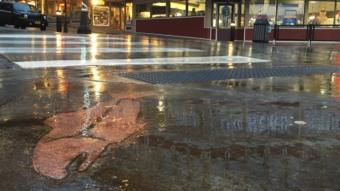
Rain trickles onto the pavement in an intersection in downtown Juneau on Tuesday. (Photo by Ryan Cunningham/KTOO)

There are back-to-back storms hitting Alaska’s Panhandle this week. That means significant rainfall and strong winds are predicted for Juneau.

The National Weather Service says Juneau can expect 2 to 4 inches of rain through Thursday morning, with additional rainfall on its way.

Aaron Jacobs with the weather service said the first storm will bring some gusty winds and a risk of falling debris on steep mountainsides.

“But that won’t be the end of it, because we have another weather front right on its heels that’s going to move into the region on Thursday and Friday, which will produce another 1 to 3 inches of rainfall,” he said.

Jacobs there could be a higher risk of flooding in some areas.

Rainy, windy weather is nothing out of the ordinary for Southeast Alaska. What makes this year’s weather unique is the higher temperatures.

Jacobs said November storms like these usually produce more snow, especially at higher elevations.

“That has changed in the past five to 10 years, where we’re just not seeing as much fall snowstorms up in the mountains,” he said.

Because of the higher risk of landslides, the City and Borough of Juneau announced Tuesday that the Flume Trail will be closed temporarily. The city said it will notify the public when the trail reopens.

KTOO reporter Matt Miller contributed to this story.

‘Potentially lethal’ toxins found in Juneau shellfish

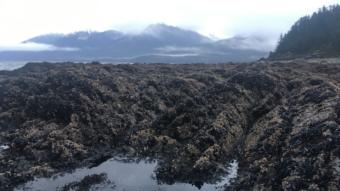
A low tide leaves shellfish exposed on a beach near Juneau. Nov. 17, 2018.
A low tide leaves shellfish exposed on a beach north of Juneau. (Photo by Ryan Cunningham/KTOO)

A group that monitors shellfish toxin levels is warning Juneauites not to consume shellfish from some locations in the Auke Bay area and beyond.

The Central Council of the Tlingit and Haida Indian Tribes of Alaska has issued a public notice of a shellfish advisory for areas near Amalga Harbor, Point Louisa and the Auke Recreation Area.

According to the notice, recently-collected samples of blue mussels, cockle clam and butter clam from those locations had “extremely elevated levels” of harmful toxins — well above federal Food and Drug Administration limits for consumption.

Kari Lanphier, environmental lab manager for the Sitka Tribe of Alaska, said her lab hasn’t seen shellfish toxin levels this high in Juneau since they started operating three years ago.

“Once we start to see levels of paralytic shellfish toxins reach in these ranges that we’re seeing in Juneau … it’s pretty dangerous. Those are levels that could be potentially lethal if ingested,” she said.

Lanphier said most of the Auke Bay samples were collected on June 4. Because of the unusually high toxin levels, her lab’s partners at Tlingit & Haida will collect a new round of blue mussel samples on Thursday.

According to the Alaska Division of Public Health, early symptoms of shellfish poisoning include tingling feelings in the lips and tongue, followed by tingling and loss of muscle control in the arms and legs. Within a couple hours, a poisoning victim could stop breathing.

Shellfish become toxic when they’re contaminated by harmful algae blooms. Some toxins can be up to 1,000 times stronger than cyanide.

If you think you’ve consumed toxic shellfish, seek immediate medical attention. Any potential poisonings should also be reported to the state’s Section of Epidemiology by calling 907-269-8000 or 800-478-0084 if the call is after regular office hours.

For general information about shellfish toxins, visit SEATOR.org or contact Tlingit & Haida.

Snowboarder dies in avalanche near Haines

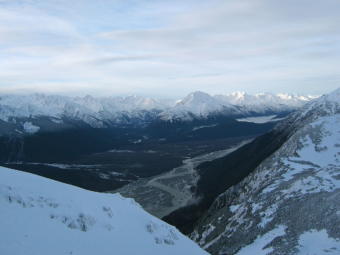
View of the Chilkat River from the Takshanuk Mountains.
View of the Chilkat River from the Takshanuk Mountains. (Creative Commons photo by Jonathan.s.kt)

A snowboarder died Wednesday after being buried under an avalanche outside Haines.

In a press release, Alaska State Troopers say that David Dzenawagis, a Haines resident, was snowboarding above the Takshanuk Mountain Trail when an avalanche was triggered.

The release says two skiers in the area were able to dig Dzenawagis out of the snow within a matter of minutes. The skiers, both from Haines, attempted to resuscitate Dzenawagis before emergency personnel arrived. When Haines Fire Department EMS personnel reached the scene via helicopter, they pronounced Dzenawagis dead.

A forecast issued Thursday by the Alaska Avalanche Information Center ranks the risk for avalanches around Haines from “considerable” to “high,” depending on elevation. Because of a pileup of wet, heavy, windswept snow in recent days, AAIC recommends avoiding “all avalanche terrain” on Thursday.

Site notifications
Update notification options
Subscribe to notifications