Scott Burton, KTOO

Juneau Afternoon 6-15-15

Monday on A Juneau Afternoon, Scott Burton will host.

We’ll talk to Erik Scholl about a new business in town: Gla-Scholl Grinds,

We’ll find out about upcoming Fish & Game Outdoor Skills classes;

We’ll talk to Jody Weber about this Friday’s performance by the Weber Dance Troupe

Mike McLarron will be here to highlight CANVAS Improv classes for youth;

That, Writer’s Almanac, Bird Note, Music & more, live at 3 on KTOO-NEWS, repeated at 4 on KRNN, and available on demand via ktoo.org

Tlingit language immersion program co-founder Kitty Eddy retires after 31 years

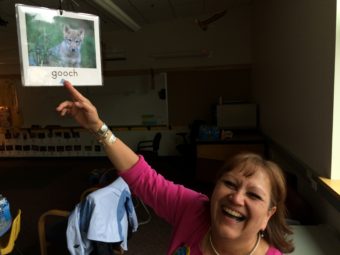
Images like these are among the learning tools in Eddy's classroom. (Photo by Scott Burton/KTOO)
Images like the one shown serve as learning tools in Eddy’s classroom. (Photo by Scott Burton/KTOO)

Kitty Eddy has been a driving force behind the Tlingit Culture, Language and Literacy Program at Harborview Elementary School since its inception. This week, she’s retiring after 31 years of teaching.

It’s the last day of class in Eddy’s combined kindergarten and first grade classroom. You’d think it’d be hard to gather the students, but it just takes counting down from five — in Tlingit.

Kitty Eddy and students from the Tlingit Culture, Language and Learning program. (Photo by Scott Burton/KTOO)
Kitty Eddy and students from the Tlingit Culture, Language and Learning Program. (Photo by Scott Burton/KTOO)

“Keijín. Daax’oon. Nás’k. Déiý. Tléix’!” Eddy says in a patient yet stern manner as the students move to the front of the class to sing and dance.

The program, which began in 2000 with help from a federal grant, is a collaboration between Sealaska Heritage Institute and the Juneau School District. The two founding teachers were Eddy and Nancy Douglas.

“That first year was lot of work,” says Eddy who is Tlingit, Yanyeidi (clan). “We worked every single day to try and pull together a classroom that was different than the normal classroom that was based on our culture.”

The program has since grown to include all the elementary grades at Harborview. While the majority of the students in the program are Alaska Native, any student interested in Tlingit culture and language is welcome.

The immersion classrooms are similar to other classrooms in that they do required math and reading, but there is a difference.

“We really build a family unit so that you have a group of children who come in and want to be here and that they belong,” Eddy says.

Eddy engenders the family approach with help from elder Selina Everson and language specialist Jessica Chester, among others. Chester was born and raised in Juneau and is grateful for what the program is doing.

Jessica Chester (left) is a Tlingit language specialist that works in Eddy's classroom. Shgen George has been with the program since 2002 and teaches a combination fourth- and fifth-grade class. (Photo by Scott Burton/KTOO)
Jessica Chester (left) is a Tlingit language specialist that works in Eddy’s classroom. Shgen George has been with the program since 2002 and teaches a combination fourth- and fifth-grade class. (Photo by Scott Burton/KTOO)

“I never had teachers like Ms. Kitty or Ms. Nancy,” Chester says with tears in her eyes. “So my first year here, the way I saw them work with our children was so much different from the way I was treated and my brother and my sister were treated when we were kids. I just saw that, and something inside me grew and it made me a better person, it made our community better and I am forever grateful for the work they did.”

Eddy knew the program was on the right track by the end of the first year. The kids and their families gathered for a party. All the students’ grandmothers were in tears.

“It was the very first time in their lives that they had heard our language spoken in a public school. And I really think for all of us it really brought to light, ‘Wow, we are doing something incredible and impacting not only the kids, but families,’” Eddy says.

Student test scores have had good and bad years, just like any other classroom, Eddy says.

“When you think about success it’s more than just what the data tells us,” Eddy says. “When you have kids happy to walk in the door in the morning, and they are engaged in what you’re doing, they figure out who they are as a person.”

Eddy says she hopes staff will be able to come together to continue the program without basing it on mandated curriculum. She says new administrations and changing mandates have sometimes put the program in flux.

“I think that they are amazing people who really are going to need to have fight in them to make changes that need to be made,” says Eddy.

And if they need help, Eddy says not to worry. She’ll come back occasionally as a substitute teacher or just to check on the family.

Juneau playwright gets national attention

Frank Katasse
Katasse is known to many as an actor. Here he plays Amos Hart in Perseverance’s production of “Chicago.” (Photo courtesy of Perseverance Theatre)

Urban life has long drawn young people out of rural Alaska. Now art is imitating Alaska life in a first-time Juneau playwright’s new play “They Don’t Talk Back.” The debut work has caught the eye of a well-known Native American theater company, and drawn the homegrown playwright to Los Angeles.

Frank Katasse says his writings often explore the sometimes confusing differences between his Tlingit heritage and contemporary society. When inspiration hits he will compose a monologue, a soliloquy or a poem; this is his first full-length play and is composed of several years of these writings that ride on a central theme.

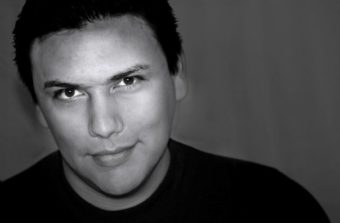
Katasse is an actor, director, producer and playwright.
Katasse is an actor, director, producer and playwright. (Photo courtesy of Frank Katasse)

Not expecting much, Katasse submitted his play to a leading Native American theater company Native Voices at the Autry in Los Angeles. The theater chose Katasse’s play amid numerous submissions as one of three major works to present at this year’s 17th Annual Festival of New Plays.

“He’s an amazing first-time playwright,” says Native Voices Producing Executive Director Jean Bruce Scott. “The fact that this is his first full-length play is telling in terms of his natural talent.”

Scott says the play is unique: “He’s using what we’re currently calling interludes that bracket the individual scenes that are happening in the play. And the interludes, each one of them is different. One may be Tlingit drumming and singing. One may be a poem. He’s using spoken word.”

He’s also using what Scott calls a beatbox-like rhythmic language.

“And then he’s telling a very important story in Indian country, and that is the connection between culture and history, and the present day, and how do Native people hang onto their children.”

Katasse will be in Los Angeles through the end of May for the Playwrights’ Retreat. A full company of nationally recognized directors, dramaturges, producers, designers and Native American actors will read and critique “They Don’t Talk Back.”

Katasse is excited, but says playwriting is different from his usual role as an actor.

“It hasn’t even started yet and I’m nervous, which is very odd,” Katasse says. “I don’t get nervous very often going on stage. But already I’m feeling like it’s something that is out of my control and I just have to trust the ensemble which other playwrights have obviously done with me.”

It’s ironic that Katasse is leaving Juneau himself, but that irony is not lost on him. He plans to bring back all that he learns and share it with aspiring playwrights in Juneau.

‘Monumental art’ makes Juneau’s new Walter Soboleff Building shine

[carousel easing=”linear”][item id=”1431579084-1-89″ tab_id=”1431579233228-1″ title=”Item”]
Haida artist Robert Davidson's metal panel "Greatest Echo" adorns the front of the Walter Soboleff Building. (Photo by Elizabeth Jenkins/KTOO)
Haida artist Robert Davidson’s metal panel “Greatest Echo” adorns the front of the Walter Soboleff Building. (Photo by Elizabeth Jenkins/KTOO)
[/item][item id=”1431579084-2-77″ tab_id=”1431579233842-1″ title=”Item”]
Robert Davidson at Celebration in 2010. (Photo by Brian Wallace Sealaska Heritage Institute)
[/item][item id=”1431579084-3-38″ tab_id=”1431579234397-2″ title=”Item”]
David A. Boxley (left) and son David R. Boxley collaborated on the Tsimshian clan house front. (Photo by Brian Wallace/Sealaska Heritage Institute)
[/item][item title=”Item” id=”1431579387938-0-1″ tab_id=”1431579387943-4″]
The blueprint of Singletary's 28 glass panels. They weigh close to 1,500 ponds all together. (Photo by Scott Burton/KTOO)
The blueprint of Singletary’s 28 glass panels. They weigh close to 1,500 ponds all together. (Photo by Scott Burton/KTOO)
[/item][item title=”Item” id=”1431579472053-0-10″ tab_id=”1431579472059-7″]
One of Singletary's 28 glass pieces that will combine to make the screen. (Photo by Scott Burton/KTOO)
One of Singletary’s 28 glass pieces that will combine to make the screen. (Photo by Scott Burton/KTOO)
[/item][/carousel]
Opening ceremonies for the Walter Soboleff Building begin Friday at 8:30 a.m. The grand opening ceremony will be broadcast live on 360 North.

The new Walter Soboleff Building in downtown Juneau will soon be fully unveiled to the public. In addition to observing the structure’s architecture, visitors will be surrounded by monumental art.

Rosita Worl says she wanted both traditional and contemporary art. (Photo courtesy of Sealaska Heritage Institute)

“We knew we wanted to have the best of our artwork,” says Sealaska Heritage Institute President Rosita Worl. “And we also knew we wanted to have all of our three nations represented: the Tlingit, Haida and the Tsimshians.”

By “we” she means the institute’s Native Artist Committee: Tlingit artist Nathan Jackson, master Haida weaver Delores Churchill, Tlingit contemporary artist Nicholas Galanin and formline expert Steve Brown. They solicited art, deliberated over the proposals and chose three. But what is monumental art?

“I think of it as something that is put on structures, canoes, or totem poles, but they’re not utilitarian objects. They’re not things that we wear. They’re not ceremonial objects per se, but that’s not to say that they don’t have a sacred dimension to them,” says Worl.

Haida artist Robert Davidson’s 40-foot red steel panels frame the building’s front entrance. The installation was inspired by a smaller contemporary piece Davidson donated to SHI that was dedicated to Walter Soboleff called “Echoes.” The piece everyone will see from the street is called “Greatest Echo.”

“The fact that it was dedicated to Dr. Soboleff (and) called ‘Echoes’ (was) because Robert Davidson said that ‘he had echoes from the past that were moving into the future’ and it was just absolutely the appropriate theme for the building,” says Worl.

Beyond Davidson’s panels and through the glass front doors, a 15-foot tall, 40-foot wide Tsimshian clan house front defines the atrium. It’s by David A. Boxley and his son David R. Boxley. The elder Boxley says his piece is a step back in time.

“It is made to look like you were coming by canoe into a Tsimshian village and this type of design would have been on the major house of that village,” he says.

The detailed painted formline design on it may be the most traditional of the three pieces of monumental art, but there’s more there. The wood is carved, too.

“Most of the old house fronts from back in the day were painted. The carving on this type of thing was usually set aside more for interior screens,” Boxley says.

Tlingit glass artist Preston Singletary hopes his work will inspire future generations to explore new mediums. (Photo Scott Burton/KTOO)

Inside, the third piece of monumental art is a clan house screen by Tlingit artist Preston Singletary.

“I created a bird design that could represent eagle or raven, so it’s a little bit nebulous there. But I wanted to create a very quintessential Tlingit style so that the formline is quite bold and has a really strong kind of architecture to it,” Singletary says.

While a traditional screen is made of wood, Singletary’s is actually 28 black and amber sandblast-carved glass panels mounted together as a mural.  Singletary says that using a contemporary medium like glass brings a new element to traditional art.

“I hope that the takeaway might be for someone to be inspired to, you know, reinterpret what they’re doing as far as the traditional arts,” Singletary says. “Maybe they’ll be inspired to create in a new material and see that it’s ok and see that we’re pushing forward on different levels, and so maybe the next generation will be a lot more comfortable with doing that.”

Worl says this is what the Native Artist Committee was after.

“We wanted to have both traditional and contemporary. We wanted to be able to show the evolution of our culture—that our culture isn’t static.”

Site notifications
Update notification options
Subscribe to notifications