Yvonne Krumrey

Justice & Culture Reporter, KTOO

"Through my reporting and series Tongass Voices and Lingít Word of the Week, I tell stories about people who have shaped -- and continue to shape -- the landscape of this place we live."
Juneau child’s clinical trial set to proceed in new year after community raises more than $1 million

Cade Jobsis and his mom, Emma, at the (Photo courtesy of Emma Jobsis)

After Juneau residents helped raise more than $1 million this fall, a local boy with a rare genetic disease will be able to receive a potentially life-changing gene therapy in the new year.

For the past two years, 4-year-old Cade Jobsisʼs mother Emma Jobsis has been raising money to allow scientists to restart clinical trials that previously showed promising results treating AP4 Hereditary Spastic Paraplegia, or SPG50. 

Cade was born with the rare disease, which would gradually take away his cognitive and motor function without treatment. 

“We got his diagnosis in 2023,” Jobsis said. “And that’s when we found this, this group that was working on this gene therapy, but there wasn’t any funding.”

Jobsis said she and three other families who have kids with the disease started asking their communities for help. She said the Juneau community has been supportive from the get go — especially the kids.

“They would knock on my door with a jar of coins, telling me they had collected them for him. And it was so heartwarming,” Jobsis said. “But it wasn’t the jar of coins that did it. It was the fact that so many kids and families were talking about him and telling people about him.”

The four families raised $3 million to pay for the production of the drugs. Then, in September, a grant that would have covered the treatment administration fell through. 

The families needed another $1.15 million.

Jobsis said she was a wreck, but she didnʼt lose hope. She used TikTok, Facebook and Instagram to spread the word. 

“I just got on my social media and just started talking. And boy oh, boy, did my community hear me,” she said.

Jobsis said so many businesses in Juneau stepped up to help raise the money she couldnʼt keep track of them all. In total, the Juneau community contributed more than $400,000 in just two months. 

They were still less than halfway to their goal. 

“And a local family contacted me,” Jobsis said. “And she said, ‘I have been watching your social media. I have seen what you’re trying to do, and I have heard you say on countless occasions that you just need to reach the right person, and we want to be that right person for you.ʼ”

That $600,000 donation brought them across the finish line, providing enough funding to treat all four kids.

One of them, a young girl named Naomi, got her first dose of the drug on Dec. 9. Now, the other three children are waiting to be scheduled. Jobsis said they’ll find out when Cade gets his treatment in the coming weeks.

“I cannot thank this community enough,” she said. “I mean, as the weather is terrible here, but we live here for the people, the community is unmatched.”

After more than 50 years, a family-run shop in downtown Juneau is closing its doors

Mike Wylie has worked at his family’s Ben Franklin store since the 70s. He said the decision to close is bittersweet. Dec. 11, 2025. (Photo by Yvonne Krumrey/KTOO)

With its Ferris Wheel made of K’nex and model airplanes hanging from the ceiling, the Ben Franklin store was a landmark in downtown Juneau, drawing attention from passersby, young and old. But in mid-December, it was almost empty as people came and went to see what’s left. 

After more than 50 years, the family-run shop in downtown Juneau is closing its doors. The owner of Ben Franklin said the store has been a part of the town’s history — and his own — and closing is bittersweet. 

Mike Wiley’s parents bought the building that houses the store in the 1970s. It was already called Ben Franklin, which was a nationwide general store franchise. 

“We sold everything from tennis shoes to pencils to bras and lampshades, because there was no real store where you could get those kinds of things,” he said. 

Wylie was in middle school when his family took over and he worked at the store every day after school.

“I went to Maria Drake Junior High, which is over by Harborview. Walked over after school,” he said. “Always was told, ‘You have to come here, go to work, stay out of trouble.’”

That tradition continued with his own kids.

“Our kids have worked here. We’ve had grandkids working here,” Wylie said. “We have no great-grandkids working here yet, but as of now, we still have like two grandkids working here and helping out.”

Juneau has changed a lot over the last 50 years, and Ben Franklin changed with it. Wylie said he thinks only people in their sixties and older remember the original chain these days.

Starting around the 1970s, the store adapted as tourism grew in Juneau. 

“There was maybe two or three gift shops in town, and we started carrying Alaska souvenirs,” Wylie said. “And it was the old steamships — like Canadian cruise lines and that kind of thing – that came in here.”

Wylie said he always made a point to continue selling things useful to locals too — like housewares, frames and toiletries. 

The nationwide Ben Franklin franchise was sold a few times, and declared bankruptcy in the 1990s. It folded about 10 years ago, and Juneau’s store became independent. Wylie said the last few years were tough on business, with the COVID-19 pandemic and supply chain disruptions. 

The store made it through, as it had for decades before. But now, he said it’s time to close the shop, of his own volition.  

“Basically, it’s the end of an era here,” Wylie said. “Why we’re closing up –  it’s just, it’s time for me to retire. I put 52 years in here.”

Wylie said the responsibility of running the store has been on his shoulders for so much of his life. 

“When you own a business, you’re never away from it,” he said. “And I just want freedom to not have to worry about that.”

The Wylie family announced in September they were going to close the store. It stayed open for the holiday season. There isn’t much left now, some fabric and decorations and a swordfish on the wall. 

As it empties, people have come in to share their memories of the store. Wylie said it’s bittersweet to hear them.   

“Especially when everybody comes in and says, you know, ‘Hey, I hate to see you go’ and whatnot,” he said. “And, you know, ‘We brought our kids in here when they were little kids,’ and ‘My mom dad brought us in here’ when they were little kids to purchase stuff. So that, you know, that part kind of tugs at heartstrings.”

Wylie said he plans to have a “garage sale” style sell-off of whatever is left after the holidays. And he said he’s had a couple of people interested in buying the century-old building.

Juneau’s homeless shelter resumes day services after months-long pause

Mindy Birk, a longtime Glory Hall homeless shelter volunteer, smiles for a photo on Wednesday, Dec. 17, 2025. (Photo by Clarise Larson/KTOO)

Juneau’s homeless shelter is once again offering daytime meals and other services after stopping them in August due to safety concerns. 

The Glory Hall’s Executive Director Kaia Quinto said there were multiple instances of violence and threats this summer that put the safety of shelter staff and clients at risk. She said it was getting harder to continue serving the community at all. 

“The reason why we closed day services was because the environment outside on Teal Street was just pretty dangerous and chaotic,” Quinto said. “Which then transferred inside of the facility, made the facility dangerous and chaotic.”

The shelter closed its doors to people who didn’t already have an assigned bed there, with a few exceptions. 

In November, the city again cleared the encampment that had built up outside the shelter, and people haven’t set up there again. The shelter renovated its entrance to have a two-door system, instead of one, allowing staff more control of who’s allowed inside.

Quinto said things calmed down enough to open services safely Tuesday morning. 

“With the encampment moved and the temperature and the weather and our improvements made to the front of the building, we’re feeling pretty confident about opening day services now,” she said.

It’s only been a couple of days, but Quinto said people are using the services. 

And the reopening comes at a good time — Juneau is expected to see single digit and below zero temperatures this week and into next.

The Glory Hall serves meals at 8:30 a.m., noon, and 6 p.m. each day. The city-funded emergency warming shelter near Thane Road opens at 9 p.m. each night until 7 a.m. in the morning, and offers transportation to the Glory Hall. 

Juneau artists rack up eight Rasmuson awards. Here’s what three of the winners are creating.

Rasmuson Individual Artist Awardees CJ Harrell, Flordelino Lagundino, and Neech Yanagut Yéil Laine Rinehart. (Photos courtesy of the artists)

The Rasmuson Foundation announced their list of Individual Artist awardees, and eight Juneau projects made the list. The 50 total awards go to artists across the state, who will receive $10,000 each toward a project they have planned. 

For Juneau-based artists like CJ Harrell, the grants support deeply personal projects. Harrell plans to make block print portraits depicting a dozen of the Southcentral Alaska homes they lived in growing up. 

First, they plan to travel to see the homes as they are now, and meet the current residents. The grant helps pay for that. Harrell said that gives them confidence to take on the project. 

“I realized, like, oh man, this would take me years to save up for otherwise and even that,” they said. “Like, I don’t know if I would be brave enough to do this if I didn’t have that funding and that support.”

The project will delve into themes of poverty and abundance in rural Alaska, including Harrell’s experience growing up with a parent struggling with substance abuse. 

“The experience of being both isolated, but also so surrounded by nature and other wonderful spaces and resources and beauties too,” Harrell said. “And how that can soften the blow when you’re dealing with other challenges.”

Harrell said the project reflects experiences many Alaskans have had, but it’s still uniquely theirs.

Awardee Flordelino Lagundino is also using his grant funding to tell a story he knows intimately. He’s putting on a play with Juneau nonprofit Theater Alaska that he first saw 20 years ago. The Romance of Magno Rubio is about a young Filipino farmworker finding his way in America. And he said the play is quite an undertaking.

“It’s a really, actually difficult script to produce. It’s mostly in poetry,” Lagundino said. “Lots of poetry in it, there’s singing, there’s lots of movement.”

He also received a grant from the Juneau Community Foundation. Lagundino is using some of the funding to fly in a young Filipino director he met when the man was only a high school student, and to hire more Filipino actors to fill out the roles.

Theater Alaska, which he founded with other Juneau thespians in 2020, puts on a lot of shows for free, or by donation. Lagundino said it would have taken years to fundraise to put on a dynamic play like this without grant funding.  

The story is set in California in the 1930s. Lagundino said the setting is familiar to Juneau’s own migrant worker history.

“The workers of this town, a lot of them have been Filipino and helped make this place,” he said.

The Romance of Magno Rubio will run this June and July. 

Rasmuson also awarded Ravenstail Weaver Neech Yanagut Yéil Laine Rinehart a grant for a project he’s been working toward for years: weaving a tunic completely out of jánwu, or mountain goat hair. It’s a traditional material for weaving in Southeast Alaska. Rinehart began collecting the fiber from weaving mentors and naturalists as he learned weaving. 

“The core reality of it is just the relationship that you have to have with other people to make something like this happen,” he said.

And he plans to document the process of using the fiber from its raw material into becoming the woven tunic. 

“It really allows you the ability to slow down and recognize, like, how much work has gone into this craft to get it from, say, the side of a mountain somewhere in Southeast Alaska,” he said. “And then just getting it to that point where you can even spin with it is just such a celebration.”

Rinehart said the grant helps him to financially support himself while devoting time and attention to the project. And he said it gives him the chance to reflect on why working with traditional materials is important to understanding weaving, and Lingít peoples’ long history working with the land and all of its inhabitants.

The Rasmuson Foundation also awarded grants to the following Juneau artists: musicians Annie Bartholomew and the Heists, Drag King Max Stout, Lingít scholar and writer X̱ʼunei Lance Twitchell, and the weaving and documentary team Gunaashaa Lisa Fisher and Gemini Waltz Media. The artists have a year to complete the project.

Editor’s note: Gunaashaa Lisa Fisher is a member of KTOO’s board.

After a Juneau sexual assault case ended in mistrial, new defense team asks for more time to prepare next trial

Public Defender Nico Ambrose in the Dimond Courthouse on Dec. 12, 2025. (Photo by Yvonne Krumrey/KTOO)

Three months after a trial against a former Juneau chiropractor accused of sexual assault ended in mistrial, the new public defense team is asking for more time to review the case before a second trial.

Fourteen former patients accused Jeffrey Fultz of sexual assault under the guise of medical care. They say the incidents took place during medical appointments between 2014 and 2020 while he was employed at Southeast Alaska Regional Health Consortium in Juneau.

In September, his trial ended in a hung jury on 14 counts of felony sexual assault, and two not guilty counts. One of the 14 counts has since also been dismissed. The state is attempting to retry the remaining charges that are eligible to be considered again.

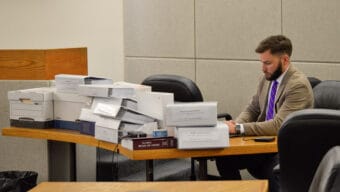
The court assigned Fultz a public defender in October, Juneau’s Nico Ambrose. Private attorney James Christie represented Fultz for the last two years, and through the trial this summer. Ambrose appeared in court Wednesday for the first time since taking over Fultz’s representation.

Ambrose requested the next hearing date to be in April, which will mark five years since Fultz’s initial arrest. 

“There are just so many things in this case that need to be dealt with before we’re ready for trial,” he said. 

Ambrose said he has to review trial proceedings, which lasted six weeks this summer, and hasn’t yet received transcripts from the trial. Ambrose is Fultz’s third defense attorney since his 2021 arrest. 

Earlier this year, the Alaska Supreme Court issued a ruling that would limit delays in old cases, and while this case falls into that window, Ambrose said he doesn’t think it was written with a case like this in mind. 

“This case has not sat around for 5 years waiting to go to trial,” he said. “It has gone to trial.”

State Prosecutor Krystyn Tendy disagrees with scheduling the next hearing so far out and said the case has taken years, regardless of the recent trial. Some of the alleged crimes happened more than a decade ago. 

“We have seen how this case has dragged out and can drag out,” she said. 

Tendy said the court needs to set a new trial date, and should schedule a hearing in February. 

Ambrose said having hearings sooner than April — six months after he was assigned to the case — would be a waste of the court’s time.

Judge Larry Woolford scheduled the next hearing for this case on Feb. 11 at 11:30 a.m.

A contest for art to go on bear-resistant trash cans in Juneau opened today

A black bear munches on grass off of Vanderbilt Hill Road near the pioneer home on April 20, 2025. (photo by Jim Weindorf)

Artists have an opportunity to have their bear-themed art work depicted on trash cans in Juneau built to keep the animals out — and win a $10,000 award.

Norwegian Cruise Line Holdings is partnering with the Alaska Department of Fish and Game to host an art contest. Selected artists will have their art turned into miniature murals that will be printed on bear-resistant trash infrastructure in downtown Juneau. 

Fish and Game’s Abby McAllister said this is a way to raise awareness about the risks unsecured trash creates for bears and encourage people to throw away their trash properly. 

“How do we get people to use our very resistant cans downtown?” she said. “Well, let’s draw their attention to these cans with art.”

When bears get into trash, they learn to turn to garbage and people for food, which can make them dangerous. The state has to euthanize bears that have become aggressive while looking for food in city streets and neighborhoods.

A press release from Norwegian Cruise Lines said panel will narrow down the entries to three finalists, and then the public will vote on the best via social media. Norwegian will award $10,000 to the person whose entry is chosen, a portion of which will go towards a local charity the artist chooses. 

That design will go on an enclosure of bear-resistant cans near the cruise ship docks. Additional designs will be on new trashcans around downtown in bear hot spots. The City and Borough of Juneau is funding and installing the new canisters using cruise passenger fees allocated in fiscal year 2025. 

McAllister said the current bear-resistant cans in Juneau aren’t user-friendly.

“Not everybody knows how to work it,” she said. “So I see people struggle with it for just a half second, and even that is long enough sometimes to deter folks.”

The new cans have more of a “mailbox” design, she said, where people pull open the canister, drop their trash in, and close it. She hopes that the new infrastructure will prevent more bears from getting into trash and save bear lives. 

Submissions are open today, Dec. 9, through Feb. 13.

Site notifications
Update notification options
Subscribe to notifications