Alaska coronavirus news

Live updates and information on COVID-19 in Juneau and Alaska

Stock up on books: Juneau’s public libraries close for 2 weeks in response to coronavirus

The Juneau Public Library runs a number of children’s programs to promote literacy among young people. (Photo by Jacob Resneck/KTOO)

Add one more thing to the stockpile list while life grinds to a halt for coronavirus: books.

Following Gov. Mike Dunleavy’s announcement of statewide school closures, the City and Borough of Juneau has closed public facilities, too, until the end of the month, including Juneau’s public libraries.

But on the last day before the closure, things seemed pretty normal at Juneau’s downtown branch. It seemed a little busier than you might expect on a sunny Sunday afternoon, but a lot of people were there to stock up on books for while they’re potentially stuck at home due to workplace and school closures taking effect Monday morning.

But a few things were already different. There’s usually a pile of giant stuffed animals in the story time corner.

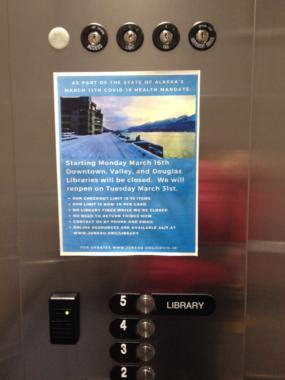
A note in the downtown branch of the Juneau Public Library elevator on March 15, announcing a closure as part of the state’s COVID-19 response. (Photo by Jennifer Pemberton/KTOO)

Librarian Kathy Ward said they had to put them all away.

“Because they’re very difficult to clean, and they got a lot of use. When this all dies down, they’ll be back out for people to play with,” she said.

“I’m going to miss the snake,” she adds. “The snake’s been my pal for 20 years.”

Ward says that everyone can hang on to their books until the library reopens on March 31 — regardless of due dates — and there are no fines while they’re closed.

Also, they won’t cancel anyone’s holds that were placed before the closure. Patrons can pick those up when the library opens again. And library staff will still be working during the closure. So you can still call or email a librarian and get a thoughtfully researched answer.

It was the adults that made the library feel busy on Sunday. For instance, all of the library’s public computers were being used.

But for the kids, it felt like business as usual.

Seven-year-old Zoe Bliss was starting to read a few pages from her very tall stack of books. Her mom, Taryn Bliss, works in public health and is happy to roll with the punches while things slow down in Juneau.

“You know, we all have our responsibility to our community and to our high-risk populations and our health care system to do what we can,” she said. “And sometimes that means just pressing pause.”

Eight-year-old Leo checked out a multi-disk set of audio Dr. Seuss books. And his bag was full of Lego books, which you might assume are prep for school being closed.

“We’re homeschooled,” he said. “So we have school everyday.”

Turns out that’s how many books he always checks out. It’s good to know that life feels totally normal to someone.


As coronavirus concerns grow in Alaska, officials warn shoppers not to overdo it

The toilet paper shelf stands nearly empty at Fred Meyer in Midtown Anchorage on March 3. (Photo by Julia O’Malley/Alaska Public Media)

Photos of bare grocery store shelves and long checkout lines have flooded social media channels this past week. And with Thursday’s announcement of Alaska’s first case of COVID-19, people are stocking up.

Jeremy Zidek, a spokesperson for the Alaska Division of Homeland Security and Emergency Management, said that’s smart, but he said buying toilet paper in bulk might be excessive.

“We would ask people to be realistic about what they’re going to need for a week or two. We recommend people have emergency supplies for seven days. Two weeks would be the ideal,” he said.

Zidek said it’s unlikely the coronavirus outbreak will cause a disruption to the delivery of goods from out of state. Many of those supplies come north to the port in Anchorage from Seattle.
“The ports are open,” he said, “and there’s no restrictions on U.S.-based cargo vessels to Alaska at this time.”

Two shipping terminals in Seattle slowed operations and a third shut down completely on Friday, the Seattle Times reported. But the slowdown comes in response to a decline in cargo arriving from China and not because of the virus itself.

Seattle has been hit hard by COVID-19. But Zidek said that should not cause concern for consumers in Alaska.

“There’s also no evidence to support that COVID-19 can be transported in imported goods, and there hasn’t been any cases of that in the United States. So there’s no real inherent danger to transporting goods,” he said.

Many Alaskans keep their freezers stocked with meat they’ve hunted and fish they’ve caught themselves. And Zidek said that is going to help in the coming weeks as the coronavirus emergency plays out.

“I think the tendency is, whenever you have a bit more (of a) remote community, you have to be more self-sufficient,” Zidek said.

By Monday, officials in Alaska say they will have a unified command response team mobilized to respond to COVID-19 in Alaska. This includes four agencies: Health and Social Services, Emergency Management, Military and Veterans Affairs and Public Safety.


Alaska health department recommends postponing non-urgent or elective procedures

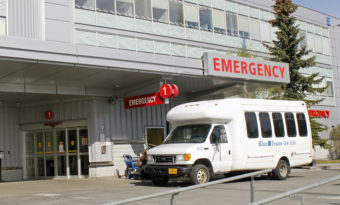
Entrance to Anchorage’s Providence Hospital emergency room. (Photo by Josh Edge/Alaska Public Media)

Alaska’s health department asked Monday that providers postpone non-urgent or elective procedures for the next three months “to decrease the overall impact on the Alaska health care structure,” the department said in a statement.
The recommendation comes from U.S. Surgeon General Jerome Adams and the American College of Surgeons.

“Given Alaska’s distances and limited health care capacity, it is especially important to open acute health care beds for anticipated COVID-19 care,” the statement said. “The state of Alaska believes that by delaying non emergent procedures, individuals will receive optimal care.”


Anchorage mayor suspends restaurant dining, bar service and large gatherings

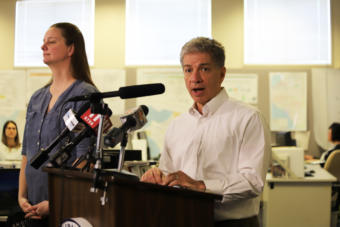
Anchorage Mayor Ethan Berkowitz at a COVID-19 news conference on March 12. (Photo by Hannah Lies/Alaska Public Media)

Anchorage Mayor Ethan Berkowitz has banned dine-in service for food and drink at restaurants, bars and breweries, to prevent the spread of the coronavirus. The order also closes gyms, bingo halls and theaters, and it bans gatherings of more than 50 people.
“These closures are consistent with CDC recommendations and with our strategy of doing what we can to reduce the possibility of transmitting COVID-19,” Berkowitz said in a news release. “As a friend told me, ‘It will be impossible to know if we overreacted or did too much, but it will be quite apparent if we underreacted or did too little.’”

Restaurants are not completely shut down. They can still provide to-go, pick-up, drive-through and delivery orders.

The ban does not apply to grocery stores.

The order goes into effect Monday at 5 p.m. until the end of March.

Alaska’s chief justice shuts down all new jury trials

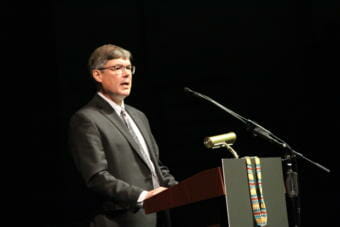
Alaska Supreme Court Chief Justice Joel Bolger addresses the Alaska Federation of Natives convention on Oct. 18, 2019. (Photo by Wesley Early/KOTZ)

Alaska Supreme Court Chief Justice Joel Bolger on Sunday ordered that all new jury trials be suspended, building on a directive last week that led to the suspension of trials in half of the state’s judicial districts out of concern over the spread of the novel coronavirus.

In his second special order in three days, Bolger cited last week’s disaster declaration by Alaska Gov. Mike Dunleavy and the national emergency declaration by President Donald Trump, along with Dunleavy’s mandate closing all public schools through the end of the month.

“These emergency declarations may affect the availability of court staff, attorneys, and jurors to begin new jury trials,” Bolger wrote in his order Sunday.

Jury trials already underway will continue. But the court system, in a pair of tweets Monday morning, urged defendants in pending new trials not to report to previously scheduled hearings.

“If you are scheduled for a state pre-trial conference today 3/16 at 9:30 a.m. before Judge Hanley in courtroom 38, Boney courthouse, DO NOT COME to court,” the court system wrote. “There will not be a bench warrant issued for people who do not show. Talk to your lawyer at a later time to discuss next steps.”

New trials had previously been suspended in two of the state’s four judicial districts, including the Third District — which covers Anchorage, Palmer, Kenai and other areas — and the Second District, which includes the northern Alaska hub towns of Kotzebue, Nome, Unalakleet and Utqiaġvik.

On Thursday, the Alaska Supreme Court is set to consider an emergency order that could loosen court rules in response to the coronavirus’ spread.

The court system says “essential functions” will continue and that it will ensure due process.

Those essential functions include domestic violence and emergency mental health proceedings, and bail and emergency child welfare hearings. The court system also says courthouses statewide have taken steps to reduce COVID-19 transmission, including social distancing measures.


Alaska health department issues advisory for travelers returning from other countries and states

Alaska flight 64 takes off from Petersburg airport in July of 2018. (Joe Viechnicki/KFSK)

Update (Wednesday, March 18, 2:21 p.m.) — Abbey Collins, Alaska Public Media

State officials are taking additional steps to slow the spread of COVID-19 from people traveling to the state. (Read more)

Original story

The Alaska Department of Health and Social Services issued an advisory Sunday recommending Alaskans returning to the state from other countries and other states practice varying degrees of isolation to halt the spread of coronavirus.

It classifies returning travelers in two categories: higher risk and medium risk. It recommends different isolation considerations for each group.

It defines higher risk travelers as those returning to Alaska within 14 days from the time they left an area with “widespread, ongoing community spread” of coronavirus such as Europe, China and other countries classified as Level 3 by the CDC.

Higher risk travelers returning to the state should:

  • Stay home and avoid contact with other household members.
  • Contact their employer and stay home from work or school for a 14-day period after they return.

It defines medium risk travelers as those returning to Alaska within 14 days from anywhere Outside, including the rest of the United States.

Medium risk travelers returning to Alaska should:

  • Discuss their work situation with their employer before returning to work.
  • Minimize contact with people as much as possible, self-monitor and practice social distancing.

“This may mean not going to work or school if you cannot safely be distanced from others – especially if you traveled in a location where community transmission is occurring,” the health recommendation said.

The department issued the following guidance for higher and medium risk returning travelers:

  • Take your temperature with a thermometer two times a day and monitor for fever. Also watch for cough or trouble breathing.
  • Do not take mass transportation during the time you are practicing social distancing.
  • Avoid crowded places (such as shopping centers and movie theaters) and limit your activities in public.
  • Keep your distance from others (about 6 feet or 2 meters).
  • If you get sick with fever (>100.3°F), cough, or shortness of breath, please call your health care provider.
  • If you seek medical care for other reasons, such as dialysis, call ahead to your doctor and tell them about your recent travel.


Site notifications
Update notification options
Subscribe to notifications