KRNN

‘Wrestling Jerusalem’ comes to Juneau after locals talk out Israel-Palestine tiff

Wrestling Jerusalem,” a play that explores the Israeli-Palestinian conflict, opens Thursday at the Juneau Arts and Culture Center. Coincidentally, a small conflict in Juneau is part of the reason the play will be performed here.

Photo by Tom Kublik, courtesy of Aaron Davidman
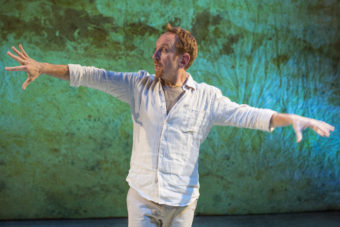
Writer, producer and actor Aaron Davidman plays 17 different characters in “Wrestling Jerusalem.” (Photo by Tom Kublik and courtesy Aaron Davidman)

The conversation that eventually brought “Wrestling Jerusalem” to Juneau was catalyzed by a 2014 ad in the Juneau Empire. The ad, paid for by Juneau People for Peace and Justice, stated the group’s opposition to U.S. military funding for Israel. It got Sukkat Shalom Rabbi Dov Gartenberg’s attention, said peace group member Rich Moniak.

“He was upset by the ad and wanted to debate the larger politics that we’re always debating and that initial contact turned into a conversation where we all sat down around a table for a few hours on a few different nights and started listening to each other as human beings first, and pushing aside the politics and cultural differences that we listen to and divide us,” said Moniak.

(Photo by Ken Friedman and courtesy Aaron Davidman)

Sukkat Shalom member Natalee Rothaus was at the table, too. She saw “Wrestling Jerusalem” in San Francisco and recommended adding its perspectives to the conversation. Rothaus said the play takes a human-centric approach.

“Aaron portrays up to about 17 different characters that are Israeli, Palestinian, Muslim, Jewish, nonpolitical, just the person on the street to try to come to an understanding of not only the conflict that is currently — and has been for so long — in the Middle East, but also to come to an understanding that if people will listen to somebody who is ‘the other’ and just stop and see that we do have commonalities, and that we might not walk away with an answer, but we might walk away with a deeper understanding an another individual,” said Rothaus.

Photo by Ken Friedman, courtesy of Aaron Davidman
(Photo by Ken Friedman and courtesy Aaron Davidman)

Aaron Davidman is the writer, producer, and sole actor in “Wrestling Jerusalem.”

“Without having to buy a plane ticket, I’m bringing you on the journey with me to Israel and Palestine to meet these people,” said Davidman.

“And on the other hand I’m also modeling the possibility that we have as human beings to hold multiple perspectives within ourselves because I am carrying all these different characters in me.”

Davidman hopes those characters and their varied perspectives will further the conversation.

“The role of art and the role of theater isn’t to smooth out the issue so that everybody feels good. The role of art is to turn over the compost heap, and let the fumes out and let’s talk about it. Let’s grapple with it together. That’s really the objective: is to move us from our fixed positions back into the unknown which is actually where we really are. You know we don’t really know how to solve the problem. It hasn’t been solved. We haven’t figured it out yet,” said Davidman.

Bringing “Wrestling Jerusalem” to Juneau has been a collaboration between Juneau People for Peace and Justice, Sukkat Shalom, Perseverance Theatre and Northern Light United Church. Like all performances of “Wrestling Jerusalem,” Davidman and the groups invite playgoers to the table with a moderated conversation after the show.

“Theater says out loud in a room full of strangers, and full of community, what we might be too afraid of to say on or own. And that helps move the conversation publicly forward,” said Davidman.

These interviews came from KTOO’s Juneau Afternoon and Peace Talk. “Wrestling Jerusalem” plays Thursday and Friday at 7:30 p.m., and Saturday and Sunday at 2 p.m. at the Juneau Arts and Culture Center.

Audio Postcard: Getting ready for Wearable Art 2016

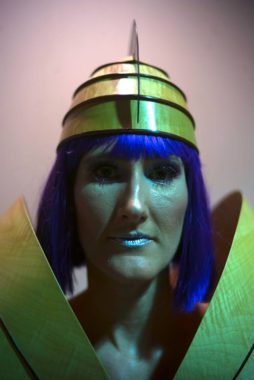
Wearable Art 2016 Grand Parade. (Photo courtesy John Hutchins)


The 2016 annual Wearable Art show was February 12 and 13 at Centennial Hall.

Artists, models, producers, technicians and countless volunteers worked to pull the Juneau Arts and Humanities Council’s fundraiser together.
I caught up with some of the participants and made this audio postcard on the eve of the big event.

Throw, fire, etch, repeat: Mercedes Muñoz ceramics show features 140 pieces

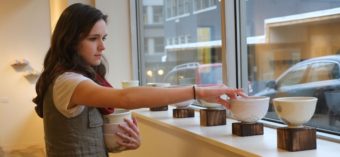
Ceramics Studio Manager and Juneau artist Mercedes Muñoz displays her bowls at The Canvas gallery. (Photo by Annie Bartholomew/KTOO)
Juneau artist Mercedes Muñoz displays her bowls at The Canvas, where she manages the ceramics studio. (Photo by Annie Bartholomew/KTOO)

It’s a rainy Saturday morning and Mercedes Muñoz is working over a crackling fire pit outside her Starr Hill home.

Mercedes Munoz burns wooden blocks to show her pieces on during her show at The Canvas. (Photo by Annie Bartholomew/KTOO)
Mercedes Muñoz chars wooden blocks outside her home. The blocks will become pedestals for her ceramic pieces at The Canvas. (Photo by Annie Bartholomew/KTOO)

“I cut a bunch of 4-by-4 cubes and right now I’m torching them, putting them over a fire,” she says. “And then I’m going to go back and sand them down, get them all polished up and then cut a keyhole mount in the back so that each tumbler will have its own little pedestal to sit on, on the wall. It ended up being maybe just as big of a project as making the work.”

She mounts the custom blocks all over the gallery walls of The Canvas. There’s one to display each of her tumblers, bowls, mugs and tea pots. Over the past few months, she’s created more than 140 functional ceramics for her show “Good Continuation” at The Canvas, which opens tonight. It’s her second professional show after almost a year as the ceramics studio manager.

The entire project is four months in the making. It’s the product of evenings, lunch breaks and weekends throwing, firing, glazing and creating her intricate designs.

Her pottery features a technique called Mishima that allows her to etch fine dark lines onto the surface of her porcelain pieces, marrying her background in drawing and illustration with organic three-dimensional forms. The lines tangle and twist into repetitive geometric patterns, which break up her creamy pastel glazes. Metallic gold accents punctuate the designs.
One was inspired by her grandmother, the late Alaskan artist Rie Muñoz.

Mercedes Muñoz holds a tea pot that features a cross-hatching design inspired by the work of her grandmother, Rie Muñoz. (Photo by Annie Bartholomew/KTOO)

“On this teapot, I have a bit of cross-hatching that’s actually a technique that Rie used. If you look at the backgrounds of a lot of landscapes she had watercolor washes, but underneath it, she had pen drawings, and they had this exact cross-hatching technique,” she says.

Her exhibition isn’t the only deadline she’s working toward. She’s also making 90 handcrafted plates that The Canvas is giving to guests at its annual fundraising dinner.

Last year, Brandon Howard was sweating over the plates when he was in Mercedes’s role.

“Just to put this in perspective, each plate requires 6 pounds of clay to start with. That’s 500 pounds of clay that Mercedes manhandled into plates. And if you’ve ever meet Mercedes Muñoz she’s not this big, buff lady. She’s slight but she’s a powerhouse. She was in there and she was cranking out 25 plates a day like it was nothing,” said Howard.

Muñoz made the plates with a little help on the sepia-toned design reproduced on each one.

Joanne Sam at The Canvas
Joanne Sam shows a plate she helped design at The Canvas. (Photo by Annie Bartholomew/KTOO)
Joanne Sam's design on a plate made by Mercedes Munoz for The Canvas.
Joanne Sam’s design on a plate made by Mercedes Munoz. (Photo by Annie Bartholomew/KTOO )

“The artist is Joanne Sam and she did a beautiful image of a bunch of little figures and they have these really expressive eyebrows and eyes, big smiles and it just covers the entire center of the plate,” says Muñoz.

She also teaches ceramics to adults with developmental disabilities, community wheel-throwing classes and home school students.

Brandon Howard, who is now the artistic coordinator at The Canvas, says she’s an amazing teacher.

“People learn a lot and they learn quickly taking a class from Mercedes. Those organizational skills lend themselves really well when it comes to handing out information in a clear, succinct way to her students,” Howard says.

Muñoz says her grandmother encouraged and inspired her to pursue the arts.

“From when I was a little kid and making horrible little drawings and she acted like it was the most beautiful thing she’s ever seen. I see a lot of people who say that they can’t create anything. ‘Oh I can’t draw, I can’t paint, I can’t do this,’ and I think that’s a shame and I feel like that starts when kids are young and don’t have the encouragement. So that’s something I always try to do whether it’s adults I’m teaching or kids, I want everybody to feel like they can create, because they can. It’s just practice.”

With more than 200 new pieces, the practice shows.

Some of the tumblers that will be on display at Mercedes Munoz's show, Good Continuation. (Photo by Annie Bartholomew/KTOO)
Some of the tumblers that will be on display at Mercedes Muñoz’s show “Good Continuation.” (Photo by Annie Bartholomew/KTOO)

New art show plays abundance, attraction and aversion against each other

Jacob Higgins with "Cannery"
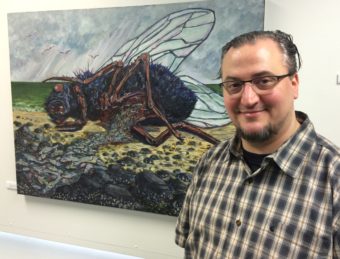
Among other aspects, “Cannery” explores impermanence in a rain forest, and alludes to a sense of home with the addition of the giant hermit crab. (Photo by Scott Burton/KTOO)

A collection of oil paintings are being shown at the Juneau Arts and Culture Center. The exhibit is the result of two years of work by multimedia artist Jacob Higgins.

When Jacob Higgins’ show opened in early January, he aired it with music by Mozart.

“I want an art experience — a painting exhibit to feel relaxing, even if the painting themselves, the images, are not relaxed,” he said. “The person needs to be so they can take in what they are looking at.”

But for my tour, he recommends a song from the soundtrack of the movie “Birdman” called “The Anxious Battle for Sanity.” It opens with rolling jazz percussion, punctuated with crashing cymbals and abrupt silences.

An angry white clown smokes a cigarette on a patio with some bohemian Europeans in all black, an ox carcass hangs in a shed, wood pilings weather on a beach, a naked woman reclines on a bear — these are some of the 29 oil paintings in the gallery.

“As I’m creating an exhibit I want there to be a sense of–you move through chapters and you’re involved in a greater idea by the virtue of a collection of things put together,” he said.

His painting “Red Pears and Pork Hearts” is a good place to start.

Jacob Higgins with "Red Pears and Pork Hearts"
Jacob Higgins with “Red Pears and Pork Hearts.” (Photo by Scott Burton/KTOO)

“If you look at a still life of a basket, of a bowl of fruit, those things are actually on people’s tables. Pears and raw pork hearts leaning together — you don’t see that. And that’s where this elevates to an idea of a bit of the bounty and abundance, but also a bit of a tension, an attraction-aversion. And that piece, why I chose it for the show poster, was I feel like it really sums up the concept of the show overall,” said Higgins.

This is Higgins’ seventh solo show, and while he is a multimedia artist, all 29 paintings are in oil. Beyond bounty and abundance, Higgins’ work evokes something more visceral.

“One of the reasons people may find it grotesque to see flesh, meat, blood, those sorts of things, is because we all have an inherent sense of our vulnerability as humans. We are meat. The ideas of how we harvest meat, to eat it, the way the we maybe callously hang it from hooks in a butcher shop, and then we so delicately cook it at a restaurant, that’s a very interesting thing when you consider the fact that we also anthropomorphize something like a hanging meat or a cow head—we see ourselves a bit even in an animal that has died,” said Higgins.

The exhibit is a result of an academic study where Higgins explored different styles like still life, landscape, narrative painting — and it shows as you move around the gallery. Next to “Red Pears and Pork Hearts” is a landscape of Southeast, seemingly without any symbolic images.

“Fly” is a 3-by-4-foot piece with a beach scene of a building-size fly on it. Spawning salmon spew out of its gut.

Jacob Higgins with "Fly"
Jacob Higgins with “Fly.” (Photo by Scott Burton/KTOO)

Down the wall is a piece called “Three Hands” that explores human volatility. Among other interpretations, the hands, which are gloved with hospital scrub-like sleeves, allude to surgery–when we are most vulnerable. While they are trying to help, they may hurt, like the sting of a yellow jacket.

Jacob Higgins with "Three Hands"
Higgins says “Three Hands” is one of his favorite conceptual pieces. (Photo by Scott Burton/KTOO)

Higgins is taking chances with his work.

“You cannot create something new without having it sort of rub people the wrong way — some people. And you have to, just sort of be OK with that, you have to be at peace with the fact that you’re not gonna please everybody, and if you do, if you try to please everybody, you’re going to be greatly disappointed because it just does not work that way,” said Higgins.

Whether people like his work or not, Higgins is proud of it.

“As far as I am concerned, my artwork does not look like any other artwork I’ve seen. It has elements of other artwork. It has elements of Southeast Alaskan painting, it has elements of art history, some of my work even has elements of pop culture, but I feel that it’s truly my own voice,” said Higgins.

It would be impossible to sum up all of Higgins work in a short radio piece. Check out his work yourself. It will be up through the weekend in the JACC gallery.

Juneau artist completes yearlong portrait series focused on everyday locals

MK MacNaughton and Sherman Johnson in his shop. Photo by Scott Burton/KTOO)
MK MacNaughton and Sherman Johnson in his shop. (Photo by Scott Burton/KTOO)

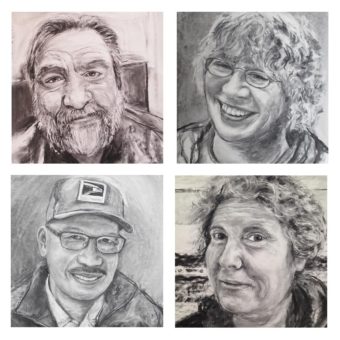
As 2015 came to a close, Juneau artist MK MacNaughton finished a yearlong art project that portrays 52 of her fellow community members — a portrait for each week of the year.

MacNaughton picked her subjects not for how they look, but for what they do, where they do it, and how hard they work at it. On 18- by 18-inch archival acid-free paper, she used charcoal to drawn portraits of a seldom recognized group of people.

A construction site in the middle of winter, in a city, in a rainforest, in Alaska, is a unique place to find inspiration for an art project.

“There were some guys working on the district building and it was January I think,” MacNaughton says.

It may sound lackluster, but she saw potential.

“It was like sideways rain, horrible snow, slush, windy, and they were there everyday. I drove by in my cozy little car, and went to my cozy little studio and I thought I should draw these guys.”

The possibilities multiplied from there. An electrician, a fisherman, a midwife, a hospital custodian, a landscaper, detox support staff, a postal carrier, a counselor, a welder — MacNaughton says her subjects work in professions that often go unrecognized all over Juneau and have “exceptional tenacity, or work ethic, or work hard jobs in the elements.”

She then conceived the portrait-a-week idea, which includes an interview and photograph of each person she draws. She started the project in the first week of 2015 and days later hung her first portrait at the Juneau Arts and Culture Center.

“I was kind of flattered really,” says Sherman Johnson. He’s portrait 33. Johnson was recommended to MacNaughton by Beth Weldon, a fire fighter who is the subject in portrait 17. Johnson has been welding, fitting and fabricating since he was a teenager. He says the work he does is hard to see because it make’s things look normal.

“Ideally, you shouldn’t tell I was there. It should look like it just came out, you know that things were just supposed to be like that,” Johnson says. “But I’m proud of my work and I’m proud of what I do. I try and do a nice job on things. You know, the quality of what I do is the driving thing for me.”

Among other jobs, AEL&P has hired Johnson to weld in the tunnels of Snettisham and to install a new valve on the Salmon Creek Dam. He’s repaired and modified countless fishing boats and is helping with the new State Library, Archives and Museum. He says a lot of work in the trades is like his — essential but invisible.

“I think that’s how a lot of these working people that MK found — that’s how they are. They get down and go do their stuff, and if it means putting on your rain gear, it mean’s putting on your rain gear. You realize there’s so much more of the world and so many people doing so many little things that your just don’t notice,” Johnson says.

Welder, Fitter and Fabricator 33 of 52
Johnson says his portrait captures what he really looks like.

MacNaughton asked her subjects questions about their work, challenges in their lives and dreams for the future. Then she took a picture. She says knowing the person informed her drawings.

“This was a picture of where … I am most comfortable,” Johnson says. “It made me smile — still makes me smile. Makes me laugh everyday.”

MacNaughton says there’s usually a gift at the end of her projects, or the answer to something personal she’s trying to figure out. In this case, she decided the time was right to transition from working at a nonprofit to teaching and exhibiting fulltime.

“I think this project has been kind of a way to give myself the courage to keep doing what I love doing,” she says.

MacNaughton gave each portrait to her subjects for free. She says the portraits took about seven hours to create — which means the project altogether took about 364 hours. She didn’t have a grant, or make any money.

At least the next time she needs a welder, or an electrician, or a landscaper, she’ll know who to call. She may even get a good deal.

Site notifications
Update notification options
Subscribe to notifications