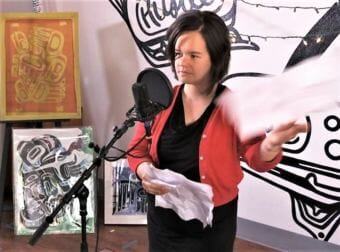
Juneau Chilkat weaver, performing artist and fashion designer Lily Hope performs “One Square Inch in Chilkat Weaving” as part of the Red Carpet Celebration Sessions, a video series featuring Alaska Native artists filmed during Celebration 2018 in Juneau.
“I more often have it imposed on me as a Native writer of what I should be writing,” said Vera Starbard to a ballroom of 70 people at a recent social justice summit in Juneau. Starbard is an Anchorage-based playwright and writer who is Tlingit and Dena’ina.
“And it either needs to completely conform to a dominant society norm, or it needs to be completely what they consider cultural acceptable traditional,” continued Starbard.
The summit, Social Justice Doers: Partners for the Next 10,000 Years, was hosted by the First Alaskans Institute and gathered diverse community members who worked to make Alaska a more equitable and just place. Among the discussions was social justice and the arts that brought together four prolific indigenous artists.
Indigenous artists discuss social justice and the arts at a Social Justice Summit in Juneau hosted by the First Alaskans Institute on Tuesday. From left to right: host Ayyu Qassataq, and artists Steve Qacung Blanchett, Vera Starbard, Irene Goodiarook Bedard, and Nicholas Yéil Ya-Tseen Galanin. (Photo by Scott Burton/KTOO)
“There is a huge section I feel was just completely lost, because in the end, I got told over and over and over again by non-Native audiences that this didn’t make sense, or it wasn’t quite that way. And I look at it now, and I’m like, I lost the most pure part of my heritage in that,” said Starbard.
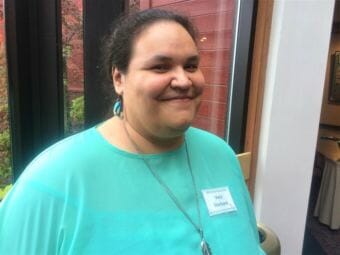
Vera Starbard at Centennial Hall in Juneau during the 2018 Social Justice Summit hosted by First Alaskans Institute. (Photo by Scott Burton/KTOO)
She said the institutions of art, and the decision makers are generally white, upper class, often male. These are what she refers to as gatekeepers.
“So, we as artists of color, often female, have to navigate that and have to sort of go, well I know you don’t understand my perspective at all, but trust me, it’s a story that will relate to an awful lot of people,” said Starbard.
Starbard’s next story is a play called “Devilfish” set to stage in the fall of 2019. She says what happened to her previous play will not happen again.
“It’s different from ‘Our Voices’ in that I’m standing much more firmly in what I know is good storytelling practices told from a Tlingit perspective,” said Starbard.
“Devilfish” was inspired by a traditional clan story, set in a backdrop imagining the beginning of the Tlingit people.
“It needs to be grounded in Tlingit history, Tlingit culture, Tlingit arts, Tlingit sensibilities and Tlingit values,” said Starbard. “Much more than it needs to be a Western piece of art. A Western stage piece.”
For the gatekeepers reading, Starbard has this request.
“I would say just starting with helping us tell our own stories. … Share the power,” said Starbard. “This is a pretty strong social justice concept of power. Where does the power lie? Not with people of color. Not with women of color certainly. … Sharing the power is such a huge one and something that as people of color we can’t make you do. You just have to do it.”
Watch the one-hour discussion here:
Editor’s note: 360 North was under contract with First Alaskans Institute to produce video coverage of the summit.
U.S. Poet Laureate Tracy K. Smith is making a stop in Juneau on Wednesday. It’s part of a national tour that’s bringing her to rural communities in Alaska, South Dakota, Maine and Louisiana.
She’s excited to take poetry to parts of the country where literary festivals don’t always go.
Smith won a 2012 Pulitzer Prize for her collection of poetry called “Life on Mars.” Here she is reading from her poem “The Weather in Space.”
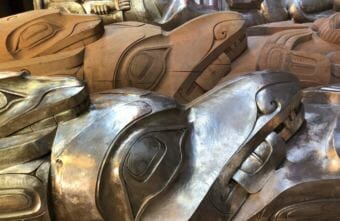
Three bronze house posts will be installed at the Walter Soboleff Building on Sunday. Each of the 8-foot posts were carved from cedar, then cast in bronze. They weigh close to 1,000 pounds each.
The original posts were carved in cedar, then cast in bronze. (Photo courtesy Sealaska Heritage Institute)
Traditionally, the posts would have been the main pillars that held up a clan house.
Sealaska Heritage Institute President Rosita Worl said, “It’s exciting to see these posts carved in a traditional way in wood and then cast in a contemporary material. These pieces demonstrate that our cultures and our art are alive, thriving and evolving through our younger generations.”
On A Juneau Afternoon, Sealaska Heritage Chief of Operations Lee Kadinger said these posts are part of a bigger plan.
SHI COO Lee Kadinger describes the posts on A Juneau Afternoon on Wednesday. (Photo by Scott Burton/KTOO)
“We see that there is a need for more northwest coast art in our community. If you go to a community like Sante Fe, where you see all types of indigenous art work in the whole community. Here, you see it in some small areas and so we see this as a contribution to continue to educate the community on Tlingit, Haida, Tsimshian cultures,” said Kadinger.
The posts will be erected on at 1:30 p.m. Sunday at the corner of Front and Seward streets in front of the Walter Soboleff Building. The raising is free and open to the public and will also be streamed on SHI’s Facebook page.
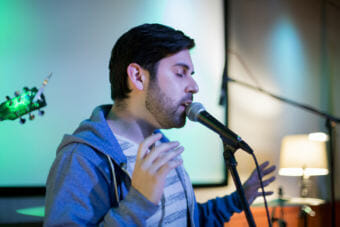
Lead vocalist Alejandro Chavarria of the band Revilla performs at the KXLL Showcase during the 2018 Alaska Folk Festival at the Hangar Ballroom. (Photo by Annie Bartholomew/KTOO)
Alex Nelson of Juneau performs with Amish Robots, now known as Revilla, at the KXLL Showcase during the 2018 Alaska Folk Festival at the Hangar Ballroom. (Photo by Annie Bartholomew/KTOO)
Drummer Clae Good plays drums for a Juneau set with the Amish Robots, now known as Revilla at the KXLL Showcase during the 2018 Alaska Folk Festival. (Photo by Annie Bartholomew/KTOO)
Guitarist and songwriter Patrick Troll headlines the 2018 KXLL Showcase with the Amish Robots during the Alaska Folk Festival. (Photo by Annie Bartholomew/KTOO)
Amish Robots is a band with Southeast Alaska roots.
After their breakout set at this year’s Alaska Folk Festival in Juneau, they headlined a KXLL Showcase concert filling the Hangar Ballroom to capacity.
Now the band’s got a new EP and name change inspired by its members’ hometown of Ketchikan.
Hear guitarist and songwriter Patrick Troll talk about the band’s formation and latest release as Revilla:
Seattle’s Amish Robots began as Ketchikan teenagers Patrick Troll and Alejandro Chavarria’s musical duo.
The pair played under the names Baby Shower and Really Cool Guys before settling on Amish Robots.
After moving to Seattle and welcoming Juneau musician Alex Nelson into the fold, Troll said the group outgrew the Amish Robots sound.
“I’m kind of the sensitive one about the name change because I was the one who came up with Amish Robots,” Troll said. “Of course, once we changed it, it came out of the woodwork that people didn’t like the name Amish Robots — or not that they didn’t like it, they just thought it was too much of a gimmick.”
Their new name “Revilla” is inspired by Revillagigedo Island where Ketchikan is located on the Alexander Archipelago.
Their four-track EP is an homage to the trio’s first Alaska Folk Festival performance together in 2007, when they performed together as The North Sea.
Though based in Seattle, Revilla hasn’t forgotten their Southeast Alaska roots, calling on visual artist Matt Hamilton to create the group’s album artwork.
Listen to the North Sea EP and hear Patrick Troll Friday nights on KXLL as DJALTERNATIVE on his electronic music program Burger Church.
This year’s Alaska Folk Festival backdrop was created by the Juneau-Douglas High School Art Club with more than 15 students contributing to the project.
Listen to JDHS students Riley Stadt, Kane Ginter and advisor Heather Ridgeway of the JDHS Art Club who made this year’s Folk Fest backdrop:
The students are auctioning off the fish and backdrop this weekend in the Centennial Hall lobby to raise money for their trip to Craig to compete in the Region V Art Fest.
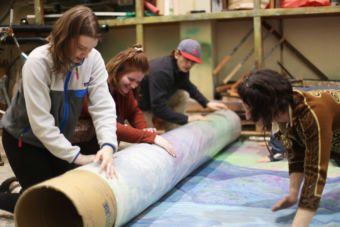
Erika Lee, Jocelyn Miles and Salissa Thole sing as the group “Brown Sugar” at the 44th Annual Alaska Folk Festival in front of the backdrop created by the JDHS Art Club. (Photo by Annie Bartholomew/KTOO)JDHS Art Club members Riley Stadt, Janessa Goodman, and Kane Ginter roll up the 2018 Alaska Folk Festival backdrop with adviser Heather Ridgway. (Photo by Annie Bartholomew/KTOO)JDHS Art Club advisor Heather Ridgway with the display model created by the JDHS Art Club who created the 2018 Alaska Folk Festival backdrop. (Photo by Annie Bartholomew/KTOO)Juneau-Douglas High School Art Club co-President Riley Stadt and Secretary Theo Houck auction off fish sculptures to raise money for the club’s trip to Region V Art Fest. (Photo by Annie Bartholomew/KTOO)
Close
Update notification options
Subscribe to notifications
Subscribe
Get notifications about news related to the topics you care about. You can unsubscribe anytime.