KRNN

Folk Fest headliners harmonize on stage and off

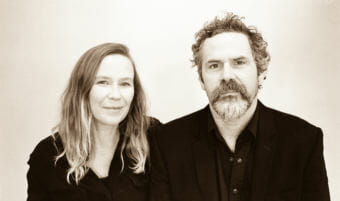
The Alaska Folk Festival’s Guest Artists, Pharis and Jason Romero, arrive in Juneau today. They’re from Horsefly — a rural town in British Columbia, and split their time between parenting, making custom banjos and playing music. Sometimes with two guitars, often with a banjo, they’re known for their tight harmony singing.

Listen to this introduction that features their voices and music:

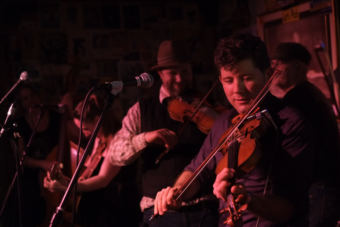
The Romeros will be joined by fiddle player Josh Rabie and will premiere 8:30 p.m. tonight on the main stage at Centennial Hall. They’ll also teach workshops on singing and banjo playing, and play a dance at 9:20 p.m. Saturday at the Juneau Arts and Culture Center.

Music: Hope Griffin live on ‘A Juneau Afternoon’

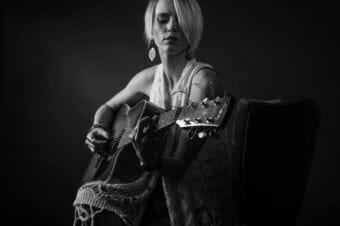
Jamie Leigh Bennett and Hope Griffin play live on ‘A Juneau Afternoon’ on Monday. (Photo by Micah MacKenzie, courtesy of Hope Griffin)

Acoustic folk and Americana musician Hope Griffin and cellist Jamie Leigh Bennett played live on ‘A Juneau Afternoon’ today.

Griffin has roots in Alaska and now lives in Asheville, North Carolina.

Listen to the interview:

Listen to “Hanging in the Balance”:

Listen to “Curious”:

Hope and Bennett play 9:45 Tuesday night as part of the 44th annual Alaska Folk Festival in Centennial Hall.

Admission to the festival is free, but if you can’t make it to the hall you can watch it here.

2018 Folk Fest Nightlife Guide

It’s not hard to find something to do during the Alaska Folk Festival. Once again, your friends at KTOO tried to make it easy and list the downtown evening venue schedules all in one place. As these things go, we’ll be updating the schedule daily with changes, new events and start times as we learn more.

Cameron Brockett and Taylor Vidic of The Quaintrelles perform their song "Rolling Stone" live at the Alaskan Hotel during the 2017 Alaska Folk Folk Festival. (Photo by Annie Bartholomew/KTOO)
Taylor Vidic is hosting the “Hump Day Listening Room” at the Gold Town Nickelodeon Wednesday night of Folk Fest. Cameron Brockett and Taylor Vidic of The Quaintrelles perform their song “Rolling Stone” live at the Alaskan Hotel during the 2017 Alaska Folk Folk Festival. (Photo by Annie Bartholomew/KTOO)


Wednesday

The Bowties perform Thursday night at the Red Dog Saloon at 9:30. Billy Moore and Yoseff Tucker of The Bowties perform a Red Carpet Concert at the Alaskan Hotel during the 2016 Alaska Folk Festival. (Photo by Annie Bartholomew/KTOO)
The Bowties perform Thursday night at the Red Dog Saloon at 9:30. Billy Moore and Yoseff Tucker perform a Red Carpet Concert at the Alaskan Hotel during the 2016 Alaska Folk Festival. (Photo by Annie Bartholomew/KTOO)

Thursday


The North Country Cajun Club play the Alaskan Hotel Friday night during the Alaska Folk Festival. (Photo by Annie Bartholomew/KTOO)

Friday


Gamble and the High Costa Livin' plays the Red Dog Saloon on Saturday night of the Alaska Folk Festival. (Photo by Annie Bartholomew/KTOO)
Gamble and the High Costa Livin’ plays the Red Dog Saloon on Saturday night of the Alaska Folk Festival. (Photo by Annie Bartholomew/KTOO)

Saturday

  • Alaskan Hotel and Bar – The God Particles at 10:00 p.m.
  • The Viking – Alex K and The Unmentionables at 10:00 p.m.
  • Red Dog Saloon – Gamble and the high Costa livin’ at 9:30 p.m.
  • Rendezvous – Raisin’ Holy Hell at 10:00 p.m.
  • Rockwell – Square Dance
A picture of Jason Overby as he performs with the Overby Family Band at the Rendezvous at the 40th Folk Fest in 2014. (Photo by Annie Bartholomew/KTOO)
Jason Overby performs with the Overby Family Band at the Rendezvous at the 40th Folk Fest in 2014. (Photo by Annie Bartholomew/KTOO)

Sunday

Back in Juneau after moving to Wisconsin, guitarist Dara Rilatos performs at the Rendezvous Wednesday night and hosts Bad Babes and Bandanas at Rockwell Friday night. (Photo by Annie Bartholomew/KTOO)

Alaskan Hotel & Bar

The Gold Town

Hangar Ballroom

  • Friday – The KXLL Showcase featuring: Amish Robots EP Release, Indian Agent, Avery Stewart, Christy NaMee Eriksen, QUEENS, Taylor Vidic & Cody Russell at 8:00 p.m.

The Viking

  • Friday – Hope Griffin Duo at 10:00 p.m.
  • Saturday – Alex K and The Unmentionables at 10:00 p.m.


Red Dog Saloon

The Rendezvous

Rockwell


Theater featuring Juneau’s real histories plays this weekend only

After years of preparation, and months of interviews and rehearsals, “Aan Yátx’u Sáani: Noble People of the Land,” opens tonight at the Juneau Arts and Culture Center.

The multimedia theatrical presentation features five people with histories in the Juneau’s Indian Village and Willoughby District.

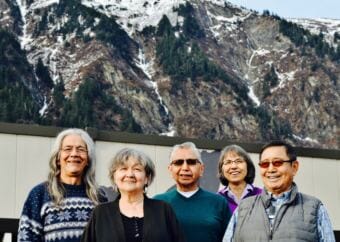
“Aan Yátx’u Sáani: Noble People of the Land” opens tonight at the Juneau Arts and Culture Center. The cast is Walter A. Soboleff Jr., left, Ernestine Saankalaxt’ Hayes, Khinkaduneek Paul Marks, Lillian Petershoare and Marcelo Quinto. (Photo courtesy Ryan Conarro)

Lillian Petershoare is one of them.

“Instead of having five individuals, individually come and tell their story exclusively by themselves, it’s like a Chilkat blanket, where each person’s story is woven in with the other individual stories,” Petershoare said. “The other individuals actually support you and help you in the delivery or your lines. It’s really kind of a collective experience and that makes it very dynamic.”

The other storytellers are Ernestine Saankalaxt’ Hayes, Khinkaduneek Paul Marks, Marcelo Quinto, Walter A. Soboleff Jr. They’re all Tlingit.

The project is a collaboration between the New York-based Ping Chong and Company, and the Juneau Arts and Humanities Council. The council wants to hear the voices of the first residents of its neighborhood.

“There’s a lot about growing up in the village. There’s experiences from elementary school,” Petershoare said. “There’s experiences at Juneau-Douglas High School at the time that ANCSA (Alaska Native Claims Settlement Act) passed. There’s reference to my college years. There’s reference to coming home, readjusting to being back in Juneau again. There’s references to my employment with the U.S. Forest Service.”

The production team, which includes theater artist Ryan Conarro and Tlingit theater artist Frank Henry Kaash Katasse, interviewed more than 20 people before choosing the five storytellers.

Then, they creatively scripted the stories.

The writers added elements like repetition and echoes.

Project co-writer and co-director Ryan Conarro at his art opening “This Hour Forward” at the JACC in 2013. (Photo by Scott Burton/KTOO)

Visual artist Abel Ryan drew formline designs on a screen hanging behind the storytellers. Greg Mitchell, on projections and lighting design, fills the screen with historical photos, animations and videos.

Katasse said the participants went through historical traumas and serious struggles, but everyone is positive and hopeful.

Humor plays a big part, too.

“This is a super important part about Native theater that I’ve noticed as well,” Katasse said. “We have to make sure the audience knows they have permission to laugh, and we establish that right off the bat throughout this show. Because it not just the writing, everyone in this show is really funny.”

Petershoare noticed another theme.

“People had happy childhoods,” she said. “I think that is something that is delightful for the community to know.”

“That was emphasized with every single person we interviewed,” Katasse said. “They were like this stuff happened. It was Jim Crow era of Juneau and this and that. But it was fun. Like we went sledding, and we did this, and we played in puddles, and we built rafts. And you’re like, this is the important part that we’d really like to emphasize.”

The show opens at 7:30 p.m. tonight at the Juneau Arts and Culture Center, and plays through Saturday night. Tickets can be purchased through JAHC.

It’s this weekend only, but if you miss it, it will be on 360 North television and 360North.org.

The JAHC will host a community conversation Monday, April 2, in response to the stories and ideas raised in the show.

Editor’s note: KTOO Public Media is a promotional partner of this production.

Frank Henry Kaash Katasse and Lillian Petershoare on “A Juneau Afternoon” on March 27, 2018. (Photo by Scott Burton/KTOO).

Interview: Paula Poundstone talks beaver dens, improv and using her audience

(Photo courtesy of Paula Poundstone)

Comedian Paula Poundstone will perform Thursday night in Juneau, her second trip to the capital city. Her last visit was in 2012.

I gave her a call and we talked about beaver dens, “Wait Wait … Don’t Tell Me!” and more.


Below are excerpts from our conversation. You can listen to the entire 15 minute interview at the bottom.

On one of her trips to Alaska, she had a hiccup on the way to her show. She also talks glaciers, beaver dens and software developers (2:32):

Poundstone postulates on why she and “Wait Wait … Don’t Tell Me!” are such a good match (2:40):

I ask how her interactive and improvisational style developed since she started doing comedy in 1979 (2:57):

Poundstone illuminates how she never does the same show twice and how little biographies emerge from the crowd (2:28):

Advice for aspiring comedians (1:00):

Listen to the full interview here (14:48):

Doors open 5 p.m. Thursday at Centennial Hall for the 7 p.m. show. Salt will provide a no host bar.

Poundstone will use a handmade stool by Dean Graber of Rainforest Custom that will be auctioned just before the performance.

Tickets for the event are still available here.

Juneau shamanism retreat leader’s financial, cultural and spiritual legitimacy challenged

A shamanic retreat in Juneau led by a Californian has caught Sealaska Heritage Institute’s attention.

SHI learned about the Dance of the Deer Foundation’s retreat and asked them not to come to Juneau.

Despite Sealaska Heritage’s objections, the company’s owner, Brant Secunda, continues to advertise for the June retreat.

Part of the advertising includes a video on his website titled “Alaska: A Living Dream.”

In the video, Secunda, wearing his signature dark felted cowbow hat, leads his clients through Juneau: They’re sitting on a beach with the Chilkat mountains in the distance, hiking on fern-edged trails and visiting Nugget Falls at the Mendenhall Glacier.

In another video on his website titled “Shamanic Journeying,” under the Shamanism TV tab, Secunda explains part of his belief.

“By going on a shamanic journey, into the nierika, you find your life and you find your connection to a hidden universe, or what we might say, the sky world. Or we might say, you feel a connection to Mother Earth, and all that lives on Mother Earth.”

While he is originally from New Jersey, Secunda journeyed to Mexico, Carlos Castaneda-like, when he was 18 and met a man named Don José Matsuwa. Secunda said a 12-year apprenticeship followed.

“My apprenticeship involved working with him, living with him, laughing with him, but it also involved going on many many pilgrimages,” Secunda said in another video titled “Shamanic Apprenticeship.”

According to advertisements, the nine-day retreat will be the 24th annual one in Alaska, but it just hit Sealaska Heritage Institute’s radar a few weeks ago.

Since then, SHI President Rosita Ḵaaháni Worl sent Dance of the Deer two letters: one asking them not to come here, and another to end their commercial exploitation of shamanism.

“We are not averse to people wanting to seek religious enlightenment or teachings — we absolutely support that. But we do not believe in the exploitation of our spiritual beliefs and our practices,” said Worl, who is incredulous that she had not heard about him from his past visits to Juneau.

Sealaska Heritage Institute President Rosita Ḵaaháni Worl says Dance of the Deer Foundation is exploiting indigenous people’s spiritual beliefs and practices. (Photo by Scott Burton/KTOO)

In addition to animism — the belief that all objects, places and creatures have spirits — shamanism is also part of Tlingit culture.

“In our culture our shamans go on a spiritual quest, they acquire spirits, those spirits then help the shaman protect the welfare of their clan,” Worl said. “And each clan has their own shaman.”

Charging for shamanistic practices is where Worl said the exploitation comes in.

Dance of the Deer is charging up to $3,865 for the retreat, depending on lodging and an optional whale watching trip.

In a recent letter responding to SHI, signed by Dance of the Deer’s management team, they cite Juneau’s cost of living as an explanation for the high costs, and add that they’ve made very little profit on this program, and some years it loses money.

Their website says proceeds from all their activities go to Secunda’s mentor’s people — the Huichols.

Dance of the Deer Foundation would not provide documentation to verify these claims or make Secunda — or anyone with the organization — available for interview.

We couldn’t find public tax documents showing that Dance of the Deer Foundation is a foundation, in the sense of an IRS-recognized tax-exempt charity.

A filing with the Santa Cruz County Clerk identifies “Dance of the Deer Foundation” as a business alias for Secunda, meaning he is the sole owner.

Cilau Valadez is a Wixárika yarn painter. He identifies as Wixárika, the indigenous name for his people rather than the colonial name, Huichol. He says Wixárika people should be representing their culture, not a non-indigenous person like Secunda who dresses up like them. (Photo courtesy International Folk Alliance)

“We don’t need someone like him to speak on behalf of ourselves. We have a voice. We’re a people. We can speak for ourselves,” said Cilau Valadez, a Wixárika yarn painter from the region in Mexico where Secunda said he learned about shamanism. He uses the indigenous name of his people, Wixárika, rather than the colonial name, Huichol.

“I know a lot of the people might have the right intentions to go to these ceremonies. We need people that are conscious about these knowledge, and we need people to learn this knowledge,” said Valadez from his art studio in Sayulita, Mexico. “But I think it has to be on a proper way where the people, which is us, that are direct descendants of this tradition, should have a voice, and not just someone who is dressed up like us, trying to represent us.”

In addition to a non-indigenous person appropriating his culture, he agrees with Rosita Worl about profit.

“When you combine money in between healing, it might pollute the whole situation,” Valadez said. “Because you can never sell ceremonies.”

In other parts of Secunda’s promotional video for Juneau, we see aerial views of mountains, humpback whale flukes diving, eagles flying, the moon behind the Chilkats, lupine, skunk cabbage, a candle burning on a mossy mound near a stream, and Secunda and his clients in a skiff leaving Adlersheim Lodge at 33 mile, the retreat’s home base.

Worl does not like the idea of Secunda profiting from shamanism, but she is concerned about the lodge losing business.

“If there is that economic impact, what can we do to alleviate that,” Worl said. “We don’t want to hurt our own people here, and this is our town, and Juneau is our community, and we want to protect our community.”

But if Secunda does come?

“I suspect there will be people who will want to picket, or whatever you want to call that, demonstrate outside of that place,” Worl said. “I don’t think that I would do that. I can’t anymore, I’ve got a bum knee.”

In the meantime, SHI is working on a plan to bring Valadez up to Juneau to teach about his Wixárika culture.

In addition to locations in the Bahamas, Patagonia, New Zealand, Greece and Italy, Secunda continues to advertise his June retreat in Juneau, and has not responded to SHI’s latest letter.

Site notifications
Update notification options
Subscribe to notifications