
Andy Miller describes himself as a reclusive Juneau songwriter and poet. We got Miller, Nanooks hoodie and all, out of the house recently to play a Red Carpet Concert here at KTOO.
The musician’s songs focus on what he calls heart-felt reflections on modern life in Juneau, and often blur lines between earnest observation and satire. Song titles on his most recent album include “Five Exes in Douglas,” “After the Legislature Leaves” and “Mike Chenault and the Triangle Bar.”
Here is Miller singing “Justin Parish’s Beard.”
Andy Miller introduced himself to KTOO by way of a hand-written newsrelease. (Photo by Scott Burton/KTOO)
Christy NaMee Eriksen‘s new video for her poem “How To Say Goodbye” follows a pair of friends over a lifetime. The film is dedicated to Amy Henderson, her friend who passed away from cancer earlier this year. The video arrives on Henderson’s birthday. She would have been 33 today.
Recorded in the days following Henderson’s death, Eriksen partnered with guitarist Avery Stewart to create the soundtrack. Stewart’s warm electric guitar accompanies Eriksen’s drawn out farewell. Both artists experienced loss in 2017.
“In my family, when we say goodbye on an ordinary day it’s a very long process, almost comically long sometimes,” Eriksen wrote in an email. “After my friend died I felt so angry and sad at having not gotten to experience that final long goodbye with her.”
Her poem is a reminder that saying goodbye is just the ritual to honor and give thanks for friendship, “All the reverence, all the gratitude, everything that happens before the goodbye should matter more than the goodbye itself.”
The film is the third in a series created with videographer Ryan Cortes with support from a Rasmuson Foundation artist award.
Portugal. The Man. From left: John Gourley, Jason Sechrist, Zach Carothers, Kyle O’Quinn and Eric Howk (Photo courtesy Atlantic Records)
Portugal. The Man started out as a modest indie band with deep roots in Alaska and has since ascended to national, even international, popularity.
The Portland-based group’s music has long been described as “alternative rock,” but their song “Feel It Still” recently earned the band its first Grammy Award nomination — in the pop category.
The single is off their newest album, “Woodstock,” and it has spent weeks at the top of music charts, peaking at number 4 on the Billboard Hot 100.
Reached by phone while he was walking around Atlanta before a show, co-founder and bass player Zach Carothers said the attention has been surreal.
“We absolutely don’t belong in that world, which is funny,” Carothers said. “I don’t have a tan. I’m 36 years old, and I’m from Wasilla, Alaska. And we’re playing next to Selena Gomez and stuff like that. It’s wild.”
The band also includes vocalist and guitar player John Gourley and guitarist Eric Howk, who are joined by Kyle O’Quinn on keyboards and Jason Sechrist on drums.
Like Carothers, Gourley and Howk are originally from Alaska.
The experience has been fun, overall, Carothers said.
It’s given the band a chance to see the world, and he said their lives are a little easier than the days when they toured in a van and ate out of a rice cooker in random parking lots.
Still, it’s a lot of work.
“Since ‘Feel It Still’ has gotten massive, our day-to-day life hasn’t really changed,” Carothers said. “We still just go out on tour, we’re just still on a bus and on an airplane, and we go and do a show, it’s just those shows are getting bigger. But it’s hard to see what’s really happening when you’re kind of in the eye of the hurricane.”
Gourley has said the band’s work ethic comes from growing up in Alaska and seeing how hard work is necessary for survival.
Carothers said the environment in the North contributes as well.
“Growing up and how you grow up is at least half of what you’re made of,” Carothers said. “Half of it is how you were brought up. And then the other half is what you see along the way as your adult life. I feel like Alaskans really know themselves.”
Carothers knows it’ll be a completely different scene when the band walks the red carpet at the Grammys in January.
They’ve been to some awards shows already, and he describes them with one word: “bright.”
The Grammys are a whole different level of attention, though, Carothers said.
“It’s a really weird world and it’s something just very strange to see, especially coming from Alaska,” he said. “It’s just things that you saw on movies or on TV and you never expect to be there. But it’s really fun.”
Carothers said the Alaskan members of Portugal. The Man will take a break from touring to head north for Christmas.
They’ll be in New York on Jan. 28 for the 60th annual Grammy Awards at Madison Square Garden.
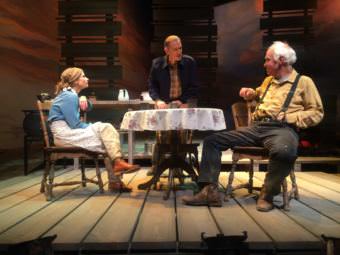
John Barrymore’s, portrayed by Peter DeLaurier, theatrics are as interesting to Muz, actress Shelley Virginia, and Joe Ibach, actor Mike Peterson, as their simplicity is to him.
A new play titled “Dreaming Glacier Bay” opens tonight at Perseverance Theatre. Based on true events, the play is set on Lemesurier Island near the entrance to Glacier Bay, and involves Hollywood movie star John Barrymore. But what brought Barrymore to our waters?
Check out the above video of John Barrymore playing Larry Renault in the 1933 “Dinner at Eight.”
I asked local film buff Collette Costa if Barrymore was a big deal. She said that in today’s world, Barrymore might be like a Ralph Fiennes or Daniel Day-Lewis stylistically, or a Tom Hanks popularity-wise.
“Dreaming Glacier Bay” playwright Joel Bennett hangs out during a sneak preview of his show Wednesday, October 25, 2017, at Perseverance Theatre in Juneau, Alaska. (Photo by Rashah McChesney/Alaska’s Energy Desk)
Just before making “Dinner at Eight” in ‘33, Barrymore motored his yacht — three or four times — from southern California to southeast Alaska to visit Joe and Muz Ibach.
Juneau photographer, filmmaker and playwright Joel Bennett was introduced to the history in the 1970s.
“I was always perplexed by why no one really had done anything with this material. Not even a book,” Bennett said.
Since his first introduction to the mysterious story, Bennett spent time at the Ibach couple’s house, which still stands on the island.
He’s examined photographs, letters and any other evidence he could find to explain Barrymore’s strong interest in either Alaska, or the couple — Joe, or Muz — a woman with a mysterious background as a show business dancer back east.
Joe Ibach, played by actor Mike Peterson, Muz, actress Shelley Virginia) and John Barrymore, actor Peter DeLaurier, share a drink during rehearsal for "Dreaming Glacier Bay" on Wednesday, October 25, 2017 at Perseverance Theatre in Juneau, Alaska. (Photo by Rashah McChesney/Alaska's Energy Desk)
Joe Ibach, portrayed by Mike Peterson, worked as a hunting guide, fox farmer and prospector. He sits in his cabin during rehearsal for "Dreaming Glacier Bay" on Wednesday, October 25, 2017, at Perseverance Theatre in Juneau, Alaska. (Photo by Rashah McChesney/Alaska's Energy Desk)
Cate Ross, Shelley Virginia and Michael Evan Harvey prepare for a rehearsal of "Dreaming Glacier Bay" on Wednesday, October 25, 2017, at Perseverance Theatre in Juneau, Alaska. (Photo by Rashah McChesney/Alaska's Energy Desk)
Dolores Barrymore, portrayed by actress Cate Ross, and John Barrymore, portrayed by Peter DeLaurier, get notes from Michael Evan Harvey, director of "Dreaming Glacier Bay" on Wednesday, October 25, 2017, at Perseverance Theatre in Juneau, Alaska. (Photo by Rashah McChesney/Alaska's Energy Desk)
“I’m pretty proud of the fact that the dialogue I think is a true representation of how they would have spoken and what they would have talked about,” Bennett said.
Thanks to their film work, Bennett says the Barrymores were easy. But re-creating the Ibachs was harder — thankfully he had some experience.
“I actually spent a lot of time with an old Alaska couple here that lived on Admiralty Island — Stan and Ester Price who made Pack Creek famous,” Bennett said. “I knew how they talked. I knew kind of how they lived…you know self-sufficiency, and living simply, appreciating the wilderness, attraction to beauty, a relation to wildlife and birdlife—all the things the Ibachs held dear.”
What really brought Barrymore back to Alaska every year? (Photo by Scott Burton/KTOO)
On the surface, that lifestyle attracted Barrymore — a celebrity entrenched in the 1920s and ‘30s Hollywood scene.
“Because he came from a world of illusion and a world of not knowing who your friends were — driven by money and greed,” Bennett said. “He loved regular people.”
And the most fulfilling part of the process for playwright Bennett?
“For people here, it’s a local story. And to be able to share it with the community is really satisfying to me,” Bennett said. “It means a life and those people won’t be forgotten.”
But were two people living off the grid who had a seemingly loving relationship that interesting? Or was there something else that brought Barrymore up year after year?
You’ll have to watch the play to find out.
Actor John Barrymore, played by Peter DeLaurier, impresses the Ibachs with a scene from “Hamlet,” in “Dreaming Glacier Bay,” on Wednesday, October 25, 2017, at Perseverance Theatre in Juneau, Alaska. (Photo by Rashah McChesney/Alaska’s Energy Desk)
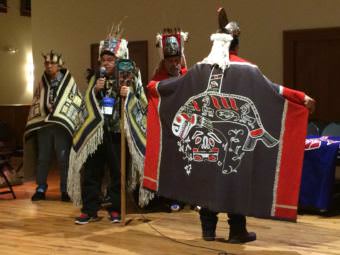
Sharing Our Knowledge: A Conference of Tlingit Tribes and Clans took place in Sitka over the weekend. The biennial conference began in 1993 as a way to document customs and traditions and includes lectures, ceremonies, and hands-on art and technology demonstrations.
This year’s gathering, at the historic Sheldon Jackson College campus, was scheduled to coincide with Alaska Day celebrations.
On the the front lawn, participants hurled spears at an elk target using Alaska Native spearthrowing boards.
Inside, master weavers and aspiring artists’ fingers spidered across Chilkat and Raven’s Tail-style works.
“I’m weaving again!” said Liana Wallace who was among the weavers gathering sitting in a large, windowed foyer. Abundant natural light illuminated a welcoming smile and her work.
Liana Wallace works at the weavers gathering. (Photo by Scott Burton/KTOO)
“I’m from Juneau. I’m Aak’w Kwáan from the Big Dipper house,” said Wallace who admitted she hadn’t woven in some time.
“I’ve been inspired by my sisters who are all weaving in honor of our teacher,” she said referring to the late master weaver and multi-disciplinary artist Clarissa Rizal.
“And so I am working with Lily, her daughter, and I’m working with Irene, her sister. And yes, it makes it more powerful to begin again,” said Wallace.
Elsewhere on campus, scholars and experts presented with titles like “Tlingit-Russian Interpreters Before and After 1867,” “Misconceptions about Alaska Natives,” and “The Seward Pole: Indigenous Claims in Alaska’s Sesquicentennial.”
Jixeik, or Gerry Hope, is the conference’s Executive Director. He’s Sik’nax.ádi from Wrangell. He said that he and the organizing committee decided to schedule this year’s symposium now, just before Alaska Day. For Hope, it’s been a long time coming.
“As a child growing up here, born and raised, who doesn’t like a parade? … Parades encourage fun and happiness and that’s hard to resist. As I got older into my young adulthood is when I started hearing some of the frustrations, some of the anger, and some of the resentment,” said Hope.
“I have had for quite some time negative feelings about the holiday,” said Kaasáank’ Andrew C. Williams, who was among the conference presenters.
“It’s associated to the defeat of our people in this area. It’s associated to an idea that it’s OK to take control of somebody else’s stuff as long as you have the latest technology to stomp them down and control of the history of those people,” said Williams.
Executive Director Jixeik Gerry Hope has ideas for how healing for Williams’ negative feelings might begin.
“If I were to see a vision, it would be a number of things. One is acknowledgements from the dominant society that wrongs were committed against the first people. Another outcome that I’d like to see is a healthy dialogue in how we proceed from that. It doesn’t have to be demands. It doesn’t have to be any necessarily big news events that are conflict based. … As long as it is constructive and safe, and health-based,” said Hope.
That fits with the this year’s conference theme, “Our History, We Are Healing Ourselves.”
Alex Kotlarsz performed for us in the KTOO arts room Thursday as part of our Red Carpet Concert series. Listeners may know Kotlarsz from The Wool Pullers, his solo performances, or as Alex K. and the Unmentionables.
You can catch Alex K. and the Unmentionables live at 10 p.m. Friday at McGivney’s in the valley. Stay tuned for more Red Carpet Concerts as we celebrate New Member Month here at KTOO. Next week we feature Laura Zahasky, Josh Lockhart, Jason Cornish, Sarah Jane Klinger and Jeff Bowman.
Close
Update notification options
Subscribe to notifications
Subscribe
Get notifications about news related to the topics you care about. You can unsubscribe anytime.