KXLL

Juneau shamanism retreat leader’s financial, cultural and spiritual legitimacy challenged

A shamanic retreat in Juneau led by a Californian has caught Sealaska Heritage Institute’s attention.

SHI learned about the Dance of the Deer Foundation’s retreat and asked them not to come to Juneau.

Despite Sealaska Heritage’s objections, the company’s owner, Brant Secunda, continues to advertise for the June retreat.

Part of the advertising includes a video on his website titled “Alaska: A Living Dream.”

In the video, Secunda, wearing his signature dark felted cowbow hat, leads his clients through Juneau: They’re sitting on a beach with the Chilkat mountains in the distance, hiking on fern-edged trails and visiting Nugget Falls at the Mendenhall Glacier.

In another video on his website titled “Shamanic Journeying,” under the Shamanism TV tab, Secunda explains part of his belief.

“By going on a shamanic journey, into the nierika, you find your life and you find your connection to a hidden universe, or what we might say, the sky world. Or we might say, you feel a connection to Mother Earth, and all that lives on Mother Earth.”

While he is originally from New Jersey, Secunda journeyed to Mexico, Carlos Castaneda-like, when he was 18 and met a man named Don José Matsuwa. Secunda said a 12-year apprenticeship followed.

“My apprenticeship involved working with him, living with him, laughing with him, but it also involved going on many many pilgrimages,” Secunda said in another video titled “Shamanic Apprenticeship.”

According to advertisements, the nine-day retreat will be the 24th annual one in Alaska, but it just hit Sealaska Heritage Institute’s radar a few weeks ago.

Since then, SHI President Rosita Ḵaaháni Worl sent Dance of the Deer two letters: one asking them not to come here, and another to end their commercial exploitation of shamanism.

“We are not averse to people wanting to seek religious enlightenment or teachings — we absolutely support that. But we do not believe in the exploitation of our spiritual beliefs and our practices,” said Worl, who is incredulous that she had not heard about him from his past visits to Juneau.

Sealaska Heritage Institute President Rosita Ḵaaháni Worl says Dance of the Deer Foundation is exploiting indigenous people’s spiritual beliefs and practices. (Photo by Scott Burton/KTOO)

In addition to animism — the belief that all objects, places and creatures have spirits — shamanism is also part of Tlingit culture.

“In our culture our shamans go on a spiritual quest, they acquire spirits, those spirits then help the shaman protect the welfare of their clan,” Worl said. “And each clan has their own shaman.”

Charging for shamanistic practices is where Worl said the exploitation comes in.

Dance of the Deer is charging up to $3,865 for the retreat, depending on lodging and an optional whale watching trip.

In a recent letter responding to SHI, signed by Dance of the Deer’s management team, they cite Juneau’s cost of living as an explanation for the high costs, and add that they’ve made very little profit on this program, and some years it loses money.

Their website says proceeds from all their activities go to Secunda’s mentor’s people — the Huichols.

Dance of the Deer Foundation would not provide documentation to verify these claims or make Secunda — or anyone with the organization — available for interview.

We couldn’t find public tax documents showing that Dance of the Deer Foundation is a foundation, in the sense of an IRS-recognized tax-exempt charity.

A filing with the Santa Cruz County Clerk identifies “Dance of the Deer Foundation” as a business alias for Secunda, meaning he is the sole owner.

Cilau Valadez is a Wixárika yarn painter. He identifies as Wixárika, the indigenous name for his people rather than the colonial name, Huichol. He says Wixárika people should be representing their culture, not a non-indigenous person like Secunda who dresses up like them. (Photo courtesy International Folk Alliance)

“We don’t need someone like him to speak on behalf of ourselves. We have a voice. We’re a people. We can speak for ourselves,” said Cilau Valadez, a Wixárika yarn painter from the region in Mexico where Secunda said he learned about shamanism. He uses the indigenous name of his people, Wixárika, rather than the colonial name, Huichol.

“I know a lot of the people might have the right intentions to go to these ceremonies. We need people that are conscious about these knowledge, and we need people to learn this knowledge,” said Valadez from his art studio in Sayulita, Mexico. “But I think it has to be on a proper way where the people, which is us, that are direct descendants of this tradition, should have a voice, and not just someone who is dressed up like us, trying to represent us.”

In addition to a non-indigenous person appropriating his culture, he agrees with Rosita Worl about profit.

“When you combine money in between healing, it might pollute the whole situation,” Valadez said. “Because you can never sell ceremonies.”

In other parts of Secunda’s promotional video for Juneau, we see aerial views of mountains, humpback whale flukes diving, eagles flying, the moon behind the Chilkats, lupine, skunk cabbage, a candle burning on a mossy mound near a stream, and Secunda and his clients in a skiff leaving Adlersheim Lodge at 33 mile, the retreat’s home base.

Worl does not like the idea of Secunda profiting from shamanism, but she is concerned about the lodge losing business.

“If there is that economic impact, what can we do to alleviate that,” Worl said. “We don’t want to hurt our own people here, and this is our town, and Juneau is our community, and we want to protect our community.”

But if Secunda does come?

“I suspect there will be people who will want to picket, or whatever you want to call that, demonstrate outside of that place,” Worl said. “I don’t think that I would do that. I can’t anymore, I’ve got a bum knee.”

In the meantime, SHI is working on a plan to bring Valadez up to Juneau to teach about his Wixárika culture.

In addition to locations in the Bahamas, Patagonia, New Zealand, Greece and Italy, Secunda continues to advertise his June retreat in Juneau, and has not responded to SHI’s latest letter.

Ray Troll’s Ratfish Wranglers return to Juneau

Ray Troll and the Ratfish Wranglers perform Thursday, Feb. 1 at 7:00 @360 and Friday, Feb. 2 at 7:00 at the JACC for the American Salmon Forest fundraiser. (Photo courtesy of the artist)
Ray Troll and the Ratfish Wranglers perform at 7 pm. Thursday, Feb. 1,  @360 and at 7 Friday, Feb. 2, at the JACC for the American Salmon Forest fundraiser. (Photo courtesy of the artist)

Ketchikan’s Ray Troll is known for his visual art seen on T-shirts like “Spawn Till You Die” and “Fish Worship.” But this week he plays two shows with his band The Ratfish Wranglers that have been together for more than 35 years. 

Troll said the group started when we was a substitute art teacher at Ketchikan High School during the mid-1980s.

I had a couple of snarky kids in this one class, Russell (Wodehouse) and Shauna (Lee), and they were giving me a lot of guff. But they also had a radio show and they were in their band and I really liked their music.”

Their band was called The Squawking Fish, and even though Troll was 12 years their senior, it marked the beginning of their sub-aquatic, fish-inspired rock ‘n’ roll. 

Troll views his music as extension of his visual art, adapting the themes of his popular T-shirts to music form like in “Fish Worship” and the iconic “Spawn Till You Die.”

But his music also aims to teach. Subject matter includes plate tectonics, ammonites, trilobites, and of course, ratfish.

One of their most popular songs is a Beastie Boys-inspired track called “Rockfish Barotrauma” with a music video that demonstrates how to save a rockfish when you’re out fishing.

“When you catch a rockfish it’s suffered from barotrauma,  their eyes pop out of their head,” Troll said.  “These fish are 100 years old and you’re only supposed to catch one a day. What do you do with that fish? How do you save that fish? So that song actually teaches you how to save that fish.” 

The band will be joined by Juneau’s own Bob Banghart, who has has played on their studio albums and will feature visualizations of Troll’s works.

Though known for their fishy costumes, Troll said they will save the outfits for their Friday night gig, and let the music speak for itself during their television broadcast show Thursday night on “Alaska Originals.”

See Ray Troll and the Ratfish Wranglers play a free show at 7 p.m. Thursday, Feb. 1, @360 in the KTOO building. The group performs a fundraiser show at 7 p.m. Friday, Feb. 2, at the JACC, benefitting American Salmon Forest with support from Trout Unlimited and the Alaskan Brewing Company.

Inupiaq playwright uses Jungian psychology, tradition and humor to tackle heavy topics

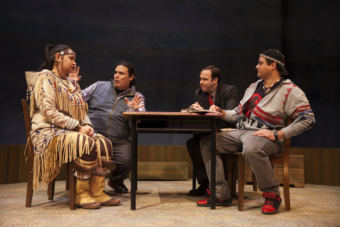
Joker (Alec Shamas) unfurls his wings and reveals his power. Costuming for the production is by E.B. Brooks. (Photo by Rashah McChesney/Alaska’s Energy Desk)

The world premiere of “William, Inc.” is tonight at Perseverance Theatre. The dramatic comedy focuses on the life of an over-worked Alaska Native substance abuse counselor.

The title character, William, creates a Native corporation in his head to help cope with the stress of his job, a failing marriage and his own substance abuse.

The corporation’s board members include archetypes — or typical examples of certain types of people — like Shadow (James Sullivan), Joker (Alec Shamas, Chickasaw) and Traditional Woman (Erin Tripp, Tlingit). Joker and Shadow have a knack for appearing at what seem to be the most inopportune times.

This is Inupiaq playwright Lucas Rowley’s first major staged play.

“When I was in grad school I really enjoyed Jungian psychology,” said Rowley on the phone from Anchorage. “And that’s kind of where I took these ideas of archetypes and the collective unconscious.”

Rowley now works as a mental health therapist, but he’s also worked for Native corporations, where he says he’s had negative and positive experiences.

Inupiaq playwright Lucas Rowley was born and raised in Homer, and now lives in Anchorage. (Photo courtesy of Lucas Rowley)

“It’s kind of an alien structure when you compare it to the kind of the traditional culture and values that Native peoples had,” Rowley said. “And then you kind of thrust them into this corporate-suit-and-tie type of deal and it’s just kind of a funny transition that I had fun with,” said Rowley.

And fun it is. Imagine a scene where William, who is arguing with his very-frustrated wife Cindy, (Erika Stone, Iroquois) answers a call (bad move) from a belligerent Shadow and Joker. Joker is man-twerking on Shadow as bumping club music and disco ball lights flash (lighting by Tom Onitveros). The two holler through a toyish, lightly amplified phone (Betsy Sims, audio engineer) as they try to convince William to ditch the wife, and come party at the club. The tension, and absurdity of that scene alone made me belly laugh.

“You know, it always helps to have humor when you’re dealing with heavy topics like this,” Rowley said.

Substance abuse, mental health, generational trauma and recovery are among them. Rowley says the play is loosely based on his life.

“I’ve been sober now for 13 years, and recovery is very important to me,” Rowley said. “I like to help people out that way, and I’ve also been a substance abuse counselor several times before. It is just such a big issue people struggle with that I wanted to make that a part of the play and give a positive message about that as well.”

“You see. That’s why we need a drink. Now give us a drink! It’s medicine we need,” exclaimed Shadow in one poignant scene.

“That isn’t medicine, this is,” responds Traditional Woman as she begins to drum and sing — underlining the play’s main theme.

Traditional Woman (Erin Tripp) is a member of the board of directors of a Native corporation that William (center) (Frank Kaash Katasse) , formed in his head to deal with stress. Board member Shadow (James Sullivan) turns his back on both of them. (Photo by Rashah McChesney/Alaska’s Energy Desk)

Brian Westcott (Athabascan and Yup’ik) plays two characters: Walter, an alcoholic seeking treatment, and Gary, William’s uncle and fellow treatment counselor.

The play is directed by Randy Reinholz (Choctaw) of Native Voices at The Autry, who readers may remember from last season’s “They Don’t Talk Back.”

The set’s floor is a massive therapeutic sand box, the kind counselors like William use with figurines to analyze their patients. Akiko Rotch created that witty parallel, and its mountainous background.

Tom Onitveros produced projections made from videos of clouds that soar, like northern lights, over Rotch’s mountains. Costumes, like Joker’s parachute-pack raven wings, are by E.B. Brooks (Sami, Abenaki, and Wampanoag). The original music is by Ed Littlefield (Tlingit).

I asked Rowley what he wants people to think about as they walk out.

“That there’s always hope, and just the power that traditional culture can have in our modern life and our world,” he answered.

How tradition and modernity play together is a theme he plans to explore in his next play, too. “Raven One” is about an Alaska Native corporation that funds a trip into deep space.

For now, we don’t even have to leave Douglas to feel the healing powers of humor and traditional Alaska Native ways.

“William, Inc.” opens 7:30 tonight at Perseverance Theatre and runs until February 17 before it goes to Anchorage.

The cast and creative team of “William, Inc.” includes (from top left) Erin Tripp, Erika Stone, Alec Shamas, Frank Kaash Katasse, Brian Westcott, James Sullivan, Randy Reinholz (front left), Lucas Rowley and Cameron Thorp (stage manager). (Photo courtesy of Lucas Rowley)

Women’s March organizer outlines Saturday event

Women’s March on Juneau is Saturday morning here in the Capital City.

Organizer Trish Custard outlined the schedule on A Juneau Afternoon.

“At 9:45, they should be walking up towards the State Capitol Building,” Custard said. “At 10 a.m. the rally will begin. By about 11 o’clock we’ll start marching down to Marine Park—very short march, downhill all the way. And from there we can break up and go to coffee shops … to meet with the speakers, the guest speakers, and continue the conversation.”

Those speakers include Beth Kerttula, Lt. Gov. Byron Mallott, and Rep. Ivy Spohnholz to name a few.

Last year’s march gathered close 1,000 people despite cold temperatures.

“It’s important to me because so often we feel so isolated when we’re advocating for or against something,” Custard said. “We can send out emails, we can call up, we can send out letters, but when we combine together as a force, we’re so much stronger.”

This year’s theme is “Positively Powerful!” and organizers have asked the speakers to include a call to action.

“Things that people can actively do, that all of us can do in our homes or with each other, to keep participating in our democracy,” Custard said.

It’s an inclusive event and men and children are welcome.

Saturday’s forecast calls for mostly cloudy skies with a slight chance of snow showers and a high about 31 degrees.

The anti-abortion group Alaskans for Life is also holding a rally from noon to 1 p.m. Monday on the Capitol steps.

Poetry Omnibus solicits submissions, offers workshops

Poetry Omnibus program coordinator Ceann Murphy was among the contest winners in 2014. (Photo by Scott Burton/KTOO)

Poetry Omnibus, the poetry contest that displays locally written work in our Capital Transit buses, is now accepting submissions from both youths and adults.

The program is in its 11th year, program coordinator Ceann Murphy said on A Juneau Afternoon.

She read a past winner’s poem, “The Life of a Cherry Blossom” by Acey Wall.

“It will fall off
the tree and it will
float and float and float
and come down like
a parachute. There
it waits and waits and waits
until a girl comes and picks
it up and eats it.
That is the life
of a cherry blossom.”

Each poem must be 10 lines or less, and each line must not exceed 60 characters. Individuals can enter up to three poems.

“It’s on the buses so just a really diverse population of people get exposed to reading poetry,” Murphy said. “A lot of tourists comment on it. And then just people here in our community, so it gives them something fun to contemplate or be introduced to.”

To help compose poetry like “The Life of a Cherry Blossom,” join Emily Wall and Monika Haygood for a youth poetry writing workshop focused on ages 8 to 17 at 5:30-7:30 p.m. Wednesday at the Douglas Library.

Youths can also join Christy NaMee Eriksen at the Downtown Library from 3 to 4:30 p.m. Saturday.

The submission deadline is Jan. 31. Click here for a link to the entry form.

Juneau ranks 6th in the nation for ‘creative vitality’

Out of 933 communities nationwide, Juneau ranks sixth for its overall creative vitality. That is according to an index created by a Denver-based arts organization.

“You might say, ‘Wow, Juneau, Alaska: How did you rank sixth?’” said Susan Gillespie, a technology specialist for the Western States Arts Federation, or WESTAF, that produced the rankings. “Well, you have a smaller population, but a higher concentration of creative activity.”

Juneau’s sixth spot lies between Glenwood Springs, Colorado, at five, and the Washington D.C. metro area at seven.

The Western States Arts Federation’s data tool is called the Creative Vitality Suite. The tool rated Juneau sixth in the nation for creative vitality. (Map courtesy WESTAF)

Gillespie and company created a data tool that crunches numbers to rank our communities. The data included labor statistics, census information and nonprofit tax disclosures from 2015.

They tool favors communities with a high concentration of creative jobs and creative industries. The revenue of arts nonprofits, like ticket sales, grants and community contributions, also factored in.

“I mean, to be sixth in the nation out of 933 is very commendable,” said Gillespie. “It looks like there’s a lot of efforts going on behind the scenes to make Juneau an interesting place to live. And you are in the company of Martha’s Vineyard, Santa Fe, and Jackson, Wyoming — Jackson Hole. So I think it’s pretty commendable and it’s something to kind of keep your eye on year after year and see if your efforts in that area are continuing to pay off,” said Gillespie.

The number one creatively vital city in the U.S.? Summit Park, Utah. And other Alaskan cities on the list? Fairbanks at 197, Anchorage at 110 and Ketchikan at 81.

Site notifications
Update notification options
Subscribe to notifications