Inside KTOO

KTOO’s quarterly source diversity report: pandemic edition

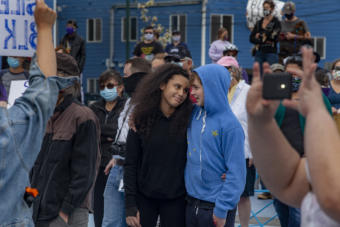
About 250 people gathered for a public “I Can’t Breathe” rally protesting the death of a black man, George Floyd, who was killed after a white officer pressed a knee into his neck while taking him into custody in Minnesota. People held signs decrying violence against black people, calling out systemic and institutional racism, and supporting the Black Lives Matter movement on Saturday, May 30, 2020 in Juneau, Alaska. Similar protests happened throughout the state with hundreds turning out in Fairbanks and Anchorage, they’ve also erupted in dozens of cities all over the country. (Photo by Rashah McChesney/KTOO)
About 250 people gathered to support the Black Lives Matter movement on Saturday, May 30, 2020 in Juneau, Alaska.  (Photo by Rashah McChesney/KTOO)

In the summer of 2019, KTOO commissioned a source audit, or a report on the make-up of the sources we use for KTOO news stories and the guests we have on Juneau Afternoon.

Last October, we started asking everyone who appeared in a news story or was a guest on Juneau Afternoon to identify their gender and race and/or ethnicity.

Here’s what our first report in late 2019 revealed about who we’ve been interviewing. And here’s what the first quarter of 2020 showed us.

We’ve just finished compiling our third report, which reflects a period in which the COVID-19 pandemic was wholly present in Alaska.

For the period from April 1 through June 30, 2020:

  • There were 337 total sources
  • 228 appeared in news stories
  • 49 appeared on Juneau Afternoon
  • 90% of sources self-identified their gender
  • 88% sources self-identified their race and/or ethnicity

Gender

Our goal here is obvious: include more female and non-binary voices. And it appears that we’re moving in the wrong direction.

For the previous six months (October 2019 – March 2020), 46% of our sources identified as male. For the last three months, that shot up to 60%.

Chart showing Gender for KTOO sources Q2 2020.

One thing to consider is that in June, Juneau Afternoon went to a summer schedule with fewer programs and fewer guests. That program consistently has more female guests and balances out the news team’s tendency to interview more males.

To understand the difference between the guests on Juneau Afternoon and sources for news stories, it’s helpful to look at the subject experts we’re inviting to speak with us.

For news stories we talk to a lot of government officials, while Juneau Afternoon guests tend to be from the non-profit sector or artists or educators.

Graph showing the subject matter expertise of KTOO sources for 2020 Q2

One trend I’m particularly interested in is the percentage of “general public” we include on our airwaves, especially since we know there’s an equal opportunity to talk to a man or a woman when things like expertise, educational background or profession don’t dictate why we’re talking to someone. For both Juneau Afternoon and our news stories, this is trending up — which is a result of an intentional effort to talk to more “regular people” about the pandemic and how it is impacting our community.

Ethnicity

While 69% of Juneau’s residents identify as white-only, 79% of KTOO’s total sources for the past three months were white-only. And over the past nine months, the percentage of white-only sources in our coverage hasn’t changed much. (When we looked at this data in December, 75% of sources were white-only; in March, that number was 77%).

graph showing the race/ethnicity of KTOO sources for Q2 2020

The two groups we have actively been trying to hear more from are people who identify as Alaska Native and Asian. If the goal is to reflect our community, these numbers should be 18% and 10% respectively. In total, we’re not there yet, but the make-up of Juneau Afternoon guests got very close (20% Alaska Native and 8% Asian).

One important factor we look at when we look at the racial and ethnic make-up of our sources is the focus of the story. The mix changes when the story or program has a focus on race.

Not surprisingly, stories that are not about race skew whiter than stories that address race. But this is not what we want our coverage to look like. We want a wide diversity of voices in every story we tell and every topic we cover.

Graph showing the race/ethnicity of KTOO stories sorted by the focus of the story for 2020 Q2

One thing we did see in the last three months was an increase in stories and programs that were focused on race. In the last report, we only talked to two sources for stories that were primarily about race; for this reporting period, there were eight.

What’s Next?

Documenting this information about our sources for these past nine months has been a mostly observational exercise. “Tracking our sources” (which isn’t as big brother as it sounds) is just holding up a mirror to our coverage so what we see is a true reflection of the everyday decisions we make when we decide to interview someone.

So far we haven’t been prescriptive about trying to change things. We know in general what we need to do but we haven’t decided on what levers to start pulling to try and start moving things around. That’s about to change. Without making a concerted effort to include more women and non-binary voices and more Black, Indigenous and Asian perspectives and experiences in our stories, we can’t expect these numbers to change.

This is our newsroom mission, which feels very aspirational right now:

Relying on voices, perspectives and stories historically underserved by news outlets, KTOO News provides information our community needs to gain a deeper understanding of ourselves and our role in local, statewide and national issues and events.

Here are some stories and programs from the past three months where I feel like we have kept our mission in our sights. Hopefully we’ll have more of these to share at the end of the next quarter and we’ll see our numbers start to shift.

Still work to do to diversify the voices we hear on KTOO, but the pandemic brings an unprecedented opportunity

Alaska Gov. Mike Dunleavy, center, takes a tour of the Alaska Airlines Center in Anchorage on April 15, 2020.
Alaska Gov. Mike Dunleavy, center, takes a tour of the Alaska Airlines Center in Anchorage on April 15, 2020. The sports arena was set up as an alternate care facility for COVID-19 patients. (Creative Commons photo by Alaska Governor’s Office)

In the summer of 2019, KTOO commissioned a source audit, or a report on the make-up of the sources we use for KTOO news stories and the guests we have on Juneau Afternoon. The period between January through June of 2019 became our baseline data, because it was the first time we had looked at the demographics of the people whose voices we hear on the air.

In October of 2019, we started asking everyone who appeared in a news story or was a guest on Juneau Afternoon to identify their gender and race and/or ethnicity. You can read what our first report from the last quarter of 2019 revealed about who we’ve been interviewing.

We’ve just finished compiling our second report.

For the period from January 1 through March 31, 2020:

  • There were 452 total sources
  • 220 appeared in news stories
  • 230 appeared on Juneau Afternoon
  • 95% of sources self-identified their gender
  • 94% sources self-identified their race and/or ethnicity

Gender

In total, we had more female sources (54%) than male (46%). There were no sources in the reporting period who identify as non-binary.

The gender breakdown is very different between news stories and Juneau Afternoon guests. Juneau Afternoon has twice as many female guests (67%) as male guests (33%). Sources for news stories are more often male than female, though the ratio isn’t quite as extreme (60% / 40%).

To understand why the sources for news vs. Juneau Afternoon look so different, it’s important to look at who the sources are and what they are being asked to speak about. Sources for news stories are predominantly elected officials (37%) and government spokespersons (18%), where Juneau Afternoon guests are mostly activists (20%), artists (17%) and educators (15%).

Ethnicity

While 69% of Juneau’s residents identify as white-only, 77% of KTOO’s total sources for the past 3 months were white-only.

The two groups we have actively been trying to hear more from are people who identify as Alaska Native and Asian. If the goal is to reflect our community, these numbers should be 18% and 10% respectively. We didn’t achieve that in this quarter. In fact, we got further away from that goal than we were at the end of 2019 (Q4 had 17% Alaska Native sources and 4.5% Asian sources).

Sources for news stories and guests on Juneau Afternoon tracked similarly when it comes to race and ethnicity.

One important factor we look at when we look at the racial and ethnic make-up of our sources is the focus of the story. The mix changes when the story or program has a focus on race.

Not surprisingly stories that are not about race skew whiter than stories that address race. But this is not what we want our coverage to look like. We want a wide diversity of voices in every story we tell and every topic we cover.

Note: there were only 2 stories or programs this quarter that were primarily about race.

What’s Next?

Toward the end of this reporting period, something extraordinary happened that has changed almost everything about what we’re doing here at KTOO: The COVID-19 pandemic came to Alaska in mid-March. The pandemic has changed a few things for KTOO. For one, the volume of news stories we’re producing is up. That means there are more opportunities every day to talk to new people who haven’t been a part of our coverage before.
The conversations on Juneau Afternoon have shifted from promoting events and featuring art and advocacy work to truly building community out of our audience and blurring the lines between listeners and makers through our Community Connections segment.

Perhaps the biggest change the pandemic has brought is the opportunity to focus on the ways the impact of the pandemic exacerbates inequities in our community. We are hearing from people in power every day. Gov. Mike Dunleavy appears almost every night on TV and our website with Chief Medical Officer Anne Zink and other members of his cabinet. Juneau’s city manager Rorie Watt is on the air every morning and afternoon. These addresses bring important information to our audience and are a critical part of our service as a news organization. But for every elected official and authority figure we include, there must be an equal opportunity to hear from the voiceless, the powerless and the people who are disproportionately impacted by the disease and the economic disaster accompanying it:

A letter to the KTOO community from our editor

Public media was made for social distancing. It’s almost cliche to talk about audio storytelling as the most intimate form of storytelling, but there is something about how much like a conversation it feels — one voice speaking directly into one pair of ears. Even as we move more and more of our operations online, we bring the tradition of that storytelling with us. We write our web stories with that same one-to-one ratio in mind. And as a public media station, you can be assured that we are doing all of this for you.

Thank you for continuing to depend on us for local news and for supporting our efforts when you can. We take our public mission seriously and instead of scaling back during these uncertain times, we are ramping up.

Here are just a few of our commitments to you from the KTOO newsroom as we all experience the events of the coming weeks together:

  • The news team is checking in with the hospital, the schools, state health officials, lawmakers, tribal government leaders, city leaders and visitor industry representatives every day and bringing you their updates as quickly as we can.
  • Reporters have moved schedules around so we can bring you late-breaking news, early morning updates and weekend coverage. (And also to keep the numbers of people down in our building.)
  • You will hear from health experts and community leaders. But also from people whose expertise is going through the same thing you are going through. You’ll hear from your neighbors and fellow Alaskans who are making sense of the same strange changes happening around them. We always strive to balance breaking news and information with in-depth coverage and storytelling.
  • We will keep you — our audience — in mind when we decide to prioritize national news over local news or to leave national news for local news. We are making these decisions sometimes several times a day.
  • We will offer reprieve from coronavirus coverage by chasing other stories that are important to Alaska — the recall campaign, the impact of low oil prices on Alaska’s economy, legislation being debated in the Capitol, the barriers to this year’s cruise season. We’ll also bring you unexpected stories from our community and sleuth out answers to questions you submit for our Curious Juneau program.

You might start to notice more phone interviews as we keep our reporters at their desks more often than we usually like to. This is for their safety and for the health and wellness of our whole community.

Also know that our Arts and Culture team is working on several things to make sure you stay connected to the community at this time, including new call-in segments on Juneau Afternoon and the ability to hear the live voices of your favorite DJs on KRNN and KXLL, even while we have suspended our volunteer program to keep the volume of our building’s visitors low.

360 North and Gavel Alaska are providing a huge service to you while the state Capitol is closed to visitors. We’re carrying regular legislative coverage as well as special news conferences and appearances from state and local leaders. This video coverage can be found at KTOO.org as well as on TV.

The best place to look for news updates is KTOO.org. We haven’t expanded our local newscasts yet, but we will consider carving out more time for local news on our airwaves if the volume of updates demands it. Right now you can catch our freshest news throughout Morning Edition and during the 4:00 p.m. hour of All Things Considered. Highlights from the day from throughout the state will be on Alaska News Nightly at 6:00 p.m..

Send us tips and story ideas, corrections and kudos, and all your questions to news@ktoo.org.

We’re here to listen.

Most sincerely,

Jennifer Pemberton
Managing Editor, KTOO

Changes to the websites for KTOO and 360 North

Starting on Saturday, Jan. 11, you may notice some improvements to the layout and design of KTOO.org. As a part of the website redesign, we’ve consolidated our digital services in order to better serve our online audience.

One big change: We’re merging the website for our TV channel, 360 North, into our organization’s main site, KTOO.org. You can continue to find 360 North and KTOO on the air in all the usual places — the only change is that you’ll find information about 360 North and its programs on KTOO.org.

KTOO has always been the organization behind 360 North and Gavel Alaska, and that hasn’t changed: We’ve just decided we could better serve our audience and our mission by consolidating everything into one website. Now all our programs and content will be on one site, no matter where they originally aired.

If you have any comments for us, or if you need help finding anything, please don’t hesitate to contact us with questions.

About KTOO

Community volunteers founded the organization in 1972 and started broadcasting on the radio in Juneau on Jan. 27, 1974, with a heavy commitment to local service, community access and diverse viewpoints.

In 1977, we launched a television production unit to provide daily legislative coverage, and 18 months later, KTOO-TV signed on the air as a fledgling PBS station on Oct. 1, 1978. By 1983, the TV station was broadcasting on low-power translators through Southeast Alaska.

Today, KTOO provides a variety of public services throughout Alaska. In addition to providing Alaska Public Media program services (PBS, PBS KIDS and Create) to Southeast Alaska, KTOO operates a full-time cable and satellite television channel, 360 North, which beams live C-SPAN-style legislative coverage throughout the state with Gavel Alaska. The channel expanded in 2007 to provide a wide variety of Alaska programming on a year-round basis.

You can read more about KTOO and our history on our about page.

Here’s the first diversity report since KTOO started asking everyone we interview about their gender and ethnicity

Host Christina Love (left) and Sara Gallagher on Juneau Afternoon, December 2, 2019. (Photo by Scott Burton/KTOO)

In the summer of 2019, KTOO commissioned a “source audit,” or a report on the make-up of the sources we use for KTOO news stories and the guests we have on Juneau Afternoon. The period between January through June of 2019 became our “baseline” data, because it was the first time we had looked at the demographics of the people whose voices we hear on the air.

In October of 2019, we started asking everyone who appeared in a news story or was a guest on Juneau Afternoon to identify their gender and race and/or ethnicity. We’ve been doing this for 3 months now, and here’s what that last quarter of 2019 revealed about who we’ve been interviewing.

For the period from October 1 through December 31, 2019:

  • There were 377 total sources
  • 194 appeared in news stories
  • 177 appeared on Juneau Afternoon*
  • 342 sources (91% of total) self-identified their gender
  • 334 (89% of total) sources self-identified their race and/or ethnicity

     * Juneau Afternoon numbers are for November and December only.

See the data

Gender

In total, we had more female sources (54%) than male (46%). One individual identified as non-binary (0.3%).

The mix of male and female sources is different for news stories compared with Juneau Afternoon.

Sources in news stories were roughly two-thirds male (62%), while guests on Juneau Afternoon were more than two-thirds female (69%). This is largely because of their differing areas of expertise. In news stories, the people we talked to the most include government officials and spokespersons (29%) as well as people from businesses and industry (12%). A lot of guests on Juneau Afternoon are activists and community organizers (36%) and artists (18%).

One takeaways from this section is that our reporters could be talking to more women for news stories.

Ethnicity

While 69% of Juneau residents identify as being white, 75% of KTOO’s sources for the quarter were white. This is closer to reflecting the community than the last survey period (Jan – June 2019), which was 84% white. One difference between the survey periods is that the Alaska legislature was in session during the beginning of the year and white lawmakers and the white governor appeared in stories nearly every single day.

The two groups who have been most under-represented in our coverage are Alaska Natives and Asians.

Alaska Natives make up 18% of Juneau’s population, and during this last quarter, 17% of our total sources identified as Alaska Native. For the previous survey period, that number was 13%, so this quarter was much closer to matching our community. Among Juneau Afternoon guests 13% were Alaska Native, and in news stories 21% of sources identified as Alaska Native.

The population of Juneau is 10% Asian. In the last quarter, 4.5% of our sources identified as Asian: 2% of news sources and 7% of Juneau Afternoon guests. This is an improvement over the six month period we looked at last year, which contained 1% Asian voices.

But more than just looking at the ethnic make-up of all our sources, we are also looking at the focus of the stories that include the most diverse sources. For example, in stories that are not about race at all, only 7% of sources identify as Alaska Native. In stories that address race, that number jumps to 47%. And when the story is primarily about race, 92% of the sources are Alaska Native.

This isn’t a criticism of our coverage and doesn’t diminish the importance of the the sources we heard from in those stories, but it does show us that we tend to reach out to the Native community for stories or programs that are about the Native community or issues facing Native communities exclusively. It is an important benchmark for me to hear from Native voices when the story isn’t focused on race. The first pie chart in the graphic above is the one that we think needs to look most like the make-up of our community.

What’s next?

We’re still asking everyone we interview to identify their gender and race/ethnicity. We’ll report on the first quarter of 2020 after March 31. That will include the start of the legislative session, where we expect to start hearing from lawmakers daily. We’ll continue to strive to include the voices of everyone in the community we serve despite the shift in focus of the news cycle.

Also, for Juneau Afternoon, one of the things we are looking at is not just who we have on as guests, and in what capacity, but also who is hosting and crafting each show. This quarter we had three individuals of Alaska Native descent as “guest hosts” who also produced the content for that day’s show. We see this as another important step in having our programming better reflect our community and are working on having these individuals, and others, host and produce more regularly.

We looked at everyone we interviewed for 6 months and this is what we found

KTOO strives to be inclusive and diverse in our coverage. Part of our newsroom’s mission is to “consciously seek out the voices, perspectives and stories not found in other news outlets.” In order to ensure that we’re doing our best to reflect the variety of lived experiences we know exist in our community, we are asking everyone we interview for a news story or on Juneau Afternoon their gender, their race or ethnicity and their date of birth. Answering these questions is voluntary, but there’s no way we can track our progress without asking.

We started this work by conducting a “source audit” — it’s like a snapshot of our inclusivity. We looked at six months’ worth of stories and segments broadcast over our airwaves from January 1 – June 30, 2019.

That included:

  • 309 News Stories
  • 237 Juneau Afternoon Interviews
  • 1,066 total sources (includes people we talked to multiple times for separate stories)
  • 725 unique sources (68% of sources were only interviewed once)

Information on these sources was collected using a variety of methods: an email survey, phone calls and personal knowledge of individuals. There was no guessing. All information was given voluntarily by the sources. Partial information was obtained for about 95% of the 1,066 total sources interviewed, and complete information was obtained for 60% of the total sources.

Here’s what our sources over that period looked like:

Ethnicity

While just 69% of Juneau community members identify as being white only, 84% of KTOO’s sources over the survey period identify as white only.

And two key minority groups are under-represented in our coverage: Alaska Natives represent 18% of Juneau’s population, but only 13% of KTOO’s sources. Asians make up 10% of Juneau’s population, but only 1% of KTOO’s sources.

We also looked at KTOO’s news stories and Juneau Afternoon segments separately.

Gender

Our source audit showed that two-thirds of the interview subjects used in our news stories are male and one-third are female.

Guests on Juneau Afternoon are flipped: almost two-thirds (64%) are female and just over one-third are male.

There was one Juneau Afternoon guest and one news source who identified as non-binary.

Some aspects of source gender is out of our control. For instance, Gov. Mike Dunleavy is a male and he was the single most interviewed source during the surveyed period (29 times). But if we want the voices and perspectives on our airwaves to reflect the community we live in, we could try to get this closer to what Juneau looks like, which is 51% male and 49% female.

Expertise

We also took a look at the expertise areas of everyone we interviewed. For the news stories, the most people we talked to, by far, were elected officials (35%) and government spokespersons (16%), followed by members of the general public (11%) — most of whom were individuals testifying before the Alaska Legislature during the session or reacting to legislation under consideration.

For Juneau Afternoon, guests most often represent non-profits or are activists / community organizers or artists.

What Happens Next?

We are asking everyone we put on the radio about their gender, race and /or ethnicity and age. This makes our goal of being inclusive and diverse part of our daily work.

We are also intentionally reaching out to people we haven’t talked to before and introducing KTOO, our news team and everything we do to more and more members of our community.

We’ll chart our progress and publish it for you here on a quarterly basis so you know exactly how we’re doing and how we’re deciding what and who to cover.

A Note on Methodology
We commissioned Rain Coast Data to perform our source audit.

Ethnicity was measured using the same demographic breakouts employed for the 2013-2017 American Community Survey 5-Year Estimates, in order to accurately compare and contrast audit results to current demographic information. Respondents were able to list up to three ethnicities during the survey. Questions involving gender contained three options: Male, Female and Non-binary. Sources were placed in age groupings based on generation.

Read the full report from Rain Coast Data.

Site notifications
Update notification options
Subscribe to notifications