Inside KTOO

Why we’re pausing our Twitter account

KTOO has recently decided to stop posting to Twitter from its main station account. Twitter has become less and less a place where we feel like we can effectively engage with our audience. And last week, Twitter labeled NPR’s official twitter account “state-affiliated media,” a designation given to government-controlled media outlets. Twitter later updated that designation to “government funded media,” implying “government involvement over editorial content,” per the company’s definition.
NPR has announced its organizational accounts will no longer be active. While Twitter has not applied this designation to KTOO’s account, we’ve decided to suspend activity on our account, too. We’ve made this decision due to the misleading nature of this label, the incongruence of its application, and a declining audience on the platform. We will continue to monitor this situation and may resume posting content to Twitter if this situation changes.

Gavel Alaska will continue to tweet about changes in meeting times, cancelations, recesses, and other procedural details at the Alaska State Legislature.

KTOO is an independently operated nonprofit organization. Our priority is to serve our community with news, music, arts, and culture from Alaska’s Capital City. Our editorial independence is at the core of these services, with a primary focus on stories of local and statewide importance.

KTOO is governed by a volunteer Board of Directors, made up of members from the community who provide strategic and fiduciary oversight of the organization. Like KTOO, NPR is governed by an independent Board of Trustees and editorial integrity is upheld through a vigorous code of ethics which NPR and KTOO journalists adhere to.

On NPR and KTOO funding

National Public Radio (NPR) funding derives primarily from corporate and individual supporters, philanthropic grants and NPR member stations. NPR does not receive any funding directly from the federal government. However, a small percentage (less than 1%) of NPR’s funding does come directly from the Corporation for Public Broadcasting (CPB), a separate nonprofit entity created by Congress as a part of the Public Broadcasting Act of 1967. The act charged the CPB with encouraging and facilitating program diversity, expanding educational broadcasting, and ensuring that a portion of radio and television programs are in service to the public interest throughout the country.

Over two thirds of KTOO’s annual operating revenue derives from individual members, businesses, and organizations within our community. We receive an annual Community Service Grant from CPB which assists us to offset the expense of maintaining our regional radio broadcast and statewide television services. KTOO receives no direct state funding.

Broadcast media is a lifeline in many parts of Alaska. Concurrently, our democracy is under continual threat from misinformation and divisive outlets, making it essential that we deliver independent and community-centered journalism with integrity. In keeping with these values we are saying goodbye to Twitter. You can still find news, music, and cultural stories from KTOO Public Media on Facebook, Instagram, YouTube, and our weekly newsletter, The Signal.

Remembering Jeremy Hsieh’s 13 years with KTOO

Jeremy Hsieh portrait
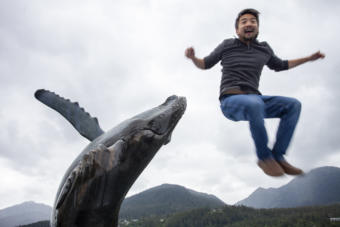
KTOO’s Jeremy Hsieh jumps for a portrait in Overstreet Park in Juneau in 2019. (Photo by Rashah McChesney/KTOO)

Tuesday, Sept. 27, is Jeremy Hsieh’s last day with KTOO.

The first time Juneau heard Jeremy on the radio was Christmas Eve in 2009, with a story about how you couldn’t get Chinese food in Juneau on Christmas. He even called the Japanese and Thai restaurants in town. 

In 2013, he covered professional jump roper Peter Nestler…extensively

He coined the phrase “fecal cliff”or thought he did

City and Borough of Juneau wastewater engineer Lori Sowa discusses wastewater treatment with KTOO reporter Jeremy Hsieh during a tour of the Juneau-Douglas Wastewater Treatment Plant on March 18, 2021. (Photo by Andrés Camacho/KTOO)

Then there’s a simple story from 2013 called “A bear walks into a bar.”

And who can forget the world’s smallest Costco?

Jeremy wore a lot of hats at KTOO. He was a reporter, an editor, a producer. He started freelancing for KTOO in 2009 after getting laid off from the Juneau Empire. In 2011, he started producing Gavel Alaska. He joined the news team in 2013.

His interest in government is a thread that runs through his career here.

Over the last 10 years he reported nearly 1,000 stories for KTOO. That’s 10 years of referendums, of assembly meetings, of gubernatorial candidates. Stories about sewage, about infrastructure spending and property taxes, about Mendenhall River floods, about garbage bears and drug busts. 
Jeremy is moving to Anchorage next month and will report for Alaska Public Media, so you’ll still hear him on the radio. We can all expect to get to know the sewage situation in Alaska’s largest city soon.

To participate in Alaska’s upcoming election, start by asking questions

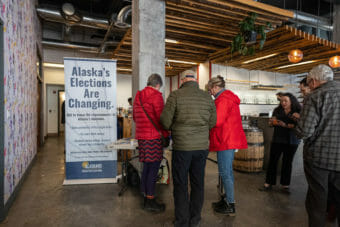
Alaskans For Better Elections hosts an event educating people about ranked choice voting at Amalga Distillery in Juneau, Alaska on April 19, 2022. (Photo by Lyndsey Brollini/KTOO)

The 2022 midterm elections are on the horizon. This will be Alaska’s first time using ranked choice voting for statewide races. Are you planning to vote? Do you know how to vote, where to vote, and what you might need to have when you show up to the polls? What if your voter registration is out of date or has a mistake, and you get challenged at the polls — what can you do?

KTOO is part of a new community-powered journalism project to answer those questions and any others you have about how to exercise your right to vote in the upcoming election. Our mission is to provide you with the information you need to vote.

We’re not concerned about how you vote and especially not about who you vote for. We just want to make sure you are armed with the information you need to vote and understand how elections are run and kept secure.

This project is part of the work of America Amplified, an initiative funded by the Corporation for Public Broadcasting to support community engagement journalism in public media. We’re also working with 28 other public media stations across the country to ensure that all eligible American citizens can vote.

Many states, including Alaska, have changed voting regulations since the 2020 general election when concerns about the pandemic led to an expansion of absentee and mail-in voting. This time around the rules are different, and there’s a ton of misinformation and disinformation circulating about elections and election security. We’re here to clear things up.

You can’t change anything unless you choose to participate in the process. We’re asking you to participate by sending us any and all questions about taking part in the upcoming election.

With help from our partners at America Amplified, we’ll answer the questions online, on the air and on social media. We’ll send the answers directly to you as well. If you share your contact information, we may even reach out personally. We can’t do this without you. Gunalchéesh!

Why we didn’t broadcast the first Jan. 6 committee hearing live

Thursday’s coverage of the first hearing of the Jan. 6 select committee was described as a “primetime” news event. Of course, it wasn’t primetime here in Alaska. It was at 4 p.m., which is when the KTOO news team presents its freshest local and statewide news on the radio.

So we didn’t take NPR’s live coverage of the event, and it felt like maybe we were the only station in the country that didn’t. After learning that Fox News refused to air the hearing and described it as “propaganda,” I did feel weird about my decision.

But it’s Celebration here in Juneau — a crucial community event that we haven’t gotten to enjoy for four years. Unlike the Jan. 6 hearings, coverage of Celebration can’t be found on every channel or platform. You can only get it from KTOO. That’s why, yesterday, our audiences had to actively walk away from KTOO to get to national coverage.

That said, next week there are more hearings from the House’s investigative committee. These will happen not in primetime, but in real time — which in Alaska will be 6 a.m. We will bring you that live coverage from NPR during Morning Edition, which means we’ll have to forgo local news on the radio for several hours for three days next week.

That doesn’t mean we won’t be covering the community in the ways you rely on, but it does mean that you might have to wait for the afternoon newscasts or find our stories on KTOO.org instead of hearing them on the air over breakfast.

All this to say, we think carefully about our programming decisions, especially when the stakes are this high. Sometimes it’s like choosing between apples and oranges, and sometimes it’s like picking your favorite child. Knowing that it’s impossible to give everyone what they want, we always welcome your feedback on the coverage decisions we make. We are here to serve you.

Sharing stories for Filipinos in Alaska

Independence Day
Members of Filipino Community, Inc. dance during the Independence Day parade on July 4, 2016, in Juneau. (Photo by Rashah McChesney/KTOO)

For hundreds of years, Filipinos have made their marks in communities across Alaska but have largely been excluded from its history — and especially in news media. KTOO is changing that.

We are working with America Amplified, a national collective of public media organizations bringing visibility to underrepresented communities. Through this program, we’re leveling up our community engagement work and focusing on sharing stories for people, not just about them.

So far, we’ve met community leaders from Juneau and Anchorage who shared their experiences living in Alaska and their knowledge about Filipino cultures and history in the state. And we’ve learned a lot.

In March, we talked with a small group about media representation of Filipinos in general, what they hoped to see, what news organizations get wrong and what we don’t know about.

We’re also paying close attention to the upcoming national elections in the Philippines, which impact Filipino migrant workers in Alaska and other Alaskans who will be voting in those elections overseas. We learned that these members of the Filipino community are most often overlooked, so we want to help keep them informed about the issues they care about. That means you’ll be seeing news from the Philippines right here on our website.

Another part of our conversations that stood out was about the nuances of Filipino identity and the importance of also centering different cultures within that identity — from Ilocano to Tagalog, Visayan to Kapampangan, to Indigenous Filipinos and Filipinos with Alaska Native ancestry. And in our first story for America Amplified, we shared a look into the creation of a “Molly of Denali” episode that focused on the Kapampangan heritage of a Filipino Athabascan character.

We are still in the early stages of this work. And while one project sparked this new approach to community engagement, this is work we will continue to do with everyone we serve in Juneau and beyond.


America Amplified

KTOO is amplifying the voices of Filipinos in Alaska. We want to hear from you. What stories would you like to share or learn more about?

Name(Required)

KTOO says goodbye to Rashah McChesney

Reporter Rashah McChesney in Unalakleet in 2019, where she was reporting on contaminated sites in rural Alaska. (Photo courtesy of Rashah McChesney)

Friday, March 11, is Rashah McChesney’s last day with KTOO. She’s brought so much memorable reporting to our airwaves over the past six years. More recently, she’s shaped almost everything you hear out of the newsroom as our daily news editor.

Rashah started at KTOO working for Alaska’s Energy Desk in 2016. Her focus was on energy policy. She was intimidating in how much she knew about the ins and outs of Alaska’s oil industry. She was also deeply sourced and seemed to have every lawmaker and commissioner on speed dial.

For the “Midnight Oil” podcast, she drove the haul road with one of the first female truck drivers to work on the Trans-Alaska pipeline.

She joined former Gov. Bill Walker’s trade mission to China.

She went on a reporting trip to the Yukon-Kuskokwim Delta for an investigation into contaminated sites — mostly schools — that no one was responsible for cleaning up. And in addition to award-winning stories on that, she came back with this unforgettable profile of a teacher in the village of Tuntutuliak.

Alice Fitka in her classroom on Wednesday, April 3, in Tuntutuliak, Alaska. (Photo by Rashah McChesney/Alaska’s Energy Desk)

In late 2019, Rashah became the daily news editor for the local newsroom at KTOO. Shortly after taking on this new role — on a Sunday in December — Juneau police shot and killed a man on Cinema Drive in the valley. Rashah went to the scene immediately and started talking to neighbors and friends who had witnessed what happened.

“Many stood on their porches quietly talking, watching their children run along a nearby ditch where bits of bright yellow crime scene tape fluttered in the wind,” she narrates in the story. “Some shook and cried when they talked about what had happened. Many didn’t want to talk on-the-record about Kelly Michael Stephens, better known as Rabbit. But, a handful of people — including Georgianna Joseph — did. They rolled up their sleeves, pulled up their shirts and showed off tattoos that Stephens had done.”

We have a picture of one of those tattoos hanging in the hallway at the KTOO studio. Because people inherently trust Rashah, they warm up to her immediately. Enough to speak into her microphone about their trauma. Enough to roll up their sleeves and pull up their shirts to show themselves to her.

Residents and visitors at the Chinook apartment complex in the Mendenhall Valley show tattoos they were given by Kelly "Rabbit" Stephens on Sunday, Dec. 29, 2019 in Juneau, Alaska. Many said they didn't want their identities known for fear of reprisal. Stephens was killed during an early-morning altercation with Juneau Police. (Photo by Rashah McChesney/KTOO)
Residents and visitors at the Chinook apartment complex in the Mendenhall Valley show tattoos they were given by Kelly “Rabbit” Stephens on Sunday, Dec. 29, 2019 in Juneau, Alaska. Many said they didn’t want their identities known for fear of reprisal. Stephens was killed during an early-morning altercation with Juneau Police. (Photo by Rashah McChesney/KTOO)

Also, she can sing. Which led to this story about a choir that formed during lockdown in Juneau — a choir that practiced entirely from their cars parked around downtown.

Join us in thanking Rashah for her years of service to Juneau and Alaska. She’s taking those same skills and sensibilities to Alabama to serve as an editor for the Gulf States newsroom.

We’ll miss you, Rashah.

Site notifications
Update notification options
Subscribe to notifications