Inside KTOO

KTOO Public Media responds to White House executive order attacking public media funding

Public media at riskLast Thursday, President Trump issued an executive order directing the Corporation for Public Broadcasting (CPB) and all federal agencies to cease federal funds, both directly and indirectly, to NPR and PBS.

It also attempts to restrict how local stations use their independent funding. This action jeopardizes the partnerships and funding that power the trusted journalism, educational programming and public safety messages that local communities rely on every day.
In response, KTOO President and General Manager Justin Shoman has issued the following statement:

“This executive order signals a deliberate and dangerous escalation in efforts to defund and dismantle public media. This is not about politics. This is about protecting a service that millions of Americans rely on every day — one that has enjoyed bipartisan support for over 50 years.

This order is coming on top of an expected rescission package from the White House that would claw back funding for public media that has already been appropriated by Congress. If this effort is successful, it will have an immediate impact on KTOO’s ability to provide services to our community by eliminating one third (1.2 million dollars) of our annual operating budget. The rescission package, originally expected last week, is now reported to be delayed; we don’t know how long.

In Juneau and throughout Alaska, public media plays a vital role in daily life. In many communities the local public radio station is the only locally owned and controlled media outlet and often the sole source of local information.

Local public radio and television stations are not partisan organizations, they are independent nonprofit institutions that strive to reflect the communities that they exist in. Station staff live and work in the communities they report on and provide residents with news, information, connection to each other and life-saving public safety alerts.

These services are deeply connected to the resources and collaborations provided by NPR, PBS and our statewide network. This includes our role in the Emergency Alert and Wireless Alerts Systems and our ability to report during and after natural disasters. Losing this funding would compromise our ability to continue this essential work.

For decades, stations like KTOO have been trusted sources of factual reporting, civil discourse, lifelong learning, and public safety. Our newsroom brings local issues to the national stage, made possible through a rich network of partnerships. We provide stories that don’t chase clicks, but change minds, open hearts and spread joy.

KTOO has provided Juneau with independent journalism, connected our community to the arts and promoted civic participation for more than a half century. KTOO has also connected every Alaskan to their state government by producing and distributing Gavel Alaska (previously called Gavel to Gavel) for thirty years. Our commitment to public service has allowed KTOO to become a cornerstone of public trust.”

You can help defend independent public media by joining Protect My Public Media today. You can also support KTOO directly with a donation. No matter what happens in Washington, D.C., KTOO Public Media’s mission to inform, engage and serve every member of our community remains unwavering.

KTOO bids farewell to Weather and Climate Reporter Anna Canny

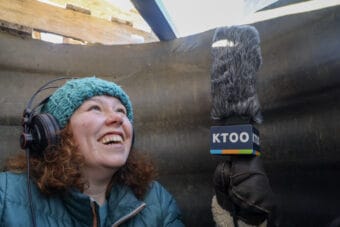
KTOO’s Anna Canny hides in a barrel while a dog on the SEADOGS team sniffs for her during an avalanche obstacle training course on March 6, 2024. (Clarise Larson/KTOO)

Tuesday is Climate and Weather reporter Anna Canny’s last day with KTOO. Over her two years in Juneau, she covered the many ways climate change is changing Southeast Alaska’s landscape. 

Listen:

When Anna first moved to Juneau from the East Coast, she immediately set a high standard by making scientific research and complicated stories understandable to listeners and readers.

She provided vital coverage of disasters that shaped Juneau, in the past, and now. 

In August 2023, Juneau’s annual glacial outburst flood was disastrous for the first time. Anna went from door to door, speaking with homeowners who were impacted by the flood waters. 

Anna flew to Wrangell a few days before Thanksgiving that year to cover the deadly landslide and its aftermath. She spoke with survivors and people who had lost loved ones, and closely followed search-and-rescue efforts. 

Then, Anna spent hours reading old newspapers to recount the story of the deadly 1936 landslide here in Juneau, and spoke with survivors, like 94-year-old Albert Shaw

And this year, she reported on Suicide Basin monitoring in the weeks leading up to yet another unprecedented glacial outburst. When it hit, damaging more than 300 homes in the Mendenhall Valley, Anna covered the community-wide recovery.

These stories gave people the information they needed to prepare for disasters and seek aid in the aftermath. Anna attended countless city meetings to follow the conversation between impacted homeowners and city officials who are all looking ahead to the next outburst flood. She also brought Juneau’s struggles to listeners across the nation by reporting for NPR. 

But between disaster coverage, Anna covered many other important topics, like the movement to train Alaska Native farmers.  

She chased ravens through downtown and reported on other encounters of the animal kind.

KTOO reporter Anna Canny interviews Leslie Daugherty, Chief Bridge Engineer for Alaska Dept. Transportation and Public Facilities, along Mendenhall River during the August 2024 glacial outburst flood. (Photo by Clarise Larson/KTOO)

She also kept us abreast of important weather updates in the region. 

You may have also heard Anna hosting newscasts, seen her coaching kids crossing-country skiing, and passed her on Juneau’s trails. 

What’s next for her? She’s on her way to Colorado where she’ll be doing science writing for a university, delving into the ways climate change is impacting disasters throughout the West. 

We’re grateful for all the important work Anna did here at KTOO, and excited to see where her career takes her. Please join us in wishing her the best with this new chapter. 

Correction: The 1936 landslide in Juneau took place 88 years ago. 

Juneau Afternoon: ‘KTOO 50th Anniversary Kick-Off Special’

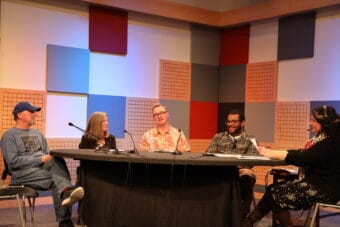
Volunteer DJ panel during Juneau Afternoon special two-hour kick-off celebration for KTOO’s 50th anniversary on May 3, 2024. (Clarise Larson/KTOO)

On today’s program:

KTOO celebrates 50 years of operation in 2024. On this special two-hour Juneau Afternoon, broadcast live with a studio audience from Studio 1A at KTOO, voices from past and present talk about the early origins of KTOO, the beginnings of KTOO-TV and Gavel Alaska, plus a look into the launch of two additional radio stations in 2007, and a panel with long-time volunteers on music, the magic of Jeff Brown, and more.

Voices heard in this broadcast: Dennis Harris, Frederick Hoskinson, Linda Ellerbee, Bill Legere, Bruce Theriault, Betsy Brenneman, Sharon Gaiptman, Laury Scandling, Glenda Carino, Elizabeth Arnold, John Greely, Wayne Jensen, George Reifenstein, Kristine Harder, Andy Kline, Annie Bartholomew, Chandre Boom, Kyle Paw, Jonas Lamb, Katie Bausler, Ricky D., Callie Conorton, Jaime Waste, Adelyn Baxter, Anna Canny, Clarise Larson, and Susan Fitzgerald.

For more on KTOO’s 50th Anniversary, visit the Inside KTOO page.

Live studio audience during Juneau Afternoon special two-hour kick-off celebration for KTOO’s 50th anniversary on May 3, 2024. (Clarise Larson/KTOO)
Musician Annie Bartholomew during Juneau Afternoon special two-hour kick-off celebration for KTOO’s 50th anniversary on May 3, 2024. (Clarise Larson/KTOO)
Former President and General Manager Bill Legere with host Bostin Christopher during Juneau Afternoon special two-hour kick-off celebration for KTOO’s 50th anniversary on May 3, 2024. (Clarise Larson/KTOO)

Bostin Christopher and Cheryl Snyder host the conversation. Juneau Afternoon airs at 3:00 p.m. on KTOO and KAUK and is rebroadcast at 7:00 p.m. You can listen online or subscribe to the podcast at ktoo.org/juneauafternoon.

Subscribe to the podcast:

Juneau Afternoon is a production of the KTOO Arts and Culture Team.
Bostin Christopher produced today’s show
with help from Cheryl Snyder, Craig Georg, Mikko Wilson, Lisa Purves, and Erin Tripp.

Celebrate 50 years of KTOO broadcasting on First Friday!

Join KTOO in celebrating a half-century of broadcasting during May’s First Friday!

First, tune in Friday, May 3 from 2 to 4 p.m. on KTOO 104.3 and 91.7 FM or online for a special edition of Juneau Afternoon featuring live music from local artists and guests from KTOO’s past and present.

Afterward, join us for an open house at our 360 Egan Drive studio starting at 4 p.m. Enjoy light refreshments, tour the studios and see photos and items from KTOO’s 50-year history on display. RSVP to the Facebook event here.

We’re celebrating our milestone all year with stories, interviews and events. If you have memories you’d like to share, submit them here. Stay tuned for more on upcoming celebrations!

After 50 years, KTOO is still Juneau’s community radio station. But how did it get started?

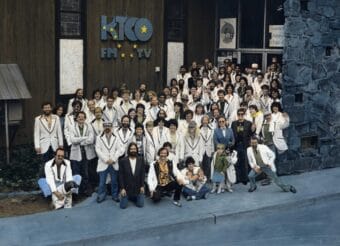
KTOO staff and volunteers pose outside the station’s former location on 4th Street in Juneau circa 1985. The story goes that longtime staffer Jeff Brown bought suit jackets for everyone on discount. (KTOO archives)

Editor’s note: For our 50th anniversary we decided to step back and highlight a few of the people who helped get us started. Engagement Editor Adelyn Baxter spoke to founders and other people who had a role in making KTOO what it is today. 

Juneau’s locally owned, listener-supported public radio station is 50 years old this week. A lot has changed after five decades on the air — KTOO now boasts three radio stations,  a television channel, a website and a staff of more than 20 people.  

But like most community radio stations, it had humble beginnings. 

“You’re listening to KTOO, stereo FM radio for Juneau, Alaska,” says John Corso, one of the founders of KTOO, during a radio spot that ran in early 1974. “KTOO is owned by the people who listen to it, and operated by the people who own it. You’re a listener right now. You can become an owner by joining Capital Community Broadcasting. And you can become an operator by volunteering your time.”

The spot ends on an irreverent note that’s characteristic of the station’s early days. 

“If you’d like to know more about owning and operating, keep listening. If you’d like to know more about listening, see an audiologist.”

Fifty years later, in the KTOO archives, former general manager Bill Legere examined dusty boxes of photos and documents. He pulled out a booklet called “How to KTOO,” written by Elaine Mitchell.

A KTOO volunteer assists a young volunteer in the radio booth at Juneau-Douglas High School: Yadaa.at Kalé in the 1970s. (KTOO archives)

Mitchell was a champion of Alaska radio. She died years ago, but she went on from KTOO to help found the Alaska Public Radio Network, which still connects dozens of rural and urban stations today. Legere called her “the founding mother of KTOO.”

“There’s this line in here that says, ‘You’ll never need more than $10,000 a year to run the radio station,’” he said. “So, sort of quaint in that regard, but it was the blueprint for how to start a public radio station.” 

KTOO wasn’t the first public radio station in Alaska, but it was one of them. To understand its scrappy beginnings, we need to go back to the early 70s, when Juneau had just two AM commercial radio stations. 

KTOO volunteers inside a recording booth in the station’s 4th Street location circa 1985. (KTOO archives)

As Dennis Harris recalls, neither one was locally owned. He and other staff at one of the stations got fired abruptly one day — which wasn’t unusual. They often got hired back. But it was tedious. And this time, his colleague, Mitchell, had an idea. 

“Elaine had bought this book called ‘How to Start a Community Radio Station,’ where they recommend that you build a 10-watt station because it was cheap,” Harris said. “And she passed it around to us, and we talked about it. And we had a meeting. And we decided to start a nonprofit corporation.” 

Harris, Mitchell and a small group of determined volunteers began to get the word out that they were starting a community-focused radio station.

“We were able to raise the money necessary to build the station in about two months, just from donations,” Harris said. 

In the early 70s, public radio was in its infancy across the country. The Public Broadcasting Act of 1967 created the Corporation for Public Broadcasting, which distributes federal money to public media stations across the country as a portion of their funding. NPR was incorporated in 1971, along with 88 founding member stations. 

Meanwhile, national community radio trailblazer Lorenzo Milam wrote “Sex and Broadcasting: A Handbook on Starting a Radio Station for the Community” – the same book that inspired Mitchell and scores of other stations around the country.

It took more than a year to get the equipment and FCC license necessary to get on the air. They found space for two radio booths in Juneau-Douglas High School: Yadaa.at Kalé’s auditorium. They were tiny, but they worked.

Longtime KTOO staffer Jeff Brown inside the radio booth at Juneau-Douglas High School: Yadaa.at Kalé in the early 70s. (KTOO archive)

“Having a locally owned, locally controlled radio station was part of the big impetus,” Harris said. “And the other was to have a place where we could have an open microphone where the community could come and say anything they wanted, as long as they didn’t libel or slander anybody.”

The first official broadcast was sometime around midnight between Jan. 26 and 27, 1974 — or maybe earlier, depending on who you ask. It was a bit chaotic (you can hear more about it in this Juneau Afternoon conversation), according to the remaining founders. But either way, Frederick Hoskinson’s voice was the first to go out over the airwaves. 

“I was hired as the first coordinator of volunteers, which we only had that one position,” Hoskinson said. “Everyone else was a volunteer.”

There were more than 100 volunteers in the early days. They didn’t broadcast all day long — Hoskinson said they would start around 12:30 p.m. People could host shows on just about any topic and played any kind of music they wanted. He remembers a Saturday program hosted by middle school students aimed at kids their own age. 

“There was no way that we can be everything to everybody all at the same time,” he said. “We tried to be everything to everybody at various different times.”

Part of the station’s early focus revolved around legislative coverage. Mitchell and Harris hosted a legislative digest that aired in the evenings and was available to public radio stations statewide.

Betsy Brenneman came to work at the station in 1977 from KYUK in Bethel. 

“It was a real hub for the community. I mean, there were people coming in and out of the station,” she said. “People would just come in and hang out and talk.”

KTOO volunteers and staff outside the station’s second location on Main Street downtown circa 1979. (KTOO archives)

KTOO later moved to two other buildings downtown before finding its current home at 360 Egan Drive in 1996. A television station — now called 360TV — went on air in ‘78. The TV station was led by Sharon Gaiptman and Brenneman was the news director. 

“(We) just found a lot of people who came together and made things happen that, in some ways, if you look back — ‘Oh, how did we do that?’ You know? But, we did it,” she said. 

Legere didn’t arrive at KTOO until the 80s, and took the helm in 1991, but he said the same spirit that started the station persisted even then. 

“KTOO started in a time when there was no one to say ‘no.’ You could do anything you wanted, as long as you could figure out how to do it,” Legere said. 

There are more people than we could ever hope to mention in this story who helped build KTOO and kept it going for half a century. 

Today, as in 1974, KTOO remains locally owned and operated.

KTOO’s Tasha Elizarde and Bostin Christopher contributed to this story. 

If you have a memory you’d like to share for KTOO’s 50th anniversary, you can find out how to submit it here

Correction: A previous version of this story misidentified what year Betsy Brenneman arrived at KTOO and her role at the station. 

KTOO turns 50 in January — help us celebrate by sharing your message

KTOO turns 50 this January and we’re marking this milestone by celebrating you, the community that has supported locally owned airwaves in Juneau for five decades.

As part of our celebrations, we’d love to hear how KTOO impacts you. We’re looking for audio submissions that are 60 to 90 seconds in length that share your thoughts, memories, driveway moments and personal stories about the station that we can use on the air.

To submit, record your message on your smartphone, and email it to juneauafternoon@ktoo.org.  Instructions for getting good audio can be found below.

We look forward to hearing from you! Gunalchéesh! Thank you!

INSTRUCTIONS FOR SUBMITTING KTOO REFLECTIONS:

1. Find a quiet place.

2. Take smartphone out of its case. (Cases can obscure the microphones.)

3. On an iPhone, go to:
Settings, Voice Memo and then Audio Quality and choose “Lossless.” (On other devices, avoid MP3s or compressed files. We want “Lossless” or “Uncompressed.”)

4. Put the phone on airplane mode so no one will call in the middle of your recording.

5. Open Voice Memos, start a new recording.

6. Hold phone about 6 inches from your mouth with the bottom, where the microphones are, facing you.

7. Pivot the phone to the side at about a 45-degree angle. This will reduce the breath from plosives (like Ps and Bs) hitting the microphone.

8. Stop recording when done (60 to 90 seconds), and take phone off airplane mode.

9. Email the file or link to the file to juneauafternoon@ktoo.org.

Site notifications
Update notification options
Subscribe to notifications