Inside KTOO

Matt Miller steps away after 23 years of hosting Juneau’s ‘Morning Edition’

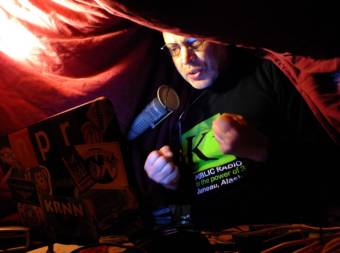
Matt Miller has been the voice of KTOO’s morning news since 1998. Thursday, Sept. 30 2021 was his last day hosting Morning Edition at the station.
Matt Miller has been the voice of KTOO’s morning news since 1998. Thursday, Sept. 30 2021 was his last day hosting Morning Edition at the station. (Photo courtesy of Matt Miller)

Matt Miller has been the voice of KTOO’s morning news since 1998. Thursday, Sept. 30 was his last day hosting “Morning Edition” at the station. Reporter Bridget Dowd will be filling in as host for at least the month of October.
But before Matt stepped away, he sat down with Bridget to talk about what the job has meant to him and look back on some of his favorite memories.

Read a transcript of the conversation with minor edits for clarity.

Bridget Dowd: What’s been the hardest part of your job?

Matt Miller: It’s basically getting up at 3:20 every morning, and having to have two alarm clocks set in order to get up. When the weather’s really bad in the winter, sometimes it’s a little bit of a trek to get across the Douglas Bridge in order to get in on time before the first newscast. That’s kind of the hardest thing. It’s overturned my sleep schedule and you don’t have much of a social life because you’re going to bed at about the same time that everybody else is out having fun at night.

Bridget Dowd: What’s been the best part of your job?

Matt Miller: Best part of the job is being able to talk and connect up with the people of Juneau and bring them the stories that I think that they need to hear in order to start their day. Radio is a real powerful medium and when you’re producing stories for radio, you’re taking advantage of the listener’s own imagination to draw a picture that’s probably more indelible sometimes than perhaps television and even print.

Bridget Dowd: What has it been like to be Juneau’s first connection to what’s happening every day? Has it changed what it’s like to live here for you?

Matt Miller: It’s been fun. Like I said before, I like connecting with the Juneau audience. As a result, I’ve become a little bit more connected, since I’ve been here, to the community. I’ve stayed here a lot longer than I thought I was going to stay and I’ve kind of put down roots. So I’ve really come to appreciate the community and the people since I’ve been here and since I’ve worked here at KTOO.

Bridget Dowd: Do you have any stories from trekking to the office early in the morning or interesting things that happened during your early morning shift?

Matt Miller: There’s probably a lot of little different things that have happened — not really significant — it just kind of comes as part of the job. I remember one day, in this particular studio, which is the air studio for Morning Edition, being live on the air and because of construction that was underway at the time, a board that was behind the door fell down and essentially locked us all out of the studio while we were live on the air. So that was a little frustrating, a little bit of a panic, there’s only one door into the studio, for those who don’t know, and there’s no other way to get in here. 

One of my memories of getting to the station early in the morning, I think that really kind of sticks with me, is one night, we had a real heavy snowfall and the plow trucks had not been out. I couldn’t get my truck out of the driveway and even drive to work. So I had to put on snowshoes and just kind of hoof it into the station, you know, in a blizzard. 

Bridget Dowd: That’s a very uniquely Alaskan thing to do. What’s the strangest story you’ve covered?

Matt Miller: There was an event, several years ago, that included some people who had just kind of plopped into town. It was kind of nebulous. It wasn’t quite clear what it was they were doing, but they were soliciting donations of merchandise, from local businesses for this undefined event. There are a lot of good organizations in town for fundraising purposes that go to local businesses for this sort of thing, but the people who came into town were obviously from out of town. 

As it turned out, this merchandise was being used as prizes in order to lure people into this kind of Evangelical revival type of event, which was spearheaded by this kind of D-list community access TV Evangelist, who had come up here and that was kind of the strangest thing.

Bridget Dowd: What’s your favorite story you’ve covered? 

Matt Miller: So when I first started here at KTOO, one of the things that was kind of not really well known was a shipwreck that happened just north of Juneau, a century ago now. That was the wreck of the Princess Sophia. I did a mini documentary and a couple of features on that. 

Some other things that I’ve had an interest in and it’s really been satisfying, you know, working on stories that have an impact on Alaskans. 

One of them was about 2014 or 2015, there was something really weird that was happening in the North Pacific and Gulf of Alaska with water temperatures and there was nobody else covering it and nobody else doing stories about that at the time. It turned out to have enormous impacts on seabirds, marine mammals and whales and fin fish in the state and that of course was “the blob.” 

Other stories that are really satisfying are ones that, when it comes to the court system and the justice system in the state, where there are issues with the pandemic and trials being postponed or budget cuts and people not getting the legal aid that they need in order to pursue their own legal issues. That’s really been fun and fulfilling to do stories like that. 

Bridget Dowd: I’m gonna throw another one in here really quick because I know you’ve been sort of the natural disaster reporter around here. You seem to be the avalanche guy, the every disaster kind of guy. How did you get an interest in that and how did that start?

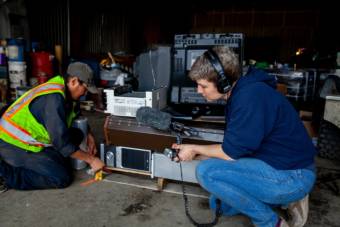
Matt Miller was recording audio for a story on ice self-rescue techniques when he was challenged to put on a dry suit and try it himself.
Matt Miller was recording audio for a story on ice self-rescue techniques when he was challenged to put on a dry suit and try it himself. (Photo courtesy of Matt Miller)

Matt Miller: I don’t know if one particular event started that or one particular story started that. I do remember several years ago that Capital City Fire Rescue put on a one day crash course firefighting training for members of the media and the assembly. I took part in that and that kind of spawned a whole bunch of different stories and kind of solidified the connection to emergency services and disasters, if you will. That kind of evolved eventually into, like you said, avalanches and, you know, search dog training and that sort of thing.

Bridget Dowd: Is there anything else that you want to say to the people who’ve been listening to you for so long?

Matt Miller: Just thanks for listening. Keep listening to KTOO. We have a crack team here in the news department who are probably not only best in Southeast, but probably the best in the entire state. Even if I’m gone, they will continue to bring you the news and information that you need. Just keep listening and I’ll be around in town for a while at least anyways.

Bridget Dowd: All right, well, thank you for sitting down and talking to me and I know a lot of people are going to miss you. So best of luck and in anything you do next.

Matt Miller: Thank you. Thank you very much.

It’s not a typo: Why we are using ‘Lingít’ instead of ‘Tlingit’

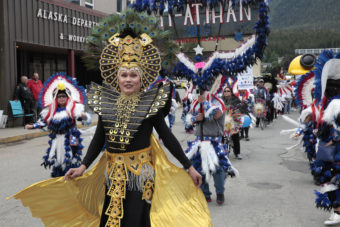
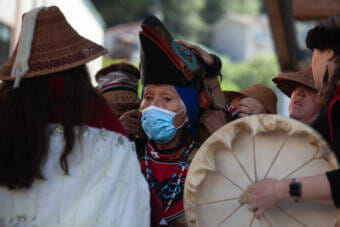
Several Lukaax.ádi clan dancers help Nathan Jackson Yéil Yádi (Raven Child) into his regalia during a stamp dedication for artist Rico Lanáat’ Worl’s new postage stamp “Raven Story,” on Friday, July 30, 2021 in Juneau, Alaska. (Photo by Rashah McChesney/KTOO)

Lingít or Tlingit — no matter how you spell it — is the name of one of the Indigenous groups of people of Southeast Alaska and the name of their language. In the language itself, it’s spelled Lingít.

The letter “l” in Lingít, though, is pronounced by placing the tip of your tongue on the roof of your mouth and blowing air out the sides of your tongue. It’s also not vocalized, meaning you don’t engage your vocal chords; you just blow air like you would for a “t” or a “k” in English. That’s why you’ll see the name of the language and the people spelled “Tlingit” in English. The closest sounds in English are “tl” or “kl,” so you’ll hear it pronounced “TLING-it” or “KLING-it.”

Tlingit is the accepted English spelling of the language and we do write and present news in English. But KTOO supports the normalization and familiarization of the Lingít language, especially in the region that includes and surrounds Juneau known as Lingít Aani or “land of the Tlingit.”

We use Lingít words to convey respect for the people whose homelands we live and work on. Using Lingít and trying our best to pronounce Lingít words accurately is one of the ways we are trying to lift up the voices of people who have been underrepresented on our airwaves.

Gunalchéesh (thank you!) for your patience as we learn and put that knowledge into practice.

KTOO’s source diversity report from the last quarter of 2020

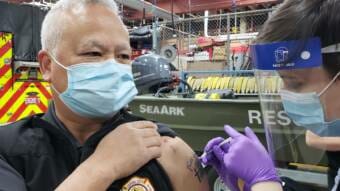
Asst Chief Ed Quinto and Lily Kincaid COVID vaccination
Capital City Fire/Rescue paramedic Lily Kincaid injects a dose of Pfizer’s COVID-19 vaccine into Assistant Chief Ed Quinto’s arm at the downtown station in Juneau on Dec. 17, 2020. Quinto said he didn’t have any anxiety about it and it felt like just another shot. (Photo by Jeremy Hsieh/KTOO)

In the summer of 2019, KTOO commissioned a source audit, or a report on the demographics of the people we talk to for KTOO news stories and the guests we have on Juneau Afternoon.

Now, we ask everyone who appears in a news story or is a guest on Juneau Afternoon to identify their gender and their race and/or ethnicity. We do this in order to understand whose voices we are relying on too much and whose voices we might be leaving out.
We’ve just finished compiling our 4th quarter report of 2020, which includes most of the lengthy election season, the arrival of the COVID-19 vaccine in Alaska, and extreme weather in Southeast Alaska that displaced dozens of people and killed two residents in Haines.

For the period from Oct. 1st through Dec. 31st, 2020:

  • There were 376 total sources
  • 242 appeared in news stories
  • 134 appeared on Juneau Afternoon
  • 77% of sources self-identified their gender
  • 80% of sources self-identified their race and/or ethnicity

Gender

In total, 57% of our sources for the quarter were male. The percentage was slightly higher than that for news sources, but for Juneau Afternoon, female voices were the majority at 51%.

In the KTOO newsroom we are engaged in an ongoing conversation on including more female sources in our reporting, especially subject matter experts. It is especially difficult to keep the balance during events like a general election, where we don’t have any control over who is running for office or the fact that there are frequently more men than women in political races.

A graph showing the gender breakdown of sources who appeared on KTOO programs Oct - Dec 2020


We always look at subject matter expertise at this point because it helps clarify some of the gender numbers. Most of the guests on Juneau Afternoon for the quarter were non-expert members of the general public, which means that they are not pre-sorted by gender in the same way that subject experts are.

For the news department, 39% of the sources were either elected officials or government spokespeople and 8% were politicians, who are more likely to be male. That makes sense given that all three months in the reporting period were dominated by election coverage.

A chart showing the subject matter expertise of KTOO sources from Oct - Dec 2020

Ethnicity

In general, the number of our sources who identify as white-only has stayed roughly the same since we started reporting (between 75% and 84%) but at 72%, this period had the lowest overall. That’s mostly due to the weekly addition of Juneau Afternoon hosts from the Black Awareness Association of Juneau, which has made Black voices the majority on the program. Sources for news stories, however, were 85% white.

In the news department, the largest percentage of non-white sources was Alaska Native, at 8%.

Across all of our programs and stories, there continues to be very little in the way of Asian, Latinx and Hawaiian/Pacific Islander voices. This is especially concerning with the rise of hate crimes against members of the Asian American and Pacific Islander community in the past year. We know we need to do better.

One thing we always look at when we look at the racial and ethnic make-up of our sources is the focus of the story. The mix changes when the story or program has a focus on race.

Stories that are not about race tend to feature the most white-only voices and we start to see Black and Indigenous sources appear in stronger numbers when the story addresses race or is about race. While this is one way to get more diverse voices on the air, it’s a very limited way of changing the overall inclusivity of our stories.

A graph showing the breakdown of the race of KTOO sources by story focus for Oct - Dec 2020

What’s Next?

We’re learning Lingít , the Tlingit language! Thanks to a grant from the Alaska Community Foundation, the entire staff at KTOO is taking a semester-long language class with X̱ʼunei Lance Twitchell.

As a publicly owned media organization, it is our job to reflect the community we serve. Language is culture, and even with a very basic, entry-level understanding of the language, we hope we can do a better job at serving more of our audience’s informational needs. Also, as more places and individuals in our broadcast area reclaim their Lingít names, we have an obligation to properly pronounce them on the air, spell them correctly online and understand their meanings.

It will be interesting to see if this deeper understanding and connection to the land will yield new sources or story ideas for KTOO.

The Best of KTOO News 2020

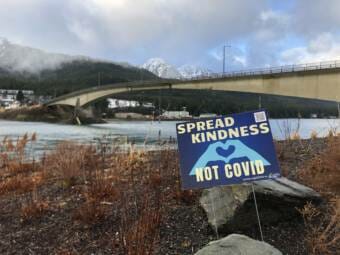
A City & Borough of Juneau sign reads "Spread Kindness, Not COVID." Photographed Nov. 26, 2020, at Overstreet Park.
A City & Borough of Juneau sign reads “Spread Kindness, Not COVID.” Photographed Nov. 26, 2020, at Overstreet Park. (Jennifer Pemberton/KTOO)

Almost everything we reported on this year falls into the categories of pandemic, election, racial justice or weather. We relentlessly covered the big events that defined the year. We started reporting on potential impacts of COVID-19 before it reached Alaska and eventually we reported on the pandemic daily, including the arrival of the first vaccine in Juneau.

We covered Juneau’s first all by-mail election and then the Alaska primary and then the general election and the glacially slow weeks of ballot counting that followed.

We were at the protest in Juneau after George Floyd was killed in Minneapolis — quite possibly the city’s largest demonstration ever. And we were at the virtual rally hosted by Central Council of Tlingit and Haida Tribes of Alaska with hundreds of others.

We were there when the beautiful new CCFR ambulance was unveiled with its new formline paint job.

We were out before the sun rose in early December when record-breaking rain caused flooding and landslides all over town and then we shifted our focus to Haines when it was clear that things were much worse there.

But first, some stories that are not about those things. These are the five most popular stories on our website this year and they are all the result of original reporting by KTOO reporters. And in my honest opinion they are very deserving of the attention they got.

Top Five KTOO stories of 2020

1. Neiman Marcus is getting sued for selling a ‘Ravenstail Knitted Coat’ for $2,500 (by Elizabeth Jenkins)

Sealaska Heritage Institute filed a lawsuit in April against Neiman Marcus, alleging the company copied a traditional Ravenstail pattern when it produced a coat that retails for more than $2,500. SHI president Rosita Worl called it “one of the most blatant examples of cultural appropriation and copyright infringement” she’d ever seen. It is thought to be the first time a business has been sued in the U.S. for copying a traditional Indigenous pattern.

2. Cruise ships dumped more than 3 million pounds of trash in Juneau last year (by Adelyn Baxter)

At a public hearing back in January, a Juneau resident listed a few of the items taken from cruise ships to the landfill last year, including bedding, furniture and even slot machines. It turns out more than 3 million pounds of garbage came off of the ships during the cruise season in 2019 and ended up at the dump. That’s concerning, especially since the local landfill is expected to be full in 20 years.

3. Mother of all jökulhlaups reported in Southeast Alaska (by Matt Miller)

Lituya Glacier terminus

Jim Moore was fishing for Chinooks in Lituya Bay in August. The water was muddy, full of trees and icebergs, which he says he hadn’t seen since the 70s. He said it was “spooky.” A National Park Service geologist solved the mystery by looking at satellite imagery and said that it was caused by water breaching a giant ice dam and flowing under a glacier and into the river — the equivalent flow of the Amazon River each hour. No one might have known it happened if it weren’t for Jim Moore’s observations.

4. The runway lights broke, but Igiugig guided in a child’s medevac plane with headlights (by Rashah McChesney)

Vehicles light Igiugig's runway on Friday, August, 28, 2020. (Photo courtesy Ida Nelson)

In August, a child in Igiugig in Southwest Alaska needed to be medevaced, but the village’s runway lights wouldn’t turn on. People could hear the plane circling overhead, but it couldn’t land because it couldn’t find the runway. A local woman, Ida Nelson, got up out of bed and jumped on her four-wheeler to see if she could help. She called more than 30 people and they all lit up the runway with their headlights. The plane was able to land, get the patient and take off again for Anchorage.

5. What does this sign even mean? (by Jeremy Hsieh)

In July, a guy in Juneau was hiking on the Windfall Lake trail and there was a sign that said “Poop pumping. Hike at your own risk.” It had the U.S. Forest Service logo on it, but that was it. That was the whole sign. Jeremy Hsieh looked into it and learned about how the Forest Service hires helicopters to take human waste out from the outhouses at Juneau’s most popular cabins. Program manager Ed Grossman said that they don’t mention helicopters on the sign because “people are attracted to the show,” and if they know “it’s a pumping-human-waste event,” there probably won’t be a crowd.


We have four priority areas for our news coverage. Here is the most popular, impactful and important reporting for each of them.

Juneau’s cruise ship docks are empty on April 23, 2020. The cruise ship season was supposed to begin, but sailings have been suspended due to the coronavirus pandemic. (Jennifer Pemberton / KTOO)

Best reporting on tourism and Juneau’s economy

  1. Cruise ship will arrive early in Juneau after canceled Asia sailings (by Adelyn Baxter)
  2. Everyone got tested, but Alaska’s only cruise this year still came back with COVID-19 on board (by Jennifer Pemberton)
  3. Seasonal workers laid off by pandemic get to work improving local trails in Juneau (by Adelyn Baxter)
Bartlett Regional Hospital RN Katie Church demonstrates the correct way to put on an N95 mask on Monday, April 7, 2020 in Juneau, Alaska. The city hospital is preparing for an influx of COVID-19 patients. (Photo by Rashah McChesney/KTOO)

Best reporting on the pandemic and its impacts on health, schools and society

  1. How the ‘infodemic’ is playing out in Juneau (by Jeremy Hsieh)
  2. Juneau’s hospital sees surge in kids experiencing mental health crises (by Adelyn Baxter)
  3. They sanitized, screened, quarantined and they still got COVID-19 (by Adelyn Baxter)
Lacey Davis joined about 250 people gathered for a public “I Can’t Breathe” rally protesting the death of a black man, George Floyd, who was killed after a white officer pressed a knee into his neck while taking him into custody in Minnesota. People held signs decrying violence against black people and calling out institutional racism, many supporting the Black Lives Matter movement on Saturday, May 30, 2020 in Juneau, Alaska. Similar protests happened throughout the state with hundreds turning out in Fairbanks and Anchorage, they’ve also erupted in dozens of cities all over the country. (Photo by Rashah McChesney/KTOO)
Lacey Davis joined about 250 people gathered for a public “I Can’t Breathe” rally protesting the death of George Floyd. People held signs decrying violence against black people and calling out institutional racism, many supporting the Black Lives Matter movement on Saturday, May 30, 2020 in Juneau, Alaska. (Photo by Rashah McChesney/KTOO)

Best reporting on social justice

  1. A former student speaks out about racism in Juneau schools; administration says it’ll do better (by Pablo Arauz Peña):
  2. Another staffer at Lemon Creek Correctional Center tests positive, as inmates ask for more cleaning supplies (by Adelyn Baxter)
  3. Neighbors push back on plans for cold weather shelter for Juneau’s unhoused (by Rashah McChesney)
Voters fill out their ballots just an hour before voting was to end in Juneau's municipal elections on Oct. 6, 2020, at Juneau Public Libraries' Valley Branch. Most voters cast their votes by mail, but some went to vote in person. (Photo by Andrew Kitchenman/KTOO and Alaska Public Media)
Voters fill out their ballots just an hour before voting was to end in Juneau’s municipal elections on Oct. 6, 2020, at Juneau Public Libraries’ Valley Branch. Most voters cast their votes by mail, but some went to vote in person. (Photo by Andrew Kitchenman/KTOO and Alaska Public Media)

Best reporting on state government, politics, economy

  1. More than a quarter of Alaska communities haven’t claimed state CARES Act grants. Why not? (by Andrew Kitchenman)
  2. In close races, results in Alaska not expected for at least a week after Election Day (by Andrew Kitchenman)
  3. Gov. Dunleavy believes President-elect Biden has ‘outside chance’ of becoming next president (by Andrew Kitchenman)

‘Just change something’: KTOO’s latest quarterly source diversity report

Capital City firefighters Cat Pearson, Jannelle Pine, and Sadie Inman in hazmat gear. The three women are part of Juneau’s all-female team of first responders. (photo courtesy of Sadie Inman, CCFR)

In the summer of 2019, KTOO commissioned a source audit or a report on the demographics of the people we talk to for KTOO news stories and the guests we have on Juneau Afternoon.

Last October, we started asking everyone who appeared in a news story or was a guest on Juneau Afternoon to identify their gender and race and/or ethnicity.

Here’s what our first report in late 2019 revealed about who we’ve been interviewing. And here’s what 2020 has looked like so far: first quarter (January – March) and second quarter (April – June).

We’ve just finished compiling our third-quarter report, which includes reporting from our “new normal” pandemic life and the ramp-up to the 2020 election.

For the period from July 1 through September 30, 2020:

  • There were 404 total sources
  • 265 appeared in news stories
  • 125 appeared on Juneau Afternoon
  • 82% of sources self-identified their gender
  • 74% of sources self-identified their race and/or ethnicity


Gender

We did it! We reached gender equality. Well, not really, but our sources were split evenly between men and women for the first time since we started keeping track.

Look at the difference between news sources and Juneau Afternoon guests. This quarter is actually the best showing we’ve had for female sources in news stories: that 43% has been more like one-third in previous reports. And of the Juneau Afternoon who responded to the question, a whopping 80% were women.

chart showing the gender breakdown of KTOO sources for 2020 Q3

We always look at subject matter expertise at this point because it helps clarify some of the gender numbers. Half of Juneau Afternoon guests for the quarter were non-expert members of the general public. This means they weren’t representing an organization or promoting an event. They are just normal people talking on our daily community program about their lives. But given that, it is puzzling to me that 80% of the show’s guests were women.

Considering that this period includes the months leading up to a big deal general election, I’m pleased to see that only 5% of our news sources were politicians or political candidates. There’s still a strong tendency to talk to government and elected officials, but there’s still a nice mix of expert and non-expert voices in a variety of fields represented here.

chart showing the subject matter expertise of KTOO sources for 2020 Q3

Race & Ethnicity

In general, the number of our sources who identify as white-only has stayed the same since we started tracking over a year ago, ranging from 75% – 84%.

The real development this quarter was the addition of Juneau Afternoon hosts from the Black Awareness Association of Juneau. They’ve been running the show on Thursdays for a few months and that’s really increased the representation of Black voices on the program.

Across all of our programs and stories, there is still very little in the way of Asian, Hispanic/Latinx and Hawaiian/Pacific Islander voices.

chart showing the race and ethnicity of KTOO sources for 2020 Q3

One thing we always look at when we look at the racial and ethnic makeup of our sources is the focus of the story. The mix changes when the story or program has a focus on race.

Stories that are not about race always feature the most white-only voices and we start to see Black and Indigenous sources appear in stronger numbers when the story addresses race or is about race. While this is one way to get more diverse voices on the air, it’s a very limited way of changing the overall inclusivity of our stories.

chart showing the race and ethnicity of KTOO sources broken down by story focus

What’s next?

In addition to sharing all this information with you, our audience, every quarter, we also dive into it as a team. It has not been easy to set goals around our source diversity, but it is easy to see that there’s so much incentive here to try and do things differently. And as NPR’s Chief Diversity Officer Keith Woods, who has been guiding us through some of this work says, “just change something.” It doesn’t matter what. The possibilities are endless and there’s a big ol’ world out there of voices in our community that deserve to and demand to be heard.

Here are a few examples of thoughtful, inclusive sourcing:

  • There were only two women on Juneau’s COVID-19 Conservation Corp working at Eaglecrest this summer and Adelyn Baxter made sure to talk to one of them for this story
  • Talking to teachers and parents of school-aged kids is one way to make sure we’re hearing from women in our community.
  • Pablo Arauz Peña highlighted the artwork on Juneau’s new ambulance and included interviews with the female Tlingit artists behind the design.
  • Rashah McChesney knew there would be plenty of women at the Ruth Bader Ginsburg vigil in Juneau and was able to interview a mother and daughter for this story.
  • In August, KTOO partnered with the Black Awareness Association of Juneau to help us host and source Juneau Afternoon a few programs each month. You can find these rich discussions on the program page. 
  • In July, Sheli Delaney profiled Juneau’s all-female team of first-responders.
  • Rashah McChesney interviewed photographer Brian Wallace, who is Tlingit, for an hour-long special on Juneau Afternoon.
  • Scott Burton had Haines-based Henry Nalimu Leasia, who is Pacific Islander, on Juneau Afternoon to play live music and talk about his new album.
  • In August KTOO aired the fourth episode of Lingít Aaní Káa Kei Nas.áx̱ Haa Yoo X̱’atángi (Our Language Is Sounding Off on Tlingit Land), a show and associated language lessons that seek to open the radio waves to Tlingit-language use and normalization

What to expect when you’re expecting election coverage from KTOO

Voters sign for their ballots at the Auk Bay precinct on Tuesday, Nov. 3, 2020, in Juneau, Alaska. (Photo by Rashah McChesney/KTOO)

This is a note to the KTOO audience from VP News & Managing Editor Jennifer Pemberton.

Back in early September, reporter Andrew Kitchenman and I attended an online election prep course called “The Weirdest Election Day Ever,” but KTOO’s news team started prepping for today long before that.

Like preppers who actively prepare to survive major disruptions, we’ve been anticipating the potential social disorder or other big news events that could be awaiting us.

Here’s our plan for making sure you get timely, fair and accurate news from KTOO today…and in the news-heavy days to come:

  • We take the time to fact check everything we report and make sure it goes through multiple edits so that several people besides the reporter read through the story to make sure it’s accurate, fair and understandable.
  • We care about being right and not necessarily being first– especially when it comes to something like elections. You might hear or see reporting from other outlets first. That’s okay. We’re seeing them, too, but will wait until we can confirm the reporting ourselves.
  • We’ll be up late. A team of KTOO reporters and our partners at other stations across the state will be updating our websites and writing news stories for the morning until at least midnight here in Alaska. And when that team heads off to bed, some fresh journalists will take over in the morning.
  • We will follow NPR’s lead and rely on The Associated Press (AP), a news organization with a track record of fairly and accurately calling election results. For races that aren’t covered by the AP, we’ll wait until all votes are counted.
  • We will keep you frequently updated throughout Election Day and Night, but we will not speculate or project any results. We’ll keep reporting on the counting process until there’s a clear winner — even though that could be days or weeks away.
  • When we make mistakes, we will correct them as soon as possible. When that mistake is on the web, we correct it on the web. When it’s on the air, we correct it on the air. When it’s in a social media post, we correct it on social media.
  • We’ll bring you live national coverage from NPR from 4:00 – 9:00 PM on Nov. 3 and then live statewide coverage from our partners at Alaska Public Media from 9:00 – 11:00 PM.
  • We’ll be updating an elections results post on KTOO.org starting at 4:00 PM on Nov. 3. NPR’s elections results map as well as vote counts for Alaska’s national races and ballot measures will be available at KTOO.org/elections starting at 4:00 PM on Nov. 3.
Site notifications
Update notification options
Subscribe to notifications