
NPR News

ICE Now Admits It Released More Than 2,000 Undocumented Immigrants Due To Budget

Immigration and Customs Enforcement (ICE) Director John Morton, center, testifies before the House Homeland Security Subcommittee in Washington, D.C. Win McNamee/Getty Images

Backpedaling, the Obama administration is now admitting that it released more than 2,000 undocumented immigrants from immigration jails because of budget contraints prompted by the sequester.

Earlier, the Associated Press ran a story citing the number, but officials from Immigration and Customs Enforcements said the number was actually in the hundreds. The 2,000 number included routine ins and outs, ICE said in a statement disputing the AP report.

But today, the director of U.S. Immigration and Customs Enforcement, John Morton, told a congressional panel the agency released 2,228 people from immigration detention centers across the country for “solely budgetary reasons.”

The AP adds:

“After the administration had challenged the AP’s reporting, ICE said it didn’t know how many people had been released for budget reasons but would review its records.

“Morton, who testified with two other agency officials, told lawmakers that the decision to release the immigrants was not discussed in advance with political appointees, including those in the White House and Homeland Security Secretary Janet Napolitano. He said the pending automatic cuts known as sequestration was ‘driving in the background.'”

As we reported, Republican lawmakers criticized the administration for the move. House Speaker John Boehner, a Republican from Ohio, said the release of immigrants was “outrageous.”

“Morton said that although the most serious offender category can include people convicted of aggravated felonies, many of those released were facing financial crimes,” the AP reports. “Those released include immigrants who had faced multiple drunken driving offenses, misdemeanor crimes and traffic offenses, Morton said.”


Read original article

ICE Now Admits It Released More Than 2,000 Illegal Immigrants Due To Budget

’47 Percent’ Video Maker: ‘Didn’t Go There With A Grudge Against Romney’

The man who videotaped 2012 Republican presidential nominee Mitt Romney infamous comments about the “47 percent” has stepped out of the shadows.

He’s bartender Scott Prouty, who was working last May at the Romney fundraiser in Boca Raton, Fla., when the candidate made comments that in September would come back to haunt him after Prouty’s tape surfaced on the Internet. Romney came under withering fire from President Obama’s campaign and other liberals for saying that 47 percent of voters would never support him and that they are those who are “dependent upon government … believe that they are victims … believe the government has a responsibility to care for them … [and] pay no income tax.”

On the openly liberal MSNBC Ed Show Wednesday night, Prouty said “I didn’t go there with a grudge against Romney.”

He did, though, go with the intention of recording Romney’s remarks. “A lot of other people had brought cameras” as well, Prouty said.

Prouty also came to the fundraiser with a feeling about Romney based on a previous encounter. He told the liberal-leaning Huffington Post that “he had actually met Romney at a previous fundraiser, held months before.”

“I handed him a diet Coke with lemon on it,” Prouty told Huffington Post, “because I was told that that’s what he drank. … He took it and turned and didn’t say anything. … I presented him the exact right drink that he wanted … Had it there, sitting there on a napkin. He took it out of my hand and turned his back without a ‘thank you’ or anything else. … You can tell a lot about someone the way they take a drink from you. … [Romney] took it and just turned his back.”

About two weeks after the fundraiser, Prouty said, he decided he wanted to share the video. He’s an admirer of liberal writer David Corn’s reporting, and got in touch with someone who had done research for Corn — James Carter, a grandson of former President Jimmy Carter. That led to the surfacing of the tape and the brouhaha over the “47 percent.”

Visit NBCNews.com for breaking news, world news, and news about the economy

Read original article

’47 Percent’ Video Maker: ‘Didn’t Go There With A Grudge Against Romney’

‘Over A Year Or So’ Before Iran Could Develop Nuclear Weapon, Obama Says

Putting a more specific estimate that he has in the past on the issue of how long it might take Iran to develop a nuclear weapon, President Obama has told Israel’s Channel 2 TV that it could happen in “over a year or so” if efforts to dissuade Iran do not succeed.

The president also said that while he wants to resolve the issue diplomatically, he is keeping “all options on the table.”

For its part, Iran has long said its nuclear program is only aimed a peaceful uses for that energy source.

CNN has a video clip from the interview, which aired in Israel on Thursday. The president is due to make a visit to Israel next week.

Obama repeats in the interview that a nuclear-armed Iran is a “red line for us.” Then, he adds that “right now, we think that it would take over a year or so for Iran to actually develop a nuclear weapon. … Obviously we don’t want to cut it too close. … What we’re going to be doing is to continue to engage internationally with Iran, understanding that we’ve set up the toughest sanctions ever. … If we can resolve it diplomatically, that’s a more lasting solution. But if not, I continue to keep all options on the table.”

The New York Times notes that “Obama’s estimated timeline contrasts with [Israeli Prime Minister Benjamin] Netanyahu’s stated belief that Israel and its Western allies are likely to have to intervene by the spring or summer, when, he says, Iran’s scientists will have enriched enough uranium to become a nuclear threat. … The question of how close Iran is to being able to use a nuclear weapon has generated friction between the two leaders and will be at the center of their security discussions.”

Read original article

‘Over A Year Or So’ Before Iran Could Develop Nuclear Weapon, Obama Says

More Problems Aboard Carnival Cruise Ships

Carnival Dream docked in St. Thomas, U.S.VI. in December 2010. Andy Newman/Associated Press

For the past month, management at Carnival Cruise Line has been in a nearly constant state of damage control.

In the past week alone, three of the cruise line’s giant floating playgrounds have experienced embarrassing malfunctions that have at least inconvenienced, if not angered many passengers.

Here’s the latest status report: On Saturday, Carnival Elation had to be escorted by tug because of a problem in its steering system. Since Wednesday, Carnival Dream has experienced power interruptions at the island of St. Maarten, stranding more than 4,000 passengers. And now, Carnival Legend is limping home to Tampa at reduced speed because of an issue with one of its propulsion units.

All this, of course, follows by barely a month the so-called ‘cruise from Hell’ aboard the Carnival Triumph after an engine room fire left the vessel adrift in the Gulf of Mexico with 4,200 passengers aboard.

Christopher Muller, of Boston University’s School of Hospitality, tells CNN that the latest wave of issues at Carnival appear to be a management problem.

“They are doing something wrong with preventative maintenance,” he says. “Carnival has so many working ships that to say the fleet is in distress is maybe a little bit broad, but clearly something is not right.”

Carnival has blamed the problems aboard the Carnival Dream, docked in St. Maarteen, on a malfunction that occurred in the ship’s emergency diesel generator during a routine safety test.

“At no time did the ship lose power and the ship’s propulsion systems and primary power sources were not impacted,” Carnival said on its website. “However, for a period of time last night, there were interruptions to the elevators and restroom services. Toilets and elevators are currently working, and have been since about 12:30am.”

On Friday, the cruise company announced that 12 commercial planes would take the Carnival Dream 4,363 passengers back to Orlando – the closest major airport.

The Carnival Legend’s problems, though at sea not in port, appear to be more in the way of an inconvenience. One of the ship’s two Azipods, a directional propulsion unit, was experiencing an unspecified “technical issue” which has forced the ship to reduce its speed.

Even before the latest problems, questions have been raised about the cruise industry in general and specifically Carnival, the largest line in the industry.


Read original article

More Problems Aboard Carnival Cruise Ships

In Partisan Vote, Senate Committee OKs Ban On Assault-Style Weapons

Assault-style rifles on display at Chuck's Firearms gun store in Atlanta. Erik S. Lesser /EPA /Landov
Assault-style rifles on display at Chuck’s Firearms gun store in Atlanta. Erik S. Lesser /EPA /Landov

By a 10-8, party-line vote with Democrats in favor and Republicans opposed, the Senate Judiciary Committee on Thursday moved legislation that would revive the ban on assault-style weapons that expired in 2004.
The vote, while expected, remains noteworthy because it is among a handful of legislative responses so far to the mass shootings in recent years — most notably the Dec. 14 attack on an elementary school in Newtown, Conn., that left 20 children and six educators dead.

The bill, sponsored by Democratic Sen. Dianne Feinstein of California, now goes to the full Senate — where it is not expected to get enough support to pass. The ban also lacks support in the Republican-controlled House.

Earlier this week, the Judiciary Committee — also on a party-line vote — approved a bill that would expand background checks of gun purchasers to sales between private parties. Last week, the committee voted 11-7 for a bill that would make gun trafficking a federal crime carrying long prison terms. Sen. Charles Grassley of Iowa was the sole Republican supporter.

The Committee members:

Democrats

— Patrick Leahy of Vermont (chairman)

— Feinstein

— Charles Schumer of New York

— Richard Durbin of Illinois

— Sheldon Whitehouse of Rhode Island

— Amy Klobuchar of Minnesota

— Al Franken of Minnesota

— Christopher Coons of Delaware

— Richard Blumenthal of Connecticut

— Mazie Hirono of Hawaii

Republicans

— Grassley (ranking minority member)

— Orrin Hatch of Utah

— Jess Sessions of Alabama

— Lindsey Graham of South Carolina

— John Cornyn of Texas

— Michael Lee of Utah

— Ted Cruz of Texas

— Jeff Flake of Arizona


Read original article

In Partisan Vote, Senate Committee OKs Ban On Assault-Style Weapons

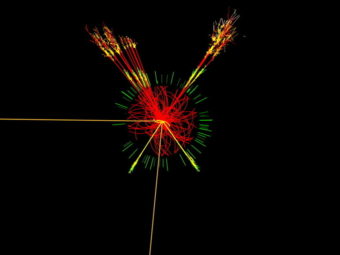
‘God Particle’ Update: Scientists Think They’ve Pinned Down The Higgs Boson

This is what researchers at the ATLAS detector at the Large Hadron Collider expect a Higgs boson to look like. The Higgs boson is the subatomic particle that scientists say gives everything in the universe mass. ATLAS Experiment/CERN

“Scientists working with data from a large particle accelerator in Europe are now almost certain they have pinned down the elusive sub-atomic particle known as the Higgs Boson,” NPR’s Joe Palca tells our Newscast Desk.

Or, as it’s also known, the “God Particle” (more on that moniker below).

Joe reports that:

“The Large Hadron Collider sits in a 17-mile long circular tunnel straddling France and Switzerland. There are two scientific instruments called detectors located at distinct points around the tunnel. These detectors measure the debris when larger atomic particles are smashed together. Now, scientists have analyzed results from both these detectors, and both have seen a particle consistent with what theoretical models have predicted would be the Higgs Boson.

“Although the result is gratifying in the sense that the collider was built largely to find the Higgs, finding it exactly as predicted is a little disappointing. Finding something that wasn’t predicted would mean there’s an entire new field of physics is waiting to be discovered.”

OK, we realize this is complicated — and that as scientists do, the geniuses at the European Organization for Nuclear Research, or CERN, are leaving themselves some wiggle room. This is from their announcement Thursday:

“Having analysed two and a half times more data than was available for the discovery announcement in July, they find that the new particle is looking more and more like a Higgs boson, the particle linked to the mechanism that gives mass to elementary particles. It remains an open question, however, whether this is the Higgs boson of the Standard Model of particle physics, or possibly the lightest of several bosons predicted in some theories that go beyond the Standard Model. Finding the answer to this question will take time.”

To help us all better understand this, let’s look back to an exchange Eyder had last June with 13.7 blogger Adam Frank:

Q: I’ve heard many metaphors for what this Higgs boson is. A basic explanation is that it’s the thing that gives subatomic particles their mass. The best metaphor I’ve heard is from Fermilab’s Don Lincoln, who says the energy field made by the Higgs is like water. Depending on your mass you’ll move through the water with ease — like a barracuda — or slowly, like a big, fat man. How would you explain the Higgs to a friend at a bar?

A: In a bar, I’d probably use one of those analogies. The real important thing for me is that fundamental particles are as far as we can tell zero-dimensional particles. They have no radius. You can’t think of fundamental particles as being glass marbles. They literally have no extension in space. They can never bump into anything else.

It’s all about interactions. It’s about them exchanging other particles as forces. With a particle like the electron — what gives the electron mass is really inertia, that’s the property that we associate with massive particles. Mass and inertia go together.

So since an electron or a quark has no extension in space, you sort of wonder where did the mass go? Well it’s not that the mass resides with the electron or the proton. It’s that the mass comes from its interaction with other things. And in this case, it’s the Higgs field that gives this point particle — the electron — the appearance of inertia. That is what allows it to act like it’s resisting changes in its motion.

Whereas you have other particles like the photon which has no mass, and because of that it can go at the speed of light, whereas a massive particle will never be able to go at light speed.

Q: So, if the Higgs didn’t exist, what would the world look like?

A: It would all be photons. Everything would be moving at the speed of light, right. Which means at light speed, you wouldn’t be able to have the kinds of structures we see today. You’d never get atoms and chemistry and rocks. So it’s really important. The property of mass is really important for getting clumpy structures, essentially, like us.

Now, about that “God particle” name. As another of 13.7’s bloggers, Marcelo Gleiser, has written, it’s a misnomer:

The God Particle is the title of a popular science book by Nobel Prize winner Leon Lederman, who was Fermilab’s director for many years and thus my boss when I was a postdoctoral fellow there. According to Leon, he wanted to call the book The Goddamn Particle because nobody could find the thing. However, his editor discouraged him from the title, suggesting that The God Particle would sell many more copies. This is the story that Leon tells us.

“In any case, the name stuck. Of course, the particle has nothing godlike about it. It’s a hypothetical particle, part of the so-called Standard Model of particle physics. Its main job is to give masses to all other particles. I guess, in this role, it does have something of a centralizing influence, although nothing quite divine. Its real name, the Higgs boson, honors Scottish physicist Peter Higgs who, in the 1960s, worked on perfecting the details of the mass-giving mechanism.”

Two related posts from Marcelo:

The End Of The Universe, The Higgs And All The ‘Ifs’

Dispatch From CERN: Which Higgs?


Read original article

‘God Particle’ Update: Scientists Think They’ve Pinned Down The Higgs Boson

Site notifications
Update notification options
Subscribe to notifications