NPR News

Pakistan Begins Construction of Pipeline Link With Iran

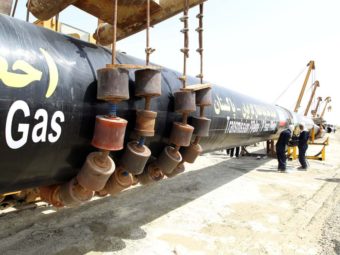
Iranians work on a section of the pipeline on Monday. Atta Kenare/AFP/Getty Images

Iran and Pakistan are moving closer to completion of a nearly 1,000-mile natural gas pipeline linking the two countries, despite U.S. objections that it could become a source of hard currency for Tehran in defiance of international sanctions.

Monday marks the beginning of construction on Pakistan’s part of the pipeline, which will consist of a 485-mile run. Iran has already completed most of its 760-miles of the link, which will stretch from Assaluyeh along Iran’s Persian Gulf coast to Nawabshah in Pakistan’s Sindh Provence.

The pipeline is meant to help alleviate shortfalls in energy demand in Pakistan, where brownouts and blackouts occur daily.

In a live television broadcast Monday, Iran’s Mahmoud Ahmadinejad stood side-by-side with his Pakistani counterpart, Asif Ali Zardari just inside the Iranian border.

Iran reportedly gave Pakistan a $500 million loan for the project, which is expected to cost Islamabad $1.5 billion.

“Today is a historic day. The gas pipeline project is the beginning of a great work,” Ahmadinejad told assembled dignitaries from both countries.

“The Westerners have no right to make any obstacles in the way of the project,” he added.

The U.S. has strenuously objected to the project, which Iran and Pakistan agreed to in 1995. According to the Pakistani media, U.S. Consul General Michael Dodman said in January that the U.S. would impose sanctions on Islamabad if the pipeline went ahead.

“If this deal is finalized for a proposed Iran-Pakistan pipeline, it would raise serious concerns under our Iran Sanctions Act. We’ve made that absolutely clear to our Pakistani counterparts,” State Department spokeswoman Victoria Nuland said during a Washington news conference last week.

Pakistan’s Dawn newspaper reports Pakistani presidential spokesman Farhatullah Babar “brushed aside” U.S. concerns and pressures.

Babar was quoted as saying the project was only about energy requirements.

“The project will bring economic prosperity, provide better opportunities to the people and help defeat militancy,” he told Dawn.

The pipeline was scheduled to begin operations in 2014, but delays have caused construction to fall behind.

Copyright 2013 NPR. To see more, visit http://www.npr.org/.image

Read original article

Pakistan Begins Construction of Pipeline Link With Iran

Past Century’s Global Warming Rates Are Fastest On Record

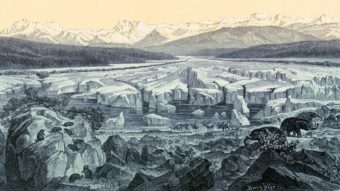
Scientists say they have put together a record of global temperatures dating back to the end of the last ice age, about 11,000 years ago. This historical artwork of the last ice age was made by Swiss geologist and naturalist Oswald Heer. Oswald Heer/Science Source

There’s plenty of evidence that the climate has warmed up over the past century, and climate scientists know this has happened throughout the history of the planet. But they want to know more about how this warming is different.

Now a research team says it has some new answers. It has put together a record of global temperatures going back to the end of the last ice age — about 11,000 years ago — when mammoths and saber-tooth cats roamed the planet. The study confirms that what we’re seeing now is unprecedented.

What the researchers did is peer into the past. They read ice cores from polar regions that show what temperatures were like over hundreds of thousands of years. But those only reveal changes in those specific regions; cores aren’t so good at depicting what happened to the whole planet. Tree rings give a more global record of temperatures, but only back about 2,000 years.

Shaun Marcott, a geologist at Oregon State University, says “global temperatures are warmer than about 75 percent of anything we’ve seen over the last 11,000 years or so.” The other way to look at that is, 25 percent of the time since the last ice age, it’s been warmer than now.

You might think, so what’s to worry about? But Marcott says the record shows just how unusual our current warming is. “It’s really the rates of change here that’s amazing and atypical,” he says. Essentially, it’s warming up superfast.

Here’s what happened. After the end of the ice age, the planet got warmer. Then, 5,000 years ago, it started to get cooler — but really slowly. In all, it cooled 1.3 degrees Fahrenheit, up until the last century or so. Then it flipped again — global average temperature shot up.

“Temperatures now have gone from that cold period to the warm period in just 100 years,” Marcott says.

So it’s taken just 100 years for the average temperature to change by 1.3 degrees, when it took 5,000 years to do that before.

The research team tracked temperature by studying chemicals in the shells of tiny, fossilized sea creatures called foraminifera. Their temperature record matches other techniques that look back 2,000 years, which supports the validity of their much longer record.

Climate scientists predict that the current warming will continue, given the amount of greenhouse gases going up into the atmosphere.

“The climate changes to come are going to be larger than anything that human civilization and agriculture has seen in its entire existence,” says Gavin Schmidt, a climate researcher at NASA’s Goddard Institute for Space Studies. “And that is quite a sobering thought.”

The research appears in the journal Science.


Read Original Story

Past Century’s Global Warming Rates Are Fastest On Record

Bill Clinton: Defense Of Marriage Act That I Signed Is Unconstitutional

Former President Bill Clinton (and then-Vice President Al Gore) in 1996, the year Clinton signed the Defense of Marriage Act. Stephen Jaffe /Reuters /Landov

Times were different in 1996 when he signed the Defense of Marriage Act into law, former President Bill Clinton writes in today’s Washington Post.

“In no state in the union was same-sex marriage recognized, much less available as a legal right, but some were moving in that direction,” Clinton says. Supporters of the act that defines marriage as being between a man and a woman, thought its passage would head off a constitutional amendment banning gay marriage.

But now, Clinton says, he believes DOMA is “incompatible with our Constitution.” As the Supreme Court prepares to take up the act’s constitutionality, he is making the case that it discriminates against “same-sex couples who are legally married in nine states and the District of Columbia [but] are denied the benefits of more than a thousand federal statutes and programs available to other married couples.”

As NPR’s Nina Totenberg has reported:

“The test case that the Supreme Court said it will review involves a New York couple, Edith Windsor and Thea Spyer, who had been together for 42 years prior to their marriage in 2007. When Spyer died, however, the federal government, acting under DOMA, required Windsor to pay $363,000 in estate taxes that she would not have owed if her spouse had been of the opposite sex. …

“Windsor won in the lower courts. Indeed, in the past couple of years, 10 courts, with judges appointed by both Democratic and Republican presidents, have ruled that DOMA is unconstitutional.”


Read original article

Bill Clinton: Defense Of Marriage Act That I Signed Is Unconstitutional

Coroner: Zoo Intern May Have Been Killed After Lion Lifted Cage Handle

An undated photo of Dianna Hanson provided by her brother, Paul Hanson. Paul Hanson/Associated Press

A woman killed by a 550-pound male lion at a conservancy near Fresno, Calif., earlier this week may have been caught by surprise after the animal escaped its cage, investigators say.
According to a preliminary autopsy, Dianna Hanson, a 24-year-old intern for Cat Haven was killed Wednesday when the lion snapped her neck.

Hanson, whose father has described her as a “fearless” lover of big cats, died quickly from a fractured neck and “some suffocation,” said Fresno County Coroner David Hadden. The body had “numerous claw marks and bite damage” elsewhere, probably inflicted after the initial swipe, he said.

The five-year-old lion, named Cous Cous, apparently escaped from a feeding cage while Hanson was cleaning its main enclosure. Hanson was talking with a co-worker on her cell phone moments before she was killed, the corner said. The co-worker called authorities when the conversation ended abruptly and Hanson failed to call back, he said.

Sheriff’s deputies shot Cous Cous after he couldn’t be coaxed away from Hanson’s body.

According to the AP, Hanson had worked for two months at the 100-acre private zoo east of Fresno. Her Facebook page contains several photos of her posing with big cats.

“She was disappointed because she said they wouldn’t let her into the cages with the lion and tiger there,” her brother, Paul Hanson, said.

The AP quotes the owner of the zoo, Dale Anderson, as saying that safety protocols were in place but he would not discuss them because they are a part of the law enforcement investigation.

Anderson said he’s the only person allowed in the enclosure when lions are present.

“We want to assure the community that we have followed all safety protocols,” Anderson said. “We have been incident-free since 1998 when we opened.”

The Los Angeles Times says Cous Cous had been raised at the park since the age of 8 weeks and “was one of Hanson’s favorite animals.”


Read original article

Coroner: Zoo Intern May Have Been Killed After Lion Lifted Cage Handle

Pyongyang To Cut North-South Hotline, Cancel Non-Aggression Pact

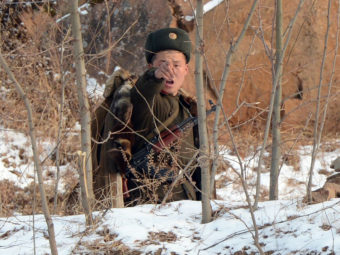
A North Korean soldier reacts as he patrols along the Yalu River near the Chinese border last month. Mark Ralston/AFP/Getty Images

North Korea responded to new U.N. Sanctions aimed at starving its nuclear program by vowing to cut a Cold War-style hotline and scrap a non-aggression pact with the South.
State-run media said North Korea “abrogates all agreements on nonaggression reached between the North and the South … and also notifies the South side that it will immediately cut off the North-South hotline.”

Pyongyang’s statement appears to refer to the bilateral pact signed in 1991 that endorses the peaceful settlement of disputes and the prevention of accidental military clashes. However, earlier this week the North also reiterated threats to walk away from the 1953 armistice that technically ended the Korean War.

Also this week, Pyongyang threatened to launch a preemptive nuclear strike against the U.S. and its allies.

(As Reuters notes, while the threat of a strike against the U.S. is “a hollow one,” South Korea and Japan are in easy range of the North’s short- and medium-range missiles.)

The stepped up rhetoric from Pyongyang is the latest in a week of bellicose posturing in the lead up to the United Nations Security Council’s unanimous approval on Thursday of sanctions to tighten trade and financial restrictions on the North in an effort to force it to halt its nuclear weapons program.

Even so, as The Associated Press points out, sanctions have done little to deter Pyongyang thus far:

“Since 2006, North Korea has launched long-range rockets, tested a variety of missiles and conducted three underground nuclear explosions, the most recent on Feb. 12. Through it all, Pyongyang was undeterred by a raft of sanctions — both multilateral penalties from the United Nations and national sanctions from Washington, Tokyo and others — meant to punish the government and sidetrack its nuclear ambitions.”

The war of words is testing South Korea’s new president, Park Geun-hye, who campaigned on a promise to remain vigilant while keeping the door open for the possibility of ending the long conflict on the peninsula.

Speaking at a graduation ceremony for South Korean military cadets on Friday, Park promised to “deal strongly with North Korea’s provocations.”

The early days of Park’s administration could prove dangerous, according to the Center for Strategic and International Studies.

A CSIS analysis suggests a causal link between a change in South Korean leadership and “a military provocation of some form within weeks.”


Read original article

Pyongyang To Cut North-South Hotline, Cancel Non-Aggression Pact

U.N. Security Council Approves New Sanctions On North Korea

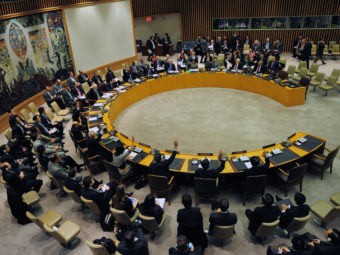
U.N. Security Council members vote to adopt sanctions against North Korea on Thursday. Emmanuel Dunand/AFP/Getty Images

The U.N. Security Council unanimously approved tough new sanctions on North Korea just hours after Pyongyang threatened a pre-emptive nuclear strike against the United States and its allies.

The Security Council’s actions to clamp down on the North’s nuclear program follow the country’s third nuclear test, carried out last month in defiance of previous United Nations’ sanctions.

The 15-0 Security Council vote Thursday includes China, which has backed North Korea in the past and is one of the country’s few allies.

The U.S.-drafted resolution would tighten financial restrictions on North Korea and seek to prevent its efforts to trade in banned cargo that could be used in its nuclear and missile programs.

U.N. Secretary-General Ban Ki-moon welcomed the vote, issuing a statement that it “sent an unequivocal message to (North Korea) that the international community will not tolerate its pursuit of nuclear weapons.”

The new sanctions come during a week in which Pyongyang threatened to scrap a 1953 armistice ending the Korean War if the U.S. and South Korea didn’t stand down from ongoing joint military exercises in the region.

An unidentified spokesman from North Korea’s Foreign Ministry said Washington was pushing for a nuclear war against Pyongyang and that, in response, the country would act on its right for “a pre-emptive nuclear attack to destroy the strongholds of the aggressors.”

Update at 12:50 p.m. ET: U.S. Warns North Korea:

Glyn Davies, the top U.S. envoy for North Korea policy is Glyn Davies, warned Pyongyang on Thursday not to miscalculate and says the U.S. is working with South Korea to ensure it’s ready for any threats that arise.

The AP reports that Davies made the remarks during testimony before the Senate Foreign Relations Committee shortly after the U.N. Security Council vote.

The panel’s chairman, Democrat Robert Menendez of New Jersey, says the North’s “absurd” threat of a nuclear strike on the U.S. would be tantamount to suicide.

Although the North has successfully tested both nuclear bombs and long-range rockets, it is not thought to have successfully married the two into an intercontinental ballistic missile, or ICBM.

As we reported on Wednesday, South Korea has matched Pyongyang’s rhetoric with its own promise to “carry out strong and resolute retaliations” if the North attacks.

According to The Washington Post, however, the North’s statement might not be quite as bellicose as its English-language translation suggests:

The Korean-language version suggested that the North would only carry out such a strike against “invaders,” meaning only if another nation breached its borders. But the English-language version of the statement says the strike will be carried out against “aggressors,” a more subjective term.

” ‘So there’s some nuance in there,’ said Dan Pinkston, a Seoul-based security expert for the International Crisis Group. ‘It’s not like a barge is going to float up the Potomac and a nuke will go off. Still, it’s problematic. … This says something about their doctrine with nuclear weapons. It says, ‘If we’re invaded with conventional weapons, we will respond with nuclear strikes.’ ”

Copyright 2013 NPR. To see more, visit http://www.npr.org/.image

Read original article

U.N. Security Council Approves New Sanctions On North Korea

Site notifications
Update notification options
Subscribe to notifications