NPR News

Senate Approves Nomination Of John Brennan As CIA Chief

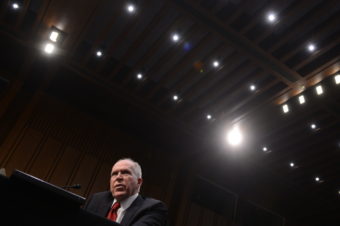
John Brennan testifies during his confirmation hearing before the Senate Intelligence Committee in Washington, on February 7, 2013. Saul Loeb /AFP/Getty Images

After an epic filibuster by Sen. Rand Paul that lasted into the early morning hours, the Senate voted this afternoon to confirm the nomination of John Brennan as the country’s next Central Intelligence Agency director.

As we reported, Paul, a Republican from Kentucky, stood on the floor of the Senate for nearly 13 hours, repeatedly asking for an explanation of the Obama administration’s targeted killing program.

Right before the vote, Paul said he would drop his filibuster because the administration had provided a key answer.

As Mark reported, Attorney General Eric Holder sent a very short letter to Paul in the early afternoon.

“It has come to my attention that you have now asked an additional question: ‘Does the President have the authority to use a weaponized drone to kill an American not engaged in combat on American soil?’ The answer to that question is no,” Holder wrote.

A few hours later, on the floor of the Senate, Rand said receiving that “explicit answer” made the “entire battle … worthwhile.”

Brennan’s nomination was approved by the Senate Intelligence Committee on Tuesday. Today, the Senate voted in favor of the nomination 63 to 34.

Brennan has been serving as President Obama’s chief counterterrorism advisor. Under George Bush, he served as the interim director of the National Counterterrorism Center.

As Mark reported, when Obama announced the Brennan nomination, he “praised Brennan for his long experience at the CIA and White House and for being a key part of a team that in the last four years took more al-Qaida leaders and commanders off the battlefield than at any other time since the Sept. 11 terrorist attacks.”

Once sworn in, Brennan will replace Acting Director Michael Morell.

(Paul, by the way, voted in favor of ending debate, but voted against confirming Brennan.)


Read original article

Senate Approves Nomination Of John Brennan As CIA Chief

Holder Responds To Paul About Drone Strikes On U.S. Soil

A Predator drone. General Atomics/Getty Images

As he rose to begin his nearly 13-hour filibuster Wednesday, Sen. Rand Paul (R-Ky.) said “no American should be killed by a drone on American soil without first being charged with a crime, without first being found to be guilty by a court.” He would filibuster John Brennan’s nomination to be CIA director, Paul said, because he wanted a clear statement from the Obama administration acknowledging that U.S. citizens could not be the targets of such strikes while on U.S. soil.

His demand had been fueled in part by a letter he’d received from Attorney Gen. Eric Holder that said, in part:

“It is possible, I suppose, to imagine an extraordinary circumstance in which it would be necessary and appropriate for the President to authorize the military to use lethal force within the territory of the United States. For example, the President could conceivably have no choice but to authorize the military to use such force if necessary to protect the homeland in the circumstances of a catastrophic attack like the ones suffered on December 7, 1941, and September 11, 2001.”

Thursday, responding to all the attention Paul got for his filibuster, Holder sent the senator this brief statement:

“It has come to my attention that you have now asked an additional question: ‘Does the President have the authority to use a weaponized drone to kill an American not engaged in combat on American soil?’ The answer to that question is no.”

Update at 2:20 p.m. ET. “I Kind Of Won My Battle,” Paul Says:

On CNN a moment ago, the senator said that Holder’s statement means “I kind of won my battle” and that he’s satisfied with the response he’s gotten.

Copyright 2013 NPR. To see more, visit http://www.npr.org/.image

Read original article

Holder Responds To Paul About Drone Strikes On U.S. Soil

Syrian Rebels Seize U.N. Peacekeepers

The U.N. is demanding the immediate release of 21 peacekeepers seized by members of the Syrian opposition in the disputed Golan Heights area between Syria and Israel.

Here’s a statement from U.N. Secretary-General Ban Ki-Moon:

“The Secretary-General condemns the detention of 21 United Nations Disengagement Observer Force (UNDOF) peacekeepers by armed elements in the vicinity of Al Jamla in the area of limitation and calls for their immediate release.

“The Secretary-General reminds all actors in Syria that UNDOF is mandated to monitor the Disengagement of Forces Agreement between Israel and Syria. UNDOF’s freedom of movement and safety and security must be respected by all parties.”

The U.N. Security Council also demanded the “unconditional and immediate” release of the peacekeepers.

A U.N. spokesman said that the peacekeepers had been detained by about 30 armed fighters.

Here’s more from The New York Times:

“A video uploaded on YouTube by a group that identified itself as the Martyrs of Yarmouk claimed responsibility and said the peacekeepers would be held until Syrian government forces withdrew from the area around Al Jamlah, the site of the weekend clashes. The video does not show any of the captives, but United Nations vehicles are visible.

“A speaker in the video warns in Arabic: ‘If the withdrawal does not take place within 24 hours, we will deal with those guys like war prisoners. And praise to God.’

“The threat underscored the widening risk that the Syria conflict is destabilizing the Middle East, and raised new concerns about the agendas of some Syrian insurgent groups, just as Western nations, including the United States, were grappling over whether to arm them.”

The capture of the peacekeepers comes a week after a member of the force was reported missing.

U.N. peacekeepers in the area monitor the 1974 disengagement accord between Syria and Israel after the 1973 Yom Kippur War between the two countries. The Security Council extended the mission’s mandate in December 2012 for another six months, until June 30.

The development comes as Syrian rebels, over the past several days, have made significant gains in their campaign against the regime of President Bashar Assad.

U.S. Secretary of State John Kerry announced last week that the U.S. would provide $60 million in direct — non-lethal — aid to Syrian rebels.

Copyright 2013 NPR. To see more, visit http://www.npr.org/.image

Read original article

Syrian Rebels Seize U.N. Peacekeepers

U.S. Spent Too Much In Iraq, Got Little In Return, Watchdog Report Says

Ten years and $60 billion in taxpayer funds later, Iraq is still so unstable and broken that even its leaders question whether U.S. efforts to rebuild it were worth the cost. That's the finding of a report to Congress by Stuart Bowen, the Special Inspector General for Iraq Reconstruction. Evan Vucci/AP
Ten years and $60 billion in taxpayer funds later, Iraq is still so unstable and broken that even its leaders question whether U.S. efforts to rebuild it were worth the cost. That’s the finding of a report to Congress by Stuart Bowen, the Special Inspector General for Iraq Reconstruction. Evan Vucci/AP

A decade and $60 billion later what does the U.S. have to show for the reconstruction efforts in Iraq? That’s the question being answered by the Special Inspector General for Iraq Reconstruction in his final report to Congress.

The report by Stuart Bowen was based upon audits and inspections, as well as interviews with Iraqi and U.S. officials and politicians. Here’s the crux of what happened to that money, according to the report:

“The general belief across each group is that the relief and reconstruction program should have accomplished more, that too much was wasted, and that the lessons derived from the Iraq reconstruction experience should drive improvements to the U.S. approach to stabilization and reconstruction operations.”

Or as The Associated Press puts it: “Since the invasion a decade ago this month, the U.S. has spent too much money in Iraq for too few results.”

The report said that several broad themes emerged in the interviews with Iraqi officials, including Prime Minister Nouri al-Maliki and former Deputy Prime Minister Ahmed Chalabi. Here’s what the Iraqis said:

1. The United States failed to consult sufficiently with Iraqi authorities when planning the reconstruction program.

2. Corruption and poor security fundamentally impeded progress throughout the program.

3. The overall rebuilding effort had limited positive effects.

The war in Iraq cost about $800 billion, and Wednesday’s report from Bowen could portend what lies ahead for the U.S. in Afghanistan where it is also engaged in reconstruction, and has spent $90 billion.

Sen. Bob Corker, the ranking member of the Senate Foreign Relations Committee, said in a statement that Bowen’s final report “demonstrates the need for a top-to-bottom review of the State Department and U.S. foreign assistance programs to ensure taxpayer dollars are used to advance U.S. interests.”

Copyright 2013 NPR. To see more, visit http://www.npr.org/.image

Read original article

U.S. Spent Too Much In Iraq, Got Little In Return, Watchdog Report Says

House Gives OK To $982 Billion Short-Term Spending Bill

The House has approved a bill to fund the federal government through the end of September. The $982 billion continuing resolution introduced by Rep. Harold Rogers (R-KY), who heads the Appropriations Committee, would avoid a potential government shutdown on March 27.
The measure provides spending through the end of the current fiscal year, and while it does not undo the “sequestration” cuts, the resolution does allow the Pentagon more room to manage its share of the reductions. It was approved by a vote of 267-151, with 53 Democrats joining Republicans to support the legislation.

As NPR’s Tamara Keith reports for our Newscast unit, the measure now heads to the Senate:

“Democrats and the White House have made it clear they don’t like this bill because it locks in across-the-board spending cuts and only gives additional budget flexibility to the Defense and Veterans Affairs departments. Senate leaders say they plan to make changes to allow other agencies more flexibility as well. But they aren’t planning to undo the sequester cuts, which means a fight that would threaten a government shutdown is unlikely.”

Copyright 2013 NPR. To see more, visit http://www.npr.org/.image

Read original article

House Gives OK To $982 Billion Short-Term Spending Bill

Today: First Key Votes On Gun Laws Since Newtown Shootings

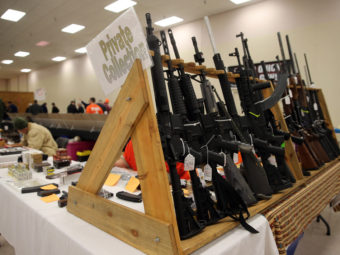
Guns on display at a show in Fort Wayne, Ind., last month. Brian Cassella /MCT /Landov

The most aggressive attempts to change federal gun law since 1994, when Congress passed a ban on assault-style weapons, come up for key votes Thursday on Capitol Hill, as Morning Edition reports.

CBS News sums up the story this way: “Senate lawmakers today are beginning what appears to be their final push to pass gun control legislation in response to the deadly massacre at a Newtown, Conn., elementary school in December.”

The action will be at a Senate Judiciary Committee hearing set to start at 10 a.m. ET. Due to be voted on:

— The “assault weapons ban of 2013,” sponsored by Sen. Dianne Feinstein, D-Calif.

— The “stop illegal trafficking in firearms” act put forward by Committee Chairman Pat Leahy, D-Vt.

— New York Democratic Sen. Charles Schumer’s “protecting responsible gun sellers act of 2013,” which would expand background checks for gun buyers.

— The “school safety enhancements act of 2013” from Sen. Barbara Boxer, D-Calif.

The Democratic-controlled committee is expected to vote in favor of all four bills, meaning they would then be considered by the full Senate. As for the bills’ prospects after that, The Hill writes that:

“The decision to stage separate votes, rather than bundle the measures together, is significant, as it will allow centrist Democrats wary of Obama’s gun-control strategy to hand-pick which elements (if any) they want to support. It also ensures that the assault weapons ban – the most radioactive of the measures – is not automatically included in the package, thereby threatening the less controversial reforms. …

“The [Newtown] massacre led Obama to launch a package of anti-gun-violence proposals, and members of the Senate Judiciary Committee have already met twice this year to consider them — the first time Congress has publicly examined the nation’s gun laws in many years.

“Many of Obama’s proposals, however, have a difficult road ahead. Although Senate Majority Leader Harry Reid (D-Nev.) has vowed to bring to the floor whatever Leahy can move through his committee, Reid is also a long-time opponent of tougher gun laws, including Obama’s push for a ban on assault weapons. Senate Republicans, meanwhile, are also uniting against most of Obama’s gun-reform proposals.

“Given those political dynamics, gun-control supporters are focusing on one element of Obama’s package they see as low-hanging fruit: an expansion of the criminal background check system for gun purchases.”

The bills would also face uphill battles in the Republican-controlled House.

We’ll update with news about the committee votes after they happen.


Read original article

Today: First Key Votes On Gun Laws Since Newtown Shootings

Site notifications
Update notification options
Subscribe to notifications