NPR News

For Baby Boomers, Lessons In Financial Basics

The oldest of the baby boomers came of age in the 1960s and are beginning to retire. Their younger cohorts are still putting kids through college and building careers. Baby boomers are a giant portion of the population — 78 million people, by one estimate.

They grew up in an era of rising living standards, but the Great Recession destroyed any sense of financial security — and many nest eggs. Financial planner Tim Maurer outlines a variety of issues boomers face.

Who is a baby boomer, and what defines their financial situations?

“The age range is vast — anyone from 48 to 67 — so we’re really talking about a couple of generations within the baby boomer generation. Some of them are now in retirement. Their kids are out of the house. And some of them are still in the thick of getting kids through college in their peak expense years, but also their peak income-earning years. And obviously this is all taking place within one of the most confounding periods of time in financial history. There’s an awful lot of confusion, a lot of market volatility and economic uncertainty, so a lot of questions on that front.”

How much income can be generated in retirement?

“We’re really looking at three different sources [of income]. If they’re one of the few who still have a pension, that would be a great benefit. Then they will also have some sort of Social Security. The baby boomer generation is expecting quite a deal from Social Security, actually. Some of them will be getting up to $2,400 per month of income from Social Security. And then they have their retirement savings.

“An easy way of getting an idea of how much income your retirement savings can generate is that you add it all up and you multiply it by .04. That is the equivalent of 4 percent, which would be a reasonable rate of return that you can expect to take out of your investment dollars. If you take the pensions, add the Social Security and add 4 percent of the retirement savings that they currently have, that will give them a good idea of what they can reasonably generate in terms of income today.”

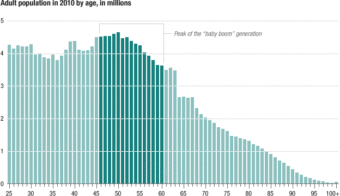
Graph: Adult population age in 2010
Adult population, 25 and older. Highlighted bars show the ages of the people born during the peak years of the baby boom. Source: 2010 Census. Credit: Alyson Hurt / NPR

What are their immediate financial issues?

“The baby boomers truly are our first sandwich generation, where they have concerns of their parents, who are still living, possibly having to help fund them in their old age. We’re also talking about the expectation of baby boomers: This is the first generation that was expected to put their kids through school. … Many of them did take on the financial obligations for their children’s education.”

What kinds of investments should boomers be in?

“Boomers have really [ridden] the roller coaster of the market because they grew up professionally in the 1980s; 1982 to 2000 was the longest bull market stretch that we’ve ever seen in this country. And so they grew up basically believing that if they just plowed money into the market, it was going to make all of their dreams come true. From 2000, 2001, 2002 — the three-year stretch where the bubble burst in the tech market and 9/11 hit — I think that they were all scared. If they were scared in those three years, 2008 really scared them into a cocoon, and they never wanted to come out again. And just over the course of the last several weeks was the [Dow Jones industrial average] reaching 14,000. So if they just did hang on for the ride throughout all of that volatility, now is the time when I’m saying to them, ‘It is time to put together a truly diversified, more conservative, balanced portfolio that will be able to provide you with income throughout your retirement.’ ”

Is this a generation on top of estate planning?

“The generation is not, but I think few generations are. I think what’s important about estate planning for baby boomers is now they are actually glimpsing needing to utilize these documents with a higher degree of probability. In other words, baby boomers are possibly glimpsing down the road when they will be leaving this Earth, and it makes the will that much more important, but because they have assets, because they have concerns about health care. It also makes the powers of attorney and the advanced directive, the living will document and the health care power of attorney all the more important as well. They should also be thinking of their parents, who are still alive, and that imminent need for their estate planning documents to be completed.”


See Original Post

For Baby Boomers, Lessons In Financial Basics

Pilot Reports Seeing Drone In Sky Near JFK

The pilot of an Alitalia pilot flying into New York’s John F. Kennedy International Airport told controllers Monday afternoon that he had spotted “a drone aircraft” 1,500 feet high in the sky and approximately 5 miles west of the airport.
ABC News, which has cockpit audio (from LiveATC.net) of the pilot’s exchange with controllers, says the Federal Aviation Administration and the Joint Terror Task Force are investigating.

In a statement sent to CNN, FAA spokeswoman Laura Brown says the pilot reported seeing “a small, unmanned or remote-controlled aircraft while on final approach to Runway 31 Right.” The news network says that “puts the aircraft somewhere over Brooklyn.”

Who was controlling the drone — if that is indeed what the pilot saw — isn’t yet known.

As NBC News points out, “drones are growing in popularity with government agencies and the public.”

CNN adds that:

“Unmanned aerial systems, sometimes called drones, and other remote-controlled planes could pose a risk to larger passenger aircraft if they collided or were sucked into an engine.

“For recreational hobbyists, flying remote-controlled planes is only allowed by the FAA up to 400 feet in the air, and within sight of the operator. If they are going to fly within three miles of an airport, they have to let air traffic controllers know.

“Flying unmanned aerial vehicles is illegal for most business purposes; however, governments and public entities such as police departments can apply for permission to operate them.”


Read original article

Pilot Reports Seeing Drone In Sky Near JFK

Scientists Are The New Kings (Or At Least Secretaries) At Energy Department

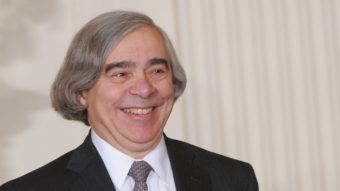
Massachusetts Institute of Technology scientist Ernest Moniz is introduced by President Obama as the nominee to run the Energy Department, Monday at the White House. Mandel Ngan/AFP/Getty Images

With President Obama naming Ernest Moniz to be the nation’s next energy secretary, he continued a relatively recent trend of putting scientists atop a part of the federal bureaucracy once overseen by political types.
If confirmed by the Senate, Moniz, an MIT physicist, will follow Nobel laureate Steven Chu, a University of California physicist who served as Obama’s first-term energy secretary.

And Chu came after President George W. Bush appointee Samuel Bodman, who was no slacker in the field of science either. He held a doctorate in chemical engineering from the Massachusetts Institute of Technology, where he also taught as an associate professor.

All right, it might be a stretch to include Bodman, since by the time Bush named him to the Energy Department post, he had long before traded academia for big gigs in corporate America. Still, he did have that engineering doctorate.

It might seem like a no-brainer to have an individual with a strong science background at the helm of a federal department that oversees a lot of complex science projects, like maintaining the nation’s nuclear weapons labs and researching new energy technologies.

But Washington isn’t a city that necessarily does no-brainers well.

Which helps explain the heavy dose of political figures — a former senator (under President George W. Bush); a former governor (under President Reagan); a former House member (under President Clinton); a former big city mayor (also under Clinton) — who dominate a list of previous energy secretaries, a list that also includes lawyers, businessmen and a retired admiral.

Obama has clearly broken away from the pattern by naming two highly regarded scientists to lead a department that in the past has had a reputation for dysfunction. And some might be inclined to give George W. Bush credit for, at the very least, naming a secretary with a STEM doctorate.

Of course, Obama’s choices at Energy can be read as something of a rebuke to that same Bush, whose officials were known to question scientific consensus, such as humans contributing to climate change. Obama has repeatedly promised to “restore science to its rightful place.”

If it’s a trend, it may be too soon to know if it will take hold.

When I asked Paul Light, a professor of public service at New York University, how we got from Hazel O’Leary (an energy secretary under President Clinton) and Spencer Abraham (who served Under President George W. Bush) to Steven Chu and Ernest Moniz, he told me:

“It’s a trend that’s well worth replicating elsewhere. … We do pay attention to it in places like the CDC and other scientifically oriented agencies. but it would be nice if the first thing you asked as a president, or as a candidate was, ‘Can they do the job and do they know anything about it?’

“That’s actually a good thing. We like politicals. For whatever reason, Energy is breaking out of it. That’s terrific. It sets a higher bar and maybe we’ll get that in other key posts. It is an interesting trend, I’ll give you that one.”


See Original Story

Scientists Are The New Kings (Or At Least Secretaries) At Energy Department

Napolitano: Airport Lines Have Seen ‘150 to 200 Percent’ Increase Since Sequester

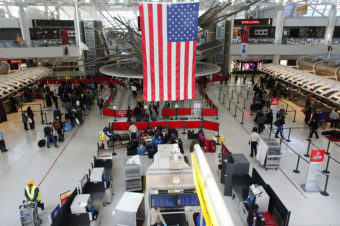
People wait in a security line at John F. Kennedy Airport on February 28, 2013 in New York City. Spencer Platt/Getty Images

Homeland Security Secretary Janet Napolitano says the across-the-board spending cuts that went into effect on Friday are already causing headaches at the nation’s airports.
“Now that we are having to reduce or eliminate basically overtime both for TSA and for customs, now that we have instituted a hiring freeze… we will begin today sending out furlough notices,” Napolitano said, according to Politico.

Lines at some Transportation Security Administration checkpoints, Napolitano added at the event sponsored by Politico, are already “150 to 200 percent as long as we would normally expect.”

On the weekend shows, the Obama administration was hammered for what some said was their exaggeration of the effects of the sequester.

Sen. Tom Coburn, a Republican of Oklahoma, was a chief critic.

“There’s easy ways to cut this money that the American people will never feel … not cutting spending is going to be disastrous for our country,” Coburn told Fox News Sunday.

We reached out to the TSA asking for details of the delays Napolitano was talking about.

They sent us a broad statement saying that security lines at airports will worsen as sequestration takes hold, causing the government to cut overtime and put off filling vacant positions.

The statement went on:

“While wait times can vary on a number of factors, due to the reductions mandated by sequestration, TSA will put in place a hiring freeze, which will result in up to an additional 1,000 TSO vacancies by Memorial Day Weekend and up to 2,600 vacancies by the end of the fiscal year. With TSA staffing levels decreasing over time, we expect that during busy travel periods wait times exceeding 30-40 minutes could double at nearly all of the largest airports. In addition, passengers who schedule their travel outside of peak flight schedules and plan to arrive close to their scheduled flight time may see their wait times now reach 30 minutes or more.”

TSA’s hiring freeze is expected to go into effect in April.

Update at 2:30 p.m. ET. Long Lines In Salt Lake City:

Fox 13 in Salt Lake City reports that 12 TSA employees who were working overtime at the Salt Lake City International Airport were sent home, today, causing longer lines.

“In one terminal, travelers waited in a line that stretched from the second-floor checkpoint, down the escalator and to the first floor,” Fox 13 reports.


Read original article

Napolitano: Airport Lines Have Seen ‘150 to 200 Percent’ Increase Since Sequester

The Sequester That Wasn’t Meant To Happen Begins

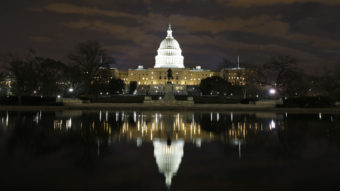
The U.S. Capitol
The U.S. Capitol (Alex Brandon/AP)

It was never supposed to happen, but now it has. With President Obama’s signing of the order to commence the sequester spending cuts of $85 billion from this fiscal year’s federal budget, what was once unthinkable is now hard reality.

The indiscriminate, across-the-board spending cuts to the Defense Department and domestic programs were supposed to be so odious and harebrained that, of course, the president and Congress would agree on a more reasonable path to deficit reduction.

In this, the parties obviously underestimated just how dysfunctional Washington is.

Unfortunately, the use of the sequester appears to have been a major miscalculation. Certainly, this hasn’t played out how the president would have preferred.

Obama had counted on Republicans to be as protective of military spending as Democrats are of federal spending on the rest of government.

But Republicans, who initially seemed unwilling to allow the defense cuts, gradually warmed to the idea that the sequester would, at the very least, get them $1.2 trillion in overall federal spending cuts over 10 years that they might not otherwise see.

This was especially powerful for Republicans who have felt burned in the past by the history of Washington deficit-reduction deals, which raised taxes but failed to produce the agreed-on spending reductions.

In the end, Obama and other Democrats had less leverage than Republicans because of a fundamental asymmetry: Large federal spending cuts alarmed Democrats; Republicans, not so much.

And that was true not only because the GOP would get spending cuts that conform to its smaller government/lower tax identity. Republicans also gambled that they wouldn’t face a massive public backlash from the sequester.

Most Americans would barely notice, if at all, much of the reduced federal spending, the GOP has calculated. They may be right. As David Dayen wrote in a piece for the Pacific Standard, there are a number of reasons to believe that the impact of the sequester cuts will seem muted, if even noticed, by most Americans.

Given how much the Obama administration warned of the potential disruptions to federal and private-sector workers, as well as programs reliant on federal money, in the run-up to the sequester, it would be surprising if the White House failed to highlight in coming days actual sequester horror stories.

If anything seems safe to say at this point, it’s that it will be a long time before another president agrees to a budget sequester on autopilot as a way to force Democrats and Republicans to compromise.

Now that the sequester has happened, attention shifts to the next key battle in Washington’s ongoing, partisan fiscal war. At the end of March, Democrats and Republicans must agree on how to continue funding the overall government if it’s not to shut down.

Unlike the sequester, a government shutdown would likely be much more disruptive and noticeable to the average American — and politically damaging, especially to Republicans.

So the talk on both sides now is that a shutdown is out of the question. Which sounds a lot like what they once said about the sequester.


See Original Story

The Sequester That Wasn’t Meant To Happen Begins

Obama Taps Nominees For EPA, Budget Office And Energy Department

Calling them “three outstanding individuals” who will help him tackle some tough problems, President Obama on Monday morning nominated:

— Gina McCarthy, currently an assistant administrator at the Environmental Protection Agency, to lead that agency. She would succeed the departed Lisa Jackson.

— Ernest Moniz to be the next secretary of energy, replacing Steven Chu, who like Jackson decided not to stay for Obama’s second term. Moniz is director of MIT’s Energy Initiative and is a former undersecretary at the department.

— Sylvia Matthews Burwell, to head the Office of Management and Budget. She is president of the Walmart Foundation and served as deputy director at OMB in the late 1990s. She would replace Acting OMB Director Jeffrey Zients.

NPR’s Scott Horsley previewed the nominations earlier today. All three choices must be confirmed by the Senate. According to Scott:

“The new EPA Administrator could be the biggest lightning rod, given that agency’s high profile in administration efforts to combat climate change. While the president has said he would prefer to attack greenhouse gases through legislation, the odds of passing a bill appear slim. A comprehensive climate bill failed in 2010, even though Democrats still controlled both houses of Congress.”


Read original article

Obama Taps Nominees For EPA, Budget Office And Energy Department

Site notifications
Update notification options
Subscribe to notifications