NPR News

FDIC Says In 2012, Banks Posted Second-Best Earnings On Record

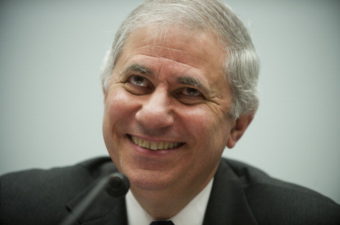
Martin Gruenberg, Acting Chairman of the Federal Deposit Insurance Corporation (FDIC), testifies during a U.S. House Financial Services Committee hearing on Capitol Hill on June 19, 2012. Saul Loeb /AFP/Getty Images

Profits for U.S. banks skyrocketed in 2012, a report from the Federal Deposit Insurance Corp. finds today.

According to Bloomberg, U.S. banks made $141.3 billion in net income last year. That is the “second-best earnings on record.” The best year was 2006, when banks reported $145.2 billion in earnings.

The AP explains:

“‘The improving trend that began more than three years ago gained further ground in the fourth quarter,’ FDIC Chairman Martin Gruenberg said in a statement. Still, ‘troubled loans, problem banks and bank failures remain at elevated levels, while growth in lending and revenue remains sluggish.’

“Banks with assets exceeding $10 billion drove the bulk of the earnings growth in the October-December period. While they make up just 1.5 percent of U.S. banks, they accounted for about 82 percent of the industry earnings.

“Those banks include Bank of America Corp., Citigroup Inc., JPMorgan Chase & Co. and Wells Fargo & Co. Most of them have recovered with help from federal bailout money and record-low borrowing rates.”

Bloomberg reports that the profits were broad with “60 percent of banks reporting increases from the previous year even as interest-income margins tightened.”


Read original article

FDIC Says In 2012, Banks Posted Second-Best Earnings On Record

Senate Allows Nomination Of Chuck Hagel To Move Forward

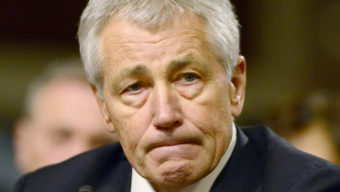
Former Sen. Chuck Hagel, R-Neb., who has been nominated to be the next secretary of defense. Ron Sachs /DPA /LANDOV

The Senate voted today to stop debating and allow the nomination of former Republican Sen. Chuck Hagel as Secretary of Defense to come for a vote before the full Senate.
Hagel is expected to be confirmed.

As we reported, Senate Republicans took the unprecedented step of filibustering his nomination. On Valentines Day, they voted 58 to 40 to continue debate on his nomination.

Today, the Senate voted 71 to 27 in favor of cloture.

As they detailed in a letter to President Obama, Republicans oppose Hagel in part because of what they say is an untenable position on Iran.

Fifteen Republicans called for Obama to withdraw the nomination. The White House refused.

Reuters reports the nomination is now expected to come before the full Senate either later today or Wednesday. Hagel needs at least 51 votes to be confirmed.


Read original article

Senate Allows Nomination Of Chuck Hagel To Move Forward

John Kerry To German Students: Americans Have ‘Right To Be Stupid’

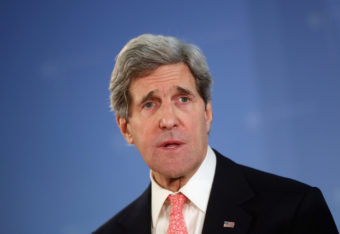
U.S. Secretary of State John Kerry. Sean Gallup/Getty Images

In his first foreign trip as Secretary of State, John Kerry defended America’s civil liberties during his talk with German students.
Kerry said that the United States’ tradition of freedom of speech — even if it includes offensive speech — is a virtue.

He said, according to Reuters:

“As a country, as a society, we live and breathe the idea of religious freedom and religious tolerance, whatever the religion, and political freedom and political tolerance, whatever the point of view.

“People have sometimes wondered about why our Supreme Court allows one group or another to march in a parade even though it’s the most provocative thing in the world and they carry signs that are an insult to one group or another.

“The reason is, that’s freedom, freedom of speech. In America you have a right to be stupid — if you want to be. And you have a right to be disconnected to somebody else if you want to be.

“And we tolerate it. We somehow make it through that. Now, I think that’s a virtue. I think that’s something worth fighting for.”

The “stupid” line, by the way, received a round of laughs.

If you remember, former Secretary of State Hillary Clinton had to defend the First Amendment after a U.S.-produced film depicting the Prophet Muhammad inflamed the Arab world.

“I know it is hard for some people to understand why the United States cannot or does not just prevent these kinds of reprehensible videos from ever seeing the light of day,” she said. “In today’s world with today’s technologies, that is impossible. But even if it was possible, our country does have a long tradition of free expression which is enshrined in our constitution and our law.

“And we do not stop individual citizens from expressing their views no matter how distasteful they may be.”


Read original article

John Kerry To German Students: Americans Have ‘Right To Be Stupid’

Scientists Trace Origin Of Destructive Russia Meteor

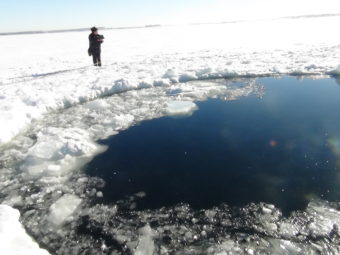
A circular hole in the ice of Chebarkul Lake, where the Chelyabinsk meteor reportedly struck on Feb. 15. Uncredited/Associated Press

Scientists from Colombia believe they have pinpointed the origin of the giant meteor that smashed into a remote region of Russia earlier this month, injuring more than 1,000 people.

Using some of the dozens, if not hundreds, of videos that captured the once-in-a-century event, the scientists have calculated the Chelyabinsk meteor’s trajectory, tracing it back to a group of Earth-crossing objects known as Apollo asteroids. Unlike objects in the Asteroid Belt, which orbit between Mars and Jupiter, Apollos sideswipe Earth’s orbit, posing a risk of collision. According to the International Astronomical Union’s Minor Planet Center, more than 4,800 Apollo “close approachers” have been identified to date.

The BBC reports that the Colombian researchers used video of the fireball taken from camera phones, car-dashboard cameras and CCTV footage, including traffic cams that contained precise time stamps:

“Using the footage and the location of an impact into Lake Chebarkul, Jorge Zuluaga and Ignacio Ferrin, from the University of Antioquia in Medellin, were able to use simple trigonometry to calculate the height, speed and position of the rock as it fell to Earth.

“To reconstruct the meteor’s original orbit around the sun, they used six different properties of its trajectory through Earth’s atmosphere. Most of these are related to the point at which the meteor becomes bright enough to cast a noticeable shadow in the videos.”

The team then plugged the data into astronomy software developed by the U.S. Naval Observatory.

Early estimates of the size of the Chelyabinsk meteor put it at about 10,000 tons, but NASA later estimated the object at between 7,000 and 10,000 tons. The energy released by the event was estimated at about 500 kilotons, or 30 times the power of the atomic bomb dropped on Hiroshima in World War II.


Read original article

Scientists Trace Origin Of Destructive Russia Meteor

Donations Pour In For Homeless Man Who Returned Ring He Got By Mistake

Billy Ray Harris.
Billy Ray Harris.

Nearly $152,000 has been donated online to help Billy Ray Harris, a homeless man in Kansas City who returned an engagement ring to the woman who accidentally left it in a cup he uses to collect change.

Here’s his good news story:

Last Friday, as local KCTV reported, Sarah Darling “unzipped her wallet and dumped her change” into Harris’s cup. She’d forgotten, though, that earlier in the day she had taken off her diamond engagement ring and put it in her coin purse.

The next day, she retraced her steps. The Associated Press writes that “she went back to Harris, squatted beside him and told him that she might have given him something valuable. ‘Was it a ring?’ he recalled asking her. ‘And she says, Yeah. And I said Well, I have it.’ ”

“It seemed like a miracle,” Darling said, according to the AP. “I thought for sure there was no way I would get it back.”

Darling says she gave Harris all the cash she had with her in thanks. Then her husband, Bill Krejci, launched a Give Forward page to collect money for Harris. As of mid-morning Tuesday, close to $152,000 had been pledged. Krejci wrote over the weekendthat he had spoken with Harris “about what he’s planning to do with the donations. The details would be better left for later but know that he has a very solid plan and a very solid way of making it happen.”As for why Harris didn’t pawn the ring when he had the chance, he told KCTV that “my grandfather was a reverend. He raised me from the time I was 6 months old and thank the good Lord, it’s a blessing, but I do still have some character.”

Read original article

Donations Pour In For Homeless Man Who Returned Ring He Got By Mistake

In Discussion About Internet Privacy, It Comes Down To Expectation Versus Reality

Do you expect that your email communications are private? That police, for example, need the OK from a judge before they dig through your email or the GPS data transmitted by your phone?

Most people says David Lieber, the privacy policy counsel for Google, would think yes. But for the most part, they would be wrong.

Lieber was speaking at a panel discussion about privacy in the Internet age at New York University’s Brennan Center for Justice in Washington on Monday.

“As users become more aware of where the law is versus where their expectations are, they’ll become more interested,” Lieber said. And they’ll demand action from their elected officials.

At the heart of the discussion was the Electronic Communications Privacy Act, a 1986 law that still controls modern communication and allows for authorities to read electronic communication with only a subpoena.

But Lieber as well as Laura Murphy, of the ACLU, argued that Congress needed to act to make the standards for searching email clearer as well as uniform.

Lieber said Google’s goal is for the “same procedural protections that apply when police want to search your home” to also apply to “searching your electronic records.”

Kenneth Wainstein, a former homeland security advisor to President George W. Bush, took the government’s side. He said in many cases — especially in those where the government is trying to prempt a terrorist strike — “emails would be critical to build a case” but there may not be enough proof for a warrant.

Also, Wainstein said, “speed is of essence” in many of these cases. These kinds of searches, said Wainstein, are the price we pay for for “having an effective intelligence operation.”

“The probable cause argument has served the test of time,” Murphy countered. “Why is it different for your personal communication?”

She said the average American would be outraged if City Hall asked them to print out their search history, for example, and turn it over to authorities.

This debate is, of course, not new. Back in January of 2011, The New York Times ran a story declaring that the 1986 privacy law “is outrun by the web.” That story was in part sparked by a new-at-the-time Google initiative that made public the number and types of government requests for information they received each day.

The number of requests, said Lieber, continues to increase. (Here’s a the data for the U.S., where you’ll see the vast majority of requests came through subpoenas and not a search warrant or a court order.)

Monday afternoon’s discussion was in part prompted by the FBI investigation that led to discovery of an affair between former Gen. David Petraeus and Paula Broadwell. It was also prompted by a bill written by Sen. Patrick Leahy, a Democrat from Vermont, that would require a warrant before reading people’s emails.

As The Hill reported at the time, the bill made it out of the Senate Judiciary Committee with an overwhelming vote in November.

Google said it was pushing for the bill to become a priority this Congress.


Read original article

In Discussion About Internet Privacy, It Comes Down To Expectation Versus Reality

Site notifications
Update notification options
Subscribe to notifications