NPR News

Tourist Tragedy In Egypt: Hot Air Balloon Catches Fire; Many Aboard Killed

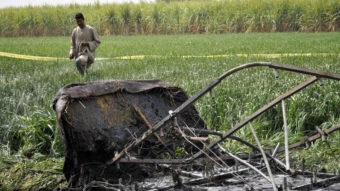
The wreckage of a hot air balloon and its gondola lay in a field near Luxor, Egypt, on Tuesday. A fire and subsequent crash killed many of those who were aboard the tourist flight. Reuters /Landov

The final death toll has not yet been determined, but the number is high. A hot air balloon carrying tourists on a flight over historic sites around the ancient Egyptian city of Luxor caught fire Tuesday. It then plunged to the ground.

NPR’s Leila Fadel reports from Cairo that 19 people may have perished. Al-Jazeera puts the current death toll at 18. According to NBC News, at least 14 people were killed — but another four are said to be missing.

Regardless of the final number, “it was the deadliest hot air balloon accident in the world in at least 20 years,” says CNN. Those killed included tourists from Japan, Britain, Belgium and France, according to news reports.

As for the cause, NBC reports that:

“There were conflicting accounts of what happened.

“[Ahmed Aboud, who runs another balloon company and acts as a spokesman for balloon operators in the area] said that gas tanks caught fire and ignited the balloon at about 1,000 feet.

“But an eyewitness, who did not want to be identified, said the balloon was about 12 feet off the ground when a landing rope was thrown to people on the ground. As they grabbed it, the rope wrapped around a gas container, which broke and a fire then started. The witness estimated the balloon then ‘shot up 500 meters’ (1,640 feet) and the pilot ‘jumped out as it was going up.’ ”

According to The Associated Press, “hot air ballooning, usually at sunrise over the famed Karnak and Luxor temples as well as the Valley of the Kings, is a popular pastime for tourists visiting Luxor. The site of the accident has seen past crashes. In 2009, 16 tourists were injured when their balloon struck a cellphone transmission tower. A year earlier, seven tourists were injured in a similar crash.”

Read original article

Tourist Tragedy In Egypt: Hot Air Balloon Catches Fire; Many Aboard Killed

Justice Sotomayor Chastises U.S. Attorney For Race Baiting In Drug Case

Supreme Court Justice Sonia Sotomayor spoke with NPR in December at the Supreme Court in Washington, D.C. Kainaz Amaria/NPR

Usually when the United States Supreme Court refuses to hear a case, it does so without a lengthy opinion.

Today, however, Justice Sonia Sotomayor joined by Justice Stephen Breyer, issued a pointed rebuke of the United States Attorney for the Western District of Texas.

The case involves a man who was arguing he did not know the two friends he was with intended to buy drugs. During the trial the U.S. attorney, whom Sotomayor did not name, made a racist comment.

“You’ve got African-Americans, you’ve got Hispanics, you’ve got a bag full of money,” the attorney said. “Does that tell you — a light bulb doesn’t go off in your head and say, This is a drug deal?”

The court refused to hear the appeal, but Sotomayor took the opportunity to school the attorney in the history of race baiting in the U.S. judicial system.

The full statement is worth a read. Sotomayor says there was a time “when appeals to race were not uncommon when a prosecutor might direct a jury to ‘”consider the fact that Mary Sue Rowe is a young white woman and that this defendant is a black man for the purpose of determining his intent at the time he entered Mrs. Rowe’s home.”‘

The bottom line, writes Sotomayor:

“It is deeply disappointing to see a representative of the United States resort to this base tactic more than a decade into the 21st century. Such conduct diminishes the dignity of our criminal justice system and undermines respect for the rule of law. We expect the Government to seek justice, not to fan the flames of fear and prejudice. In discharging the duties of his office in this case, the Assistant United States Attorney for the Western District of Texas missed the mark.”

Sotomayor closes by saying she hopes “never to see a case like this again.”


Read original article

Justice Sotomayor Chastises U.S. Attorney For Race Baiting In Drug Case

Scientists May Have Uncovered Ancient Microcontinent

Rodinia. Mauritia is shoehorned between India and Madagascar. United States Antarctic Program/Wikipedia Commons

The remains of a small continent have been hiding right under our noses for the past 85 million years or so.
That’s according to a new study published Sunday in the journal Nature Geoscience. Scientists looked at lava sands from beaches on Mauritius to determine when and where the material might have originated.

Their conclusion? The lava sands, containing particles called zircon xenocrysts, came from a Precambrian microcontinent dubbed ‘Mauritia’ that was sandwiched between the land masses that today make up Madagascar and India. It was all part of a supercontinent known as Rodinia that existed between 2 billion and 85 million years ago. (Not to be confused with the better-known, and slightly more contemporary supercontinent Pangaea).

Mauritia was a sliver of land that broke apart and disappeared under the sea as the Rodinia ripped itself apart as part of the process of plate tectonics, scientists believe.

The BBC quotes the study’s lead author, Trond Torsvik, as saying the sand his team examined dates to an nine-million-year-old eruption near the modern-day islands of Marion and Reunion that spewed much older material.

“We found zircons that we extracted from the beach sands, and these are something you typically find in a continental crust. They are very old in age,” said Torsvik of the University of Oslo, Norway.

Torsvik believes pieces of Mauritia have been interred under 6 miles of surface and spread over a swath of the Indian Ocean, according to the BBC.

“However, a small part could have survived.

‘At the moment the Seychelles is a piece of granite, or continental crust, which is sitting practically in the middle of the Indian Ocean,’ explained Prof Torsvik.

‘But once upon a time, it was sitting north of Madagascar. And what we are saying is that maybe this was much bigger, and there are many of these continental fragments that are spread around in the ocean.’


Read original article

Scientists May Have Uncovered Ancient Microcontinent

Plains Will See Second ‘Crippling, Historic Blizzard’ In As Many Weeks

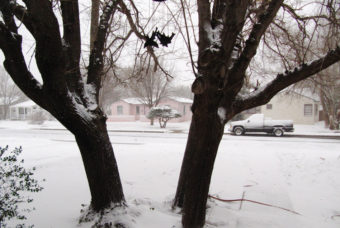
Blizzard conditions persist in Lubbock, Texas, on Monday. The storm system packing snow and high winds has been tracking eastward across western Texas toward Oklahoma, Kansas and Missouri. Betsy Blaney/AP

Just a week after a blizzard swept through an area from Western New Mexico to West Texas, another system is dumping record snowfall today.
The headline from the National Weather Service in Amarillo, Tex.? “Crippling, Historic Blizzard Ongoing.”

As of 12 p.m., one weather station had measured 17 inches of snow. The Weather Service says this blizzard could “easily be in the Top 3 all-time snow events for Amarillo.” The all-time snow record for the city is 20.6 inches, so its within sight.

Wind is also an issue; the Amarillo airport recorded a wind gust of 75 mph. A video posted on the Weather Service’s Facebook page showed blowing snow limiting visibility to less than a quarter mile.

CNN reports:

“The storm was dumping snow over the Texas Panhandle at a rate of 2 to 3 inches an hour. Oklahoma also was being hit hard, and parts of Kansas and Missouri were bracing as the storm moved closer.

“Almost all roads in the Texas Panhandle were impassable, and whiteout conditions forced the state Department of Transportation to pull virtually all of its snowplows off roads, Texas DOT spokesman Paul Braun said Monday morning.”

The Amarillo Globe News reports that the National Guard was called in this morning to help stranded motorists.

The AP has a bit more on the forecast:

“‘March is the time we see intense winter storms in the Plains,” [Greg Carbin, a meteorologist at the Storm Prediction Center in Norman, Okla.,] said. He added the storm’s path will take it through the upper Midwest, including Chicago and Detroit, before pushing eastward.

“The system had already passed through Colorado, where flights were canceled, Denver city offices had delayed openings and snow was piled as much as two-feet deep.”


Read original article

Plains Will See Second ‘Crippling, Historic Blizzard’ In As Many Weeks

Supreme Court Will Not Hear Campaign Finance Case On Corporate Donations

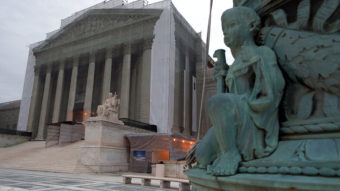
The Supreme Court denied the petition of businessmen who say the 2010 Citizens United ruling makes it legal for corporations to contribute directly to candidates. The court building is seen here during renovations in December. Alex Wong/Getty Images

The Supreme Court says it won’t hear a case that would have let candidates solicit money from corporations. By doing so, the court is reaffirming one strict ban on corporate political money, three years ago after easing other limits in its controversial Citizens United ruling.

Congress outlawed corporate contributions to candidates back in 1907. Now, two businessmen say that Citizens United makes that law unconstitutional – and they claim a First Amendment right to give corporate funds directly to candidates.

The Justice Department is prosecuting investment bankers William Danielczyk and Eugene Biagi for allegedly funneling corporate money into the old Senate and presidential campaigns of Hillary Clinton. Prosecutors say the two reimbursed employees for contributions that arrived at the campaigns as small, personal — and legal — donations.

Danielczyk and Biagi challenged the corporate donation ban before the trial began. Monday, the Supreme Court rejected their petition without explanation.

But this refusal is something of an anomaly. Federal courts have dramatically loosened the rules in recent years, most notably with two cases in 2010:

  • In Citizens United, the Supreme Court said that corporations can spend freely to support or attack candidates, and that independent spending cannot be considered a factor of corruption to the candidates who benefit from it.
  • A few weeks after that, a Washington, D.C., appellate court ruled in a case known as SpeechNow that wealthy donors can join together to raise and spend unlimited amounts on independent ads – essentially, the description of a Super PAC.

Last week, the Supreme Court said it will take up a challenge to the overall limit a donor can give during a two-year election cycle. Eliminating that umbrella limit would allow a donor to give the maximum to any and all federal candidates and party committees.

The plaintiff in that case, Shaun McCutcheon of Alabama, along with the Republican National Committee, argues that because the amount of each contribution would still be capped, a guard against corruption would remain in place.


Read original article

Supreme Court Will Not Hear Campaign Finance Case On Corporate Donations

What Will Happen To All The Letters People Sent to Newtown?

A drawing from a child sent to Newtown. Illustrator Ross MacDonald, who wants to archive and preserve art like this sent to the town after the elementary school shootings, calls it "both profoundly moving and just a beautiful piece of folk art." Courtesy of Ross MacDonald
A drawing from a child sent to Newtown. Illustrator Ross MacDonald, who wants to archive and preserve art like this sent to the town after the elementary school shootings, calls it “both profoundly moving and just a beautiful piece of folk art.” Courtesy of Ross MacDonald

Two months after the massacre at an elementary school in Connecticut, letters, cards and gifts continue to arrive in Newtown each day, but the town is not sure what to do with it all.

The outpouring of grief started arriving just days after the shooting at Sandy Hook Elementary School — poetry, stories, banners and posters. Soon the halls of Newtown’s Municipal Center and buildings all over town were packed with messages from children and parents, from a soldier in Afghanistan and an inmate at a California prison.

“I was put in charge of all the logistics for this warehouse. I’ve got about 20,000 square feet full of donations here,” says Chris Kelsey, the town’s tax assessor. These days he spends a lot of time at a nondescript warehouse in Newtown. Boxes are piled high and shrink-wrapped. There are 500 labeled as toys and 2,000 marked as school supplies.

“We’re up to over 63,000 teddy bears right now. We’ve seen bicycles, sleds. It runs the gamut of anything you could send,” says Kelsey.

A few miles away in his studio/barn in Newtown, illustrator Ross MacDonald reads from a letter written by an 11-year-old:

“Dear Families: I am sorry for your loss. My grandpa died three weeks ago. I’m in foster care. When my grandpa died I was heartbroken, so I might know what you’re going through. I go to First Baptist Church.”

MacDonald is photographing the letters and artwork, documenting reaction to an event that hit the world hard. He wants the cards, letters and art to be archived and preserved.

“This is a drawing from I believe a very young child on a piece of pink construction paper. There’s a small red heart with arms and legs and two little eyes. And there’s a word balloon that says ‘I’m sorry,’ ” says MacDonald. “It’s both profoundly moving and just a beautiful piece of folk art.”

Virtually all the mail is first delivered to the Newtown Municipal Center. Public Works Director Fred Hurley says seeing daily reminders of the tragedy has taken a toll on town workers.

“Many of the government staff has been intricately involved in this for the last two months every day. But we still have a town to run. So that’s one of the big challenges we have is to take care of the day-to-day business and also to move the needs of the town emotionally along with what has happened,” says Hurley.

Victims’ families and town residents were invited to take anything they wanted to keep. Now MacDonald and a local preservation group are talking with Newtown officials and professional archivists about ways to save the written messages and art.

Some of the many cards, letters and artwork sent to Newtown from all over the world was on display at the Newtown Municipal Center on Jan. 30. The items were recently moved to temporary storage. Courtesy of Ross MacDonald

Kathleen Craughwell-Varda is director of Conservation Connection, a conservation planning project at the Connecticut State Library. She says Newtown is the latest in a series of American tragedies that have provoked an outpouring of response.

“Virginia Tech has created an online exhibition and archive. And we have all the development of the [Sept. 11] museum and memorial. And there’s also the Vietnam War Memorial, where people are leaving things still, more than 25 years later,” says Craughwell-Varda.

Town officials have been planning to photograph the materials, then incinerate them, incorporating the ash into a future public memorial. But no decision has been made. Connecticut State Librarian Ken Wiggin says that’s not surprising.

“It’s still very raw, I mean, two months out, and so I think people are sensitive about wanting to do the right thing, but they’re overwhelmed,” says Wiggin. “This is a huge volume of material.”

The state has offered to house many of the items in a climate-controlled space. The town has agreed not to destroy anything right away. And illustrator MacDonald says he’ll continue to advocate for preserving the response to a tragedy he hopes will never happen again.


See Original Story

What Will Happen To All The Letters People Sent to Newtown?

Site notifications
Update notification options
Subscribe to notifications