NPR News

One In Three Fish Sold At Restaurants And Grocery Stores Is Mislabeled

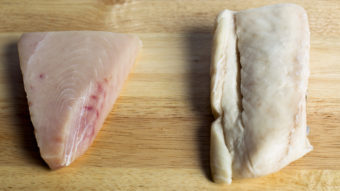
Escolar, right, is often substituted for more expensive Albacore tuna (left), a report on mislabeled seafood found. Yoon S. Byun/Boston Globe via Getty Images

There are so many fish in the sea. But from a diner’s viewpoint, peering down at a sliver of white fish atop a bed of sushi rice, a lot of them look the same.

Now a report from the ocean conservation group Oceana confirms that there’s a pretty decent chance that fish on the plate or on ice in the seafood case is not what it’s labeled to be. That means that seafood wallet cards designed by conservation groups to help steer consumers towards sustainable choices may not be doing much good.

Between 2010 and 2012, Oceana took 1,215 seafood samples from 674 retail outlets in 21 states. When they tested the DNA, they found that 33 percent were mislabeled. Sushi vendors and grocery stores were the most likely outlets to sell mislabeled food, though Oceana says the fraud can happen before it reaches them.

Earlier investigations by Oceana and the Boston Globe revealed that seafood mislabeling is common in cities like New York and Boston, where people eat a lot of fish. But the report out Thursday shows it’s happening across the country, and is as bad or worse in places like Texas and Colorado. Some 49 percent of the retail outlets sampled in Austin and Houston sold mislabeled seafood, while 36 percent in Colorado did so.

So what’s the big deal with fish sold under a pseudonym? Well, for one, it’s often just a form of swindling – a cheap fish like tilapia sold as red snapper. But Oceana says the practice also can put consumers at health risk when species like king mackerel, which is high in mercury, or escolar, which contains a naturally occurring toxin than can cause gastrointestinal problems, are marketed as grouper and white tuna, respectively.

Oceana’s also concerned that substituting cheaper, easier-to-find fish for rarer, more valuable ones gives consumers a distorted sense of the market. Of the fish types most heavily sampled by Oceana, those sold as snapper and tuna had the highest mislabeling rates — 87 and 59 percent. Only seven of the 120 samples of red snapper purchased nationwide were actually red snapper, the report found.

“The majority of fraud is various fish standing in for snapper – it’s used as catch-all name for all kinds of white fleshed fish,” says Oceana senior scientist Kimberly Warner. “But there are real conservation concerns when you slip in things in place of the real thing. People think snapper must be doing great because it’s everywhere, but it’s overfished.”

Consumers using wallet cards from groups like the Monterey Bay Aquarium and NRDC could end up buying exactly the species they’re trying to avoid, Warner says, because mislabeling is so prevalent.

One reason mislabeling has gotten so rampant is that the U.S. now imports 90 percent of its seafood and less than 2 percent is inspected for fraud. That means would-be fraudsters have a lot new options for substitutions.The Food and Drug Administration regularly updates its list of seafood approved for sale – in 2012 alone, 19 new species were added to the list, including cornetfish, sampa and claresse.

So what’s the government or a consumer to do about all this? Oceana would like to see an international traceability system where retailers would be required to tell consumers where and when a fish was caught and what gear was used. Requirements like these would help the industry — one of the least transparent in the food system — more accountable.

The National Fisheries Institute argues that the problem is one of enforcement — the FDA needs to do a better job of enforcing laws that are already on the books to discourage fraud. And they encourage consumers to seek out retailers through the Better Seafood Board.


See Original Story

One In Three Fish Sold At Restaurants And Grocery Stores Is Mislabeled

Defense Cuts May No Longer Be Political Sacred Cow

Defense Secretary Leon Panetta has warned that the automatic spending cuts due to hit the Pentagon and other branches of government next week will damage U.S. national security.
In a letter to Congress, he said those cuts would put the military on a path toward a “hollow force.” But the warnings don’t appear to be moving the needle with lawmakers or the American public.

The automatic spending cuts don’t officially take effect until March 1, but they are already being felt. As President Obama noted this week, the Navy has decided not to send one of its aircraft carriers on a scheduled deployment to the Persian Gulf.

“As our military leaders have made clear, changes like this — not well-thought through, not phased in properly — changes like this affect our ability to respond to threats in unstable parts of the world,” he said.

No Agreed-Upon Path

At one time, idling an aircraft carrier to save money would have been unthinkable. The White House thought that prospect would be so alarming to congressional Republicans that they’d never allow the automatic spending cuts to take effect.

Some Republicans are alarmed. House Speaker John Boehner calls the military cuts “devastating.” But Congressional expert Sarah Binder of the Brookings Institution says the GOP is no longer united when it comes to protecting the Pentagon.

“There’s a defense wing of defense hawks, and they’ve been pretty vocal about the impact on the Defense Department and national security, generally,” she said. “And we know there’s a hard-core group as well that’s opposed to any and all revenue increases.

“And between the two of those, there’s no agreed-upon path of what to do, and so it looks like they may prefer the sequester to any alternative — certainly the alternatives the Democrats are offering up.”

Public Unmoved

Obama is trying to enlist the public’s help. He did a series of local TV interviews Wednesday, and he’s planning to visit a military community outside Washington, D.C., next week. White House spokesman Jay Carney says the idea is to ramp up pressure on lawmakers to suspend the automatic cuts.

“The fact of the matter is, congressional Republicans are going to listen to the American people,” Carney said.

But the American people aren’t necessarily convinced that cutting the Pentagon budget is a bad idea.

Last year, the Stimson Center in Washington, along with the Center for Public Integrity and the Program for Public Consultation, asked people how they’d like to address the federal deficit: by raising taxes, reducing defense spending or cutting other parts of the government.

Matt Leatherman of the Stimson Center says nearly two-thirds opted for defense cuts.

“Defense spending was an area that respondents seemed to feel especially comfortable with reductions,” he said. “There were some partisan splits, but I would point out that both Republicans and Democrats were comfortable reducing the defense budget.”

Threat Of Sequestration

Other polls by Gallup, Harris and the Pew Research Center produced similar findings. The Stimson Center survey was unusual in that people taking the poll were given information about the workings of the Pentagon budget.

“The more that Americans learn about their defense budget, the more aware they become that not everything is equal,” Leatherman says. “When you have a chance to really grapple with the material on your own, you perhaps feel more comfortable in saying, ‘I’m prepared to prioritize this issue and accept more risk over here.’ “

Leatherman says that doesn’t mean Americans are comfortable with the kind of indiscriminate cuts to defense spending set to take effect next week. But it does suggest the Pentagon is far from a sacred cow.

That could be put to the test if lawmakers can’t make a deal to avoid across-the-board cuts. Congressional scholar Binder notes that those cuts were agreed to in 2011 as a way to postpone the pain of political gridlock. Nineteen months later, the gridlock hasn’t gone away.

“They set up the can, they kind of set it up to explode, and sure enough, this looks like one of the few times it’s actually going to go off,” she says.


Read Original Story

Defense Cuts May No Longer Be Political Sacred Cow

Inflation Was In Check Last Month; Jobless Claims Jumped Last Week

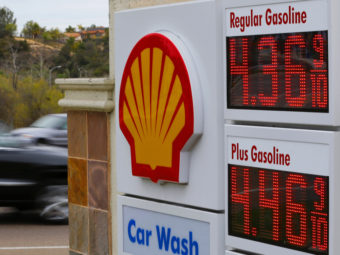
Gasoline prices at a station in Encinitas, Calif., earlier this week. Mike Blake/Reuters /Landov

Consumer prices were flat in January, the Bureau of Labor Statistics says. But a driving force behind that good news has reversed itself since then. According to BLS, gasoline prices fell 3 percent last month. In February, though, gas prices have risen sharply. So watch for next month’s BLS report on consumer prices to tell a different story.

Also this morning, the Employment and Training Administration reports that the number of first-time claims for jobless benefits rose by 20,000 last week, to 362,000. The increase was slightly larger than economists expected.

For the most part, the number of weekly claims has stayed within a range of 350,000 to 400,000 since the fall of 2011. They’ve been another in a series of signs that the U.S. labor market is only slowly recovering from the 2007-09 recession.
 

Read original article

Inflation Was In Check Last Month; Jobless Claims Jumped Last Week

Existing Home Sales Rise Again; ‘Seller’s Market Is Developing,’ Realtors Say

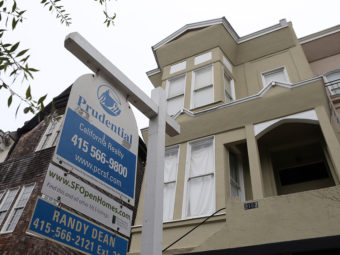
A "for sale" sign in San Francisco last summer. Justin Sullivan/Getty Images
A “for sale” sign in San Francisco last summer. Justin Sullivan/Getty Images

Sales of existing homes rose 0.4 percent in January from December and were up 9.1 percent from January 2012, the National Association of Realtors reports.
The trade group also says “a seller’s market is developing and home prices continue to rise.”

Bloomberg News writes that the news signals the housing sector is “showing more momentum” after enjoying “its best year since 2007.”

The NAR’s chief economist, Lawrence Yun, says in the group’s report that:

“Buyer traffic is continuing to pick up, while seller traffic is holding steady. In fact, buyer traffic is 40 percent above a year ago, so there is plenty of demand but insufficient inventory to improve sales more strongly. We’ve transitioned into a seller’s market in much of the country.”

Still, Bloomberg also has some cautionary news to pass along:

“Americans remain pessimistic about the economic outlook in February as rising gasoline prices compound the damage done by a higher payroll tax. The gap between positive and negative expectations was minus 7 this month, unchanged from January’s three-month low, according to the Bloomberg Comfort Index.”

Earlier Thursday, there was word that inflation remained in check last month — but that jobless claims rose last week.

Also, the Conference Board said its leading economic index rose 0.2 percent in January. That’s a sign the economy should keep growing in coming months.


Read original article

Existing Home Sales Rise Again; ‘Seller’s Market Is Developing,’ Realtors Say

Winter Storm ‘Q’ Barrels Through Nation’s Midsection

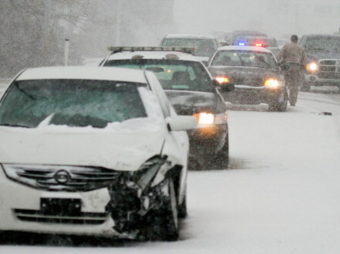
Snow-packed morning commute in Wichita on Wednesday. Wichita Eagle/MCT via Getty Images

Winter Storm “Q,” which has already dumped a layer of snow in Arizona, New Mexico and Southern California, moves with full force into the eastern Plains and Midwest on Thursday, where it could dump a foot and a half of snow in some areas.

In Kansas and Missouri, where forecasters are predicting the heaviest snowfall, flights at Kansas City International Airport have been canceled and several schools districts, as well as Kansas State University, have canceled classes.

The National Weather Service has issued a Winter Storm Warning for most of Nebraska and Iowa, all of Kansas and nearly all of Missouri. Advisories are posted for parts of South Dakota, Minnesota, Illinois, Indiana, Ohio, Kentucky, West Virginia and Virginia, Colorado, New Mexico, Oklahoma, northern Texas and Arkansas.

Kelly Sugden, a National Weather Service meteorologist in Dodge City, Kan., told The Associated Press early Thursday that the storm was moving a bit slower than first expected, but was “starting to get back together.”

The storm was mixing snow with lightning and sleet showers, Sudgen said.

“Sugden said that while forecasters weren’t expecting blizzard conditions to develop in Kansas, the Interstate 70 corridor could get as much as 13 inches of snow, and large drifts would make driving very dangerous.”

USA Today, quoting weather officials, says it could be the worst winter storm in the central U.S. since the Groundhog Day blizzard in 2011, which killed dozens of people and left thousands without power.

Road crews across the Plains states and the Rockies have been working to stay ahead of the snowfall, which has been blamed for one traffic-related death so far — in Oklahoma.


Read original article

Winter Storm ‘Q’ Barrels Through Nation’s Midsection

Biden: For Protection; ‘Buy A Shotgun, Buy A Shotgun’

Vice President Joe Biden’s advice to his wife about protecting their home in Delaware:

They don’t need an assault-style weapon. If there are bad guys on the property, walk out on the balcony and fire a couple blasts from their double-barrel shotgun. “You don’t need 30 rounds to protect yourself,” he adds, and a shotgun’s easier to aim than an assault-style rifle. Plus, two shotgun blasts should scare off most intruders, Biden says.

And that was the vice president’s advice to others Tuesday during a Facebook townhall with Parents magazine. When the subject turned to gun violence, gun control laws and weapons, Biden talked about what he says he’s told Jill Biden and concluded with this advice to others who feel they need a weapon for protection:

“Buy a shotgun; buy a shotgun,” not an assault-style weapon.

Presumably, Biden’s advice to his wife was given before they had Secret Service protection.

Read original article

Biden: For Protection; ‘Buy A Shotgun, Buy A Shotgun’

Site notifications
Update notification options
Subscribe to notifications