1 Sections

Searchers locate wreckage of missing plane

The search continues today for a missing plane that crashed in the mountains near Eaglecrest Ski Area on Douglas Island.

The U.S. Coast Guard says a debris field was found yesterday evening, including an engine and propeller, at the base of a 50-foot cliff after searchers traced an emergency locater transmitter signal.
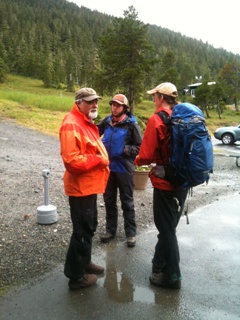
Doug Wesson with Juneau Mountain Rescue discusses Sunday's search with JMR members. (Photo by Casey Kelly/KTOO)

Low clouds, wind, and poor visibility hampered yesterday’s search for the single engine Cessna – reportedly flying from Hoonah to Juneau. Coast Guard spokesman David Mosely says the plane was coming from Anchorage and had stopped in Hoonah. He says the pilot failed to make a scheduled check-in with Juneau flight services and was reported missing at 6:43 a.m.

“They had done a call in with the air services, the flight service there in Juneau, at about 10 miles out and then did not do their scheduled next check in before landing there in Juneau,” Mosely said.

The EPIRB signal took a Coast Guard MH-60 Jayhawk helicopter low over the Mount Ben Stewart and Cropley Lake area yesterday afternoon, but wind and low clouds forced the chopper crew to abandon the air search before they could get an exact location.

Meanwhile, Alaska State Troopers coordinated the ground search and called in Juneau Mountain Rescue. JMR set up an incident command at the Eaglecrest Lodge and sent a team into the woods west of the ski area. Federal Aviation Administration officials and the Civil Air Patrol also were involved in the search. Eaglecrest employees and Alaska Zipline Adventures provided support at base camp.
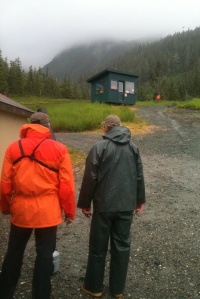
Juneau Mountain Rescue's Doug Wesson and an unidentified man watch a Coast Guard helicopter search for a missing plane near Eaglecrest Ski Area. (Photo by Casey Kelly/KTOO)

Trooper Sargent Tim Birt said it was a “moment by moment operation,” with heavy rain and wind moving through the area.

“The aircraft is described as a yellow, white and brown for the colors, Birt said. “The tail number is N as in November, 73045, and it’s a small single engineer aircraft.”

Birt does not know if any passengers were on board.

According to the FAA Registry for Aircraft N-Number, the plane is a Cessna 140, registered to Darrel A. Strachan and Dianna L. Strachan, of San Jose, California.

Coast Guard spokesman Mosely said the plane was based in Anchorage.

Census data highlights Juneau’s gender wage gap problem

Men in Juneau earn significantly more money than women, according to an economic indicator in a recent JEDC newsletter.

The Juneau Economic Development Council analyzed data from the US Census Bureau’s American Community Survey that shows men in the Capital City make 42 percent more than their female counterparts.

Of course the problem isn’t unique to Juneau. Nationwide, the same survey indicates men earn 29 percent more than women. Statewide it’s 37 percent.

But as always, numbers only tell part of the story. Casey Kelly has more.

CG buoy tender crews train, compete in Round-Up

There are over 1200 buoys and other navigational aids placed all along the U.S. coastline. Somebody’s got to repair them and make sure they all stay in position. That’s the responsibility of the Coast Guard’s buoy tenders; the black-hulled ships crewed by what could be described as the blue-collared members of the service.
Eight tenders from Alaska, British Columbia, Washington, and Oregon converged on Juneau this week for the annual Buoy Tender Round-Up. It’s chance for as many as 300 crewmembers to train together, and compete against each other. The Buoy Tender Olympics is the highlight. Events are based on day-to-day routines: the Chain Pull and Rescue Line Heave, Survival Suit Relay Swim, Crane Boom Spotting, Tug o’ War, and the Heat & Beat.

Convicted poacher sentenced on probation violation

The Juneau man convicted of baiting bears and illegally shooting a wolf is now in jail. Park Myers III could be behind bars for up to a month because he was working while he accepted unemployment insurance benefits. Myers was still on probation after pleading guilty in the poaching case. It included the taking of a black wolf believed to be the friendly and popular wolf known by many as ‘Romeo.’

Matt Miller has the story.

Rachelle Waterman sentenced in matricide case

Rachelle Waterman was sentenced on July 15th in Craig to three years in prison for her role in the brutal murder of her mother six years ago. As Deanna Garrison reports, an Anchorage jury found the 22 year old woman guilty in February of criminally negligent homicide. She was not convicted on much more serious charges of murder and kidnapping.

NTSB faults Coast Guard small boat operators for fatal accident

The National Transportation Safety Board says deficient oversight by the Coast Guard was partly responsible for an accident that killed a child and injured four other boaters.

The report issued July 12th follows an investigation into the collision between one of the Coast Guard’s small patrol boats and a recreational boat in San Diego in December of 2009.

The 33-foot boat – designated as ‘special purpose craft – law enforcement’ — with five crewmembers from Station San Diego was dispatched to check on a possible grounding. They were underway at high speed at night, in an area with heavy traffic just before a holiday boat parade, when they hit and ran up on the 24-foot Sea Ray from dead astern. Thirteen people, including the boy, were on the boat.

The Coast Guard boat was planing, or traveling at least 19-knots and perhaps as high as 42-knots.

NTSB investigators concluded that the Coast Guard boat was traveling too fast for conditions, and the reported grounding did not require such a high speed. The Coast Guard boat also had obstructions to forward visibility. Some of the crew – who could’ve been helping as look-outs — was apparently distracted with cell phone calls and text messaging. The NTSB also says that oversight of safe small boat operations at Station San Diego was “ineffective.”

The NTSB recommended that the Coast Guard implement procedures to get around the boat’s forward visibility issues, reexamine small boat operations service-wide, and establish procedures for safe operating speeds.

The NTSB had earlier recommended the Coast Guard implement a policy for the use of cell phones or wireless devices aboard their vessel.

Site notifications
Update notification options
Subscribe to notifications