A state-sponsored economic development panel wants suggestions for creating new timber industry jobs.
The Alaska Timber Jobs Task Force will hear comments from the public during a meeting Friday and Saturday in Coffman Cove. The town is a former logging camp on Prince of Wales Island.
Governor Sean Parnell created the task force last spring, with a focus on Southeast.
State Forester Chris Maisch, a member, says it has a number of goals.
“One of those does speak to state forest recommendations for additional acreage or even recommendations for additional units in the state forest. And, of course, that can be statewide, potentially,” Maisch says.
Public comments will be taken starting at 1:15 p.m. Friday at Coffman Cove City Hall. Teleconference connections will also be available at Department of Natural Resources conference rooms in Juneau and Fairbanks, and at Division of Forestry offices in Anchorage and Ketchikan.
Saturday’s session, at 11:20 a.m., will take comments via phone. The number is 1-800-315-6338. Enter the code 8467# when prompted. (Link to meeting details here.)
In addition to state forest management, the task force is focusing on state harvest rules, timber demand, and Tongass timber sales.
Parnell created the task force after pulling out of the Tongass Futures Roundtable, which had a broader agenda and membership, including logging opponents.
The Alaska Native Brotherhood and Alaska Native Sisterhood are celebrating a big anniversary.
Officers and delegates at the 99th annual Grand Camp Convention are meeting this week in Klawock, on Prince of Wales Island. The meeting has the theme, “Reviewing 100 Years of History – Preparing for the Next.”
The Brotherhood was organized in 1912 and calls itself “the United States’ oldest indigenous persons’ civil-rights organization.” The Sisterhood formed several years later.
The meeting, at Klawock High School, began Tuesday and continues through Saturday.
Beyond history, members are discussing the landless Natives issue, tobacco cessation programs and suicide prevention.
They will also hear reports from Sealaska, the Veterans Administration, the Sitka Local Foods Network, the Southern Southeast Alaska Technical Education Center and other groups.
The ANB and ANS will also elect officers and pass resolutions guiding the organization’s direction for the next year.
The Alaska Marine Highway System has finalized its summer 2012 schedule. Officials have made only one change since a draft was released in August.
Captain John Falvey says the change involves the direction of mainliners during May.
“We had three southbound sailings coming through Sitka. Two of them involved the Malaspina and one with the Columbia. Sitka had some concerns. So we made an adjustment with the Matanuska and created a situation for one northbound and two southbound stops,” he says.
The draft schedule proposed a number of changes from this past summer’s version. All of those remain.
The fast ferry Fairweather will start calling in Angoon twice a week, connecting the town to Sitka one day and to Juneau the other. There will be one more weekly Juneau-to-Sitka sailing and one fewer Petersburg run.
The Malaspina, the main Lynn Canal ship, will reverse its route, beginning in Juneau most days instead of Skagway.
“So we’ll be starting out in the morning on the Malaspina, which is high-capacity day shuttle going northbound up the canal, except Sunday night, when it will overnight in Skagway,” he says.
Gustavus will get four weekly port calls from the small ferry LeConte, twice this past summer’s number.
Most other routes will remain the same. That includes the relatively new Bellingham-to-Whitter express, which has been well-used.
No major changes were made to sailings to and from Valdez, Homer, Kodiak, and other Prince William Sound and Southwest Alaska communities.
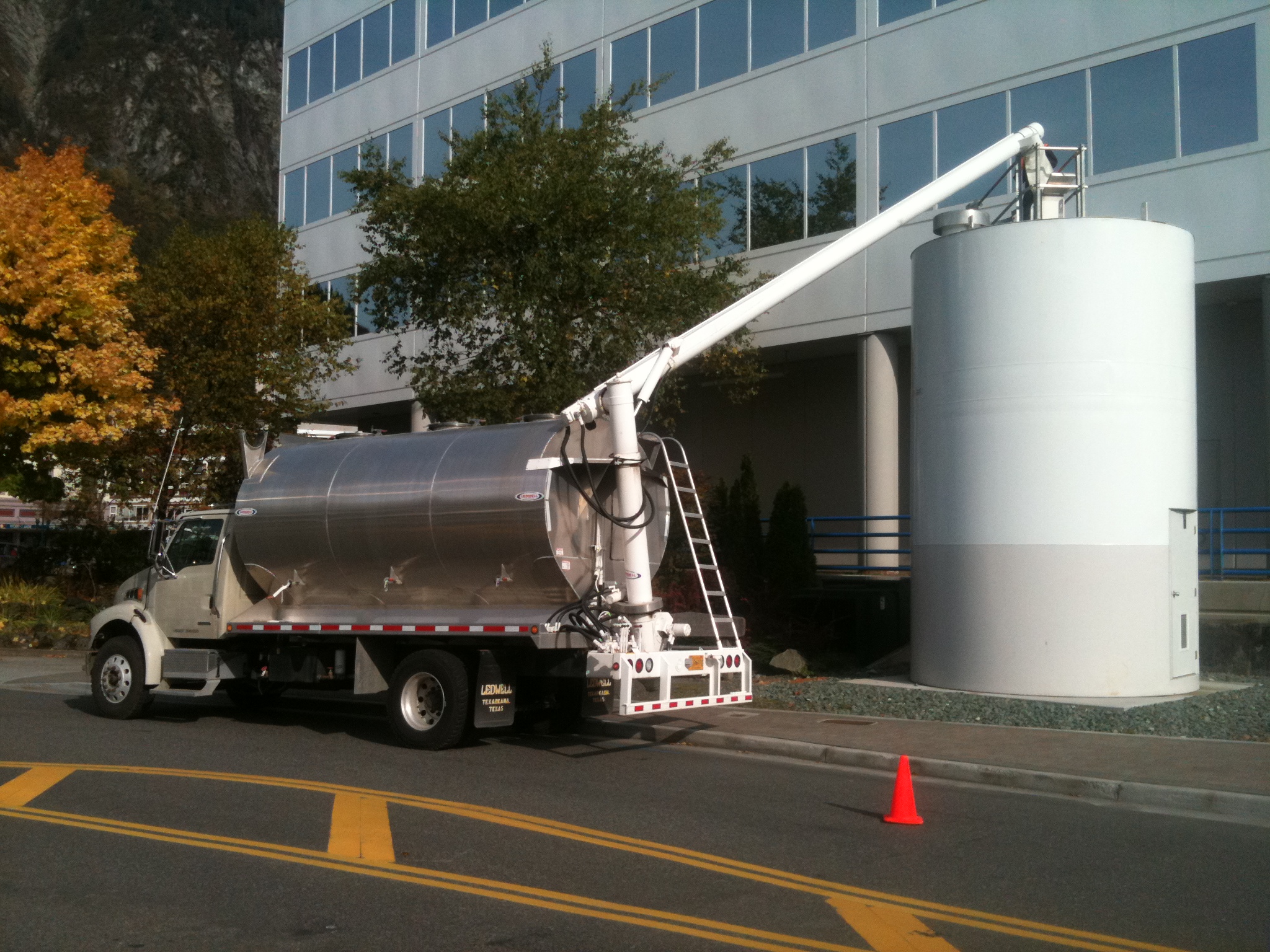
Wood pellets for a new boiler are unloaded at Sealaska's headquarters in Juneau. Casey Kelly photo.
More and more Southeast government buildings and businesses are turning to woody biomass for heat. Some experts say the region is close to having enough demand to justify building a pellet mill. But it won’t be easy.
Boilers heated by wood pellets or chips are being installed in Coast Guard and Forest Service buildings throughout Southeast. Sealaska and some other businesses have done or are looking at the same thing.
And Yakutat is among those considering wood-powered electrical generators.
But in most cases, the pellets have to be shipped from Canada or the Lower-48.
Tongass Forest Supervisor Forrest Cole says that could be about to change.
“There are a number of hurdles to cross, but I believe in the southern part of Southeast Alaska we’re pretty much getting close to a tipping point where we could supply the wood available off a roaded land base to a mill that could create a pellet that could be somewhat competitive in the market today,” Cole says.
Tongass Forest Supervisor Forrest Cole. Ed Schoenfeld photo.
One of those hurdles is land selections or trades that make part of the Tongass National Forest’s future uncertain. That includes Sealaska and University of Alaska land selections, trades with the Mental Health Trust and potential claims by landless Native corporations.
Speaking at a biomass workshop at the recent Rural Alaska Energy Conference in Juneau, Cole says they’re due their claims. But …
“I find it extremely difficult in order to invest a buck today and ensure it’s there 10 years from now, when there’s so many hands in the pot of who’s going to own the land,” Cole says.
He says logging to just supply a pellet plant is not profitable.
But he says there’s enough timber, even with reduced harvests, to provide the mill leftovers that can be turned into pellets. He says if low sales cause mills to shut down, there won’t be that waste wood.
“If we lose the current timber industry in Southeast Alaska, we’re going to miss a huge opportunity in order to take a product that’s being produced today and basically a burden on the mills, in order to make a pellet that could readily heat and get a lot of the communities in Southeast Alaska off of oil,” Cole says.
Read Smith, another energy conference speaker, says the Forest Service is unusual among government agencies. He says the Department of Defense is also bullish on alternative energy. But much of the rest of Washington, D.C., is slow to recognize wood-energy opportunities.
“The problem is they don’t get it. They don’t get what we’re trying to do here,” Smith says.
Smith works for the group 25-by-25, which is pushing to get a quarter of the nation’s energy produced from renewable resources by the year 2025. He expects Alaska to be a leader in wood energy.
“The bottom line is biomass is a huge, huge piece and I don’t think anybody, anywhere in the United States is positioned better to capitalize on some new technology that’s just going to be implemented here in the next five to ten years,” Smith says.
Wood boilers are most often used as a source of heat.
“When you’re putting in systems for pellets, think about layer-caking on top an organic rankine cycle (heat recovery) system as well and get some power out of the deal as well,” he says.
He says a heat-recovery system can add value to a wood-energy project.
It also can replace expensive diesel generators when connected to a power grid.
“So one of the ways to think this through is using the hydropower system as a great big storage battery. So as you do energy efficiency, or renewable energy, you’re preserving and stretching out that cheap hydropower,” Sjoding says.
Wood biomass energy faces other challenges beyond funding. Advocates acknowledge opposition due to pollution worries, though they say a well-built system generates few emissions.
They also know any industry linked to timber harvests will face opposition in some communities. But they say wood boilers would mostly use leftovers from mills.
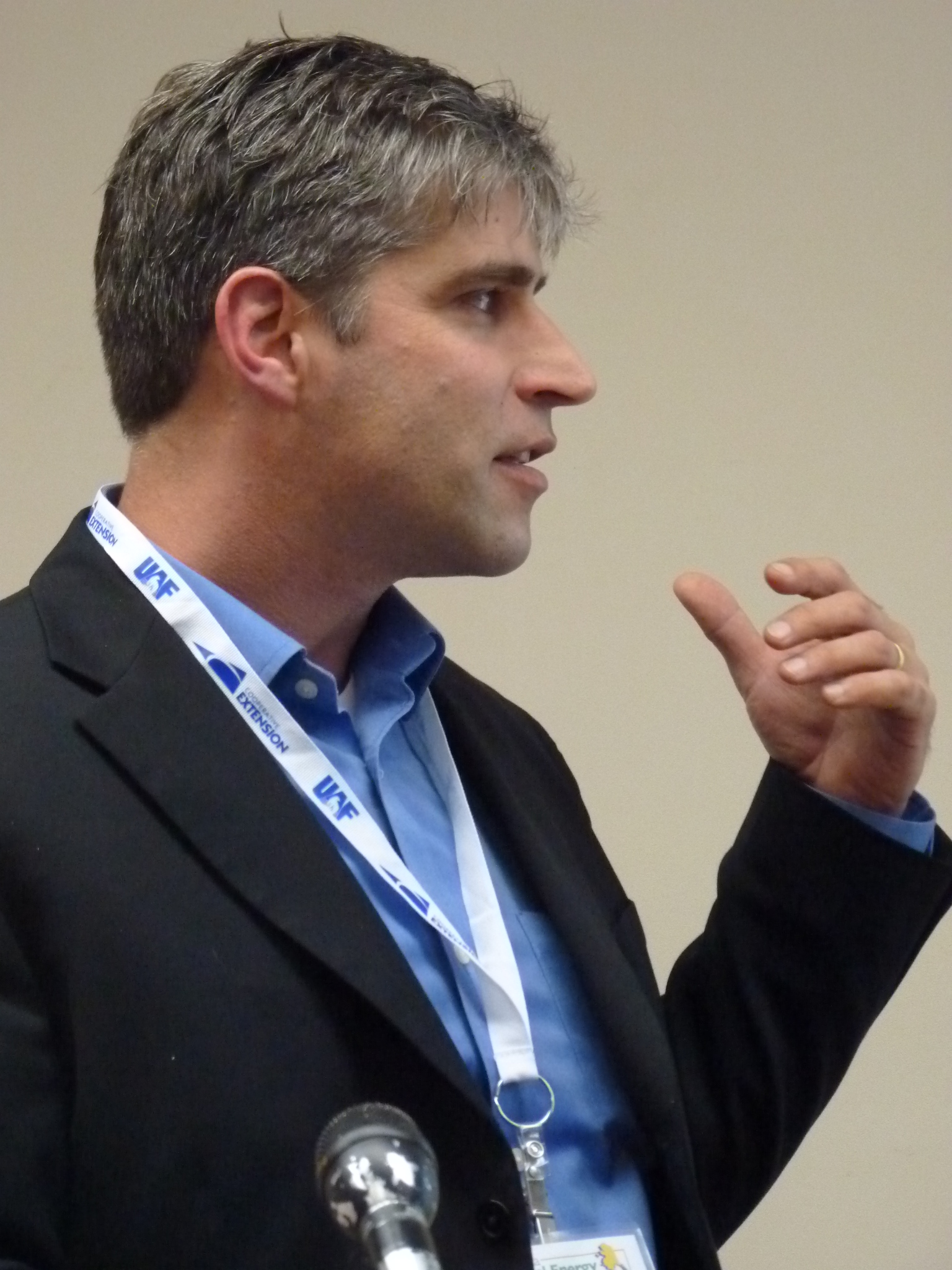
David Dungate of ACT Bioenergy speaks at the energy conference. Ed Schoenfeld photo.
David Dungate of ACT Bioenergy, and others at the conference, say it’s worth serious consideration.
“When you look at what’s the best return per dollar invested in energy, if your target is reducing carbon, what’s the most cost-effective way to do that, and what’s the best way to create jobs per dollar invested, biomass comes out very well on all those,” Dungate says.
The Alaska Wood Energy Development Task Group is trying to spur development of wood-energy projects statewide. The group is accepting statements of interest from those exploring community heating projects.
The task group, a coalition of agencies, will hire consultants to visit project locations and craft reports that could help with funding. The deadline is November 4th.
Project manager Corry Hildenbrand says that dream is close to becoming reality.
“We are on the ground. Durrett Construction is moving in with their barge. We awarded early in September. And we’ve got 9 to 11 weeks of work, so hopefully the weather will cooperate and we’ll get this first phase of work done,” he says.
Reynolds Creek is about 10 miles from Hydaburg, which is about 25 miles southeast of Craig. It’s being developed by Haida Energy, a joint venture of the Haida Corporation, and APT, the Alaska Power and Telephone Company.
Its powerhouse and small dam will feed electricity into Prince of Wales Island’s grid, eliminating the use of high-cost diesel generators.
Corry Hildenbrand
Hildenbrand, speaking at the Rural Alaska Energy Conference in Juneau, says there’s a long list of projects for this fall.
“Repairing the roads, building a road into the powerhouse site, building a road into the dam site so we can do our geotech investigations confirming what we have for foundation conditions. APT is also starting construction of the transmission line from Hydaburg out toward Deer Bay. The turbine generation is very close to being on order. And then we’ll be moving into final design based on our geotech work this fall,” he says.
The project’s power is expected to cost 11 or 12 cents a kilowatt-hour.
Its overall cost is estimated at $28 million, paid for by a mix of grants, loans and backing from its developers.
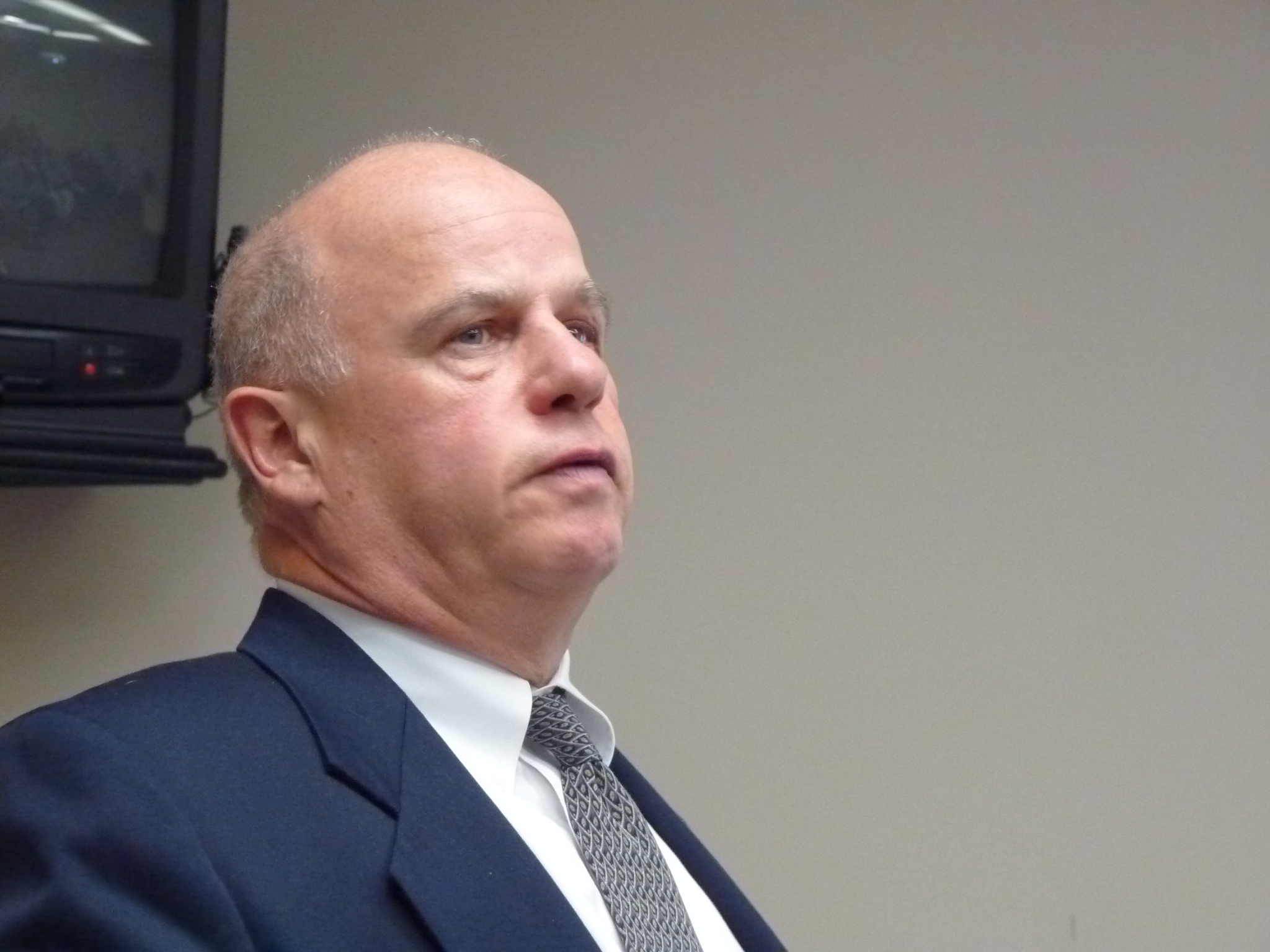
Alvin Edenshaw of the Haida Corporation says that’s more than they have.
Alvin Edenshaw
“Along the way, since 2000 and 2006, the cost has gone up. So we’ve gone back to the state and we are in the process right now with the Alaska Energy Authority and AIDA to develop another $9 million loan to bring our project on line,” he says. (Read a letter about Reynolds Creek from Edenshaw to shareholders.)
Haida Energy is also looking for ways to save money.
One approach is to change its Fish and Game Department permit. It requires what’s called a rotating drum fish screen to keep grayling out of the turbine. Hildenbrand says the fish were stocked and are not native to the area.
“So we’re looking to mitigate the cost of that fish screen and the possible operation problems with some outside mitigation funds so they can go ahead and perhaps in Hydaburg enhance some of the fisheries streams that have been damaged over history,” he says.
He says the screen costs about three-quarters of a million dollars.
Developers hope to have the hydroproject complete and producing electricity in 2014.
The three-day event includes technical workshops on newer technologies, such as wind, tidal, geothermal and biomass. Other sessions focus on funding, permitting and regulations relevant to energy projects. Still others are on hydropower, regional electric grids and efficiency.
Field trips to Juneau power projects are included. So is an Energy 101 session, providing
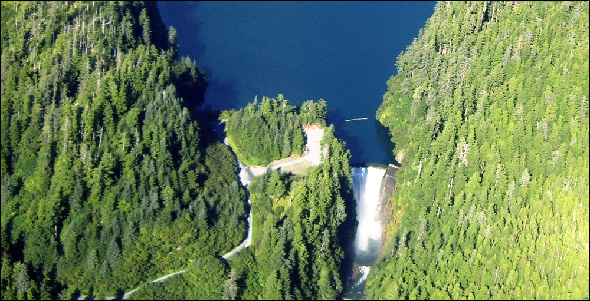
Sitka's Blue Lake hydroproject, which is slated for expansion.