Alaska

Alaska lawmakers go for a redo on vetoed corporate income tax bill

A legislative staffer waits outside the Alaska State Capitol in Juneau on March 20, 2025.
A legislative staffer waits outside the Alaska State Capitol in Juneau on March 20, 2025. (Eric Stone/Alaska Public Media)

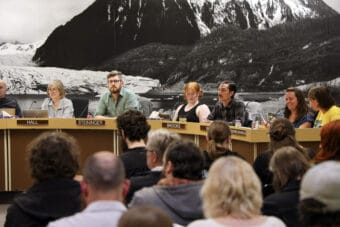
Alaska lawmakers are going for round two on a bill Gov. Mike Dunleavy vetoed last year. The bill would change the way corporate income taxes are calculated, bringing in tens of millions of dollars in new revenue.

Lawmakers failed to override Dunleavy’s veto of the bill at the beginning of this year’s session.

Backers of the bill say it’s necessary with a tight state budget, and it’s similar to a proposal Gov. Mike Dunleavy included in his fiscal plan.

Rep. Calvin Schrage, an Anchorage independent who co-chairs the House Finance Committee, said at the bill’s first hearing on Friday that it’s an effort to bring the state’s tax laws into the digital age.

“Currently, there is a loophole in Alaska’s corporate income tax structure, and that loophole is that if you’re a highly digital business that doesn’t have a physical presence here in the state, you are not paying taxes to the state of Alaska. You’re paying those taxes to other states,” Schrage said.

The bill would make two substantial changes to corporate income taxes in an effort to attribute more of Lower 48 companies’ income to Alaska.

The first implements what’s known as “market-based sourcing.” That essentially means that large businesses would pay taxes based on where their customers are, rather than where the company does its work. It’s a change dozens of other states have made and one the governor included in his fiscal plan.

The second component would change the tax rules for so-called “highly digitized businesses.” That’s an effort to extract more tax revenue from companies like Netflix, eBay and others that do most of their business over the internet but don’t have a presence in the state. That change is not a part of the governor’s plan.

Last year, the state Department of Revenue estimated the bill would raise between $25 and $65 million each year.

Rep. Will Stapp, a Fairbanks Republican in the minority who voted for the bill last year but voted against overriding Dunleavy’s veto, said he’d like to see some technical changes. For one thing, he’d rather not make the bill retroactive to the start of this year. But Stapp said he’s open to supporting it after a few tweaks.

“No change in tax structure is perfect,” he said in an interview. “But there are impacts that we should actually understand, that the public’s going to expect us to kind of understand so we can articulate it.”

Even though the bill is similar to an element of Dunleavy’s fiscal plan, it’s not clear the governor would sign the bill if passed. His office declined to comment on the new bill. But Dunleavy has said repeatedly he opposes new revenue measures without stricter limits on how state money can be spent.

The Alaska House’s draft budget has no PFD. Here’s what that means.

Rep. Andy Josephson, center, speaks during a House Finance Committee meeting alongside co-chairs Rep. Neal Foster, D-Nome, left, and Rep. Calvin Schrage, I-Anchorage, right, on Feb. 13, 2026.
Rep. Andy Josephson, D-Anchorage, center, speaks during a House Finance Committee meeting alongside co-chairs Rep. Neal Foster, D-Nome, left, and Rep. Calvin Schrage, I-Anchorage, right, on Feb. 13, 2026. (Eric Stone/Alaska Public Media)

The Alaska House Finance Committee adopted its first draft of the state’s budget. It makes a variety of smallish changes from the governor’s proposal, and one really big one: it removes the Permanent Fund dividend.

The change has attracted a lot of attention. So what does it mean?

Committee co-chair Rep. Andy Josephson, an Anchorage Democrat, said Alaskans shouldn’t panic — there will be a dividend this year.

The House’s first draft strips out everything new in the governor’s budget and represents essentially the status quo, minus the PFD. That provides a starting point for lawmakers to work from, he said.

But putting any PFD number into the budget right now could give Alaskans the wrong impression of what their legislators support and what a realistic dividend could be, Josephson said.

“Perhaps it’s counterintuitive, but sometimes starting at zero — because we are going to have a dividend — is the more honest place to start,” he said.

It’s also fairly typical, he said. House lawmakers have taken this approach for five of the past eight years, according to Josephson’s office. Members of the bipartisan House majority who control the committee approved the new draft in a caucus-line 6-5 vote.

Lawmakers on both sides have said they see Gov. Mike Dunleavy’s proposal to pay a roughly $3,600 dividend as unrealistic with low oil prices and a tight state budget.

But minority Republicans say they see removing the dividend from the budget at this stage as a worrisome sign. House Minority Leader Rep. DeLena Johnson, a Palmer Republican, said dropping the dividend from the working draft reduces pressure on lawmakers to cut spending and hold down expenses.

“If we don’t have some kind of PFD, then we’re just going to spend it, and we’re going to continue to spend, and then we are going to continue to spend into savings,” Johnson said at a news conference on Thursday.

Economists told lawmakers earlier this year that reducing the PFD to cover a deficit is akin to a regressive tax and hits low-income Alaskans the hardest.

Removing the PFD from this early budget draft also helps the majority avoid an uncomfortable vote that threatened to hold up progress on the budget last year. During the last legislative session, the budget briefly stalled when lawmakers were unable to muster the votes to reduce the PFD in a later draft.

The upper house of the Legislature is taking a different approach. The first-draft budget in the Senate includes everything the governor asked for, including the PFD. (There is one exception, Dunleavy’s proposal to create a Department of Agriculture, which is the subject of an ongoing lawsuit.)

Both the Senate and House are controlled by Democrat-heavy bipartisan coalitions.

How much the dividend will ultimately be is up in the air for now, but some key lawmakers have said they don’t expect much change from last year’s $1,000 PFD.

“My best guess is between $750 and $1,400,” Josephson said. “Personally, based on what happened last year, I think it’s going to be around $1,000, but it’s way downstream.”

The state operating budget officially sets the dividend, and it’s typically one of the last bills to pass before the end of the regular session in May.

Author Ernestine Hayes says Elizabeth Peratrovich’s advocacy work isn’t over

Crystal Worl’s Elizabeth Peratrovich mural in downtown Juneau on Friday, Feb. 13, 2026. (Photo by Clarise Larson/KTOO)

Monday is Elizabeth Peratrovich Day, an Alaska State holiday honoring a Lingít activist who testified before Alaska’s territorial legislature in Juneau to demand civil rights for Alaska Native people.  

In the 1940s, the Alaska Native Brotherhood and Sisterhood began petitioning Alaska’s territorial governor for civil rights protection. That included equal access to public facilities and services, banning racial discrimination in businesses open to the public, and no more signs that said things like “No dogs, no Natives.”

Elizabeth Peratrovich Day marks the anniversary of the Alaska Anti-Discrimination Act passed in 1945. It was the first anti-discrimination act to become law in any state or territory in the United States and came years before the Civil Rights Movement gained momentum.

Lingít author Shaankaláx̱t’ Ernestine Hayes said Peratrovich and her legacy inspire her, especially as she reads the news today. 

“Not only are we facing the same challenges as she faced,” she said. “But we have her as a model, and if we stop and consider ‘what would she be doing right now, today?’ then we can use her example as the choices we should make.”

Hayes has written two memoirs, chronicling her life in and out of Southeast Alaska in the wake of Peratrovich’s advocacy.

She was selected as Alaska State Writer Laureate in 2016. In 2021, she was named the Rasmuson Foundation’s Distinguished Artist. Two years later, she was awarded a United States Artists fellowship.

One way Hayes thinks we can embody Peratrovich’s mission today: making sure that Alaska Native people continue to have a seat at decision-making tables. 

“We need to ask ‘Has that discrimination that Elizabeth Peratrovich fought, has it just moved out of the restaurants and into the boardroom and into the organizing committees?’” she said.

And Hayes said Peratrovich’s fight against discrimination isn’t over – especially when it comes to pointing the mirror at ourselves.

“If we speak out, demonstrate against or protest against an administration that, as policy, is trying to destroy diversity and inclusion,” she said. “Then we really should be modeling that ourselves.” 

She said having a state holiday to celebrate Peratrovich’s advocacy is a step toward deeper and more meaningful acknowledgement of the role Alaska Native people have had and continue to have in shaping our community. 

“It’s certainly not our ultimate goal, which is inclusion, but I think it’s a good step, as long as we always remember there’s no real final step in nurturing our values,” Hayes said. “There’s always more to do.”

Peratrovich’s testimony is often credited with swaying the territorial legislature. Though no audio recording of her actual testimony exists, a version of it for kids has been memorialized in an episode of the PBS Kids show “Molly of Denali.”

U.S. Coast Guard Cutter Waesche makes logistics stop in Juneau

U.S. Coast Guard Cutter Waesche in downtown Juneau on Friday, Feb, 13, 2026. (Photo Courtesy of U.S. Coast Guard)

The U.S. Coast Guard Cutter Waesche is currently docked in the capital city at the downtown cruise ship dock as it prepares to venture to the Bering Sea to conduct maritime security operations and fisheries enforcement.

The 418-foot-long national security cutter and its roughly 150 crew arrived in Juneau on Thursday morning. It’s homeported in Alameda, California.

Petty Officer 1st Class Travis McGee said the ship is in Juneau for a logistical stop as it heads north for an Arctic District patrol in the Bering Sea. 

“Their primary focus on this patrol is going to be fisheries enforcement, but they’re also able to respond to other missions as well, including search and rescue,” he said in an interview Friday afternoon. 

McGee could not confirm how long the ship would remain in Juneau before continuing on. He said the Coast Guard typically does not release the specific timelines of vessel movements.

Juneau School District releases budgeting tool for community feedback on budget priorities

The entrance of Juneau-Douglas High School: Yadaa.at Kalé on August 15, 2026. (Photo by Jamie Diep/KTOO)

The Juneau School District released a budget simulation tool on Wednesday that allows people to build and submit what they think the district’s budget should look like.

Balancing Act focuses on building the district’s operating budget. That includes funding for student instruction, including teachers, administrators and school supplies.

The district originally planned to also send a budget survey to families earlier this month. But Juneau School Board Vice President Elizabeth Siddon said during a budget work session last month she was concerned that the community might not see its responses reflected in the budget.

“I don’t want to put a survey out that is not real clear to the public how we used it later, especially in our budget,” she said. “So this all needs to have clear line of sight, what we’re going to do with the feedback we get in the budgeting process.”

The board unanimously decided to set the survey aside this year after board member Steve Whitney brought up the idea.

The budget tool starts off with a preliminary budget that maintains all of the district’s current services going into the next school year. It gives the public options on where they can add or cut teachers and funding. But there are some limits.

Some funding is required by law and can’t be changed. Other services can’t be cut by more than 10%. Information in the tool states larger cuts “would likely result in the inability to maintain compliance.”

The initial budget begins with a $5.3 million dollar deficit and assumes the city will contribute $35.8 million – the maximum it’s legally allowed to. Even when making all the cuts possible within the tool, the district is still left with a $1.1 million deficit. That could be covered with the district’s savings.

There’s an opportunity within Balancing Act to write comments on every source of revenue and expenditures.

Juneau School District Chief of Staff Kristin Bartlett said in an email the tool will likely close between the first and second reading of the budget, which is currently scheduled between Feb. 19 and March 10.

This isn’t the first time Juneau residents have been able to build their own budget. The city released its own version when building a budget in 2022.The next budget related meeting is Saturday at 8:30 a.m. at Juneau-Douglas High School: Yadaa.at Kalé. Community members can also submit written feedback by emailing budgetinput@juneauschools.org. The board is expected to approve a budget by March 12.

Juneau Seahawks superfan travels to Super Bowl parade in Seattle

Juneau resident and Seahawks fan Donna James holds up a copy of The Seattle Times at KTOO on Feb. 12, 2026. (Photo by Lisa Phu/KTOO)

Hundreds of thousands of people attended the Seahawks Super Bowl 2026 parade in Seattle on Wednesday, and Juneau resident and Seahawks superfan Donna James was one of them. 

Juneau residents Donna James and Ken Willard attended the Super Bowl parade in Seattle on February 11, 2026. (Photo courtesy of Donna James)

James went to the parade with her partner, Ken Willard, also a Juneau resident. The two decided to make the trip to Seattle after the Seahawks defeated the New England Patriots 29 to 13 in Sunday’s game. 

We watched the Super Bowl, and they announced that the parade was going to be on Wednesday. So right after the Super Bowl, I said, ‘Well, are we gonna go? Are we gonna go?’ He said, ‘Let’s get our tickets now.’ So we got our tickets that night, and we flew out on Tuesday,” James said. 

On the day of the parade, James and Willard woke up at 3 in the morning and got to the parade grounds in downtown Seattle at 5 a.m. for an 11 a.m. start time.

They watched the parade from a bridge on 4th Avenue. James said being at the parade, cheering for her favorite team alongside other “12s” – as Seahawks fans are known – was “a dream come true.”

“When I’m around Seattle Seahawk fans, I get this cold chill, a happy feeling. (I’m) just so happy. It’s hard to explain,” James said. “And then halfway through, I kind of cried – just to be at a Super Bowl parade with a favorite team, all the fans.” 

James has been a Seahawks fan since 2010. She’s been known to drive around Juneau in a truck with Seahawks decals, and her license plate says “GO HWKS.”

And she has countless memorabilia – including Seahawks-themed Tlingit regalia, jewelry and a paddle, signed football helmets and Seahawks luggage. James said she never misses watching a Seahawks game and has attended 18 in person. 

Donna James has countless team memorabilia, including a Seahawks-themed cedar hat by Natalie Brown, jewelry by Doug Chilton, and a paddle by George Gardner. (Photo courtesy of Donna James)
Site notifications
Update notification options
Subscribe to notifications