Alaska Elections

Low voter turnout renews interest in elections by mail

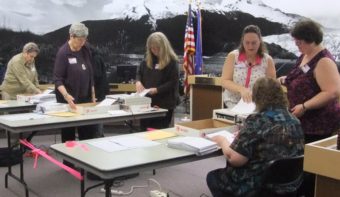
Chances are, if you’re registered to vote in Juneau, you didn’t the last time school board seats, candidates for the Assembly, municipal debt or sales tax extensions were on the ballot.

In the last municipal election in October, less than a third of the people registered to vote in Juneau actually cast a ballot, and that’s not unusual.

Voter turnout in municipal elections peaked in 1993 at nearly 63 percent, and bottomed out in 2007 at about 21 percent.
(Graphic by Jeremy Hsieh/KTOO)

“It’s election after election, and, you know, there’s definitely a way to improve it. We just have to find the right way,” said Assemblyman Randy Wanamaker.

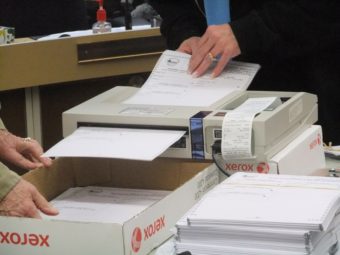
He thinks voting by mail could improve turnout. Ballots would be mailed directly to registered voters and cast by mail, like in Oregon or with Native corporations’ shareholder elections. There wouldn’t be any polling places.

City Clerk Laurie Sica, whose duties include running municipal elections, was the impetus behind a 2007 ordinance that empowered the Assembly to hold local elections by mail. All it takes is a simple majority vote, though it’s never been done.

Sica was jazzed about the possibility of holding elections by mail in 2007, especially for special elections when there’s less notice to hire poll workers. But now, Sica says she prefers the status quo, so that Juneau stays consistent with the state’s election practices.

“In terms municipal elections, I think anything we can do to improve voter turnout — once people start voting I think they’ll continue voting, and that’s what we want to do.  And if we can make it easier for them to participate, then I think it’s worth the cost,” Wanamaker said.

Cost estimates Sica put together in 2007 suggested that increased ballot printing and mailing costs would far outweigh savings in election workers’ pay. In 2007, she estimated it cost $41,800 to hold a traditional election, but $59,800 to hold it by mail.

Today, the cost difference between holding an election by mail may be even greater because of higher postage rates, and the possible need for signature recognition software. Sica says she has more research to do.

Coincidentally, 2007 was also the three-decade low for voter turnout. In that year’s June special election, only 5,231 ballots were cast out of 24,494 registered voters, about 21 percent. Ballot propositions in that election were the last in a series of multimillion dollar decisions put to voters related to the construction of Thunder Mountain High School.

Proposition 2 passed with a 70 vote margin. In terms of turnout, that’s less than one-third of 1 percent, or about a sixth of Juneau-Douglas High School’s 2007 senior class. If Proposition 2 had gone the other way, Thunder Mountain High School might not have a track and artificial turf field today, and taxpayers would have $5 million less in debt to repay.

When Wanamaker brought up vote-by-mail at the Assembly’s last regular meeting, City Manager Kim Keifer said she would put some information together for the Assembly to review at an upcoming meeting.

Juneau’s municipal elections are held the first Tuesday in October. Three seats on the Assembly and two seats on the Juneau School Board are up. Candidates can file to run beginning Aug. 2. Information about running for local office is available at http://www.juneau.org/clerk/elections/.

With representation on decline, voting rights decision worries Native districts

Most states that had been covered under the Voting Rights Act won’t feel the full impact of the Supreme Court’s ruling until 2020, when the next redistricting cycle starts up. But Alaska, along with Texas, will experience the effects straight away. Here, political lines still haven’t been finalized, and today’s decision could shape the way boundaries are drawn.

Under federal law, Alaska was required to have five House and three Senate districts with large Native populations. The point was to guarantee Alaska Natives a voice in the legislature. With the Supreme Court striking down part of the Voting Rights Act, that requirement is gone.

“What we fear is that it’s going to be a net loss,” says Alice Ruby.

Ruby is the mayor of Dillingham, where Alaska Natives make up over half the population. She says that even with the Voting Rights Act’s requirements, communities like hers have seen their power diluted in recent years. As the population of cities along the Railbelt has gone up, rural Alaska has seen its representation shrink. The number of Alaska Natives in office has also dropped, going from seven to five in the last election cycle.

“I don’t know if you define that as discrimination, but I do know that it has affected certainly my community because we ended up being part of a district that was split in an odd way or that the district was so large that our legislator really couldn’t adequately represent us,” says Ruby.

Ruby is nervous that things may get worse for her region. As a city official, she says the Supreme Court’s ruling that all Alaska voting policies — whether they involve state or local elections — go through the Department of Justice before they get cleared relieves some regulatory burdens on a municipality like hers. But she says that wasn’t much of an inconvenience, and that Section 5 of the Voting Rights Act largely benefitted her region. With the Alaska Redistricting Board currently reviewing nearly a dozen political maps, she’s worried that communities off the road system won’t be adequately represented.

“So, why wouldn’t we be afraid? The maps have been released and hearings have been scheduled in the large urban areas, and here we are, still wondering what the impact will be on us.”

Bob Brodie is a member of the redistricting board, and he says he understands those concerns.

“I think in the future it’s going to be very difficult for rural areas to perhaps be represented,” say Brodie.

A number of the plans being reviewed by the board have a lot in common with the current map, which was drawn to meet Department of Justice standards. Michael White, the board’s attorney, says that they’re still keeping Native influence in mind. But when it comes to a decline in population, there’s not much the board can do.

Brodie says this isn’t just an Alaska problem.

“I don’t know so much if we could label it a Native thing, but it’s certainly a rural thing that’s common across the country.”

In addition to affecting redistricting, the Supreme Court’s ruling could also have implications for future voting laws. A controversial bill that would require voters to display photo ID at polling places was introduced in the legislature earlier this year, and had it passed this session, the Department of Justice would have had to okay it before it would go into effect. Should the bill move forward next session, it would no longer have to go through that review process.

Minimum wage initiative one step closer to ballot

Another ballot proposition has made it to the signature-gathering phase. Yesterday, Lt. Gov. Mead Treadwelll certified an initiative that would raise the minimum wage to $9.75 an hour.

Right now, the state minimum wage is set at $7.75. The initiative would bump that up by a dollar in 2015, and then by another dollar the year after. It also would build in future increases by tying the minimum wage to Anchorage’s consumer price index.

Ed Flanagan is one of three former labor commissioners spearheading the initiative. He describes the jump as “modest,” and says you would need to make closer to $12 an hour to support a family in this state.

“I know even $9.75 would be really impossible to live on in Alaska. But you’ve got to set the floor somewhere.”

This isn’t the first time that people have tried to raise the minimum wage through the initiative process. About a decade ago, a proposition that would have inflation-proofed the minimum wage was nearly on the ballot, but the legislature preempted that by passing a bill that did the same thing. But a year later they rolled back that policy. Flanagan says that’s one of the reasons they’re trying to bring this legislation to a vote.

“By going the initiative route, we don’t have to be concerned about the legislature passing something and then undoing it a year later. They can’t touch it for two years after the effective date. So, if we are successful in getting it passed in August of 2014, we would get both one-dollar raises and the first CPI adjustment before they could basically go in and undo any part of it.”

Flanagan says they’re also trying to avoid something called a “tip credit,” which would give businesses like restaurants an exemption from paying the minimum wage to staff who earn tips.

The sponsors have until January to collect over 30,000 signatures to get on next year’s primary ballot.

With seven maps, many options before Redistricting Board

The Alaska Redistricting Board will review seven different political maps as well as several submitted by third party groups.

The board must again redraw legislative boundaries, after the Alaska Supreme Court in December found its plan did not follow the state constitution. The state Division of Elections used an interim map in the 2012 election.

The new maps are the first step in that process.

The board agreed at a meeting Friday to consider all the options. Chairman John Torgerson said members had many choices in changing the political boundaries.

“There are some strikingly similar districts. There are many options that are convened in all those.”

The Redistricting Board only started working on new boundaries two weeks ago. It had been waiting for the U.S. Supreme Court to rule on a Voting Rights Act case, which will affect the way lines are drawn. Earlier this month a Fairbanks Superior Court judge criticized the board for delaying the process and ordered them to begin work immediately.

Zack Fields is Alaska Democratic Party communications director. He says even though the board has now offered a set of maps, it’s still holding up the process:

“The redistricting board appears to be stalling, and by in theory considering many, many plans, the redistricting board has given itself maximum flexibility to change district lines later. And the problem is citizens are left in limbo wondering who are my representatives going to be.”

The Alaska Redistricting Board will hold a series of public meeting on the maps beginning in Anchorage on June 28. Testimony will be taken in Juneau on July 2nd.

Some of the most controversial districts in the interim plan are in the Interior and Southeast Alaska. As KTOO reported last week, Petersburg has asked the board to take the town out of Juneau’s House District 32 and put it in a district with smaller Southeast communities.

You can examine the proposed maps here.

Treadwell to run for Senate

Mead Treadwell.
Mead Treadwell.

Lieutenant Governor Mead Treadwell announced early this morning he’s running for Senate. He said he’s entering the race, instead of running for reelection, because he knows he can win.

His announcement named neither Begich nor the GOP primary. If he wants to face Begich, he’ll need to survive what’s expected to be a rough nominating contest.

Treadwell took a swipe at fellow Republican candidate Joe Miller without naming him.

“I think Republicans know we need a credible conservative candidate to take on Mark Begich,” he said in an early phone interview. “We know we need unity to win.”

That unity was lacking in the 2010 race. Miller, then a political neophyte, stormed onto the scene and upset incumbent Senator Lisa Murkowski in the primary. She went on to win the general election in a write-in campaign.

Murkowski urged Treadwell to run but out of principle will remain neutral during the primary.

“The best thing to do is steer clear of it,” she said Tuesday afternoon at the Capitol. “I learned that from my father, who didn’t endorse me for my very first race for the Alaska state legislature because I was in a contested primary. It was good advice.”

She called Treadwell the front runner.

Miller said he welcomes Treadwell’s announcement; that competition is good for the party. He said he sees himself as the anti-establishment candidate, and Alaskans will have a clear distinction in the primary.

He would not highlight those differences, but said they’ll be apparent as the race develops.

“I would consider all of the candidates that are at least contemplating getting into this race as establishment type candidates,” he said.

Many observers in Washington see Treadwell as the establishment candidate, too. He’ll be here next week meeting with party leaders – including the National Republican Senatorial Committee. That group – officially tasked with regaining control of the Senate – refuses to discuss Miller’s candidacy.

It would like to avoid another nasty primary, which doesn’t take place until August 2014.  The group has said Begich’s seat is crucial to winning control of the upper chamber.

“If you can put the Republicans back in the leadership you’d make Lisa Murkowski the head of the Senate Energy Committee. That’s going to help with ANWR. That’s going to help us with access to our lands. That’s the defining issue,” Treadwell said.

It’s hard to see a difference between Begich and Treadwell on the major issue in the state: Both support expanded oil and gas drilling.

Treadwell promised to campaign on three causes: Fighting for liberty, fighting for fiscal sanity, and fighting for Alaska.

He invokes a sacred name when he talks of his campaign: former Senator Ted Stevens. He said he’ll follow in the Stevens tradition of bringing power back to Alaska – letting Alaskans make decisions about the state, not the federal government.

“That part of his legacy, of trying to bring the decision making home is the legacy I want to work on,” he said. “We have a federal system now of spending too much, borrowing too much, taxing too much. Asking the federal government for earmarks is probably not the right way to go.”

Of course, Stevens is most remembered as the chair of the Appropriations Committee who doled out government money and projects all over Alaska.

Jennifer Duffy, senior editor with the Cook Political Report,said even though it’s early, this does not look like it will be as monumental a primary as 2010.

“You don’t see the Tea Party groups rallying around Miller like they did in 2010. The other thing is: I have not heard any of these groups having a real problem with Treadwell,” Duffy said.

Those groups don’t have any issues with Governor Sean Parnell either, and Duffy said that helps Treadwell.

And this far off, other candidates have plenty of time to enter the race.

Referendum sponsors say opponents are interfering with petitions

Sponsors of a referendum to repeal a tax cut on oil companies allege that opponents are interfering with their ability to collect signatures.

Pat Lavin is one of the organizers behind the referendum. He says the harassment started in Anchorage last week and escalated on Monday, when an unidentified woman interrupted the signature gathering effort at the Barnes and Noble.

“This was physically putting her hands on people signing books to kind of get their attention and basically say, “Don’t do this. That’s a bad idea. You don’t want to sign that.”

The practice is called blocking, and the intent is to make it harder not just for a petition circulator to get an individual signature but to control a high-traffic space. Lavin says that because the incident upset customers, petition circulators were asked to cut their day short. He says he’s worried the same people could target them again.

“I don’t think it’s going to be an army, but you know a few persistent harassers can really — as we saw at the Barnes and Noble — shut things down.”

With less than a month to go, the referendum group has to collect over

30,000 signatures to get on the ballot. At last count, they were above 20,000.

Because interfering with constitutional rights is a misdemeanor, referendum organizers have requested a meeting with Anchorage Police Chief Mark Mew.

Management at Barnes and Noble was not able to answer questions about the incident.

Site notifications
Update notification options
Subscribe to notifications