Alaska Elections

Alaska businesses are divided over a ballot measure that would raise minimum wage and mandate sick leave

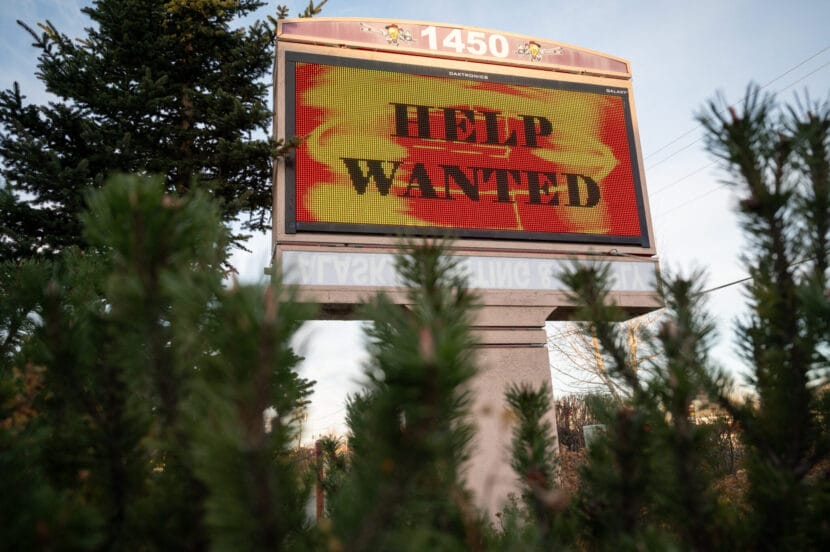
A digital marquee sign flashes “help wanted” and “looking for line cooks” out side of Bread and Brew restaurant in Anchorage on Thursday, Oct. 24, 2024. (Matt Faubion/Alaska Public Media)

David Ottoson has owned Rainbow Foods, a natural grocery store in Juneau, for 44 years. Most of his 30 employees already earn more than $15 an hour, but a handful of highschoolers make $14. They all earn paid time off.

He said his wages are competitive with other grocery stores, and thinks it’s part of the reason he’s able to retain employees.

“$15 an hour isn’t that much,” he said. “During the pandemic, it was harder to find people, so we had to increase what we were willing to pay to get people to come to work.”

If passed, Ballot Measure One would raise the minimum wage from $11.73 to $13 in 2025, $14 in 2026 and $15 in 2027. Annual cost of living adjustments would begin in 2028.

Employers with more than 15 employees would be required to allow staff to accrue up to 56 hours of paid sick leave per year, and up to 40 hours if there’s less than 15 employees. It would also prohibit employers from making their employees attend meetings about religious or political issues, but some employers would be exempt.

Ottoson said he supports the measure because Alaskans shouldn’t have to choose between being sick and their paycheck.

“The value it has for keeping people who are at work from getting sick, from having germs spread from their fellow workers, I think, probably outweighs any cost that’s involved,” Ottoson said.

Ottoson is among over 120 small businesses owners that have joined a coalition in support of the measure, called Better Jobs for Alaska.

Supporters say the measure would boost consumer spending, improve retention, and that paid sick days are good for businesses. Opponents say the measure’s language is too vague and would have detrimental impacts to small businesses.

The Chamber of Commerce in Anchorage, Fairbanks, Juneau and the Alaska Chamber are among a group of business organizations and businesses that came together to oppose the voter initiative, called Protect Our Small Businesses & Jobs.

Alaska Chamber President and CEO Kati Capozzi said the measure’s language leaves too much room for interpretation.

“I’ve read this thing 150 times,” she said. “Every day, I’ll have a member call me and they’ll be like, ‘Well, what about this? How would it apply in this way?’ And I’m unable to answer it. It’s just not tight language.”

Nearly 70% of Alaskans voted to raise the minimum wage a decade ago but unlike that measure, this one includes sick leave.

If it passes, it would allow employees to use sick leave to care for a family member, but Capozzi said the definition of family member is one example of what she believes is overly broad language. It includes immediate family members, legal guardians, and any other individual whose “close association is the equivalent of a family relationship.”

“Is that neighbor Bob? Is it my dog?” Capozzi questioned.

Alaska has the lowest minimum wage of West Coast states by almost $2, according to the Department of Labor. Capozzi said 92% of Alaskans already make more than $15.

Alaska is one of seven states that require employers to pay tipped employees the full minimum wage, and Capozzi said that wasn’t taken into consideration when writing the measure. She said many tipped workers make significantly more than their hourly wage.

She said the measure would raise operational costs for business owners and would force businesses to charge more, cut positions, or even close.

James Strong owns Sweet Caribou, an eatery in Anchorage. If the measure passes, he said he’ll have to raise prices and cut part-time positions. He estimates the measure would cost him up to $12,000 each month in operating costs.

“What I have to do is I’ll have to do combined full time jobs. So [who it] really impacts [are] college kids that [are] looking to work four or five hours a day,” he said.

Most of Strong’s employees start at minimum wage and make tips, but some staff earn higher wages and don’t earn tips.

The measure allows employees to use paid sick leave for three days before an employer can require “reasonable documentation,” which the measure exemplifies as a signed document from a healthcare professional indicating that paid sick leave is or was necessary.

Strong worries it will make employees less reliable.

“People are gonna find more reasons to call in sick,” said Stong. “You’re going to have people that are going to be less reliable.”

Employers aren’t required to provide additional sick leave if they already have a paid time off policy that’s sufficient for hourly requirements.

But up in Fairbanks, Carey Fristoe, the co-owner of Black Spruce Brewing Company, sees it differently.

Fristoe thinks the measure could give hospitality businesses, like his, a competitive hiring advantage. The brewery opened six years ago, and he said most of his seven employees have worked there for several years.

His employees all make more than $15, except a single front-of-house employee who makes minimum wage plus tips. He thinks paying a higher wage would save him the time and cost of training new employees.

“Having people on board that are trained up, [and] in there for the long haul makes such a huge difference for us,” Fristoe said.

Fristoe also said employees shouldn’t have to worry about their paycheck when sick. His business is centered on food and beverage, and he said allowing employees to take time off when they’re sick keeps their customers, and other employees healthy.

Advocates seize AFN convention as opportunity to rally the Native vote

United Tribes of Bristol Bay was among the organizations that promoted voting at the 2024 AFN convention. (Liz Ruskin/Alaska Public Media)

A person could barely move a few yards at the Alaska Federation of Natives convention in Anchorage last week without bumping into a message to vote.

Daniella Tebib was working the ground at the artisans’ market on the first floor.

“Hello! Do you guys have a plan to vote this November?” she asked of passers-by

“In November?” a man responded, a little tentative. “Everybody’s going to vote, right?”

“I hope so. That’s the goal,” Tebib said, thrusting a brochure at him. “Would you like some more information?”

Tebib, a volunteer for Congresswoman Mary Peltola’s re-election campaign, sweetened her pitch with invitations to spin the prize wheel at the Peltola booth for t-shirts, hats and other campaign swag.

The AFN convention is in October, and in election years, there’s always some emphasis on voting. But this year, AFN co-chair Joe Nelson said the convention is especially focused on encouraging a strong Native vote.

“Yes, because we know there are forces in play that are trying to marginalize our communities,” he said.

Shannon Mason staffs a popular prize wheel at Rep. Mary Peltola’s campaign booth at the 2024 AFN convention. (Liz Ruskin/Alaska Public Media)

For Nelson and other AFN leaders, an effort to suppress Native votes came into clear view this month, when a pair of Republican legislators were guests on a conservative talk radio show. State House Speaker Cathy Tilton, R-Wasilla, told host Michael Dukes that she and fellow Republicans killed a bill that would have eliminated the witness signature requirement on mail-in ballots, which she acknowledged is a barrier for rural voters.

“The changes in that bill definitely would’ve leaned the election towards, you know, towards Mary Peltola, to be quite honest,” Tilton said during the broadcast.

Tilton did not respond to an interview request for this story.

Nelson said Alaska Native voters need to show up in huge numbers to overcome barriers like the signature requirement. He’s passionate about re-electing Peltola, the first Alaska Native person elected to Congress — and, incidentally, Nelson’s ex-wife. He’s also plugging a “no” vote on Ballot Measure 2. That’s the measure that would repeal Alaska’s open primary and ranked choice voting. Nelson said Alaska’s current voting method helps eliminate partisan gridlock and serves most Alaska Native voters, who he describes as common-sense moderates.

“We’re, you know, 17-ish percent of the population, 120,000-plus Alaska Natives,” he said. “If we actually aligned on all of our things and showed up and voted, there would be no denying that our vote actually matters.”

The No on 2 campaign was one of the convention sponsors this year, so that message was on banners, pencils, buttons and brochures.

(The Yes on 2 campaign wasn’t present at the convention, but supporters of repeal say that ranked chance voting is confusing and that the open primary is unfair to conservatives.)

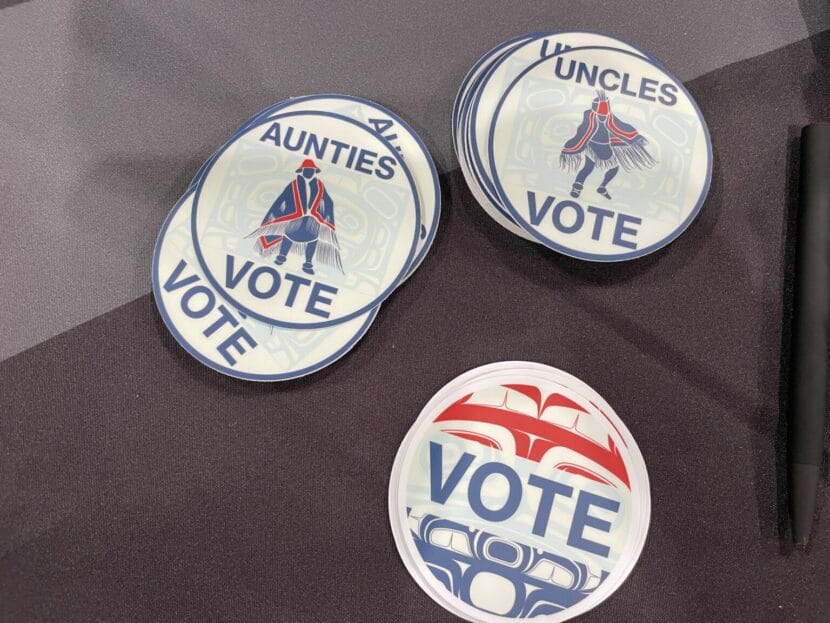
Some of the voting stickers available at a Sealaska table at the 2024 AFN convention. (Liz Ruskin/Alaska Public Media)

Some of the get-out-the vote effort was generic, not promoting any particular candidate.

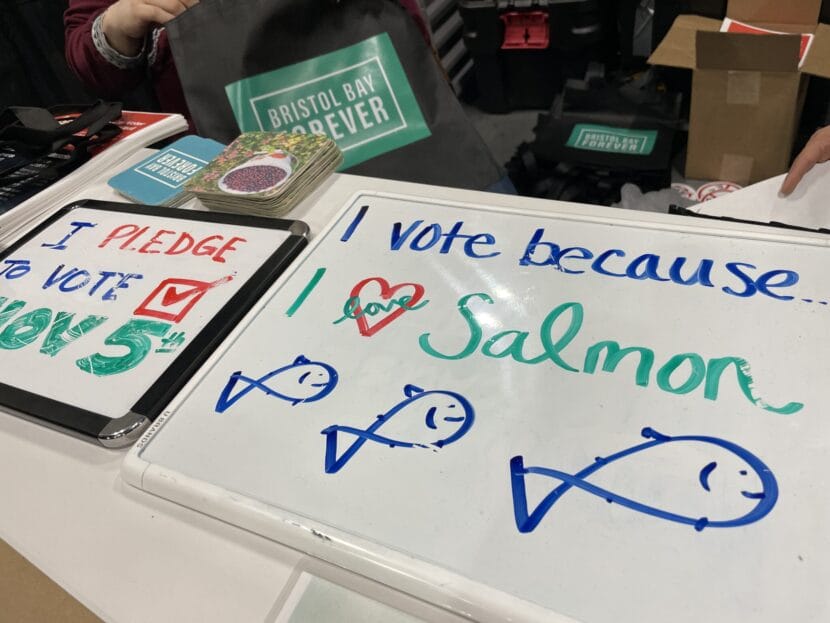
Shelley Cotton, chief strategy director of United Tribes of Bristol Bay, was reeling in shoppers at the AFN artisans market with a non-partisan approach. She invited voters to sign a pledge to vote, with check boxes to indicate they’d welcome reminder messages or translation services.

“Getting out the vote is really important for us, because we want Native people to decide who’s best for our people and for those people to be in position so we can work with them as well doing our advocacy work,” she said.

Cotton said United Tribes of Bristol Bay has 11 interns spread out in their region, to engage communities and make sure everyone knows when and where to vote.

Upstairs, Michelle Sparck beamed as she handed out indigenous-specific “I vote” buttons.

“Here we go,” Sparck said, sizing up one young family. “That’s for your baby: ‘future Alaska Native voter.’ YayI”

Sparck leads the non-partisan Get out the Native Vote. She has labored largely alone in past years. Not this time. Several Alaska Native organizations pitched in so that she could hire 30 workers for the election season, to spread the word. And, Sparck said, they’re determined not to see a repeat of what happened in the primary, where voting stations didn’t open in some rural villages, for lack of poll workers.

“We’re actually ready to fly out our volunteers to any vulnerable precinct that does not have an election worker signed up, lined up, or will fall out before Election Day on Nov. 5,” she said.

A few yards away, convention participants thronged to a Sealaska table with Native-themed voting stickers and signs. “Aunties vote” was particularly popular.

“We’re not endorsing any candidates here, but we’re just making sure that Alaska Natives have a plan to get to the polls and cast their vote,” Christian Ḵaat’aawu Gomez of Juneau said, “because we know that our voices need to be heard and that we have a huge impact.”

Near him a poster summed up the aspiration: “Voting is our way of life.”

Alaska Federation of Natives endorses Peltola, opposes ranked choice repeal

Attendees at the 2024 AFN convention, listening to an address by U.S. Sen. Lisa Murkowski, R-Alaska, on Oct. 19, 2024, hold signs with Mary Peltola’s face on Oct. 19, 2024. (Photo by Yereth Rosen/Alaska Beacon)

The Alaska Federation of Natives voted Saturday to endorse the reelection of Democratic U.S. Rep. Mary Peltola and to oppose the ballot measure to repeal the state’s open primaries and ranked choice voting.

The votes came on the last day of its annual three-day convention, which had the theme this year of “Our Children, Our Future Ancestors.” The delegates from tribes, nonprofit tribal organizations and regional and village Native corporations passed 18 resolutions on issues ranging from a call for Congress to amend federal law to explicitly recognize Native rights to subsistence hunting, fishing and gathering to support for the state prioritizing public education funding.

Peltola, who is Yup’ik, from Bethel and the first Alaska Native member of Congress, drew broad support from the delegates, though some groups abstained from the vote.

The resolution endorsing Peltola was introduced by Sealaska, the regional Native corporation for Southeast Alaska.

“Representative Peltola has been a strong advocate for Alaska’s fisheries and subsistence users by introducing and working with her colleagues, regardless of party affiliation, for legislation to strengthen US seafood competitiveness in international markets, taking actions to enhance research to improve federal programs that support domestic seafood production and working tirelessly to reduce bycatch and protect fisheries habitat,” the resolution said.

Peltola’s top opponent is Republican Nick Begich. AFN did not host a candidate forum this year, after having hosted forums at previous conventions.

The resolution opposing Ballot Measure 2 — which would repeal the voting system — passed without opposition. But a resolution in support of Ballot Measure 1 never made it to a vote.

Ballot Measure 1 would raise the state’s minimum wage to $15 per hour by 2027, require employers to pay sick leave, and bar employers from requiring workers to attend political or religious meetings.

A motion to table the resolution supporting Ballot Measure 1 was introduced by Curtiss Chamberlain, assistant general counsel for Calista Corp., the regional Native corporation for the Yukon-Kuskokwim Delta region.

Chamberlain noted that many village corporations face declining revenue because of the projected decline in revenue being shared by the Red Dog mine. The potential added costs from the ballot measure trouble village corporations in Calista’s region, he said.

“A few brought their concerns to our attention,” he said. “And with that, and based on those discussions and concerns, I respectfully ask that this be tabled.”

Debra Call, a member of the Cook Inlet Tribal Council, unsuccessfully spoke in favor of the resolution and against the motion to table it.

“You really need to raise the standard of living of many of our people, and this is the start to do that,” Call said of the minimum wage increase.

She later added: “I would request that we support this resolution for the betterment of all of Alaska, particularly those who are in jobs that don’t pay what they can live on, so it’s about a living wage.”

The delegates tabled the resolution by a voice vote.

The AFN passed all of the other resolutions. A full list of the resolutions in their draft form — before they were amended on the convention floor — can be found at this link.

Campaign ads from outside group falsely claim Peltola vote harmed Alaskans’ PFDs

Election mailers, seen Thursday, Oct. 17, 2024, incorrectly connected a vote by Rep. Mary Peltola, D-Alaska, with the size of the Permanent Fund dividend. (Photo by James Brooks/Alaska Beacon)

Alaska has just one U.S. House seat, but the race between incumbent Democratic Rep. Mary Peltola and three challengers is on track to be the most expensive in the country and the most expensive in Alaska history, with more than $15 million spent by party-aligned political groups and $31 million spent altogether across all candidates in both the primary and general elections.

Among the campaign ads flooding Alaskans’ mailboxes is a mailer — there are several versions — that incorrectly claims a Peltola vote against an oil-production bill “weakened the Permanent Fund and shrunk our PFD checks.”

The mailer’s claim includes a footnote to an Alaska Beacon article about possible future financial weakness in the Permanent Fund, but that article was written almost a year before Peltola’s vote and has no connection to it.

Furthermore, Peltola’s vote took place as state lawmakers were setting the amount of this year’s Permanent Fund dividend and had no impact on debates within the state Capitol.

The dividend is based on expected revenue in the coming fiscal year, not on speculative future revenue.

Additionally, most of the Permanent Fund’s value is due to investment income, not oil revenue, and it’s even unclear whether oil production would have been increased by the bill Peltola opposed.

The bill could have reversed restrictions on oil drilling in the Arctic National Wildlife Refuge and the National Petroleum Reserve-Alaska — assuming it could have passed the Senate and survived a presidential veto — but developing new oil projects on the North Slope can take a decade or more.

The Willow project, now under construction in the petroleum reserve, has been in the works for at least eight years. While the state is expected to gain revenue from the development in the long term, it will actually reduce state revenue in the short term, shrinking the amount of revenue available for dividends.

A 2021 lease sale in ANWR attracted little interest.

The group behind the incorrect ads is Club for Growth Action, which has spent more than $56.6 million over the past two years in support of conservative candidates nationwide.

Club for Growth endorsed Peltola’s Republican challenger, Nick Begich, earlier this year, and Begich has a long history with the group, completing a fellowship with Club for Growth before his 2022 run for House.

This year’s Alaska absentee ballots require two stamps, but USPS will still deliver them if you forget

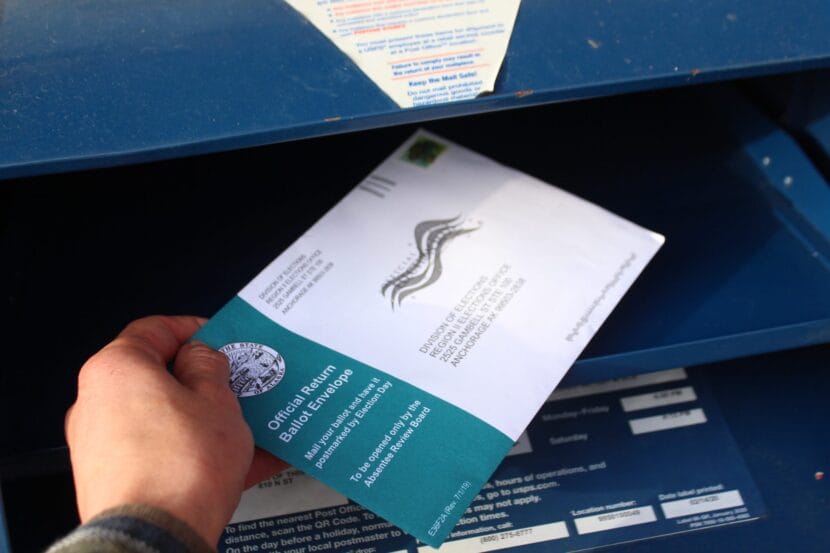
A voter mails an absentee ballot in Oct. 2020. (Lex Treinen/Alaska Public Media)

Alaskans voting by mail this fall should put two stamps on their absentee ballots, according to the Division of Elections.

This year’s ballots require two stamps because of their unusually large 17-inch size, said Carol Beecher, the head of the Division of Elections. They’re so big because the space to rank all eight candidates for president takes up a large portion of the front of the ballot, Beecher said by email.

Though the ballot envelopes require two stamps, the envelope itself simply says “First Class Postage Required.” The division says that’s because the envelopes, unlike the ballots themselves, are printed long before the deadline for candidates to get on the ballot.

“There is no way to anticipate the size of the ballots before the envelopes are printed,” Beecher said.

Nineteen states and Washington, D.C. provide absentee voters with prepaid ballot return envelopes that do not require postage, according to the National Conference of State Legislatures. Alaska, however, does not. The Division of Elections says that’s because it can’t provide prepaid envelopes without funding approved by the Alaska Legislature. Absentee ballots also required two stamps in 2022.

But if you forget to put two stamps on the envelope, don’t worry, says the U.S. Postal Service. On its website, the agency says it’ll still deliver ballots with insufficient postage.

“If a return ballot is entered into the mailstream with insufficient or unpaid postage, it is the Postal Service’s policy not to delay the delivery of completed absentee balloting materials, including mail-in ballots,” reads a frequently-asked-questions page on the USPS website.

The Division of Elections said that if the Postal Service delivers a ballot, they’ll count it, assuming it meets the other requirements for an absentee ballot to be counted. Ballots can also be dropped off at Division of Elections regional offices, early voting locations, or Election Day precincts.

The most common reason for a ballot to be rejected is a missing witness signature. In the 2022 all-mail special election for U.S. House, roughly 5% of ballots were rejected for missing witness signatures. Rural areas off the road system, which tend to be majority-Alaska Native, had a rejection rate of nearly 14%, leading to a lawsuit that remains ongoing. Though a recent bill in the Alaska Legislature would have removed the requirement, Republicans blocked it on a 20-20 vote in the closing moments of the session.

The Alaska Current reported Tuesday that Speaker of the House Cathy Tilton, R-Wasilla, said on a conservative talk radio show earlier this month that removing the requirement would “lean the election toward [Democratic Congresswoman] Mary Peltola.” In response, leaders of the Alaska Federation of Natives called on lawmakers to “work towards improvements, not disenfranchisement” in a series of statements.

What Alaska voters should know as they consider a repeal of open primaries and ranked choice voting

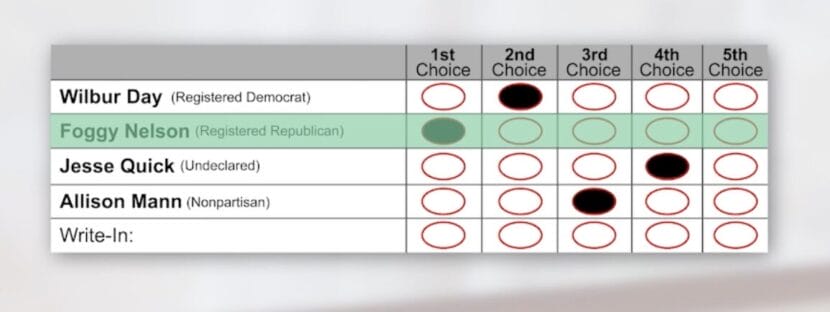
This image was used in an Alaska Division of Elections video explaining ranked choice voting. (Screenshot of Alaska Division of Elections video)

Alaska was the second state to adopt ranked choice voting in federal and statewide elections, but it may be the first to abandon it.

A citizen’s initiative ballot measure that would repeal the state’s open primary and ranked choice voting system made it to the November ballot after legal challenges. As a result, Alaskans will be asked in Ballot Measure 2 to decide if they would like to repeal or keep the state’s open primary and top-four ranked choice voting system.

If the repeal is successful, Alaska will revert to primaries that are controlled by the political parties and general elections where voters pick only one candidate.

The repeal effort centers its argument around the ranked choice aspect of the state’s voting system, while proponents of the system have dug in to fight for the open primary aspect.

The 2020 ballot measure to institute ranked choice voting succeeded with 51% of the vote. But efforts to roll it back ramped up after the system’s debut in the 2022 election.

The 2022 results showed the range of possibilities in statewide elections under the election system: conservative Republican Mike Dunleavy was reelected as governor, moderate Republican Lisa Murkowski was reelected as a U.S. senator, and Democrat Mary Peltola was elected to the U.S. House of Representatives.

Is it partisan?

Phillip Izon II, the man behind the citizen’s initiative effort to repeal the open primary and ranked choice voting, said the effort is about finding the fairest possible voting system, not about its partisan implications.

“The main objective wasn’t because I was a party member, or I was associated with the Republican Party, or anything like that,” he said. “It was primarily because I believe that there was a large percentage of the people, not just in Alaska, but anywhere that ranked choice voting is being implemented, that don’t understand ranked choice voting, and it complicates their voting so much to the point where they just stop voting.”

He pointed to a low general election turnout in 2022 — the lowest in decades.

Prominent Republicans have backed Ballot Measure 2, however. Former Gov. Sara Palin, still smarting from her loss for the state’s sole House seat, was the first to sign the repeal effort’s petition, the Anchorage Daily News reported at the time. And some Republicans pledged to withdraw from their races in this election cycle if they were not among the top vote getters in the primary, in an effort to circumvent the ranked choice system.

But the repeal opposition campaign, No on 2, is chaired by former state Sen. Lesil McGuire, an Anchorage Republican, and has collected millions in donations from national nonpartisan organizations.

Open primaries and ranked choice has benefited Republican and Democrat candidates alike. Notably, Democrat Mary Peltola was elected to the state’s only House seat in Congress after it was filled by Republican Don Young for nearly half a century. Republican Reps. Julie Coulombe and Tom McKay, who were both members of the House’s Republican majority caucus and who both support the repeal, were elected after trailing among voters’ first preferences under the ranked choice system.

What does it cost

State elections officials estimate it would cost $2.5 million to repeal ranked choice voting. That comes after the price tag to institute them, which was $3.5 million in a June estimate from state officials.

But Juli Lucky, campaign manager for No on 2, said there are other costs to an Alaska without open primaries and ranked choice voting, that come in the form of political gridlock. She argues that before open primaries and ranked choice voting, the state’s Legislature was more polarized, and that was expensive.

“The Legislature was not getting organized on time. There was a lot of partisan fighting. We were seeing delays of about 30 days where the Legislature wasn’t actually getting to work, and then we saw a lot of special sessions where there was a lot of arguments and not a lot of solving problems,” she said.

The Legislature called four special sessions in 2021, the year before open primaries and ranked choice voting, costing nearly $2 million.

Open primaries

For the last two decades, Alaska’s primary has been partially closed. The Republican Party limited its primary to registered Republicans and those without a party, while excluding Democrats and third-party voters. The other parties, including the Democratic, Libertarian and Alaskan Independence parties, have shared a primary ballot.

In 2022, with the advent of open primaries, there was only one ballot and all the candidates in each race were on it. Advocates of the open primary say that it benefits the majority of Alaskans because most are not registered with a major political party and do not vote a “straight ticket” — they vote for candidates from multiple political parties in different races. For example, a voter might choose a Republican to represent them as state senator, but a Democrat to represent them in the state House.

Lucky said that ending the open primary would give more power to political parties than to individual Alaskans because parties can choose to close their primaries.

“Right now, we have a system where every Alaskan can vote for any candidate at every election, regardless of the party,” Lucky said. “What’s at stake is taking power away from voters to choose the candidate they like at every election. And I think that’s incredibly important because in the past what we’ve seen is that a lot of races get decided in that lower-turnout primary, which in the recent past has been a closed primary, where voters did not have the ability to look at all the candidates and choose from all the candidates.”

But what looks like a benefit to Lucky, is considered a flaw by those who would like to see the end of the open primary.

Michael Tavoliero, a contributor to conservative Alaska news site Must Read Alaska, wrote in an August post that open primaries and ranked choice voting “blur the lines between political parties, allowing non-Republicans to influence the outcome of Republican primaries and erode both party integrity and conservative values.”

So the multiplicity of choice that open primary proponents value is, in his view, a threat to party ideology.

“In a closed primary, only registered Republicans would have a say in choosing their candidate, ensuring that the nominee aligns closely with the party’s ideology,” he wrote. “Open primaries, on the other hand, can lead to the nomination of candidates who appeal to a broader, less ideologically consistent electorate, potentially weakening the party’s stance on key issues like small government and personal freedom.”

Scott Kendall, an Alaska attorney who helped write the citizen’s initiative that led to open primaries and opposes a repeal, countered that diluting the influence of the parties may be more consistent with representing the will of the majority of Alaska’s electorate that are not affiliated with either major political party.

Of a repeal, he said: “We would be going back to a system where over 80% of the races are decided in the primary by a much more partisan, much smaller group of voters. And I think that’s a huge loss.”

Though Izon’s focus is ranked choice voting, he said the open primary is worth repealing because it is susceptible to manipulation.

“Anybody can finance a candidate to get on the ballot and get into the top four, and then tell them to drop out,” he said, adding that the idea should scare people from any political party. He pointed to the case of Eric Hafner, the imprisoned out-of-state Democrat who is on the U.S. House ballot after a legal challenge failed. “There’s a sizable chunk of the population that don’t even know Eric Hafner is in prison,” Izon said.

He said there are multiple examples of spoiler candidates in this year’s election, so he would rather political parties vet candidates than deal with that.

“Would you rather vote a straight ticket or have a criminal on your ballot in a general [election]?” he asked. “Personally, I would rather vote a straight ticket.”

Ranked choice voting

The main argument of many opponents of ranked choice voting is that ranking candidates is too confusing for voters. Izon said he thinks that confusion is behind a low turnout in Alaska’s 2022 general election. He said it was his grandfather’s bafflement when confronted with a ranked choice ballot that compelled him to begin the recall in the first place.

Lucky countered there were multiple factors that made voting confusing in 2022 that had nothing to do with ranking candidates. She pointed to a redistricting effort that shook up the Legislature.

“Everybody except for one senator had enough change in their district that their seats were up for election, or they were on a schedule where their seats were up for election,” she said.

Additionally, she said, there was a special election to fill Don Young’s congressional seat after his death, closely followed by that year’s primary election.

Nevertheless, she said, 99.8% of ballots in the 2022 general election were filled out properly and more than 70% of voters ranked candidates. She said those results show that voters do understand the election system.

Izon reflected that in fighting one confusing change, he may be precipitating another. But he said he is driven to find the most fair voting system.

“Every time we make a change, we’re hurting someone, and that’s the problem. What is the most fair system right now? I think the most fair system is the system that everyone understands,” he said.

If the quest for the most fair system unites the opposing sides of the recall effort, then its answer divides them.

Site notifications
Update notification options
Subscribe to notifications