4 Special Coverage

Whittier case poses a larger question: Why can’t these Americans vote?

A man in a black coat speaks at a conference.
Michael Pese was among 10 Whittier residents charged in April, 2025 with illegal voting. He was born in American Samoa, so he’s a U.S. national but not a citizen. He spoke at at a May 2, 2025 press briefing in Anchorage. (Matt Faubion/Alaska Public Media)

Ten people from Whittier charged with illegal voting made initial court appearances Friday — a routine procedure in a case that has the potential to be anything but.

The 10 were born in American Samoa. That gives them the unique status of being U.S. nationals, born on American soil and holders of U.S. passports, but not citizens. A group called Right to Democracy is championing their case.

“If they had been born instead in another U.S. territory — like Guam or the Virgin Islands or the District of Columbia — or Alaska, they would not be in this situation, facing criminal legal peril today,” said Neil Weare, co-founder of the group.

Right to Democracy advocates for people born in U.S. territories and is part of the legal team representing a previous Whittier defendant: Tupe Smith. She was arrested in 2023 and charged with illegal voting and related felonies after she won election to her local school board. Her challenge is before the state Court of Appeals.

Meanwhile, last fall Alaska State Troopers investigated Smith’s husband and other members of their extended family in Whittier. The state brought fraud and perjury charges against the 10 defendants last month.

Some, according to the charging documents, told officers they thought they could vote in state and local elections but not for president.

The case could draw a national spotlight for reasons that go beyond election outcomes in Whittier.

It is already wrapped up in a larger constitutional question about whether people born in U.S. territories have a birthright to citizenship. Weare sees that as a central issue in the Whittier cases and said it may be part of the defense.

“It is the state’s burden to prove every element of the alleged offense, and one of those elements is that they’re not a citizen of the United States,” he said. “We don’t believe they’ll be able to prove that under the Constitution.”

The case has a different import for right-wing bloggers. That’s because, despite a lack of proof, it’s a widely held belief among supporters of President Donald Trump that non-citizens voted in massive numbers in 2020.

The Whittier case doesn’t fit the stolen-election narrative well. Many of the defendants didn’t vote in presidential election years. And Trump swept tiny Whittier in 2020, winning 74 votes — more than double the vote total of Joe Biden. At least one of the Whittier defendants is an ardent Trump fan, to judge by his Facebook posts.

Michael Pese is Tupe Smith’s husband and accused of voting in 2022 and 2023. He said he loved the town of Whittier and loved serving as a volunteer firefighter there. But, he said, the charges have changed his feelings.

“After everything is done, I don’t know if I want to stay back in Whittier, because I feel unwelcome,” he said.

Prosecutors say the state built the case against Pese and the other defendants after receiving an anonymous tip that non-citizens were voting in Whittier.

Want to run for local office in Juneau? This upcoming workshop will show you how.

Frank Rue drops his ballot off in the City Hall ballot drop box on Tuesday, Oct. 1, 2024. (Photo by Clarise Larson/KTOO)

The City and Borough of Juneau will hold its annual How to Run for Local Office workshop this Saturday at City Hall.

It’s a chance for anyone interested in running for a seat on the Juneau Assembly or School Board to ask questions and learn about what it takes to campaign and serve. The workshop is put on annually by the city, the League of Women Voters and Friends of the Juneau Public Libraries. 

Peggy Cowan with the League of Women Voters spoke about the workshop in an interview on Juneau Afternoon last week.

“This workshop will hopefully encourage people who might not know that much about running for office or haven’t been involved in a campaign before,” she said. “It’s hopefully helped take a little bit of the mystery out of like, ‘How do you get started?’”

Six local seats are open for the Oct. 7 municipal election — three on the Juneau Assembly and three on the Juneau School District Board of Education. There is no mayoral race this election. 

The Assembly seats currently filled by members Ella Adkison, Greg Smith and Wade Bryson will be up for grabs. Both Smith and Bryson are nearing the end of their second full, three-year terms. Adkison is finishing her first partial term after she was elected in 2023 to serve the remaining two years of a member who resigned. 

School board seats filled by Deedie Sorensen and Emil Mackey will be open this election. There will also be an opportunity to serve a partial term following former member Will Muldoon’s abrupt resignation from the board last week. 

Muldoon was reelected to serve a second three-year term last fall. He did not give a reason for his departure. The district will soon appoint a temporary member to fill the role until the election.

Cowan recommended that people sign up before attending the workshop, but it’s not required. 

“If you get inspired and it’s a rainy morning on Saturday the third and you want to come on in, then you are more than welcome to drop in,” she said. 

There’s also a handful of citizen ballot initiatives that residents may be asked to vote on in this election, depending on whether advocates gather enough signatures in support. The filing period to run for local office will open in mid-July.

Juneau Assembly advances potential $10M school maintenance bond and utility rate hikes

Deputy Mayor Greg Smith speaks during a Juneau Assembly finance committee meeting on Wednesday, April 30, 2025. (Photo by Clarise Larson/KTOO)

The Juneau Assembly moved forward with a plan on Wednesday that would add up to $10 million to the city’s debt if approved by voters in this fall’s election. It would fund critical repairs and upgrades to Juneau’s schools after years of deferred maintenance.  

The Assembly decided to prioritize funding repairs to schools over the city’s water and sewer systems, which are also in need of some TLC. That means utility rate hikes are likely on the way. 

Superintendent Frank Hauser spoke about the need for school repairs and upgrades at a meeting last month. 

“The impact that facilities, well-functioning facilities — not only having roofs that are not leaking, but also HVAC systems that are consistent and sustained at a comfortable level — the importance of that is for the learning environment of our students,” he said. 

The repairs would include partially reroofing Juneau-Douglas High School: Yadaa.at Kalé and Sítʼ Eetí Shaanáx̱ Glacier Valley Elementary School, upgrading heating and ventilation systems and adding new security and safety measures district-wide. 

The decision last night wasn’t final. The Assembly still needs to take public comment before deciding whether the bond measure will go to voters. During the same meeting, the Assembly shot down a different bond package that would have asked voters to fund repairs to the city’s water and sewer systems, as much of its infrastructure reaches the end of its lifespan. 

Assembly member Maureen Hall said she worried that putting two bond questions on the ballot would overwhelm voters. It also comes after last fall’s election, when Juneau voters approved a different $10 million wastewater bond to replace infrastructure at the Juneau Douglas Wastewater Treatment Plant.

“I think there’s going to be an awful lot on the ballot this fall, and so I am a little hesitant to charge forward,” she said. 

Instead, members voted to push forward with a plan that would increase residential water and sewer rates by 5% annually over the next five years, and pair it with a bond package or other payment options later down the line.

City Manager Katie Koester said she believes the proposed 5% increases are the “least painful option” for residents that still addresses the need to pay for repairs. 

“I worked with the utility and we really, like, sharpened our pencils and scoured budgets to try to come to you with the recommendation that we feel like has the lowest impact on our ratepayers and the lowest current year pain on our budget,” she said. 

But the proposed increases would only begin to offset hundreds of millions of dollars in maintenance or replacement needs. In December, Juneau’s Water Utilities Division originally proposed increasing residents’ rates by more than 60% over the next five years to address those urgent repairs. 

Assembly member Alicia Hughes-Skandijs said she thinks the 5% increases are too low given the significance of the problem. 

“I don’t want us to be a body that kicks problems forward to future Assemblies and only continues to put us in a worse situation financially, at a time where our equipment is super old,” she said. 

But, Assembly member Ella Adkison said the proposed increase won’t go unnoticed.

“We talk about affordability in Juneau, utility rates are one of the biggest factors in affordability, because it affects everyone, including some of our lowest-income families,” she said. “It can really hit them hard.”

The Assembly will still need to take public comment at a future meeting before passing any rate hikes. If approved, those would go into effect in July. 

Alaska House votes down restrictions and disclosure rules for ‘dark money’ campaign cash

The Alaska and American flags fly in front of the Alaska State Capitol on Tuesday, April 22, 2025.
The Alaska and American flags fly in front of the Alaska State Capitol on Tuesday, April 22, 2025. (Photo by James Brooks/Alaska Beacon)

Ahead of its vote on a bill to restrict political donations in state elections, members of the House’s multipartisan majority rejected a series of amendments that would have expanded the bill.

Among the rejected proposals were ideas to require greater disclosure of donations funneled through so-called dark money groups enabled by the 2010 U.S. Supreme Court decision known as Citizens United.

The rejected amendments, from Rep. Kevin McCabe, R-Big Lake, would have required prompt disclosure of donations to independent expenditure groups, required advertising disclosures, and sought to limit out-of-state contributions to groups backing ballot measures. Federal courts have struck down Alaska’s limits on out-of-state contributions to candidates.

Previous bills dealing with independent expenditures haven’t advanced to a floor vote, making the rejected amendments significant.

Inverting the usual pattern, Republican lawmakers proposed the restrictions, and they were defeated by the votes of independents and Democrats.

Speaking on the House floor, McCabe called the lack of disclosure rules for third-party groups “a critical loophole” in state law.

Traditionally in Alaska, Republicans have supported actions to reduce limits on campaign contributions. The Republican Governors Association has repeatedly challenged disclosure rules imposed by voters in a 2020 ballot measure, and a Republican-backed lawsuit led to the elimination of Alaska’s campaign finance limits in 2022.

A ballot measure scheduled for Alaska’s 2026 elections would reimpose some limits, but if House Bill 16 becomes law, those limits would come into effect ahead of the election.

McCabe argued that HB 16 should be extended to cover independent expenditures, not just direct donations.

“Independent expenditure groups have become a big part of our political campaigns,” he said, speaking on one of his amendments.

Other lawmakers noted that most of the political mailers that filled Alaskans’ mailboxes last year were from independent expenditure groups, not politicians’ campaigns.

“Voters deserve to know who is funding the message,” McCabe said.

Rep. Calvin Schrage, I-Anchorage and a sponsor of the ballot measure and HB 16, was among the lawmakers who voted against the dark-money amendments.

“I think there is concern amongst the Alaskan public around both contribution limits and independent expenditure spending. However, the dire concern is really around the hole around campaign finance, and so to the maximum extent possible, my efforts were to try and keep the bill constrained to what was approved through the ballot measure, and to address the campaign finance portion of this,” Schrage said.

Under the Alaska Constitution, a law can replace a ballot measure only if the underlying bill is “substantially similar” to the ballot measure.

In addition to the dark-money amendments, the House rejected a proposal to exempt most municipal elections from campaign-finance reporting requirements, and an amendment that would have prevented the recipients of state contracts — and their family members — from donating to political campaigns.

That amendment was almost identical to a bill rejected by Hawaii’s Legislature on the same day that the Alaska House turned down the idea. Several states, including New Jersey, have so-called “pay for play” disclosure rules; the amendment proposed by Rep. Sarah Vance, R-Homer, would have gone further by actually restricting donations.

Schrage said it went too far.

“With that specific amendment, I think my biggest concern was around the fact that family members would be prohibited from making donations to political campaigns,” Schrage said. “The courts have been pretty clear that we need to be careful about limiting people’s free speech, and thanks to Citizens United, political spending is considered free speech.”

In 2010, the U.S. Supreme Court ruling in Citizens United v. Federal Election Commission eliminated restrictions on spending by political groups unaffiliated with a particular politician. Since then, the amount of money spent by independent groups has significantly increased. So has the role of dark money contributions — money funneled through independent groups in order to conceal the identity of the donor.

A ballot measure approved by Alaska voters in 2020 requires independent groups to disclose the “true source” of their contributions, but that measure has exemptions: It doesn’t cover ballot measure groups, for example.

Schrage said some of the rejected ideas could show up in separate legislation, but he wanted to keep HB 16 confined to the ballot measure that’s ready for a vote in 2026.

“There’s always this question of, how much do you try to do, and how much can you fit into a bill before it becomes too heavy and too controversial to make it through the process. There is a very strong desire from Alaskans to address our campaign contribution limits, and we have a very clear proposal before us. I wanted to move forward,” he said.

Juneau ballot petitions to lower local taxes, return to in-person voting OK’d for signatures

Shoppers grab produce at Foodland IGA in downtown Juneau on Tuesday, April 29, 2025. (Photo by Clarise Larson/KTOO)

The City and Borough of Juneau clerk’s office certified three ballot petitions aimed at lowering local taxes in Juneau on Monday. 

That means advocates can soon start collecting signatures of support in hopes of getting the proposals on the municipal ballot this fall. 

The three petitions seek to cap the local property tax rate, remove sales tax on food and utilities, and make in-person voting the default again in Juneau’s local elections. 

A Juneau advocacy group called the Affordable Juneau Coalition is leading the effort for all three petitions. 

Joe Geldhof is a local attorney and member of the group. He also unsuccessfully ran for the Juneau Assembly two years ago. He said the purpose of the petitions is to make Juneau more affordable.

“There’s been a lot of discussion for a long period of time about how to do that, and the City and Borough Assembly and the city manager never seemed to accomplish anything on that,” Geldhof said.

The Assembly already considered removing sales tax on food a few years ago, but ultimately decided against it. The city currently taxes food and utilities at 5%. Geldhof said removing that tax would directly lower people’s bills.

“Because it impacts every resident, and especially lower and moderate-income,” he said. 

But, on the flip side, those taxes bring in a combined $10 to $12 million in revenue to the city each year. If voters pass the initiative, City Finance Director Angie Flick said it likely means the city would have to cut back on spending or reduce services to make up for the lost revenue. 

“That would be a sizable chunk of the city’s budget and would definitely require the Assembly to make some hard decisions,” Flick said. 

The same goes for the petition to lower the mill rate. The city uses the mill rate to calculate how much property tax residents pay each year. Those taxes are expected to bring in about $63 million this fiscal year, which makes up roughly 40% of general fund revenue.

“While today, those limits might be manageable, it really does handcuff the city moving forward,” she said. “As the cost of services likely increases, it certainly could put the Assembly in a place where they’re having to make unpopular decisions.”

Right now, the city caps the mill rate at 12 mills, but the petition would drop the ceiling down to nine mills. While that could lower property taxes in the future for property owners, it again would likely come at a cost to the city. Geldhof said that’s the point. 

“They need to start taking a hard look at all the expenses they do, and get back to funding essentials,” he said. “How that plays out, of course, is going to be up to the Assembly.”

That leaves the petition to make in-person voting the default again in Juneau. While that doesn’t address affordability outright, Geldhof said he thinks the change will make elections cheaper. 

The Juneau Assembly approved an ordinance two years ago that made by-mail voting the default for local elections. But, residents can still vote in-person at city vote centers. Last year, a group of residents tried to repeal the ordinance but failed to gather enough signatures to get it on the ballot. 

This time around, the petition would instead amend language in that same ordinance to make elections poll-based again, instead of by-mail. 

The group will have until May 30 to gather just over 2,700 signatures for each petition to secure a spot on the ballot this October.

10 U.S. nationals in Whittier charged with illegal voting

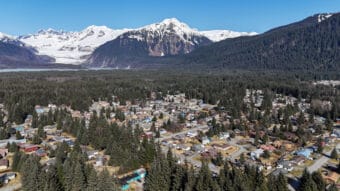
Whittier is a small Alaska city, unique in that nearly everyone lives in one apartment building, shown in the center of this aerial photo. (Gabriel Wolken/Alaska Department of Natural Resources)

The state of Alaska has charged 10 U.S. nationals in the small community of Whittier with voter misconduct and perjury.

The charges say the defendants were born in American Samoa, which makes them nationals but not citizens. Alaska law allows only U.S. citizens to vote.

The case is sure to get attention, because non-citizen voting has become a hot-button issue nationally. President Trump has claimed, without evidence, that widespread voter fraud was a reason he lost the 2020 election.

The state began investigating the Whittier case in late 2023.

“There was an anonymous call that came to the Division of Elections about non-U.S. citizens that had registered to vote, who were voting,” said Alaska Deputy Attorney General John Skidmore.

The charges say all 10 defendants voted or tried to vote in Whittier City elections or for the regional school board. Some are also alleged to have at least tried to vote in primaries.

Mathew Pese, 32, is among the few alleged to have made an attempt, or actually voted in the 2020 general election. A Facebook account that appears to be his has a lot of religious posts and several that praise or celebrate Trump. He did not respond to a Facebook message for comment, nor did several other defendants Alaska Public Media attempted to contact through Facebook.

The charges say Pese told investigators that he remembered his wife had once said he couldn’t vote because he wasn’t a citizen. Other defendants said they thought they were allowed to vote in local elections but not for president, according to the charges.

Troopers investigated by looking at the list of all 288 registered voters in Whittier and determining which were born outside of U.S. states.

Skidmore said it’s important in any democracy to ensure that only eligible voters cast ballots.

“We’re not interested in anyone’s race, ethnicity, political background — none of that stuff matters,” Skidmore said. “We’re simply looking at the laws that say, ‘This is how you determine who is supposed to be voting. This is how you determine who isn’t.’ And when we get complaints of people that shouldn’t be voting, that’s what we look into and investigate and, where appropriate, file charges.

Every year the state gets a few allegations of illegal voting and has charged about five cases in as many years, Skidmore said.

“If you think about all of the folks across the state that vote in any given election, to have this few charges filed means by and large, it’s not something that we find happens,” Skidmore said. “Most of the investigations that we conduct result in determinations that charges are not appropriate to be filed. But in those cases where we do find sufficient evidence to say that crimes did occur, then we will file charges, as we have here.”

Each defendant has been charged with at least one perjury charge, a Class B felony that is punishable by up to 10 years in prison, though Skidmore said it was too early to know any conviction would result in jail time. The defendants have not been arrested but have summonses to appear in court.

Trump swept Whittier in the divisive 2020 election. He got 74 votes, more than twice the vote total of Joe Biden.

Site notifications
Update notification options
Subscribe to notifications