For 50 years, the Alaska Folk Festival has brought together music lovers from Southeast Alaska and beyond. When you’re not catching the performances on the mainstage at Centennial Hall or tuning into the nightly broadcast on KRNN, you can find live music of all kinds playing throughout Juneau. From laid-back jam sessions to unique late-night sets, KXLL has got you covered to help you plan your after-hours Folk Fest experience. We’ll be updating it throughout the week with any schedule changes or new events, so check back for updates & make the most of Folk Fest’s 50th!
KTOO
Friday – Live Broadcast of Juneau Afternoon feat. Deke Dickerson Western Swing All-Stars 3 p.m. – 4 p.m.
Join us in the studio for a special live audience experience! Come be a part of the show, enjoy the music in person, and see how it all comes together behind the scenes.
The Alaskan Hotel & Bar
Monday – Open jam session 12 p.m. – 6 p.m., Karaoke w/ Cherie Bowman 8 p.m.
Wednesday – Open jam session 12 p.m. – 6 p.m., Oceanview 6 p.m., The Psychotics 7:30 p.m., Bards of Mendenhell 9 p.m.
Thursday – Open jam session 12 p.m. – 6 p.m., Nalimu 6 p.m., Anel and the Vatos 8 p.m., The Planktonics 10 p.m.
Friday – Open Jam 12 p.m. – 4 p.m., R.O. Shapiro 5 p.m., Juneaucorns 6 p.m., Orbe and the Sungazers 8 p.m., Whiskey Class 10 p.m., Spanks William with 3 Chord Ho 12 a.m.
Saturday – Open jam session 12 p.m. – 5 p.m., Quinton Woolman-Morgan & Coty Davis 5 p.m., Flavor Text 6 p.m., The Rain Dogs 8 p.m., Dude Mtn 10 p.m.
Sunday – Open jam session 12 p.m. – 6 p.m., Todd Grebe & Cold Country 7 p.m., The Panhandle Crabgrass Revival Band 9 p.m., Big Chimney Barn Dance 10:30 p.m.
The Crystal Saloon
Monday – Lisa Denny 6 p.m., Luke Weld and Heather Mountcastle 7 p.m., Bobb Family Band 8 p.m.
Tuesday – Ryan Irvin 6 p.m., Keep the Pool Open 7 p.m., Nalimu 8:30 p.m.
A steady trickle of voters cast their ballots at Old Saint Joe’s in Nome early Tuesday, Nov. 5, 2024. (Ben Townsend/KNOM)
President Trump last Tuesday issued an executive order to reshape U.S. elections.
The order, among other things, mandates absentee and mail-in ballots to be received by Election Day. It also requires proof of citizenship for registering to vote in federal elections.
The changes might further disenfranchise voters in rural communities and lead to a drop in voter turnout for Alaska Native residents, said Jackie Arnaciar Boyer, program adviser for the Rural and Indigenous Outreach Program, which focuses on civic engagement.
“I think it’d be pretty devastating to rural vote,” said Boyer, who is Cup’ig and has roots in Mekoryuk.
In Alaska, mailed ballots must be postmarked no later than Election Day, and can be received up to 10 days later – or 15 days for voters overseas. The timeline is helpful because hundreds of communities – predominantly Alaska Native – are accessible only by air.
Denise Louisaac is a poll worker in Dillingham who oversaw early absentee voting there for the last two presidential elections. In 2020, she said it took 10 days after Election Day for the last batch of early voting ballots to get from Dillingham to Anchorage to her regional election office in Nome. She said the new federal voting timeline would be tight for Dillingham – and even tighter for smaller villages that need to get their ballots to their hub community first.
“If early absentee voting goes until the Monday before Election Day, there is no way possible for the mail to deliver that ballot to Nome in time,” Louisaac said. “It will definitely disenfranchise smaller rural communities.”
Louisaac said she saw most absentee ballots cast in the week before the election. She said that an earlier cutoff would mean that some residents have less voting time – and less time to decide who to vote for.
“If we at villages don’t have the same access, then their voice is diminished,” she said. “If they don’t want those people to have a vote, you make it harder for them to vote. If you want them to have a voice, then you make it easier for them to vote. That’s democracy.”
Rural Alaska Native villages regularly experience challenges during elections. Storms can prevent planes from coming in and out of the villages for days or weeks, and ballots often arrive late – first, to villages and then to an election office. With the lack of volunteers, training and outreach to residents, polling places sometimes open late or don’t open at all, and mail-in votes get rejected.
The president of the First Alaskans Institute, who goes by both Apagzuk Roy Agloinga and Apagruk Roy Agloinga, said the combination of challenges makes it difficult to count votes from the rural Native communities.
“It’s just not fair, right?” Agloinga said. “I mean, to exclude an entire population because of where they live in the country, and to make it difficult for them to participate in this really important process that is a part of our civil liberties.”
The voter turnout for Alaska Native residents – who represent about 20% of the state population – peaked back in the 1980s at about 66%. It has been decreasing ever since, to about 28% in 2022, according to data that nonpartisan organization Get out the Native Vote presented at the Alaska Federations of Natives conference in October. This doesn’t match statewide turnout trends.
The new executive order also mandates people to show proof of their citizenship – such as a passport or state-issued ID – to register to vote in federal elections.
In Alaska, eligible residents are automatically registered to vote when they apply for the Permanent Fund Dividend. Agloinga said that many Alaska Natives use tribal IDs because there’s nowhere in their village or region to get a passport or state ID. The state Division of Elections does not track how many residents use tribal IDs to register to vote.
“Any number of voters that you miss in a community makes a big difference,” Agloinga said.
Democratic Rep. Robyn Niayuq Burke, who represents the North Slope and Northwest Arctic boroughs in the Alaska Legislature, said she’s looking into the legality of the executive order.
Alaska Division of Elections spokesperson Stephen Kirch said in an email last week that the division is reviewing the new executive order and will work with the state Department of Law on any potential changes to policies. Kirch said that at this time, division staff don’t know if there will be any impact in Alaska.
Rookie musher Bryce Mumford of Preston, Idaho, heads down the Chena River. Thirty-three mushers and dog teams began the 2025 Iditarod Trail Sled Dog Race from Fairbanks on March 3, 2025. (Marc Lester/Anchorage Daily News)
Thirty-three sled dog teams raced out of Fairbanks Monday onto the longest Iditarod trail in history. The last-minute plan to change the route went off without a hitch despite significant changes to the original trail. The race start was moved up to Fairbanks due to dismal snow on the normal route in Willow.
Even still, it was a balmy 40 degrees at the front of Pike’s Waterfront Lodge, with the melting snow under the dogs’ booties starting to look a little like mashed potatoes by the 11 a.m. start time. Iditarod CEO Rob Urbach said he’s optimistic about the race ahead, but he acknowledged the strain of changing the route on such short notice.
“There’s always challenges,” Urbach said. “We’re synonymous with challenges. And this year, clearly the universe even decided, ‘Hey, we need more challenges to try to overcome.’ So, we try to laugh at adversity and focus our energies on just getting it done.”
Dogs in the team of Big Lake musher Riley Dyche run down the Chena River. (Marc Lester/Anchorage Daily News)
The day was full of superlatives — race officials said this could be the warmest Fairbanks start on record. It’s also the longest Iditarod trail yet, and this year’s field of 33 teams is tied with the smallest in race history. Plus, it’s the 100-year anniversary of the 1925 serum run to Nome, when sled dog teams relayed antitoxin from Nenana to Nome to combat a diphtheria outbreak.
This year’s race will mirror that historic route, and the significance isn’t lost on Willow-based musher Gabe Dunham.
“The history of mushing that basically came in and helped save so many lives… I get goosebumps whenever you talk about it,” she said. “And that is the history of these dogs — they were modes of transportation and everything. It just encompasses everything that the Iditarod stands for.”
A dog in Gabe Dunham’s team howls before the race begins. Thirty-three mushers and dog teams began the 2025 Iditarod Trail Sled Dog Race from Fairbanks on March 3, 2025. (Marc Lester/Anchorage Daily News)
Dunham said the race is also the sum of the support it gets from sponsors and fans — like the one who gave her a tiny stuffed T-rex that is now lashed to her sled.
“I got him when I raced the Idaho sled dog challenge from a little, little guy that wanted to give me a gift,” Dunham said. “I zip-tied him on the sled, and he was starting to cry. And I’m like, ‘What’s wrong?’ And he’s like, ‘He’s a dinosaur. He’s gonna get cold.’ So, ever since then, he’s kind of been my sled mascot.”
Musher Gabe Dunham does T-rex arms next to her stuffed T-rex, gifted to her by a fan. (Shelby Herbert/KUAC)
Hundreds of people lined the starting chute as Dunham and the other mushers readied their dog teams, including other young superfans like 9-year-old Lucy Lee who huddled next to the fence with her mom. Lucy said she isn’t rooting for any musher in particular — she’s solidly “team dog.”
“I just love dogs!” Lucy said, giggling. “I just love them so much.”
Lucy and her mom, Katie Lee, wait for the race to start. (Shelby Herbert/KUAC)
Further up the line, a few people carried signs who did not love what they were seeing. It wouldn’t be the Iditarod without PETA protestors, and the last-minute route change didn’t throw them off course. John Di Leonardo flew out from New York to protest the restart in Fairbanks, as well as the ceremonial start in Anchorage.
“The Iditarod doesn’t resemble the serum run at all,” he said. “I think it’s time that we evolve this tradition into something more humane and leave the dogs out of it.”
Fairbanks musher Jason Mackey was first up to the starting line — and grateful for it. He was also the first out when he raced this year’s Yukon Quest sled dog race. He scratched on the Quest, he said, due to poor weather conditions. But this time, Mackey said, he feels like the gold is in reach.
“My goal is everybody’s goal, whether they tell you it is or not. It’s to get to Nome healthy, with a healthy team — but to get to Nome first,” he said. “I’m not saying I’m going to win the race, I’m not saying I’m not going to, but that’s my goal. I’m not here to mess around.”
Musher Jason Mackey gets help putting on his race bib before the race restarts in Fairbanks. (Marc Lester/Anchorage Daily News)
He said his team is in great shape to run. All but one of the dogs are Iditarod veterans, like him.
“I do have one dog in there that has never done this before,” Mackey said. “His name is Flash, he’s a team dog. He’s a 3-year-old, but he’s an all-star 3-year-old.”
Just after 11 a.m., Mackey and his seasoned team — and MVP Flash — charged through the corridor of cheering spectators and into the taiga beyond, with nearly 1,150 miles of snow and ice between them and the finish line in Nome.
A voter in Alaska’s special U.S. House primary election drops their ballot into a box on Saturday, June 11, 2022 as a poll worker observes. (Photo by James Brooks/Alaska Beacon)
The Alaska Legislature will take up election reform proposals this session, with Gov. Mike Dunleavy introducing a bill through the House, and the Senate majority caucus planning to introduce its own reforms later this week.
The legislation is in response to a range of issues and complaints around Alaska’s elections last year, including concerns around delays in ballot counting and transparency, election security, and problems with staffing, absentee ballots, and long lines at some polling places.
Dunleavy introduced a bill through the House on Wednesday, House Bill 63, proposing new rules for, among others, voter registration, voting by mail, voting and counting timelines.
“This bill is a necessary step to ensure the integrity and transparency of our election process while addressing Alaskans’ concerns about reliability,” Dunleavy said in a prepared statement on Wednesday. “By modernizing our election code, we can provide a more efficient and trustworthy system for voters and election officials alike.”
The bill also would put new limits on voting time.
All ballots would have to be received by the state Division of Elections by Election Day, under the new legislation, when currently they just have to be postmarked and mailed by that day. It would shorten early voting time, which opens 15 days prior to and ends on Election Day. Under the bill, it would close five days before Election Day.
The bill would eliminate the automatic voter registration process when applying for the Permanent Fund Dividend. That provision was enacted in 2016, when Alaskans passed a ballot measure to allow voter registration during the application process.
For vote by mail, it would provide postage for all absentee ballots being mailed in. It would allow ballot counting by the Division of Elections to begin sooner, up to 10 days before the election. It would also create an option for communities with less than 750 people to opt for all by-mail voting for their elections.
The bill was introduced in the House on Wednesday, and referred to the state affairs and finance committees.
On the Senate side, the new majority, made up of a coalition of Democratic and Republican senators, is set to put forth an election reform bill focused on a range of issues, including streamlining the voting process and expanding access for voters.
The bill is scheduled to be introduced in the Senate on Friday, but Anchorage Democratic Sen. Bill Wielechowski discussed the upcoming bill on Wednesday.
“First off, it addresses the fact that you have 106% more registered voters in the state of Alaska than you do citizens,” Wielechowski said. “There’s unusual reasons for that, but we’re really making an effort to try to clean up the voter rolls, because that’s been a big concern for many people.”
For mail-in ballots, the bill would also pay for postage for all ballots, and eliminate the witness signature requirement for absentee ballots, which Wielechowski said isn’t verified and has disqualified ballots unnecessarily.
“So I think a lot of Alaskans are surprised and kind of shocked that there’s this bureaucratic kind of roadblock,” he said. “And that ends up disqualifying hundreds, if not thousands of Alaskans for something that they don’t even check.”
The bill would establish a ballot tracking barcodes for absentee ballots, and a system for review. If there’s a mistake on a ballot, the bill would create an easier process for corrections, he said. “We’re trying to allow for ballot curing, which is, if you make a mistake on a ballot, the Division of Elections can notify you, and you can fix it.”
“We heard stories this past year about somebody who made a mistake on their ballot. It was identified on their absentee ballot. It was identified before the election, and they couldn’t fix it. Everybody knew there was a mistake and unfortunately, his ballot was just discounted. Yeah, so we’re trying to fix things like that.”
Wielechowski said the Senate majority would not support some provisions in Dunleavy’s bill, such as eliminating the voter registration process in the PFD application. But he said they would work with the governor on election reform initiatives, as the bills move through the legislative process.
“There were some things that were similar to what we have,” he said. “And our bill is a little bit more expansive, I’d say. But look forward to working with the governor, with the (Senate) minority, and the House, and trying to come up with a solution.”
Election reform is one of the top four priorities laid out by the Senate majority caucus this year, along with education funding, energy and pension reform.
Reporter James Brooks contributed to this article.
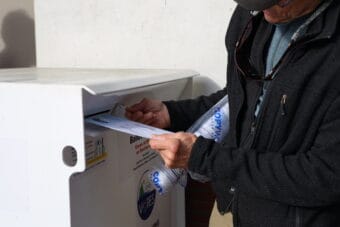
A voter mails an absentee ballot in Oct. 2020. (Lex Treinen/Alaska Public Media)
Election officials rejected 1,303 absentee ballots in the November 2024 general election, according to a report from the Alaska Division of Elections. That’s a rejection rate of roughly 1.7%, in line with the 1.6% rate the state reported during the general election in 2022.
It’s a significantly lower rate than in the June 2022 special primary election following Congressman Don Young’s death. In that race, the state’s first all-mail election, officials rejected 4.5% of all the ballots cast across the state. That included nearly 14% of all ballots cast in the four House districts representing predominantly Alaska Native communities off the state’s road system. The high rejection rate in the 2022 special primary led to lawsuits from civil rights groups.
Get Out The Native Vote director Michelle Sparck said the relatively low rejection rate in 2024 was good news, especially when compared to the 2022 special primary.
“It’s definitely a bigger sigh of relief,” she said. “Still, we’ve got our work cut out for us on getting better at this voting process.”
The number of rejected absentee ballots was greater than the margin of victory in two races, though it’s not clear that the rejected ballots would have changed the outcome.
Election officials rejected 72 absentee votes in House District 18 in North Anchorage. That’s the highest raw total in the state and more than three times the 22-vote margin by which Republican David Nelson defeated Democratic Rep. Cliff Groh.
And officials rejected 16 ballots in Wasilla’s House District 28, where Elexie Moore defeated fellow Republican Steve Menard in the final ranked choice tally by just nine votes following a recount.
Alaska law requires both the voter and a witness to sign an absentee ballot. Some state lawmakers have proposed eliminating the witness signature requirement or giving voters a chance to fix their error. That’s known as ballot curing.
Some 13% of the rejected ballots had a missing or incorrect “voter identifier” — their date of birth, ID number, voter number or the last four digits of their Social Security number, and 8% were rejected for a missing voter signature.
Another 11% of the rejected absentee ballots were postmarked after Election Day. Most of Alaska’s mail is postmarked in Anchorage and Juneau, so those rejections may have included ballots dropped in the mailbox ahead of the statutory deadline. An additional 6% were rejected because they arrived too late.
Twelve ballots, less than 1% of the rejections, “were forwarded to the Criminal Division at the Department of Law for further investigation,” a Division of Elections spokesperson said, citing division Operations Manager Michaela Thompson.
Ballot curing processes could allow voters to correct some of the issues, including things like missing signatures and identifiers. Sparck said she’s “fully on board” with ballot curing, though she says chronic staffing issues at rural Alaska precincts and mail delays could present complications. She said she’s optimistic lawmakers will tackle the issue during the upcoming legislative session.
“We think that with the bipartisan coalitions, we have a chance to tackle these systemic barriers … to make voting accessibility a better reality for rural Alaska and for tribal precincts,” she said.
Nine other states require absentee ballots to be witnessed or notarized.
House District 40, covering the North Slope and Northwest Arctic Boroughs, saw the highest rejection rate. Some 5.2% of the absentee ballots cast in that race were not counted. Half of those had an insufficient or improper witness signature.
In 2020, when the witness signature requirement was suspended because of the pandemic, fewer than 1% of absentee ballots were rejected.
Voters at Anchorage City Hall wait in line to cast their ballots on Nov. 4, 2024, the day before Election Day. City Hall, in downtown Anchorage, was one of the designated early voting sites in the state’s largest city. The director of the Alaska Division of Election answered some pointed questions at a legislative hearing last week. (Photo by Yereth Rosen/Alaska Beacon)
Alaska’s elections chief defended her division’s management of the 2024 elections at a legislative hearing last week, but she acknowledged that logistical challenges created problems for some voters.
Carol Beecher, director of the Division of Elections, reviewed the operations during a more than two hour hearing of the state House Judiciary Committee. She fielded questions from the committee’s chair, Rep. Sarah Vance, R-Homer, and other Republicans about election security and possible fraud, and she answered questions from Democrats about problems that led to rural precincts being unstaffed or understaffed, which presented obstacles to voters there.
Vance said she did not intend to cast blame, but that she hoped the hearing would lead to more public trust in the elections process.
“The purpose of this meeting is to discuss the process of the 2024 election, not the results. It’s not about the outcomes, but about making sure that every legal vote gets counted in a timely manner, and asking what improvements can be made in the process,” she said.
“A lot of the public has reached out to me and expressed a lot of frustration and concern around a lot of the activities of this election,” she said. “So this is an opportunity for us to have a conversation with the director of elections and the public so that we can gain an understanding about what happened and how the actions that we can take in the future.”
Beecher responded to Republican committee members’ queries about safeguards against fraud and the possibility that non-citizens are casting votes.
“We often get asked about U.S. citizenship as regards elections, and we are only required and only allowed to have the person certify and affirm on the forms that they are a citizen, and that is sufficient,” Beecher said. “We do not do investigations into them based on citizenship questions. If there was a question about citizenship that was brought to our attention, we may defer that to the department of law.”
Residents are eligible to vote if they are a citizen of the United States, age 18 years or older and have been registered in the state and their applicable House district for at least 30 days prior to the election. Eligible Alaskans are automatically registered to vote when they obtain their state drivers licenses or apply for Alaska Permanent Fund dividends.
Beecher said the division investigated and found no evidence of non-U.S. citizens being registered through the PFD system. “This is not happening where somebody is marking that they are not a citizen and are receiving a voter registration card,” she said.
Vance said many Alaskans remain worried, nonetheless, about non-citizens casting votes. “I think people are wanting a stronger position regarding the ability to verify citizenship for the people wanting to vote,” she said. “So can the division take action to verify citizenship on its own, or does it need statutory authority?” Beecher confirmed that the division does not have the authority to verify citizenship.
Tom Flynn, a state attorney, advised caution in response to Vance’s suggestion.
“We should be also wary of the limits that the National Voter Registration Act and its interpretation can place on citizenship checks and the federal voting form requirements,” said Flynn, who is the state’s chief assistant attorney general. The National Registration Act of 1993 prohibits states from confirming citizenship status.
Carol Beecher, the new director of the Alaska Division of Elections, answers questions from reporters on Thursday, Feb. 16, 2023. (Photo by James Brooks/Alaska Beacon)
In response to questions about opportunities for fraud through mail-in absentee voting, Beecher said the state relies on the information voters provide. “If an individual applied for an absentee ballot, and all of the information was in our voter registration system that you were eligible to vote, etc, and you had a legitimate address to send it to, then you would be mailed an absentee ballot,” she said.
Each ballot is checked for appropriate voter identification information. Ballots are coded by district, and then given another review by another group of election workers, including an observer, she said. “The observer has the opportunity to challenge that ballot. If they challenge a ballot, a challenge is sent to me, and then I review the information based on what the challenge is, and I’ll often confer with [the Department of] Law,” she said.
Alaska has notably low voter turnout, but also a steadily changing voter roll as it’s one of the most transient populations in the nation, with voters moving in and out of state.
On Election Day, Alaska has a mix of districts with ballot scanners and hand count precincts, usually in rural areas with a small number of voters, as well as voting tablets for those with disabilities. Ballots scanners record ballot information which is encrypted before being sent to a central server in Juneau. All voting machines are tested ahead of time, Beecher said. For hand count precincts, ballots are tallied up and poll workers call in the results to the division’s regional offices, she said.
“We had about 15 people on phones to take the calls that evening, and the phone starts ringing immediately, and all of the different precincts are calling in,” she said. Division workers also helped poll workers properly read rank choice ballots, she said. “And so there’s a lot of discussion that can happen on that phone call. It’s not necessarily just as simple as going through the list.”
The division of elections has 35 permanent staff who are sworn to remain politically impartial and who work in five district offices to administer the elections in the 60 legislative districts.
Beecher said the division reviews its processes, systems of communications, challenges and improvements needed in each election cycle. “The division has lists and lists and checklists and handbooks, and is very good and diligent about making sure that process and procedures are lined out and checked,” she said.
Rural Alaska problems
Administering elections in rural communities is an ongoing challenge in Alaska. Beecher answered questions on several incidents, including voters in Southwest communities of Dillingham, King Salmon and Aniak receiving the wrong ballots that had to be corrected. In August, a mail bag containing a voted ballot and primary elections materials from the village of Old Harbor on Kodiak Island was found on the side of the road, near the Ted Stevens Anchorage International Airport.
“We don’t have control over the materials when they are in the custody of the post office, in this case, it was one of their subcontractor carriers,” she said. “We weren’t told [what happened] specifically, but I know that the post office has processes when mail is lost like that, and they do deploy their processes with that contractor.”
Vance said that incident was serious.
“I hope the state is pursuing further accountability, because this is a matter of public trust that something so important was dropped out of the truck along the roadside,” she said. “It looks extremely negligent.”
Beecher said training and retaining poll workers is essential for running elections smoothly. “So one of the challenges that we run into, and frankly, it’s not just in our rural areas, the turnover of poll workers is a reality,” Beecher said. The division conducts in-person poll worker trainings, and provides support with video tutorials and by phone.
“I voted” stickers are seen on display in the headquarters offices of the Alaska Division of Elections in Juneau on Tuesday, Nov. 12, 2024. (Photo by James Brooks/Alaska Beacon)
This year, in the western Alaska community of Wales, the designated poll worker was not available and so the division of elections located a school teacher late on election day to administer the polls. “It was not ideal,” she said, but they had trained back up poll workers ready to deploy this year.
“We had trained people who were situated at all the various hubs, so Anchorage, Fairbanks, Utgiagvik, Nome, and they were trained and ready to be deployed to some of these polls should we run into a situation where we didn’t have poll workers on the day,” she said. “So we weren’t able to get them to Wales only because of the weather. They were there at the airport ready to head out there. But we did send them to Egegik, and there were polls there.”
Responding to Rep. Cliff Groh, D-Anchorage, Beecher said one thing she would have done better would have been to ensure that the official election pamphlet was more carefully reviewed and checked for errors.
A notable error in the published pamphlet was the misidentification of Republican House candidate Mia Costello as a Democrat.
“Secondly, I would have made sure that our advertisement that had a name in it would not have used names,” she said, referring to a rank choice voting education materials giving examples with fake elector names, including “Odem Harris” which Republicans pointed out filled in a first choice vote for “Harris,” also the Democratic presidential candidate.
“And thirdly, I wish that I had done a better job of anticipating the level of communication that was expected and needed,” Beecher said.
In response to a question about the ballot measure seeking to overturn the ranked-choice system, Beecher said there was no evidence of fraud. The measure failed by just 743 votes.
“We did not see something that would indicate that anything untoward happened with ballots. That simply was not something that was seen in the results,” she said.
Beecher suggested some improvements for legislators to consider this next term. Those included an expansion of mail-only precincts, paid postage for ballots and a requirement that mail-in ballots be sent earlier rather than postmarked by Election Day. “On ballot counting, doing it sooner,” she said. “So potentially changing the time frames of receiving absentee ballots to having everything have to be received by Election Day.” The latter would be a big change for Alaska, which has long counted mail-in ballots as long as they are postmarked by Election Day.
Some changes may be warranted, she said.
“We are not perfect. We know that,” she said. “And we really look to doing better, and [are] wanting it to be better, and that people are confident that it is managed in a way that they have trust in the integrity of the process.”
The next Legislative session starts on Jan. 21. Under the new bipartisan majority, Rep. Andrew Gray, D-Anchorage, is set to chair the committee in the coming session.
Close
Update notification options
Subscribe to notifications
Subscribe
Get notifications about news related to the topics you care about. You can unsubscribe anytime.