A passenger on an Alaska Airlines flight looked out the window and saw what looked like a damaged area on the wing with a handwritten note saying, “We know about this.”
The incident July 28 drew comments on Twitter and other social media websites, but the Seattle-based airline says the plane is safe and there was nothing to worry about.
Spokeswoman Bobbie Egan said Tuesday it was an approved trim repair to the corner flap on the right wing. A maintenance technician wrote to let the flight crew know.
Egan says, “The message was the result of someone’s good intentions” but the wing note “was not appropriate and did not follow company procedures.”
The message was immediately removed, and Alaska apologizes for any alarm it may have caused.
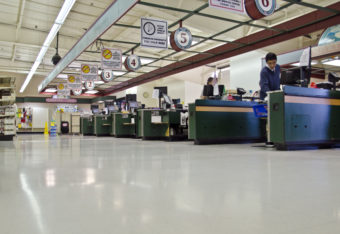
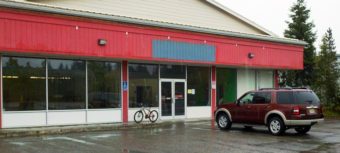
When A & P — sometimes still called by its former name, Foodland — closes in early September, it will leave Juneau without a large-scale grocery operator downtown.
The co-op group hopes to fill the void, and keep ownership local.
KTOO’s Casey Kelly has more.
Could a cooperative grocery store work at the soon to be vacant Alaskan & Proud Market? A recently formed local group thinks so. (Photo by Casey Kelly/KTOO)
The idea for a co-op started almost immediately after A & P’s April announcement that the store would be closing. Greg Fisk is a business consultant, who’s been working for years on what he calls “downtown revitalization issues” in Juneau.
“There’s about 10,000 people in Juneau that live closer to the Foodland Center than to any other grocery store,” says Fisk. “So, it’s a very strategic location. It’s very important also because a lot people who work downtown shop there, and we think it could be a lot better than it’s been.”
Fisk told a neighbor about the co-op idea. The neighbor told more people, and soon an email group started. He says the vision is not the typical organic, health food co-op from the 1970s.
“A lot of people tend to think of co-ops as kind of funky, sort of hippy dippy things,” Fisk says. “But this is not the approach we’re taking. The grocery business is very competitive, narrow margins, so you have to really mind your Ps & Qs from a business sense.”
Fisk and co-organizer Evelyn Rousso recently attended the Consumer Cooperative Management Association conference in Philadelphia, where they got advice about how to organize a co-op and find sources of startup money.
“It’s a pretty common model. There are over 500 food co-ops in the country,” says Crow.
Simply put, a co-op is a member-owned business with a democratically elected board of directors. But Crow says in the case of a grocery store the business is open to everyone, like well-known outdoor retailer REI.
“There usually are discounts once a month or a couple times a month for people who are members,” says Crow. “But anybody can shop there.”
Crow says a group in Fairbanks plans to open Alaska’s first co-op grocery store this fall, looking to sell locally grown produce from the Interior. One of the benefits of a cooperative, he says, is more influence over how your store is run and what it carries.
“In Juneau, where the guys in Fairbanks are looking for more local potatoes, you guys would want to have more local seafood and higher quality meat,” Crow says.
At this point the Juneau group’s not even talking about what products the co-op would carry, except that it would remain a full service grocery store.
Rousso says they plan to incorporate this week under the name Capital City Market. A founding member drive will follow, with the goal of raising $12,000 for a market study to look Juneau demographics and buying habits.
The time frame is short, since A & P is scheduled to close in early September. Rousso says the group already has several pledges of monetary support.
“We feel pretty confident that that’s going to happen shortly,” says Rousso. “But the thing to realize is the market study is what’s going to tell us if this is realistic or not.”
Another potential obstacle is the uncertainty over the Foodland Shopping Center. The complex — owned by the Rosenberger family of Juneau — remains on the market for $13.5-million. Real estate broker John Williams declined comment, except to say the owners continue to search for a long-term grocery tenant.
Fisk originally thought the co-op might be a good backup plan if a major retailer isn’t found. But he’s increasingly of the mind that it’s the best option.
“The expression of support so far has been really, really great,” says Fisk. “Matter of fact, we’ve just been sort of holding off with people saying, ‘Well, when are you going to get out with a membership drive?’ and things like that. We’re a little ways away from that. But I expect we’re going to have really strong local support for this.”
And if another commercial grocer decides to move into the space, Fisk says at least the effort drew together a group that can tell the operator, ‘This is what we’d like to see in a store.’
Ray Riutta plans to retire later this year after 10 years at the helm of the Alaska Seafood Marketing Institute. (photo courtesy KMXT)
The Alaska Seafood Marketing Institute is looking for a new executive director.
Ray Riutta tells KMXT he’s be stepping down at the end of the year.
“Yeah, I’m going to retire in December, see if I can’t get it right this time,” Riutta says.
Before coming to ASMI in 2002, Riutta spent 38 years in the U.S. Coast Guard, retiring with the rank of Vice Admiral. His military career included a stint as commander of the Coast Guard’s 17th District based in Juneau.
He plans to retire to Redmond, Washington, which he says is conveniently close to family. He and his wife, Barbara Kramer, have two sons.
“Grandkids are front and center,” he says, adding “I’m thinking about golf.”
He also looks forward to some sport fishing, though he admits it won’t compare to Alaska.
Riutta is helping ASMI’s board of directors with the search process for a new executive director. He says the board hopes to make a selection in August, and have the new director on the job in September to train with him during a two- or three-month transition period.
ASMI Communications Director Tyson Fick says Riutta’s Xtra Tufs will tough to fill.
“He’s done just an amazing job for ASMI as well as the seafood industry in the state of Alaska as a whole,” says Fick.
ASMI is a public-private partnership between the State of Alaska and the seafood industry. Its seven-member board is appointed by the governor.
The City and Borough of Juneau wants you to know the new garbage cans are not bear-resistant.
An announcement on the city’s website says the “48- and 96-gallon roll carts provided for trash service do not meet bear-resistant criteria…” and “must be kept in a bear-resistant structure” except on garbage pickup day.
The new cans were recently provided to residents by Arrow Refuse when it switched to an automated roll cart service. The new cans have a gravity-lock lid, so Arrow’s drivers don’t have to get out of the truck. Instead, a mechanical arm picks up the can and dumps it.
Arrow General Manager Matt Dull says the company only advertised the cans as meeting the city ordinance, not as bear-resistant.
“These only meet the curbside requirement of staying latched when they’re tipped over,” Dull says. “They are not bear-resistant. We’ve never claimed them to be, and they need to be kept in the garage or in some type of enclosure throughout the week.”
Dull says he’s not sure why people thought the containers were bear-resistant, but the company plans to include a warning next time it mails out monthly bills.
Arrow is the state regulated, private garbage hauling company for the Capital City.
Customers can choose to purchase their own bear-resistant cans from a local hardware store, but Dull says they’ll pay an extra $2.34 per month for the driver to unlatch it and manually dump the trash in the back of the truck.
City and Department of Fish and Game officials could not be reached for comment.
A water treatment plant at the Tulsequah Chief Mine project in British Columbia has been shut down.
Mine owners Chieftain Metals shut off the plant on June 22nd. The company says it cannot continue spending money on water treatment without any mine income.
As Rosemarie Alexander reports, Acid Rock Drainage downstream of the mine has long been a concern to Alaskans, though a recent study shows metals concentration remains insignificant in some Taku River fish.
Cominco was the last company to mine the old Tulsequah Chief, closing it in 1957. The mine was never properly shut down and for 60 years acidic water has been leaching into the Tulsequah River. The Tulsequah flows into the Taku River, considered Southeast Alaska’s most abundant salmon producer.
Aerial view of the old Tulsequah Chief Mine. Chieftain Metals hopes to re-open the mine in 2016. (Photo by Joe Hitselberger/ADF&G)
Canadian company Chieftain Metals, Inc. purchased the property two years ago from Redfern Resources. With it, Chieftain acquired Redfern’s permits and the requirement that it would have to clean up the Acid Rock Drainage.
In December, the company started operating what’s called an Interim Water Treatment Plant – interim, because “a permanent solution is the complete development of the mine,” says Chieftain President and CEO Victor Wyprsky. And when the mine is all played out, he says there will be no acidic drainage if it is properly shutdown and “all sealed up.”
Early in June the company notified Environment Canada and B.C. Ministry of Environment of its plan to stop the water treatment for an unspecified period of time. Treatment plant costs had ballooned and to date the company has spent about $9 million on construction and operation.
As Wyprysky puts it, “no company in the world would be treating water without a mine.”
He likens it to paying a mortgage without the benefit of owning a house.
In 60 years, Chieftain is the only company to attempt to treat the Acid Rock Drainage from the Tulsequah.
Alaska Large Mine Coordinator Kyle Moselle says committing to and constructing a Water Treatment Plant prior to mine development is unique.
“The Interim Water Treatment plant was constructed to address the legacy ARD, the acid rock drainage from past mining. So that’s really unique,” Moselle says. “They’re not generating income or profit from development of the mine yet. I can’t think of a situation that mirrors that here in Alaska.”
The Tulsequah Chief Deposit is located at an elevation of approximately 110 metres above sea level. The Tulsequah Project covers a total area of approximately 14,220 hectares and is comprised of 13 mineral claims and 25 Crown-granted claims.
With the shutdown of the treatment plant, Chieftain is now in violation of its Environmental Management Act permit from the B.C. government.
But when the plant was operating, the discharge into the Tulsequah River “met permit water quality concentrations,” according to Suntanu Dalal, of the B.C. Ministry of Environment. Dalal says the government has required the company to develop an action plan to get back into compliance. It’s unclear how long that will take.
The international conservation group Rivers Without Borders believes Chieftain’s decision to shut down the Water Treatment Plant indicates the Tulsequah project is not financially feasible.
Spokesman Chris Zimmer wants the state of Alaska to take the lead and work with U.S. and Canadian agencies to solve the acid drainage problem.
“I’d like to see some cross-border cooperation to clean this up. I mean this is the most productive salmon river in the region. There’s a lot of jobs dependent on it, so what I’d like to see is Alaska step up and go to B.C. and say ‘alright, what are we going to do to clean this up,’ because clearly we can’t depend on the company,” Zimmer says.
Study: Low metals concentration in Taku River fish
Six months before Chieftain started the treatment plant, the state of Alaska collaborated with U.S. Fish and Wildlife Service and Canadian scientists to measure the impact of Acid Rock Drainage on Tulsequah and Taku River water quality. It was the first metals testing on the U.S. side of the Taku River.
Map of test sites for Alaska Fish and Game study on metals concentrations in Taku River Dolly Varden.
Fish and Game habitat biologist Joe Hitselberger says they captured juvenile Dolly Varden char at two sites on the Tulsequah and one on the Taku River, “well above the Acid Rock Drainage site on the Tulsequah, at the discharge site, and then on the Taku River right at the border.”
Southeast Alaska fishermen and environmental groups have long expected the worst. In fact, the Fish and Game study was precipitated by Alaska fishing organizations who concerned that drainage from the old mine 37 miles east of Juneau is threatening potential salmon harvests.
But Hitselberger says they did not find high metal concentrations in the fish.
“There was no significant difference between the fish we tested at the discharge site and the fish we tested on the Taku,” Hitselberger says. “From the metals that we looked at, the values that we got were lower than what we see at other sites in Southeast and lower than EPA criteria.”
It was a small study and Hitselberger says it would be good to gather years of data like Fish and Game has from other Alaska mining sites. But he says the results don’t indicate a need to immediately keep testing.
Meanwhile, the multi-metal Tulsequah mine is about four years from opening. Chieftain CEO Wyprysky says the feasibility study continues to show a viable project. He says it’s a matter of fine tuning the economics so it is more attractive to investors.
And, Wyprsysky says, there will be no barging up the Taku River this summer.
One of the finalists to be Bartlett Regional Hospital’s new CEO says she has declined a job offer from the Juneau medical facility.
Liz Woodyard says the Bartlett job sounded like an opportunity she didn’t want to miss. But for now she plans to continue as CEO at Petersburg Medical Center, where she’s been for nearly a year.
“Professionally for my career I thought it would be a good opportunity. It’s a great job and really good people, but when all is said and done I have a great job here and I have a lot of great opportunities,” Woodyard said. “We’re doing good things at the hospital and I really wanna see it through the things we’ve started.”
Woodyard was one of three finalists for the Bartlett job – and the only in-state candidate. One applicant, William Comer, withdrew his name from consideration before the final assessment center interview earlier this month. The only remaining finalist, Christine Harff, currently serves as CEO of Sanford Medical Center in Thief River Falls, Minnesota.
The Bartlett Board of Directors has not named its top candidate, citing the need to keep personnel and financial matters private. Board President Bob Storer declined to say whether Woodyard was offered the job.
“I’m just not prepared to discuss the process until the process is completed,” Storer said.
Storer said the board continues to have “very positive discussions” with its top candidate. But he stopped short of saying an announcement would be made at a board meeting Wednesday night.
“If in fact we have an announcement to make on who the candidate is at that point, I think everybody would be happy. But I’m not prepared to say that it’ll be finalized by that point,” Storer said.
Bartlett is the largest hospital in northern Southeast Alaska. It’s owned by the City and Borough of Juneau, and its board members are appointed by the CBJ Assembly. The board late last year decided to hire its own CEO after more than two decades of an outside management company running the hospital.
Close
Update notification options
Subscribe to notifications
Subscribe
Get notifications about news related to the topics you care about. You can unsubscribe anytime.