Fisheries

Commission recommends boost in coast-wide halibut catch

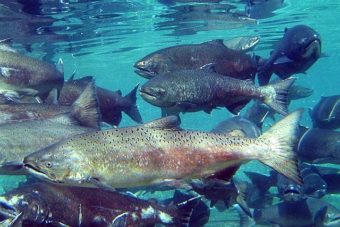
Pacific Halibut. (Creative Commons Photo by Neptune Canada)

The International Pacific Halibut Commission Friday voted to recommend a 1.7-million pound increase in the coast-wide catch of halibut.

The joint U.S. and Canadian body oversees management of the highly prized bottom fish from California to Alaska. The commission held its annual meeting in Vancouver, British Columbia this week.

The IPHC voted for a coast-wide catch for combined for commercial and charter fisheries of 29.223 million pounds, up from last year’s 27.515 million pounds.

Commissioner Jim Balsiger of Alaska noted wider participation at this year’s meeting.

“I found it refreshing is the right word, but it’s certainly a change in direction that we had other sectors than the directed halibut users in the room,” Balsiger said. “I think it’s the only way we can make progress on what has been the major issue, major point of contention between Canada and the U.S. up here, is the other users of halibut that have not been in the room before. They were here full force. I think that’s a great step forward.”

The commission heard presentations on the issue of halibut bycatch, or fish caught in other fisheries by boats targeting other species. That included input from Bering Sea trawl fleet representatives and others on efforts to reduce bycatch. The additional halibut removal increased coast-wide last year, to over nine million pounds, with over six million pounds of that coming from western Alaska and the Bering Sea. Halibut are caught in trawl nets by boats fishing for sole and hook and line boats fishing for Pacific cod.

Commissioner David Boyes of Canada said the bycatch issue was important for the entire coast.

“Juveniles from the Bering Sea migrate very extensively. They populate all areas of the coast right down to the southern most part of the range of this species. And so everybody has a vital interest in getting bycatch down to the lowest level that’s practicable, as it says in the Magnuson Stevens Act.”

The Commission plans to meet with the North Pacific Fishery Management Council on the issue February 5th. That council is scheduled to take action on recommendations for bycatch limit reduction measures this June. Those measures could be in place for 2016.

National Marine Fisheries Service assistant administrator for fisheries Eileen Sobeck wrote to the commission seeking a higher catch limit for the longline fleet in the Bering Sea. She highlighted the importance of the directed fishery to residents and businesses, along with efforts to reduce bycatch by other fishing fleets. The commission voted to recommend the same level for area 4, the Bering Sea and Aleutian islands, as last year.

For Southeast area 2C, the commission approved a combined commercial and charter catch of 4.65 million pounds. That’s an increase from last year’s limit of almost half a million pounds.

For the central Gulf, area 3A, the commission recommended a combined commercial and charter limit of 10.1 pounds. That’s also an increase from last year, of over 600,000 pounds.

The Commission also adopted catch-share plans for Southeast Alaska and the central Gulf that impact the number and size of halibut that charter anglers can keep.

Area 2B, British Columbia, was approved for just over seven million pounds, also an increase from last year’s catch.

Commissioners approved a season start date of March 14 and end date of November 7. Balsiger of Alaska was appointed chair for the next two years. The commission’s next annual meeting is in Juneau a year from now.

Board of Fish changes some shrimp pot reporting requirements

Spot shrimp. (Photo courtesy ADFG)

The Alaska Board of Fisheries Saturday changed reporting requirements for shrimp pot fishermen in Southeast. All shrimp pot catcher-processor vessels in Registration Area A will have to submit a logbook to the Department of Fish and Game at the end of a shrimp fishery.

Updates to Fish and Game are also no longer required before noon on Wednesdays during the season. That will give the department the flexibility of setting appropriate dates for reporting, which could be more than once a week.

The proposal was made by the Southeast Alaska Fishermen’s Alliance. SEAFA Executive Director Kathy Hansen said industry representatives have come to an agreement with Department of Fish and Game staff.

“The reporting of all the catcher-processors of the logbook data is the critical piece that the fishermen have been asking for since the 2000-2001 Board of Fish meeting, and the critical piece we need to move forward to start looking more at this in-season model and how it might work,” Hansen said.

Some Southeast fishermen told the Board of Fisheries they are worried shrimp stocks will decline if management decisions are not made in-season.

Although the passing of this proposal does not guarantee in-season shrimp pot management, it gives the department more data to evaluate the fishery.

Department of Fish and Game biologist Troy Thynes said Districts 6 and 7 have an experimental shrimp pot fishery with logbook requirements and in-season management.

“Only three years into it, we don’t feel entirely comfortable that this is going to be a successful way to go, as far as adjusting our fisheries management approach to these pot shrimp fisheries,” Thynes said.

He said that is because there are 21 distinct pot shrimp fisheries in Southeast.

Wrangell fisherman Sylvia Ettefagh said the shrimp pot fishery is more complex, so she thinks guideline levels are not adequate for management.

“Because of all the effort that we as fishermen in District 7 have put in as catcher-processors, we’re concerned that if a good management plan isn’t expanded to the other districts, that in effect, what happens is we end up concentrating vessels throughout Area A into specific districts that are better managed. And so we have more effort and therefore shorter fisheries, as well,” Ettefagh said.

The Board of Fisheries completed its Southeast shellfish meeting in Wrangell Saturday.

State board closes two areas to commercial Dungeness crab fleet

Dungeness crab is currently worth about $3 a pound. (Creative Commons photo by Kevin Cole)
Dungeness crab. (Creative Commons photo by Kevin Cole)

Alaska’s Board of Fish this month for the most part voted down proposed closures for commercial Dungeness crabbing around Southeast. However, the board during a meeting in Wrangell did support closed areas around Angoon and Hoonah.

Southeast residents and communities submitted 10 proposals this year seeking to place areas off-limits to the commercial Dungeness crab fleet. Most sought the closed areas to improve personal use or subsistence crabbing nearby some Southeast towns.

However, the board was not too receptive to shutting down areas to commercial crabbing without evidence of conservation problems in the areas. The board voted down a proposed closure near Hydaburg on Prince of Wales Island as well as one proposed on another part of Prince of Wales, at Whale Pass. Board chair Karl Johnstone called the Whale Pass proposal an area grab without justification.

“And when I say grab I don’t mean it to demean the proposal,” Johnstone said. “But it just describes it as taking away areas that have historically been utilized by commercial fisheries for not a good reason and there’s a lot of opportunity available for the people who are in favor of this.”

Two of the proposals sought closed areas to the commercial fleet around Petersburg. Proponent Steve Burrell wanted to improve crabbing for local personal use fishing. Burrell argued that intense commercial crabbing in the summertime around Petersburg left too few legal crab for people to catch for their dinner table.

Board member John Jensen of Petersburg opposed the closure.

“I’ve never seen a time when I could go down in this area and dump a pot out overnight and come back and get all I needed for my personal use with some left over for my family members,” Jensen said. “So I’m definitely not going to be supporting this. This would actually close a very large, both of them would close a very large area to commercial fishing and they’re both real lucrative commercial fishing areas.”

Other board members thought the area around Petersburg was important for new commercial crabbers getting a start in the fishery and did not see a conservation problem with crab stocks around Petersburg. The board voted unanimously against the first Petersburg proposal and took no action on the second. They were also unanimous in voting down a closure in the Big Bear-Baby Bear state marine park in Peril Strait north of Sitka. That closure was requested to eliminate crab gear in an anchorage used by boats waiting to go through Sergius Narrows.

Board member Tom Kluberton of Talkeetna did not see the justification.

“It just seems as though Sitka’s quite a cosmopolitan place,” Kluberton said. “There may be pressure but there’s a tremendous amount of opportunity around there and we’ve heard there’s already some closed areas to commercial fishing. The distance from Sitka to this just makes me feel it’s much more appropriate just leave it open to commercial fishing and if folks wanna go in there for the weekend and drop a pot or two there’s nothing stopping em from doing that.”

The fate was the same for two other proposed closures near Juneau and one in the Chilkat and Chilkoot inlets near Haines. There was some support for two of the proposals. Board member Kluberton supported a closure around the community of Angoon.

“Just feel that with the subsistence nature of life in Angoon that we’d have a more orderly fishery in the area without contention between commercial and the subsistence users in this vicinity.”

The city of Angoon submitted a proposal for a much larger commercial closure around that village to make sure residents sport and personal use needs could be met. That proposal was amended for a reduced area, a change supported by board member Orville Huntington of Huslia.

“I think the area of the original proposal was much too large and the smaller area I’m much more comfortable with it and I think it will provide for a more orderly fishery,” Huntington said.

The board unanimously approved that closure around Angoon. Likewise they approved an amended commercial closure around Hoonah. The Hoonah Indian Association sought a larger closure but the board agreed to a smaller area.

“Again I think there’s a long history of use of Dungeness crab in this area and again to avoid conflicts with commercial fishers whom I understand in recent years there has been an occasional incursion into this area, if that’s the proper way to describe it by new entrants to the fisheries,” said board member Fritz Johnson of Dillingham. “I understand that some of the older generation of fishermen have traditionally avoided this but to avoid those kinds of conflicts in the future I think this deserves our support.”

There are 14 areas of Southeast already closed to commercial Dungy crabbing under state regulation.

Scientists, fishermen test strategies to reduce trawl bycatch, habitat impact

F/V Auriga prepares for the start of B season. (Photo by Lauren Rosenthal/KUCB)

Reducing bycatch has been a hot topic in the pollock trawl industry. Scientists are working with the commercial fishermen to find a solution to the problem. And, at the Alaska Marine Science Symposium this week in Anchorage, they say they are making progress.

Much of the conservation effort is done in line with the Magnuson-Stevens Act, which, among other things, establishes essential fish habitats and mandates that harvests remain sustainable.

“It also says the act of harvesting can’t damage core components of the habitat that fish need,” Brad Harris, a professor at Alaska Pacific University and directs the fisheries aquatic science and technology lab, said. ”And the sense is that maybe you’re not over-fishing, but the way that you’re fishing might actually damage the productivity of the system. And so it requires that there’s a process in place that minimizes these adverse effects.”

Harris says there’s really only three ways to minimize those adverse effects.

“You can stop fishing or fish less; you can fish somewhere else – you can close an area; or you can change how you fish,” Harris said.

In Alaska, especially, the first two options aren’t viable. So, scientists are concentrating on the third option – changing how you fish.

Ideally, the pollock trawl fleet fishes pelagically – meaning in the water column above the sea floor, but, according to Carwyn Hammond, who is with the conservation engineering group at the Alaska Fisheries Science Center, sometimes that’s not where the fish are.

“There are times where, you know, you’ve got these beautiful schools of pollock that are in the water column and you can fish pelagically, but then there’s times those pollock aggregate on or near the sea floor and they do have to have a certain amount of contact in order to catch those fish,” Hammond said.

But, the more contact the net has with the sea floor, the more damage it can do to vital fish habitat. Hammond and her team are working with commercial fishing crews to try alternative gear setups using weight clusters attached to the front of the net using a strong, lightweight rope spaced every 90 feet.

Though the weight clusters still contact the bottom, it allows the rest of net between the clusters to float above the sea floor – and Hammond says it doesn’t have to be by much.

“Just a few inches; we may have knocked over either a sea whip or a basket star, which is what we used for the bottom trawl proxy,” Hammond said. ”We may knock them over, but they can recover and they can go onto still be vital habitat.”

Besides minimizing contact with fish habitat, Hammond says raising the gear off the ground limits the impact of bottom trawling on other creatures of the deep.

“What we discovered with the bottom trawl, with raising those sweeps, is we significantly reduced what we call the unobserved mortality of crabs – so snow crab, tanner crab, and king crab,” she said. “Because those invertebrates can interact with the gear on the sea floor, but they’re not actually caught, they stay on the sea floor. So we wanted to know in that study, what percentage of them lived versus what percentage of them died.”

With the adjusted gear, impacts were almost fully reduced to snow and tanner crab, and mortalities with red king crab were reduced by about half.

Scientists are testing other options as well. And when they figure out which setup is best, Hammond says the next step will be to partner with commercial fishermen to test the gear and ensure fishing can still be done effectively and efficiently.

Board of Fisheries chairman resigns

Karl Johnstone
Karl Johnstone. (Photo courtesy of ADFG)a

Alaska Board of Fisheries Chairman Karl Johnstone resigned Tuesday after Gov. Bill Walker said he wouldn’t submit his name to the legislature for reappointment.

Johnstone’s resignation came after the board blocked a candidate for Fish and Game commissioner from being interviewed for the position.

Gov. Walker’s press secretary, Grace Jang, said only one of four candidates was interviewed by the Board of Fisheries and Board of Game. That was acting commissioner Sam Cotten.

“Well, Gov. Walker was very disappointed that the process wasn’t allowed to play out and that only one name was advanced to him,” Jang said. “While he’s very confident that Sam Cotten will make an excellent commissioner and has been doing an excellent job in the past couple of months, he wanted to make sure that the public process was respected.”

A candidate rejected by the Board of Fisheries, Roland Maw, may replace Johnstone on the board. Gov. Walker nominated Maw to fill the vacancy, but the legislature has to approve the appointment.

Johnstone said he voted to reject an interview with Maw because of his history with the Board of Fisheries. He said Maw is part of a lawsuit to put some state-managed salmon fisheries under federal management.

“That was a clincher, a deal-killer for me, because I believe the state should manage its own resources,” Johnstone said.

The Board of Fisheries voted unanimously to not interview Maw.

Johnstone said Maw has also been critical of Department of Fish and Game staff and fisheries board members.

“I thought it would be very awkward for him to be involved in a leadership role when he didn’t respect many of the people he was dealing with,” Johnstone said. “And maybe they didn’t respect him as much as they should, either. That was my reason. And I gave that reason to the governor.”

Rather than wait for his term to expire in June, Board Chairman Johnstone said he volunteered to step down this winter, to help Gov. Walker get a new member on board faster. He said those changes usually happen at the end of a meeting cycle.

“This kind of changed things. And it put, I think, the Board of Fisheries in an awkward position where the chairman of the board is not going to be reappointed. And maybe it’s best that the chairman leave pretty quickly to allow a new person to come in and get their feet on the ground, rather than sit in as a lame duck for the next two meetings,” Johnstone said.

Johnstone will officially resign after this week’s board meeting in Wrangell. The board has two more meetings coming up. One is in Sitka next month, and the other is in Anchorage in March.

Johnstone has served on the Board of Fisheries since 2008.

Strong king numbers outside Sitka boost winter troll catch

(Photo courtesy KFSK)

Southeast Alaska king salmon trollers are having a strong winter season, thanks to good catches on the outer coast outside of Sitka.

The winter season started Oct. 11 and the catch of Chinook had topped 24,000 fish by the second week in January. Grant Hagerman, Fish and Game’s assistant troll biologist for Southeast, said the catch is almost double last year’s total at the same time. “Looking back it’s the highest fall catch we’ve seen for 20 years, basically, since the 93-94 winter season, so it’s pretty significant,” he said.

Typically the biggest catches in the winter come from around Sitka, Yakutat and near Petersburg. Hagerman said this year’s catches near Yakutat and Petersburg are pretty similar to those from recent years but the catches near Sitka have been unusually strong. In fact, the Sitka landings are nearly 80 percent of the winter season catch so far, or nearly 19,000 of the 24,000 total.

“You know there’s obviously a large abundance of fish on the outer coast here but I think talking to some of the Sitka trollers it sounds like there’s just been kind of increased opportunity or availability of fish,” Hagerman said.

A big part of the catch came in the early season, October and November. However, Hagerman said strong catches near Sitka continued into December as well, which is not typical. The dock price for troll caught kings averaged more than $6 a pound in the early season but it’s been climbing. “You know we did set a record this fall,” Hagerman said. “It’s the first time in the history of the winter the average prices have gone over $10 a pound before the new year. You know typically in the winter, we have building prices through about Valentine’s Day. So it could be these prices continue up into the $11-12 range. So we’ll kinda see what happens.”

The catch includes five percent Alaska hatchery fish, or about 1,100. That’s normally a higher percentage of the catch. Most of the fish caught are destined for rivers in Washington and Oregon.

The season is open until April 30 or until the catch of kings, not counting Alaska hatchery produced Chinook, hits 45,000.

Site notifications
Update notification options
Subscribe to notifications