Juneau Schools

Overcrowding and safety concerns prompt Juneau School District to restructure special education program

A wooden table with a red plastic bowl and blue clipboard next to a small yellow chair.
One of the Developmental Education Communication Classrooms at Kax̲dig̲oowu Héen Elementary School in Juneau on May 15, 2025. (Photo by Jamie Diep/KTOO)

Listen here: 

The Juneau School District is restructuring one of its specialized education programs. While staff and administrators say the change is desperately needed, some parents are concerned about how it will affect some of the district’s most vulnerable students. 

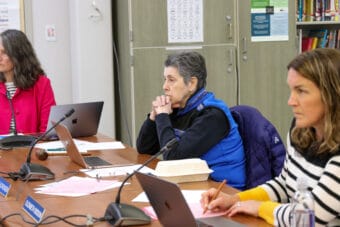
District staff reviewed the changes during a board meeting last Thursday at Thunder Mountain Middle School. Teachers, paraeducators, principals and parents filled the lecture room. Heavy silences punctuated the special education staff’s descriptions of dire circumstances.

“When all you can do is do your absolute best to make sure nobody dies today, that’s a significant problem,” said Phil Buettel, a paraeducator for the Developmental Education Communication Classrooms, or DEC-C, at Kax̲dig̲oowu Héen Elementary School. 

The class is meant to support students as they develop communication skills. But Buettel said that’s not happening.

“We don’t have the bandwidth to accomplish our most basic objective, because we’re more concerned with making sure that kids aren’t killing each other or us,” he said.

The class has 19 students this year. If the program remains unchanged, that number would jump up to 26 students next fall.

Tim Owen is the head teacher for the class at Kax̲dig̲oowu Héen. He’s been there two years, which makes him the longest serving teacher for the program in recent years. But Owen is resigning at the end of the school year. At the meeting, he said 26 students is too many for one class.

“I know 26 doesn’t sound like a lot for a general education teacher, but with the kids that we have and the needs that they have, it is impossible,” Owen said.

The increased enrollment prompted the district to work with Owen and other employees to restructure the program.

The current specialized education program has four classes based at Harborview Elementary School, Mendenhall River Community School and Kax̲dig̲oowu Héen Elementary. Student Services Director Jason DeCamillis said the new program will focus on training to help staff better meet students’ needs.

“We’re not training folks in this really broad, really shallow way,” he said. “We’re going deep and we’re going very narrow to ensure that students are getting the exact right people who have the exact right training.”

In the restructure, each class will focus on one specific skill set, like communication, social emotional skills or navigating different environments. Classes will be placed at a specific school. The proposed class sizes will be smaller, too. The district plans to have no more than 11 students in a given class.

But DeCamillis said there are some downsides to the restructuring. Up to 22 students would have to move schools to go to their new program if families want to participate in it.

“Students will have to move from one school to another, and so understanding what individual student needs and family needs are related to that transition is going to be a huge key to the work that a lot of the folks on this team are gonna have to focus in on,” he said.

The district’s plan includes working with families over the summer to develop ways to make the transition go smoothly for students.

Alyssa Cadiente-Laiti-Blattner has a son in the class at Kax̲dig̲oowu Héen. She said parents weren’t involved in initial discussions when the district first announced the program.

“We are our children’s best advocates. We are there with them every day,” she said. “We live this life with them, and so I wish there had been more parent involvement.”

After learning more about the program, Cadiente-Laiti-Blattner said she is hopeful about the smaller class sizes. But she’s still concerned about the district’s ability to carry it out.

“I know that they do have the best intentions for our children, but it still brings concerns, and this hasn’t changed for me, that they have the plan, but they don’t have the staff, they don’t have the paras, they don’t have the logistics,” she said.

The district is hiring two special education teachers for the current programs, according to job listings on the district’s website. DeCamillis said in an email the district is finalizing where to assign existing staff. 

Owen, who is leaving at the end of the school year, said teachers are reaching out to each student’s family to help ease their transitions.

He said in an interview with KTOO that, in the end, the new program will be good for students.

“For the first time in a long time, I’m actually really excited to share this with families, and I feel like they have reason for hope more than they ever have,” Owen said.

The restructuring, which doesn’t need board approval, is set to move forward. The district will continue working with families through the summer to help students with the transition if they decide to opt in to the program. The district expects it to begin in the fall.

Former member appointed to fill Juneau school board vacancy

A woman dressed in black stands over a wooden podium with her right hand raised. A man in a gray suit stands across from her.
Judge Amy Mead, left swears in Steven Whitney to the Juneau School District Board of Education on May 17, 2025 (Photo courtesy of the Juneau School District)

The Juneau School District Board of Education appointed Steve Whitney to the board on Saturday. Whitney will fill a seat held by Will Muldoon until his sudden resignation from the board last month.

Whitney is a former school board member and works for the National Marine Fisheries Service. He served a three-year term from 2016 to 2019 and decided not to run for reelection in order to care for a family member.

Steve Whitney.
Steve Whitney in 2016. (Photo by Quinton Chandler/KTOO)

In his interview, Whitney said he plans to focus on maintaining the public process at board meetings.

“My mindset going forward would be to focus much more on healing community and collaboration while we deal with difficult decisions, because I believe that is what this time calls for, and that is also what would best serve our children,” he said.

Whitney said he wants to balance ensuring teachers in the district get fair contracts with the district’s budget constraints.

Whitney will serve until the board elections in October, when a new member will be elected to serve the two remaining years of the term.

Juneau school board considers five applicants to fill vacant seat

Students walk to the Thunder Mountain Middle School entrance for the first day of school on Thursday, Aug. 15, 2024. (Clarise Larson/KTOO)

Five candidates have applied to fill an empty seat on the Juneau School District Board of Education after board member Will Muldoon resigned last month.

The candidates include a former school board member and two candidates who ran last year but were not elected.

Jenny Thomas ran for the school board last year and fell short of being elected. Thomas led the recall campaign for two members after the board closed and consolidated several schools last year. She wants to evaluate the effects of that plan if elected. Thomas currently owns Icy Strait Plumbing & Heating.

Brenda Taylor was a longtime teacher at Juneau Community Charter School and currently works with Sealaska Heritage Institute as a research coordinator. Taylor said she would focus on supporting teachers through contract negotiations and filling vacancies.

Dom Pannone is the director of program management and administration at the state Department of Transportation and Public Facilities. In his application, Pannone wrote that he went to school in Juneau and wants to “contribute meaningfully to the district.”

Melissa Cullum is a freelance writer and homeschool parent. She wrote that her top priority if appointed would be fair teacher contracts.

Steve Whitney was elected to the school board in 2016 and served one term. He didn’t run for reelection, saying at the time that was taking care of a family member instead. In his application, he said he would prioritize union contracts.

The board will conduct interviews Saturday at 10 a.m. at Thunder Mountain Middle School and afterward select a new member to serve until the next school board election in October.

More information on candidates can be found on the district’s website.

Juneau Assembly advances potential $10M school maintenance bond and utility rate hikes

Deputy Mayor Greg Smith speaks during a Juneau Assembly finance committee meeting on Wednesday, April 30, 2025. (Photo by Clarise Larson/KTOO)

The Juneau Assembly moved forward with a plan on Wednesday that would add up to $10 million to the city’s debt if approved by voters in this fall’s election. It would fund critical repairs and upgrades to Juneau’s schools after years of deferred maintenance.  

The Assembly decided to prioritize funding repairs to schools over the city’s water and sewer systems, which are also in need of some TLC. That means utility rate hikes are likely on the way. 

Superintendent Frank Hauser spoke about the need for school repairs and upgrades at a meeting last month. 

“The impact that facilities, well-functioning facilities — not only having roofs that are not leaking, but also HVAC systems that are consistent and sustained at a comfortable level — the importance of that is for the learning environment of our students,” he said. 

The repairs would include partially reroofing Juneau-Douglas High School: Yadaa.at Kalé and Sítʼ Eetí Shaanáx̱ Glacier Valley Elementary School, upgrading heating and ventilation systems and adding new security and safety measures district-wide. 

The decision last night wasn’t final. The Assembly still needs to take public comment before deciding whether the bond measure will go to voters. During the same meeting, the Assembly shot down a different bond package that would have asked voters to fund repairs to the city’s water and sewer systems, as much of its infrastructure reaches the end of its lifespan. 

Assembly member Maureen Hall said she worried that putting two bond questions on the ballot would overwhelm voters. It also comes after last fall’s election, when Juneau voters approved a different $10 million wastewater bond to replace infrastructure at the Juneau Douglas Wastewater Treatment Plant.

“I think there’s going to be an awful lot on the ballot this fall, and so I am a little hesitant to charge forward,” she said. 

Instead, members voted to push forward with a plan that would increase residential water and sewer rates by 5% annually over the next five years, and pair it with a bond package or other payment options later down the line.

City Manager Katie Koester said she believes the proposed 5% increases are the “least painful option” for residents that still addresses the need to pay for repairs. 

“I worked with the utility and we really, like, sharpened our pencils and scoured budgets to try to come to you with the recommendation that we feel like has the lowest impact on our ratepayers and the lowest current year pain on our budget,” she said. 

But the proposed increases would only begin to offset hundreds of millions of dollars in maintenance or replacement needs. In December, Juneau’s Water Utilities Division originally proposed increasing residents’ rates by more than 60% over the next five years to address those urgent repairs. 

Assembly member Alicia Hughes-Skandijs said she thinks the 5% increases are too low given the significance of the problem. 

“I don’t want us to be a body that kicks problems forward to future Assemblies and only continues to put us in a worse situation financially, at a time where our equipment is super old,” she said. 

But, Assembly member Ella Adkison said the proposed increase won’t go unnoticed.

“We talk about affordability in Juneau, utility rates are one of the biggest factors in affordability, because it affects everyone, including some of our lowest-income families,” she said. “It can really hit them hard.”

The Assembly will still need to take public comment at a future meeting before passing any rate hikes. If approved, those would go into effect in July. 

Contract negotiations grow tense between Juneau School District and teachers union amid funding uncertainty

A car drives past a Juneau Education Association sign posted next to the North Douglas Highway on Thursday, May 4, 2023. (Photo by Clarise Larson/KTOO)

A crowd of teachers filled the Thunder Mountain Middle School library earlier this month. 

Dressed in Juneau Education Association t-shirts and vests, they voiced their misgivings to the school board about contract negotiations.

Deborah Rakos has taught at the district for 25 years. She said the district’s proposed pay scale is divisive and favors certain levels of experience.

“I’m looking at bringing home less money next year,” Rakos said. “In the meantime, the cost of living in Juneau continues to rise, and we all need to be able to pay our bills.”

Johnson Youth Center teacher Janette Gagnon said she’s now finding it difficult to recommend prospective teachers work for the district.

“If negotiations continue to drag out this time and again next time my faith in the district is getting shattered,” she said.

Electra Gardinier sat in front of board members with a two-month-old baby on her hip. She and her husband are both teachers raising three children. She said the low pay and high cost of living in Juneau means her husband needs to work a second job to make ends meet.

“Three nights a week, he works 13-hour days so that we can do extravagant things like pay for our health insurance,” she said.

They’re pushing the district for better pay and benefits against a backdrop of uncertain state funding. 

Gov. Mike Dunleavy vetoed a bill that increased the state’s per-student allocation by $1,000, and the Legislature is considering several other school funding bills. 

School funding in Alaska hasn’t gone up significantly since 2017. Because of this and other budget issues, the district consolidated its middle and high schools last year to make up for an almost $10 million deficit. 

The initial proposals from the union and district have some major differences when it comes to salaries and health insurance contributions. The district is budgeted for a 2.5% increase to salaries for the first year of the contract. The proposal also includes a 1.5% increase in the second year in addition to a 1% retirement plan match. Both of those increases also include step and lane movement. The union is asking for 10% each year.

The district is also flat funding health insurance contributions for the next two years. Meanwhile, JEA is asking for the district to cover 85% of annual premiums. Right now, educators have a few options for health insurance plans, including an employer-compensated option that is free. 

Superintendent Frank Hauser wrote in an email that state funding controls how much the district can offer in salaries and benefits. He said the district estimates JEA’s proposal will cost $30 million over two years versus the district’s $2.2 million proposal.

Hauser declined to discuss the terms of contracts outside of the bargaining process, citing negotiation rules signed by both parties.

“We value our teachers and the vital role they — and all staff — play in student success, and we remain committed to working through the formal negotiation process to reach a fiscally responsible and sustainable agreement,” Hauser wrote.

Now the negotiations have passed the two month mark. JEA president Chris Heidemann said in an interview with KTOO they haven’t made progress with the district, despite counteroffers from both sides. He said the district refuses to negotiate individual financial elements within the contract proposals.

“We’re ready to bargain,” he said. “They’re just not working with us.”

Heidemann said there’s a lot of distrust between the union and the district because of a drawn out negotiation cycle for the current contract. 

They reached an impasse during the last negotiation cycle that escalated to teachers working only during the hours they were paid for. 

Heidemann said if negotiations don’t progress, he fears teachers may go into the next school year without raises.

“There’s a lot of pessimism about that,” he said. “And I think there’s just a lack of trust between teachers and the district administration right now.”

Heidemann added that a combination of flat funding from the state and poor budget management from the district resulted in a concerning contract proposal.

“They chose to attack our health plan, and if we take $0 in additional health care contributions, that means that everybody who gets insurance through us next year will take home less pay,” Heidemann said.

Contract negotiations depend on how much money the district has. Its budget for next year relies on a $400 increase in per-student funding. But that’s not guaranteed after Dunleavy’s veto.

While there are several bills that would increase district funding, Heidemann is concerned that another year without additional state money could lead to another year of staffing cuts the district can’t handle.

“We’re down to the point now where if we keep having to cut, we’re just not going to be able to keep the building safe,” he said. “We are at the bare minimum personnel to keep kids in the buildings going to school.”

The district is also in negotiations with unions for support staff and administrators.

Editor’s note: This story has been updated with additional comment from Superintendent Frank Hauser and to correct language around the district’s initial salary and health insurance proposal. 

Will Muldoon resigns from Juneau school board

Will Muldoon speaks during a Juneau Board of Education budget meeting on Thursday, Jan. 18, 2024. (Photo by Clarise Larson/KTOO)

Juneau School District Board of Education member Will Muldoon stepped down from his position on Monday.

According to a press release from the district, Muldoon submitted his resignation effective immediately and gave no reason for his departure. 

“The district and board appreciate Mr. Muldoon’s service to the community of Juneau, and the time and effort he has devoted to the district’s students and employees,” the district’s statement reads. 

Muldoon won his seat in 2021 as the first write-in candidate elected to the school board in decades. He was re-elected to another three-year term last year.

Muldoon did not respond to a request for comment on Tuesday.

The board has 30 days to fill Muldoon’s position. The board will choose from a pool of applicants at an upcoming meeting where members of the public will have an opportunity to comment. The date of that meeting has not yet been set. 

The newly appointed member will serve until this year’s municipal election in October, when voters will elect a member to serve the remainder of the term.

Applicants for the position must be qualified to vote in Juneau and cannot be a district employee.

Site notifications
Update notification options
Subscribe to notifications