Juneau Schools

Student-written plays engage Juneau community on addiction, climate change

Alexandra Wagner, Christina Apathy and Flordelino Lagundino performing radio plays written by local high school students at Thunder Mountain Middle School on April 17, 2025. (Photo by Jamie Diep/KTOO)

Students at Yaaḵoosgé Daakahídi High School and Juneau Douglas High School: Yadaa.at Kalé wrote four plays earlier this year centered on deeply personal topics. They were performed live on the radio in February, and again this week. 

Theater Alaska hosted the performance Thursday at Thunder Mountain Middle School. It was followed by a forum with teachers, mental health professionals and policy makers that gave community members the opportunity to discuss the topics brought up by the plays, including addiction, climate change and consolidating the city’s two high schools.

National Alliance on Mental Illness Juneau is a local non-profit that provides mental health education. Executive Director Aaron Surma said the lack of resources locally means they work with students to help them support one another.

“Feeling comfortable supporting your friend always makes sense. But saying that we – people who make the worlds – are just not going to have good enough systems for you to make it be helpful is a pretty tragic thing,” Surma said.

Yaaḵoosgé Daakahídi teacher Electra Gardinier said the opportunity to write radio plays helped students engage with writing in a new way.

“I, as a teacher, saw students who had never interacted with one another in a positive way suddenly be able to take on a character and interact as these characters in a really healthy and communicative way, and then also to make writing collaborative,” Gardinier said.

The performances come as schools and arts organizations face funding uncertainties in Juneau and across the state and country.

Thursday’s program wrapped up hours after Gov. Mike Dunleavy vetoed a bill that would increase the state’s per-student allocation by $1000. The Trump administration is also slashing grant funding for humanities organizations.

Still, Theater Alaska’s Artistic Director Flordelino Lagundino said they hope to continue working in local schools and expand the program next year.

Disclaimer: KTOO was a partner in the radio play performances, but the KTOO newsroom took no part in organizing the event.

Athletes celebrate Indigenous culture and diversity at Traditional Games in Juneau

Middle school athletes stand on the podium at the annual Traditional Games in Juneau on Saturday, April 5, 2025. (Photo by Clarise Larson/KTOO)

The eighth annual Traditional Games was held in Juneau this weekend at Juneau-Douglas High School: Yadaa.at Kalé.

More than 250 athletes from 30 teams from across the state, the Lower 48 and Canada competed in a dozen different events rooted in Alaska Native values. 

Matthew Chagluak of Anchorage sat low on the gym floor at Juneau-Douglas High School: Yadaa.at Kalé Saturday morning. His neck was craned upward and his eyes were laser-focused on a ball hanging on a piece of string above him. 

Suddenly, in one fluid motion, he kicked a leg up to touch the ball while balancing on one hand, successfully executing an Alaskan High Kick. 

Matthew Chagluak of Anchorage competes in the Alaskan High Kick at the annual Traditional Games in Juneau on Saturday, April 5, 2025. (Photo by Clarise Larson/KTOO)

“By showing grace in your events, its showing respect for not only the event, but yourself too,” he said. 

Chagluak is Yupik, and he’s one of more than 250 athletes who came to Juneau to compete in the eighth annual Traditional Games. Many of them are Indigenous, but the games are open to participants from any background.

“It’s all about family and people who I care about, showing my support and having fun at the same time,” he said. 

Throughout the three-day event, the athletes from 30 different teams competed in a dozen different games. Each requires a unique skill set, a lot of training and focus. They’re all rooted in Indigenous hunting and survival skills. 

“The history goes back hundreds maybe 1000s of years, so let’s see it continue hundreds or 1000s of more years,” said Kyle Worl, a coach who leads the program in Juneau. 

Athletes do archery at the annual Traditional Games in Juneau on Saturday, April 5, 2025. (Photo by Clarise Larson/KTOO)

He said the games had a profound impact on him when he began participating as a high schooler. Now, as an adult and coach, he wants to make sure other young people can experience them too.

“It’s a way to celebrate our culture and carry on these games and introduce them to youth throughout the Southeast region and beyond,” he said. 

Nathan Blake is a high school senior in Juneau. Not only did he compete, but he was also in charge of getting the crowd of family, friends and spectators excited.

He said the inclusiveness of the games is one of the biggest reasons he’s drawn to them. 

“All of us have really our own reasons to love this and appreciate the values that it brings to each home,” he said. “This is an event that teaches everyone that this isn’t just a game for one culture and one only. This is a game for everyone to come together and just be one with one another, regardless of how you look or what you do.”

Ricardo Worl, Kyle’s uncle, was a coach for the games in Juneau back in the 1980s and was honored on Saturday. During a speech to the athletes, he called on them to continue to uplift their culture and diversity amid the political turmoil happening in the country.

“We have grown-ups who don’t believe that being diverse, being inclusive, is something that should be supported,” he said. “Your added responsibility for this weekend is to be exactly who you are as athletes, Alaska Natives, proud, respectful.”

This year, athletes broke 12 records in different categories and age groups. Organizers say this year’s Traditional Games were one of the biggest held since they began in 2018. 

Juneau Assembly and School Board continue to grapple with Dzantik’i Heeni playground designs

The Dzantik’i Heeni campus on March, 11, 2025. (photo by Jamie Diep/KTOO)

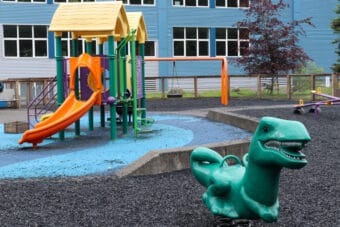
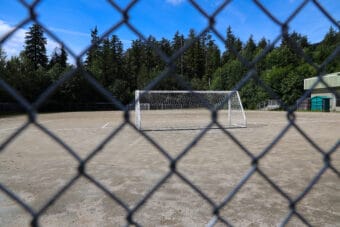
Elementary students at Juneau’s Dzantik’i Heeni campus will continue playing on a dirt field for now. 

The building in Lemon Creek previously housed middle schoolers before the district’s consolidation plan moved Juneau Community Charter School, Montessori Borealis and Yaaḵoosgé Daakahídi High School onto the campus. 

The Juneau School District and Juneau Assembly facilities committees met last week to discuss new playground designs. So far, the designs are not up to the state’s school playground construction standards. Some of the potential issues include drainage and snow removal.

School Board member Britteny Cioni-Haywood said it’s important to make sure the playground can be used by students and people in the surrounding neighborhood.

“This asset would be kind of dual purpose and that it would serve as a park for the community, but also is a playground for the schools that are in that building now,” she said.

This is the third round of designs for a playground. The initial design was estimated to cost $1.8 million dollars. And a second round of designs at roughly a third of that didn’t comply with the Americans with Disabilities Act standards.

While the city paid for designing the playground, the Assembly never committed any funds to build it. And now Juneau Engineering and Public Works Director Denise Koch said they’ve run out of design funds.

School Board President Deedie Sorensen said the district is looking for accessibility, a usable playground and fencing that can keep students safe during the day. But she says it’s taking too long.

“We need to move forward or these children who are there now will be graduating from high school and still playing in the street,” she said.

Juneau Assembly member Ella Adkison said a decision needs to be made on the playground, but that more money shouldn’t be spent on a new design.

“If we’re not spending money on a playground at that point, it feels like money out the door with no real results back,” Adkison said. “So I agree. I want to move forward. I am a little hesitant on going back to the drawing board in any way, shape or form.”

The committee decided not to bring any plans before the Assembly just yet.

Juneau school board approves budget assuming $400 BSA increase

Juneau School District President Deedie Sorensen at a meeting on Thursday, March 13, 2025. (Photo by Jamie Diep/KTOO)

After months of back and forth between administrators, staff and school board members, the Juneau School District approved a budget for the next fiscal year on Thursday.

Still, the budget is based on uncertainties that could put the district in the red. It’s built on a $400 increase to the state’s base student allocation that has not happened yet. Alaska state Senators are considering a proposed $1,000 BSA increase that has been approved by the House.

And Superintendent Frank Hauser said a proposed regulation change from the Alaska Department of Education and Early Development could shake things up as well. It would modify what counts as a funding contribution from local governments and reduce how much money the district could receive from the City and Borough of Juneau.

“That DEED regulation change could have an impact of about $2.1 million for non-instructional funds,” Hauser said.

He added that the district is also in contract negotiations with three unions representing teachers, administrators and support staff. Contract changes could affect the budget, too.

Since its last meeting, the board removed anticipated savings from unfilled positions from its budget calculations, and found programs that can be paid for ahead of time with extra money in this year’s budget.

It also set aside funding for two teaching positions for the Tlingit Culture, Language and Literacy program. Those positions are funded by grants which expire this year.

While the district is working to get another year of grant funding for the program, they can’t apply for it until the fall. As a backup, Hauser recommended funding the positions through the district’s budget until grant money is secured.

Board President Deedie Sorensen moved to set money aside for the teachers, but not for the program’s principal – which is another grant funded position. 

“The program has functioned for years without its own principal,” she said. “As we have more clarity on our budget, I am happy to pick that up again, but for right now and tonight, I want to make sure that we are funding the foundational pieces of the program.”

Jamie Shanley, an assistant education director for the regional Native nonprofit Sealaska Heritage Institute, spoke out during public testimony in support of funding the program’s principal.

“The principal plays such an important role in the support and all the extra that that team is doing. Taking her out of the equation adds even more to the shoulders of the teachers who are there,” Shanley said. “Not only are they teaching full time, they’re creating curriculum in their language while they’re learning their language and doing all the extra things that we know TCLL does.”

The board is expected to present the budget to the Juneau Assembly Finance Committee on April 5.

Juneau School District approaches decision on annual district budget

Juneau School District Board of Education President Deedie Sorensen and Vice President Elizabeth Siddon at a school board meeting in Juneau on Tuesday, March 11, 2025. (Jamie Diep/KTOO)

The Juneau School District Board of Education is expected to pass a budget at a special meeting Thursday. 

The board made last minute changes at its Tuesday meeting and now needs to rebalance the proposed budget. 

The previous budget was based on savings from unfilled staff positions this year and assumed 3% of next school year’s positions would be unfilled.

But on Tuesday, board members took that assumption out. That’s because anticipating a set vacancy rate could jeopardize a financial buffer for the following year. Board President Deedie Sorensen was the only member who voted against the change.

The financial ins and outs are complicated, but what it means is savings that come from vacancies are unreliable. Board Vice President Elizabeth Siddon said she prefers to base the budget off of known savings. She said planning for vacancies ahead of time could leave fewer savings that can go toward the following year’s budget.

“Let’s utilize the previous year’s known vacancy savings. And next year we will utilize FY26 but we won’t be like, ‘Oh, it’s 99% of this year’s because we put 1% of it in, right?’” she said. “So let’s, as a practice – because we’re starting this this year, which I think is a good practice – let’s be clean about it and utilize the previous year’s vacancy factor.”

The change would throw the current proposed budget off by more than $700,000. But savings from this fiscal year mean the district has only about $100,000 to make up for a balanced budget.

The board directed the district administration to find things that can be paid for ahead of time with savings, and to find places to cut.

The budget is still based on a $400 increase to the state’s per-student allocation. The Alaska House passed a bill Wednesday that includes a $1,000 increase, which still needs to go through the Senate.

The school board is scheduled to meet at 5:30 p.m.Thursday at Thunder Mountain Middle School.

No injuries following fire at Juneau’s Dzantik’i Heeni school that left students stuck outside

Students walking toward the Dimond Park Field House in Juneau on March 11, 2025. (photo by Jamie Diep/KTOO)

No one was hurt in a fire at the Dzantik’i Heeni campus in Juneau on Tuesday. But it left students huddled outside for hours.

Juneau School District Director of Operations Kristy Germain said the fire started in a high school science class.

“Our systems worked as they should,” she said. “The sprinklers worked to put out the fire, and we had no injuries.”

The evacuation left many students in the building’s three separate schools – Juneau Community Charter School, Montessori Borealis and Yaaḵoosgé Daakahídi High School – outside without jackets or a lunch. Montessori Borealis sixth grader Grace Blair said she thought it was a fire drill at first. 

“The alarm never stopped going off, so we were outside and our teacher had us just standing there for a while and then everyone was evacuated and we had to stay out for two hours in the cold.”

The district sent an email to families saying potential exposed wiring made the building unsafe for students to reenter. Five school buses arrived after the fire to move students to Dimond Park Field House near Thunder Mountain Middle School where families could pick up students.

Staff wheeled in white paper sacks with food for students about two hours after their normal lunchtime.

After being picked up, Blair had one thought.

“I want to be warm,” she said. 

Chava Levy, another sixth grader, shared a similar sentiment.

“It was very cold,” she said.

While Blair said the whole ordeal wasn’t too bad, there were still some intense moments. She said one of the scariest moments was seeing one of the Montessori classrooms leaving in a hurry.

“They were running and a whole bunch of kids were screaming because they had heard something,” she said.

The district reported Tuesday afternoon class will resume at Dzantik’i Heeni beginning tomorrow.

This story has been updated.

Correction: The original version of this story misstated which classroom ran out of the building on Tuesday.

Site notifications
Update notification options
Subscribe to notifications