Juneau Schools

Juneau School District will cut 2 positions, dip into savings to fill budget gap

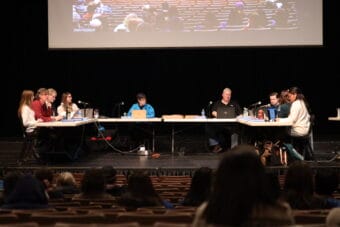
President Deedie Sorensen at a Juneau school board meeting on Tuesday, July 11, 2023. (Katie Anastas/KTOO)

The Juneau School District will eliminate two staff positions and change the way others are funded to address a budget deficit caused by Gov. Mike Dunleavy’s education funding veto.

The district will eliminate one administrative job and one position in HomeBridge, the district’s homeschool program. In an interview, Administrative Services Director Cassee Olin said neither cut will lead to a layoff — the HomeBridge staffer is retiring, and the administrative position was new and hasn’t been posted yet.

“We held it back because of these very reasons,” Olin said.

The district built its budget around a $430 increase to the base student allocation, the state’s per-student funding formula. But last month, Dunleavy vetoed half of the Legislature’s $175 million, one-time funding increase for public schools. That left the district with a $758,000 shortfall.

Eliminating the administrative position will save $140,000, and the HomeBridge position will save $110,000. Other savings will come from changing the way positions are funded. The district will fund four teaching positions using pandemic aid funding, freeing up $396,000 in general funds. 

The district’s budget had already used $1.6 million in American Rescue Plan Elementary and Secondary School Emergency Relief funding to pay for some teachers and online classroom materials. But that funding expires at the end of this fiscal year, so district leaders will have to find another way to fund those positions.

Those changes still leave the district with a $112,000 shortfall. They’ll use some money from savings to fill that gap. Olin said that will leave the district with about $500,000 in savings – “a pretty low number for us.” 

District leaders around the state have spent the last few weeks adjusting their budgets in the wake of Dunleavy’s veto. The Kenai Peninsula School District is using savings to fill its budget gap. The Kodiak Island Borough School District is using about half of their remaining savings and reducing spending on supplies and maintenance.

Some legislators are still hoping for a special session to override budget vetoes

Rep. Sara Hannan, D-Juneau, talks to a page on Tuesday, January 21, 2020 in Juneau, Alaska. (Rashah McChesney/KTOO)

Juneau’s Rep. Sara Hannan has filed to run for reelection in 2024, nearly a year ahead of the deadline. 

“It is by far the earliest I’ve filed compared to my other terms,” Hannan said. 

Hannan is a Democrat who represents District 4, which covers downtown Juneau, Thane, Douglas and a small part of the Mendenhall Valley. She was reelected to a third term last year, but she says she and some of the other members of the minority Alaska House coalition are filing early so they can fundraise around a potential special legislative session. 

“I need to make sure that I am, quote, legal, if I decide that we’re going to raise money in a campaign way to talk about vetoes,” she said. 

Gov. Mike Dunleavy’s budget vetoes cut roughly half of a one-time school funding increase passed by the Legislature. That left some districts, including Juneau, struggling to close significant budget gaps.

Hannan and the other 15 members of the House coalition sent a letter last week to Speaker of the House Cathy Tilton, R-Wasilla, requesting a formal poll of membership “to determine whether the legislature shall call itself into special session for the purpose of overriding specific vetoes made by the governor.”

Hannan – who is a retired teacher – says they hope to override the veto before the next Legislative session in January to make it easier for districts at the start of the school year. 

“We know that it’s a long shot,” Hannan said. “But public pressure can change politicians’ minds.”

Tilton has yet to respond to the letter, according to coalition Press Secretary Graham Judson. Tilton previously told the Alaska Beacon she did not see enough support among legislators to hold a special session, which requires support from at least 40 of the 60 members per the state constitution. 

Alaska Public Offices Commission filings show several other coalition members also filed early in the last week. Rep. Cliff Groh, D-Anchorage, Rep. Maxine Dibert, D-Fairbanks, Rep. Genevieve Mina, D-Anchorage, and Rep. Rebecca Himschoot, I-Sitka, have all filed to run again in 2024. 

Looking ahead to the next election, Hannan says fiscal stability remains “the big picture goal” for the Legislature. She plans to continue advocating for the things she believes Juneau residents care about. 

“My constituents continue to request, you know, better services – better ferry service, better schools, better safe public safety, and all of that costs money,” she said. “So to get there, we need to talk about revenues and long term revenues.”

Rep. Andi Story, a Democrat who represents the Valley, Auke Bay and Out the Road, and the northern Lynn Canal, said she is not yet ready to announce her plans for reelection.

Dunleavy’s education funding veto leaves Juneau School District with budget gap

A school bus full of preschoolers, their parents, caregivers and advocates pulled up to the Capitol building on Monday to hand out Valentine’s Day cards to state legislators on Feb. 13, 2023. (Katie Anastas/KTOO)

Gov. Mike Dunleavy has vetoed half of a one-time increase in public education funding approved by the Alaska Legislature.

Now, Juneau school district leaders are grappling with a budget deficit just weeks before their budget is due to the state.

“To constantly be hitting a wall around adequate and timely and sustained funding is really frustrating,” said Superintendent Bridget Weiss. “It’s exhausting.”

Juneau School District leaders built a budget around an assumed $430 increase to the base student allocation, the formula that determines how much money school districts get from the state. Dunleavy’s veto makes the one-time boost just $340 per student.

The veto leaves the Juneau School District with a $758,000 shortfall, Weiss said. And there isn’t enough in the district’s savings to cover that deficit.

“Even if we said we’re going to use every penny of fund balance that we have so that we don’t have to make any further cuts — which you don’t want to do because that’s your buffer — we still wouldn’t quite have enough,” she said.

The Legislature needs 45 out of 60 votes to override a veto from the governor, which would also be enough votes to call itself into special session. 

Juneau Sen. Jesse Kiehl said the Senate likely has more support for a veto than the House does.

“I think an override is very difficult, but it is possible,” he said. “I think what it takes is education advocates around the state calling their legislators, saying, ‘This is not ok, this is hurting Alaska’s future, Alaska’s economy, Alaska’s kids.’ The votes aren’t there today, but what it takes to change legislative votes is citizen action.”

Meanwhile, with the district’s budget due on July 15, Juneau’s school board has less than a month to decide what to cut.

“Options are pretty minimal in how we do that, because we’re already pretty thin,” Weiss said.

In March, Weiss said the district might have to increase the pupil-to-teacher ratio — essentially making class sizes bigger — if state funding didn’t increase significantly.

The district was already bracing for less funding in fiscal year 2025, when pandemic aid runs out. This year’s budget includes $1.6 million in American Rescue Plan Elementary and Secondary School Emergency Relief, or ESSER, funds to pay for some teachers and online classroom materials.

Weiss and other school district administrators and teachers advocated for a permanent increase in school funding this session. She said there seemed to be a greater statewide understanding of the importance of public education.

“Hopefully that will be momentum going forward,” she said. “But for the moment, wow, it feels pretty deflating.”

Kiehl said legislators would continue to advocate for public school funding. He said the need is urgent.

“We’re going to have to get those resources into the schools, or we’re going to see outmigration, we’re going to see economic stagnation, we’re going to see unhealthy communities,” he said.

Juneau School District retirees reflect on their careers, the pandemic and what’s next

Lucy Potter, principal at Sít’ Eetí Shaanáx – Glacier Valley Elementary School, sits in her office. Staff covered the floor in balloons. (Katie Anastas/KTOO)

School is out for summer in Juneau. For retiring teachers, principals and other school staff, this end of the year is especially bittersweet.

Over the last two decades or more, they’ve watched the district expand to new campuses, weather the pandemic and incorporate Alaska Native language and culture into the curriculum.

Three retirees reflected on their time in the Juneau School District and shared what’s next.

Henry Hopkins, teacher at Yadaa.at Kalé Juneau-Douglas High School

Henry Hopkins (left) and Donald Héendei Gregory teach students at Juneau-Douglas High School: Yadaa.at Kalé the science and tradition of Tlingit halibut hooks on March 5, 2019. (Photo by Zoe Grueskin/KTOO)

For nearly 20 years, Henry Hopkins’ outdoor biology class has been at the forefront of Juneau’s efforts to incorporate Alaska Native knowledge and language into local schools.

“I spend a lot of time in that in-between world,” Hopkins said. “If you want to get detailed knowledge about the environment, I think a good place to start is with the people who live there. If you’re ignoring that as a Western scientist, you’ve lost a whole lot of information.”

Hopkins was working as a fish biologist in Western Alaska when he first considered teaching.

“I was standing in a river, measuring fish, late in the fall with ice chunks coming by, and I figured I wasn’t going to be doing that for the rest of my life,” he said. “The next step for a biologist was to be in a cubicle writing reports, and that did not seem attractive.”

So he returned to UAF – where he’d moved to from Germany to get his biology degree – and earned a teaching credential. Then he taught in Dutch Harbor, then Wrangell, then Delta Junction before settling down in Juneau. 

He’s been in the Juneau School District for 23 years.

“My classroom overlooks Gastineau Channel,” he said. “There aren’t too many teachers that can watch orcas swim by as they’re teaching.”

After working as a technology mentor for teachers and helping set up the district’s homeschooling program, Hopkins started teaching outdoor biology. He transformed the class into one that highlighted Lingít science and subsistence. He invited classroom guests like Donald Gregory, who taught the students about halibut hooks

Conversations in those classes eventually led to the school adopting a Lingít name.

“In my outdoor biology class, we talk a lot about names, names of the landscape,” he said. “In English, we name things after people many times. In Lingít, you name things after their properties, after their character.”

His students wondered why Juneau-Douglas High School didn’t have a Lingít name like some of the other schools in the district. After the students met with the Douglas Indian Association, Fran Houston gifted the name the school has today: Yadaa.at Kalé, which means “beautifully adorned face.”

After retiring, Hopkins plans to work with Sealaska Heritage Institute to mentor other teachers as they incorporate Lingít knowledge into their science classes.

“I think, historically, our school system has done very poorly with Native students and the Native community,” he said. “I’ve been trying to bridge that gap from the first day I taught.”

Gretchen Kriegmont, counselor at Thunder Mountain High School

Thunder Mountain High School counselor Gretchen Kriegmont sits at her desk. (Katie Anastas/KTOO)

Counselor Gretchen Kriegmont has been at Thunder Mountain High School long enough to work with the children of former students.

“I had a kid come in the door, and I was like, ‘Who is your dad? I am 100% sure I taught your father,’” she said. “Seeing whole families grow up, from kindergarten all the way through, it’s pretty amazing.”

After she retires, she’ll lead educational psychology classes for aspiring teachers at the University of Alaska Southeast.

“It’s really timely now,” she said. “Giving the teachers tools to realize that they’re not just going to be teaching their content. They’re also going to be teaching psychology, and there has to be a philosophy.”

Kriegmont started teaching at Yadaa.at Kalé Juneau-Douglas High School in 1997, after she and her husband moved to Juneau from the Midwest.

“It was the most school-spirited place I’d ever seen,” she said.

Once Thunder Mountain High School opened, Kriegmont moved there to teach history, psychology and sociology. She got her master’s degree and became a school counselor. 

Kriegmont said she wanted to help students grow academically, emotionally and socially – and help teachers encourage that growth in their students. During the pandemic, that balance became more important than ever.

“We persevered, and I think that’s what education is about and what high schoolers are about,” she said. “You see the resilience that high schoolers offer and the magic that they bring to society.”

That magic has started to come back in full force, Kriegmont said. She’s watched students who had virtual seventh and eighth grade become successful ninth and tenth graders. Students who missed out on homecoming dances enjoyed prom earlier this month. 

As these seniors look ahead, Kriegmont said more and more of them are wanting to travel or pursue a trade before jumping into four-year degree programs.

“It’s reframed how I have conversations with students,” she said. “I think students are reevaluating their goals.”

Kriegmont hopes her UAS students will enjoy teaching as much as she has.

“The classroom is a microcosm of society,” she said. “You will teach every type of person, and they will enrich your life if you allow them to.”

Lucy Potter, principal at Sít’ Eetí Shaanáx – Glacier Valley Elementary School

Lucy Potter, principal at Sít’ Eetí Shaanáx – Glacier Valley Elementary School, sits in her office. Staff covered the floor in balloons. (Katie Anastas/KTOO)

Lucy Potter’s office was filled with colorful decorations during the last week of school. Staff filled her office with balloons, and students wrote cards.

“I want you to be happy when you quit your job,” one student wrote on neon pink paper. “You are the best principal ever.”

Potter is hopeful she will be happier. She’s been the principal of Sít’ Eetí Shaanáx – Glacier Valley Elementary School for the last nine years and watched some of Juneau’s youngest students go through the pandemic. 

“I don’t want to compare myself to being a nurse in the medical field, but we were first responders,” she said. “It was a really difficult couple of years. Very, very demanding in a very different way.”

Teachers quickly moved classes online. Potter oversaw distribution of food and laptops for kids who needed them. Once students came back in person, one positive test could send a whole classroom back home again. 

Potter said teachers are still trying to help kids catch up academically. They’re also seeing more behavioral and emotional challenges among students. 

Potter teared up when she talked about the changes, and how they’ve left teachers exhausted. 

“They put their whole hearts into educating our students,” Potter said. “What I’m seeing as a result of that – not only teaching but doing a lot of social-emotional learning with them and helping them through these really difficult residual effects from COVID – I think they’re really tired.”

Potter is, too. That’s one of the reasons she’s retiring. She said between Superintendent Bridget Weiss leaving and the Alaska Reads Act going into effect in fall, it was a good time to move into a less stressful job.

The Reads Act requires teachers to develop reading plans for individual students, meet with their families and consider holding them back at third grade if they’re not reading at grade level. Potter is worried about how it will affect teachers who are already feeling overworked. And she thinks holding students back can do more harm than good.

“Many of our families are just making it by – they’re working two and three jobs to provide for their family,” she said. “And some of them aren’t as involved in their children’s education. I worry that the Reads Act is creating even more of a divide for families that are economically disadvantaged.”

Potter has seen all of these factors – bigger workloads, more behavioral challenges among students and a lack of appreciation for teachers – lead to a decline in the number of people applying for teaching jobs. She said it’s more important than ever for new teachers to find supportive communities at their schools.

“It’s super rewarding, but you can’t do it alone,” she said.

Juneau School District considers late start on Wednesdays

Parents greet their children in front of Harborview Elementary School in Juneau at the end of the school day on Dec. 21, 2022. (Photo by Jennifer Pemberton/KTOO)

Juneau students could start school half an hour later on Wednesdays next school year if the school board approves a proposal by district administrators.

The late start would give teachers more time to work together without students. Administrators say it would help elementary school teachers meet the new requirements of the Alaska Reads Act, which include teacher training, student testing and contact with parents. It would also give middle and high school teachers more training and planning time.

“The research is really clear: we get the best educational outcomes when adults have time together without children,” Superintendent Bridget Weiss said at a school board meeting Tuesday.

The Alaska Reads Act, which goes into effect in July, is meant to improve reading proficiency by third grade. Board President Deedie Sorensen said she recognized the need for more training and prep time, but that many parents and teachers had told her they opposed the late start.

“I know how beneficial it was when I was a teacher and we were implementing new programs in our building, and we had the opportunity to actually think about it and work on it,” she said. “I haven’t heard from one person that thinks a late start is a grand idea.”

Virginia Behrends has four kids in the district. She told the board that putting the late start in the middle of the week would disrupt kids’ sleep schedules.

“Monday’s always hectic. After coming back from a weekend, the kids never want to get up,” she said. “Tuesday you finally get them going, and then Wednesday you’re going to say, ‘You can sleep in five more minutes, 10 more minutes,’ and then we’re going to go back on Thursday and do it again.”

Board member Elizabeth Siddon asked administrators to consider releasing students half an hour early once a week instead. But Ted Wilson, director of teaching and learning support for the district, said an early release could be disruptive to after school activities.

Board member Emil Mackey said either option would be hardest on working parents, who might have to adjust their work schedules and find additional child care. Wilson said the district may need to hire more staff for its child care program, which is already struggling to hire workers amid a citywide shortage.

Other board members asked whether the late start or early release could be reserved for elementary school, since the Alaska Reads Act only adds new requirements for younger grades. Weiss said there aren’t enough school buses to handle different schedules for just one group of schools.

Weiss said she’s seen late start times work in other districts. The key for either option, she said, is to do it every week.

“I’ve been in other districts where we did early release, and it was some weeks to try to minimize the impact,” she said. “It doesn’t last, because nobody can keep track if it’s this week or that week.”

The school board will discuss the proposal again, likely with changes from administrators, at its next meeting on June 13.

Juneau teachers union votes to approve contract with school district

The Juneau School Board meets at the Thunder Mountain High School library. (Katie Anastas/KTOO)

Juneau’s teachers union has voted to approve a tentative agreement with the Juneau School District. The school board will decide whether to approve it on Friday.

The agreement would gradually increase wages, while also increasing district contributions to health premiums and time for elementary teachers to prepare lessons and grade assignments.

“We feel like there are enough wins in this contract that members should get a chance to voice their opinions on it,” Juneau Education Association President Chris Heidemann said when the agreement was announced last month.

The district and union reached the agreement in mid-April, but details weren’t public until it was sent to union members last week.

Though the agreement would increase wages for teachers, it’s not as much as the district or the union initially proposed. 

The smaller wage increase allowed for a compromise on the district’s contributions to employees’ health premiums, a major concern for the union. The district’s initial proposal had cut its monthly contributions by more than $400, while the union had proposed increasing them by about $80 each year. The tentative agreement has a yearly increase of $10.

Other changes aim to improve the way teachers are compensated for working during lunch breaks. It would also increase prep time for elementary school teachers and allow special education teachers to request time to spend on paperwork. 

Last month, the union directed teachers to work only during paid hours and not take on any extra duties before and after school or during lunch breaks.

The tentative agreement also establishes a workload review advisory committee made up of union members and district administrators. That comes as the Alaska Reads Act, which may require districts to increase reading interventions and testing, goes into effect on July 1.

“The committee will review new programs, initiatives, grants, curriculum, or changes to existing programs and their effects on JEA members/member groups,” the tentative agreement reads. “The committee will consider all of these and develop plans for implementation, to include problem solving where necessary.”

If approved by the school board, the contract will last until June 30, 2025.

Site notifications
Update notification options
Subscribe to notifications