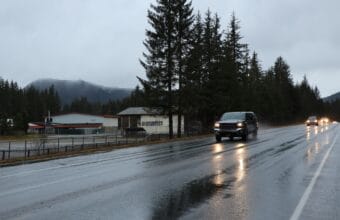
School buses line up to pick up students near Juneau-Douglas High School in 2012. (Photo by Heather Bryant/KTOO)
The first cruise ship of the year arrives in three weeks, but the Juneau School District is already feeling the effects of the upcoming season.
District leaders told families Sunday night that a shortage of bus drivers due, in part, to an earlier than usual start to the cruise ship season would lead to delays in bus service on Monday.
Cassee Olin, the district’s administrative services director, said 11 of the district’s drivers were out on Monday because of illnesses, family emergencies and vacation. And four of the 11 won’t be returning – they’re set to resign at the end of the week to start work at tour bus companies.
“It’s actually sooner than normal,” Olin said. “Instead of seeing this in early April, we usually see it at the end of April.”
The first cruise ship is set to dock in Juneau on April 17. Last year, the first one came on April 25.
In a normal year, Olin said the district would have two or three extra drivers on standby to fill in for drivers who are out sick or on vacation. This year, they don’t.
First Student, the company the district hires for student transportation, has brought two drivers from the Wasilla area to Juneau for two weeks to help. That still leaves the district nine drivers short. It’s enough to cause 15 to 20 minute delays across all routes.
“We’re trying to not cancel any routes. That’s our main objective at the end of the day,” Olin said. “But unfortunately, if we continue to lose drivers any more than we already are and not get any new drivers from other places around the state, we may eventually have to cancel routes.”
For now, Olin said parents can check their email and the district’s website for updates on route changes.
Frank Hauser, Carlee Simon and Thom Peck have been named finalists for the Juneau superintendent position. (Photos courtesy of the Juneau School District.)
The Juneau School Board has announced three finalists for the district’s superintendent position.
All three candidates will be in Juneau next week to meet with students, parents and staff.
Frank Hauser has been superintendent of the Sitka School District since the fall of 2020. He announced his resignation last month.
“While I am not sure what the future holds or if I might be called to serve elsewhere, I look forward to spending more quality time with family,” he wrote in a letter to district families.
Hauser was a finalist for superintendent positions in Anchorage last year and Fairbanks earlier this year. He was previously a music teacher and principal in Anchorage, where he was named Alaska’s 2019 Principal of the Year.
Hauser is the only Alaska-based finalist for the job.
Carlee Simon was superintendent of Alachua County Public Schools in Florida for two years, where she defied Florida Gov. Ron DeSantis by enforcing a mask mandate in Fall 2021. The school board voted to terminate her contract last March, though according to reporting by WUFT, many members of the public supported Simon. Mildred Russell, a member of the school board appointed by DeSantis, made the motion to terminate Simon’s contract.
Simon founded Families Deserve Inclusive Schools, an advocacy group that calls for adequate education funding and local control of school districts in Florida.
Thom Peck has been superintendent of Lewistown Public Schools in Montana for six years. He was previously superintendent of two other Montana school districts and is president of his region’s superintendents association. He began his career as a science teacher and coach.
“I would like to serve in this position because I desire the challenge of a larger school district with the tremendous diversity that Juneau offers,” he wrote in his online bio.
Peck was named a finalist for the Missoula County Public Schools superintendent position in January. After interviews with the finalists, the school board reopened that search, saying the finalists lacked the right experience.
Hauser, Simon and Peck will visit Juneau next week to tour schools and meet with students, staff and community members. The district will host a public forum on Monday, March 27 from 6 p.m. to 7:30 p.m. at Thunder Mountain High School. The school board will interview the candidates on Tuesday, March 28.
Juneau drag queen Gigi Monroe performs at the youth Pride party on June 20, 2019. (Photo by Zoe Grueskin/KTOO)
Earlier this month, Gov. Mike Dunleavy introduced legislation that would require parental permission for Alaska students to participate in school clubs related to gender and sexuality.
In Juneau, two such clubs are open to middle schoolers. They’re both called the Alliance, like other Gender and Sexuality Alliance clubs across the country. At one meeting last week, students told KTOO what the group means to them.
“[It’s] a place where you can be yourself,” said one student, who asked not to be identified in this story. KTOO agreed to not use club members’ names in order to protect their privacy.
“My mom is against LGBTQ,” the student said. “So I can’t really be myself around her because she doesn’t like that stuff. I’ve been coming here for around four months. And I think I really like this place.”
Oliver Sheufelt, an adult facilitator with the Alliance, says clubs like the Alliance are necessary because kids may not have other LGBTQ+ family members or support.
“That sort of community isn’t really baked in for these kids. We really have to intentionally create that,” they said. “And these kids often have to seek it out. But these are really life-altering, life-saving spaces.”
When they say life-saving, it’s not an exaggeration. The Trevor Project reported last year that 45% of LGBTQ youth in Alaska seriously considered suicide in the past year, and 64% of LGBTQ youth in Alaska lacked access mental health care they wanted. One of the top reasons was that they didn’t want to ask their parents for permission.
Another student in the Alliance said they are out to their mom but not their dad, and if they had to get permission from him, they may not be able to come anymore.
“My mom, it wouldn’t be a problem. She knows about me being transgender, but my father doesn’t. And that would cause problems,” they said.
For now, they tell their dad that they go to a homework club after school.
Some of the youth said their parents were supportive of their identities and know they go to the Alliance group. But the group is still special because they can be around other youth who share their identities.
For others, the group offers support while they think about how to talk to their families about who they are.
“I kind of want to tell them that I’m bisexual,” said one student. “It’s kind of hard to tell them, though. Itʼs scary.”
The Alliance meets weekly at Floyd Dryden and Dzantik’i Heeni middle schools. The Zach Gordon Youth Center has a weekly group for LGBTQ+ teens each Thursday. The groups are open to any student on a drop-in basis.
School board member Brian Holst and Superintendent Bridget Weiss at a school board meeting on Tuesday, March 14, 2023. (Katie Anastas/KTOO)
The Juneau School Board adopted a $96 million budget Tuesday night based on an assumed increase in state and city funding.
Board members chose to build the budget around a $430 increase to the base student allocation, the amount of money per student school districts get from the state. A $430 increase would give the district $3.3 million more than it got this year.
State legislators are considering bills that would raise the BSA by $1,000 or more, but school board members cited Gov. Dunleavy’s past vetoes to education funding when they settled on a more conservative estimate of $430 last month.
“The budget that you approve this evening is based on assumptions,” Superintendent Bridget Weiss told the board at the start of Tuesday’s meeting. “There are estimates built in here, and one of those is the increase to the BSA.”
The base student allocation is only guaranteed to go up by $30 next year. If lawmakers don’t further increase it, the school board and administrators will have to make budget cuts. Weiss said that would likely involve increasing the pupil-to-teacher ratio, essentially increasing class sizes.
“That’s a lever you likely would have to use if that worst case scenario happened,” she told the board.
Stacy Diouf, principal of Sayéik: Gastineau Community School, said she was worried about the board’s assumption that the BSA would increase more than $30.
“I feel like we’re going to have one idea of what next year is going to look like, and then once that [state] budget passes, it could be drastically different,” she told the board. “The optimist in me really hopes that it happens, but the realist in me is very concerned.”
The Juneau School District will use $1.6 million in remaining COVID relief money to pay for some teachers and online classroom materials. That funding allows the district to maintain current pupil-to-teacher ratios for kindergarten through third grade and middle school, and to slightly lower the ratio for fourth and fifth grade.
The only staff cuts in the budget are to six elementary school library assistant positions.
The Juneau School District is also assuming they’ll get the maximum amount of money the city is allowed to contribute, along with $2.5 million in outside-the-cap funding. That’s $300,000 more than it requested last year.
Earlier this month, the district asked the city for an additional $2.5 million for this year, in part to resolve a growing transportation funding deficit. Cassee Olin, the district’s administrative services director, said in an interview that administrators are considering reducing school bus routes next year in order to save money. Without cuts to bus service, the district expects to have a $483,000 transportation fund deficit at the end of the next fiscal year.
The school district must submit its budget to the city for final approval by April 5.
Correction: A previous version of this story said the board approved funding for a new world language teaching position. The board voted against funding the position.
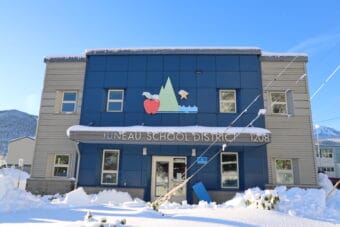
The Juneau School District office. (Photo by Bridget Dowd/ KTOO)
The Juneau School District is asking the Assembly for more than $2.5 million to resolve deficits ahead of the next fiscal year.
Alaska’s school funding formula allows local governments to contribute their own money up to a certain point. The City and Borough of Juneau has allocated the maximum amount of local funding to the school district annually for more than a decade.
School boards can also ask local governments for funding beyond that cap, and during last year’s budget process, the school board asked for $2.2 million. Now, the board is asking for an additional $2.5 million.
More than $1.2 million of that would go toward a growing transportation funding deficit. Transportation is funded on a per-student basis from the state, and Superintendent Bridget Weiss said declining enrollment led to a deficit in the fund last year. District leaders expect the deficit to grow at the end of this school year, since enrollment was once again lower than projected.
“When we went into COVID and we had a drop in enrollment, there was a hold harmless statute that supported us for a couple of years,” Weiss told the Assembly Finance Committee on Wednesday. “That was true for general funding, but it was not true for transportation funding.”
She said fuel costs have also gone up.
The other big item on the list is $750,000 for RALLY, the district’s after-school program. Weiss said many RALLY staffers work as paraeducators in schools during the day and then overtime at RALLY, which has driven costs up last year and this year. She said the program is experiencing the same hiring challenges as the rest of Juneau’s child care providers.
“Because of our negotiated agreement, that means we’re paying overtime, which is more expensive,” she told the committee. “If we pass those costs onto the family, then what we’ve discovered is it makes it unaffordable.”
Weiss said the funding would also go toward costs that have come up this year related to middle school wrestling, summer school and community classes for adults.
Weiss said if the Assembly doesn’t give the district the additional $2.5 million, the district would have to fill the gap with funds it hopes to spend on instruction next year.
“Our K-12 instructional money is the only other pot we have,” Weiss said in an interview. “We would have to use those instructional dollars to pay these deficits, and that would eat up some of our operating fund.”
Assembly member Alicia Hughes-Skandijs asked school board President Deedie Sorensen how much the school board had discussed the possibility of not getting the extra funding from the city.
“We have not spent an exceptional amount of time on these. We spent a bunch of time trying to decide whether or not we were going to make this ask of the Assembly,” Sorensen said. “Most of our budgetary discussions have been how much we need to cut in order to deal with the structural deficit.”
Some Assembly members pushed back against the request. Member Wade Bryson said the Assembly was being asked to provide an easy way out of the district’s budget problems.
“If you know that there are spots that are losing money, bring it to our attention so that we can do something about it instead of handing us a bill at the end and asking us to reward poor budgeting practices,” Bryson said.
But Weiss said the root of the problem is flat-funding from the state. The base student allocation, the amount of money per student school districts get from the state, hasn’t increased since 2017.
“This isn’t about bad budgeting. It isn’t about bad spending,” Weiss told the committee. “This is about K-12 education being underfunded, drastically underfunded.”
The finance committee voted to move an ordinance to allocate up to $2,540,737 to the full Assembly for a final vote, with members Bryson, Hughes-Skandijs and Maria Gladziszewski voting against it.
The school board’s first reading of next year’s budget is set for Tuesday.
Piles of snow sit in front of the Juneau School District offices on Glacier Avenue on Monday, Jan. 10, 2022. (Bridget Dowd/ KTOO)
A scammer stole more than $269,000 from the Juneau School District last fall.
City and Borough of Juneau Finance Director Jeff Rogers outlined the incident in a memo shared with the Assembly Finance Committee during its meeting Wednesday.
He said someone claiming to be one of the district’s vendors asked to change their banking information. They used a “spoofed email address that varied slightly from the vendor’s last known email address,” according to the memo.
CBJ recommends that staff contact vendors separately to verify requests like these. But the district didn’t double check with the real vendor, Rogers wrote. Once the banking information was changed, the scammer stole $93,477.17 on Oct. 7 and $175,600.23 on Nov. 4.
By the time the city’s finance department contacted the FBI, Juneau Police Department, CBJ Law Department and First National Bank of Alaska on Dec. 7, it was too late to recover the funds.
At an Assembly Finance Committee meeting Wednesday night, Rogers said it’s a strategy school district staff should have known about.
“This particular scheme is very common,” he said. “You can’t listen to a webinar about fraud, you can’t go to a financial conference, you can’t step out your front door without hearing that this is really a very successful method for fraudsters to use.”
The city has a risk fund for these kinds of events and could cover $250,000 of the district’s loss. But, according to Rogers, the Juneau School District hasn’t filed a claim with the CBJ Risk Manager or the city’s third-party insurers.
“I know that there has been communication from the CBJ Risk Manager to the school district, and there has not been communication back,” Rogers told the Assembly.
The district also hasn’t discussed the loss publicly, he wrote in his memo.
“Since mid-December, CBJ Finance, Law, Risk and the Manager have been in regular contact with JSD staff about the importance of disclosing this financial crime to the public. To-date, that disclosure has not occurred,” Rogers wrote. “Hence, I feel it is my fiduciary responsibility as the CBJ Finance Director to disclose this event to the CBJ Assembly and the Juneau public at this time.”
Juneau School District Superintendent Bridget Weiss said she has communicated with the city.
When reached Thursday afternoon, Weiss said she told the city in mid-February that the school board would discuss potential insurance claims in executive session at its March 7 meeting. She said the district received Rogers’ memo shortly before the finance committee meeting began.
“I think we have been in contact. Have we made all the final decisions related to this? We have not,” Weiss said. “And the board has a planned executive session on Tuesday to have this very conversation, and that was scheduled when Jeff Rogers submitted his memo to the Assembly.”
Rogers said city leaders have asked the district to make the public aware of the incident since mid-December. But Weiss said the district was waiting for more information from the investigation, which is still ongoing.
“We very much work hard as a district and a school board in being transparent, but we wanted to make sure we had all the information we could have, because then we can share more publicly if we know exactly what happened and what can be shared,” she said.
Weiss said the attack was external, and not from someone within the district. She said the district requires annual cybersecurity training and is reviewing its protocol.
Wednesday’s Assembly Finance Committee meeting also included a discussion of the school district’s request for additional funding from the city. The committee moved the request to the full Assembly for a final decision.
This story has been updated with comment from Juneau School District Superintendent Bridget Weiss.
Close
Update notification options
Subscribe to notifications
Subscribe
Get notifications about news related to the topics you care about. You can unsubscribe anytime.