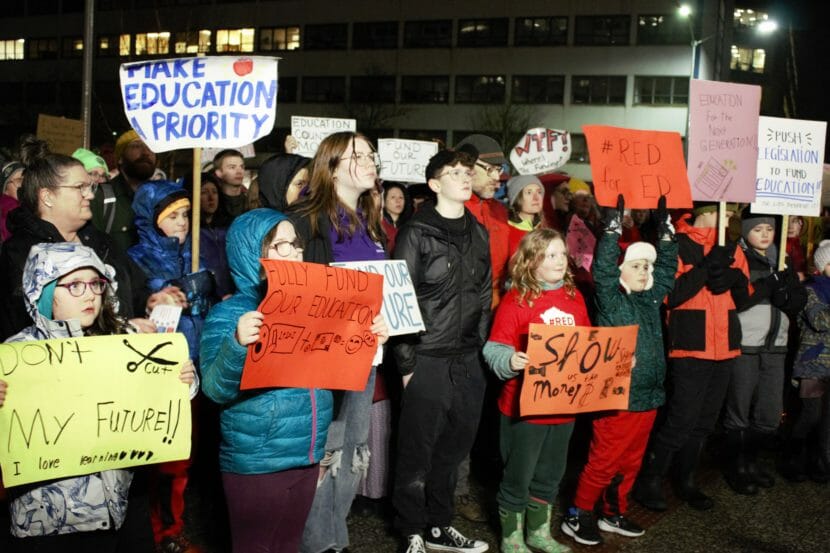
Students, parents and teachers hold signs calling for increased education funding outside the Alaska State Capitol on Jan. 23, 2023. (Photo by Katie Anastas/KTOO)
The Juneau School Board will plan the district’s budget around a moderate increase in state funding this year.
The base student allocation is the amount of money per student districts get from the state. For years, that number has been $5,930. It’s set to increase by $30 starting next school year, but lawmakers have proposed significantly bigger increases: Senate Bill 52 would furtherincrease it by $1,000, and House Bill 65 would by $1,250.
Juneau School District leaders previously considered building next year’s budget around a $540 increase. But school board members worried that was too high of an expectation.
Board member Elizabeth Siddon proposed changing the expected increase to $400.
“Wherever we fall, we need to make decisions that can be malleable to whatever the change ends up being,” she said.
School board President Deedie Sorensen said even $400 was too much.
“This makes me nervous,” Sorensen said. “I’m really at $300, because that’s what feels safe to me.”
“If this fails, not only will all of us look like the laughing stock of Alaska, individually and collectively, but it will also lead to very rapid and catastrophic cuts in order to make it right in the end,” he said.
The board ultimately decided to plan for an increase of $400, with Sorensen and Mackey voting against it.
The first reading of the district’s proposed budget is set for March 7, and the final reading is set for March 14. In the meantime, the school board has several meetings scheduled to work on the budget.
Juneau students in the Tlingit Culture, Language and Literacy program perform before the ribbon cutting of the Father Andrew P. Kashevaroff Library, Archives and Museum on June 6, 2016. (Photo by Matt Miller/KTOO)
A program at Juneau’s Harborview Elementary has been integrating Lingít language and culture into classroom teaching for decades. Now it’s expanding to middle school, with plans to teach other subjects in Lingít as well.
Molly Box is the interim principal for the Tlingit Culture Language and Literacy program. She said parents were excited to hear their children could stay in the program longer.
“Families who have fourth graders or fifth graders were like ‘Oh my gosh, this kid can’t think of better news,’” she said.
Box said the program has brought cultural heritage to Lingít students through singing and dancing, and it’s helped students learn about their clans and family histories and celebrate Lingít values at school.
The program has three classrooms at Harborview. Each has a teacher, a Lingít language teacher, and an elder helping out. Box said the program has about a dozen students in each grade.
With funding from the Sealaska Heritage Institute, the program will add a fourth classroom in the fall, for sixth and seventh graders. The grant will pay for two new classroom teachers and one Lingít teacher.
They also plan to add eighth grade students in 2024.
Box said that in time, the program will teach other school subjects in Lingít as well.
University of Alaska Southeast Lingít language Professor X̱’unei Lance Twitchell said dual-language programs have proven effective with other Indigenous languages.
“Once they started using the language as a medium of education and said, ‘We’re not teaching the language anymore, we’re teaching through the language,’ then that really shifted things in terms of adult fluency levels, and especially children,” he said.
Jamie Shanley, SHI’s program manager for the language program, said the funding includes training for teachers to help make that possible.
“The grant is also providing some resources for the teachers to strengthen their language acquisition, such as immersion retreats where they go and spend several days together in a place and only speak and live in the language,” Shanley said.
Twitchell said one barrier to dual-language programs is the fear that students won’t be prepared for standardized testing. But those measurements don’t serve language revitalization efforts, he said, and national standardized tests don’t factor Indigenous language learning into their equations.
“If our language is not part of the standard, then we need to reject the standard and say, ‘Okay, well, that might be something that you’re measuring for someone else,” he said. “But don’t use that tool of measurement for children who are invested in and families who are invested in making sure our language is still around.’”
Box said there will be an assessment planned for the program, but it will focus on the students’ language proficiency and how well the program isinvesting in the Lingít language. She said it’s vital that the program do two things: develop fluency and prepare students academically for the next step.
“We really want to make sure that we lay the groundwork for a really rigorous program, that not only do they get the benefit of staying within TCLL and having the cultural relevance in their education in the Lingít language, and we still prepare them for high school,” Box said.
Box said the program will eventually include programs for families so kids can engage with Lingít at home, too.
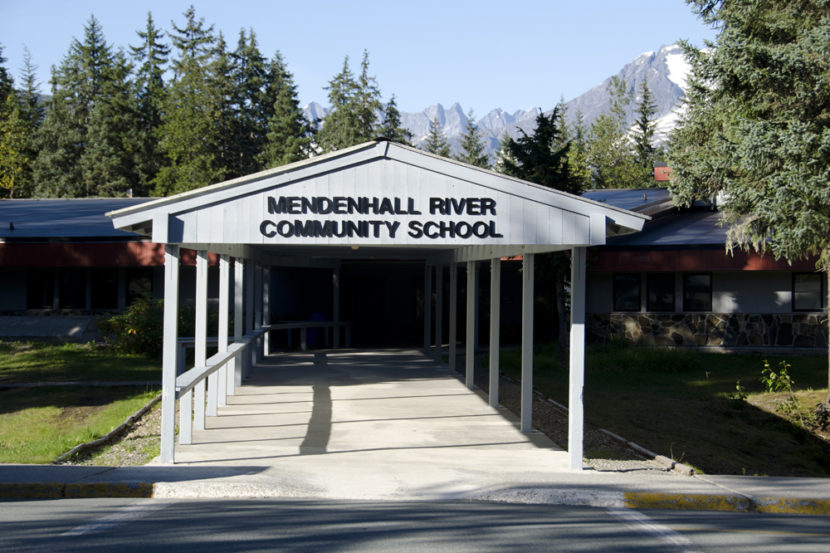
Juneau’s Mendenhall River Community School (Photo by Heather Bryant/KTOO)
Students at Juneau’s Mendenhall River Community School likely will have more reading support next year, when it’s expected to be designated as a Title I school.
Title I status is based on the percentage of students who receive free or reduced lunch. The district expects 35% of students at Mendenhall River Community School to participate in the meal program next year — up nearly 10% from 2019. The school’s change in status means it would get a share of the federal funding the state allocates to the district for Title I schools.
Ted Wilson, director of teaching and learning support for the district, said all Title I schools in the district get reading interventionists. They meet with small groups of students who need extra help and advise teachers on reading instruction.
The school’s principal and other leaders will consult with staff and parents over the next few months to decide how to spend the rest of the money.
“They will also have some supply and operational money that they can use for additional resources that they might use for interventions for math or reading,” Wilson said at a school board meeting Tuesday night.
The federal government paid for universal free meals regardless of income for two years because of the pandemic. But a lack of awareness about that program’s end left many school districts with fewer applications this school year than they had before the pandemic.
In a report to the board, Wilson said the number of students in Juneau schools receiving free and reduced lunch has been rising back toward 2019 levels. Sitʼ Eeti Shaanáx̱ Glacier Valley and Kax̲dig̲oowu Héen Elementary School still have 10% fewer students getting free and reduced lunch than they did in 2019.
The Juneau School District had three Title I schools a decade ago. The addition of Mendenhall River Community School would bring the total to five.
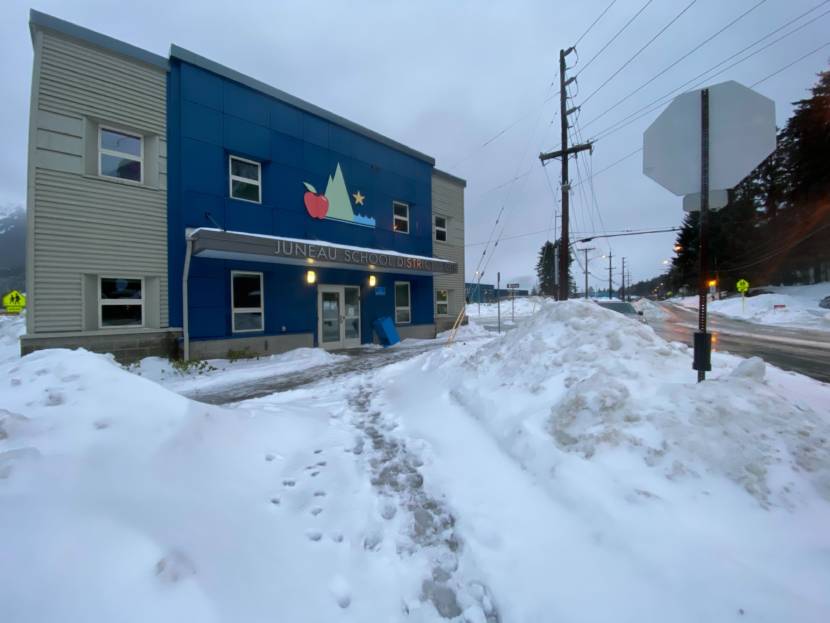
Piles of snow sit in front of the empty Juneau School District offices on Glacier Avenue in Juneau on Monday, Jan. 10, 2022. (Photo by Bridget Dowd/ KTOO)
Juneau School District leaders are gearing up for major budget decisions over the next two years as enrollment declines and major funding sources expire.
At a public budget forum Thursday, Administrative Services Director Cassee Olin said the district is facing a $4.7 million deficit next fiscal year.
The $30 increase to the base student allocation increases state funding to the district by $243,000, according to Superintendent Bridget Weiss. But it’s not enough to keep the district out of a deficit as costs go up and enrollment goes down.
The district still hasn’t felt the full financial impact of an 11% enrollment drop from 2020. That’s because of the state’s hold harmless provision, which helps districts who’ve lost students by gradually reducing the amount of state funding they receive over the course of three years instead of immediately.
That provision gave the district an extra $2.1 million in state funding this year, according to Olin. Next year, that money goes away.
Elementary, middle and high school principals shared their budget priorities with district leaders at Thursday’s forum. They included avoiding increases to class sizes and retaining reading specialists and counselors.
The district will be in a similar position next year, when one-time COVID relief from the federal Elementary and Secondary School Emergency Relief (ESSER) Fund runs out. Weiss said the district has an estimated $1.6 million in ESSER funds to spend next school year.
“So there’s another consideration as we look down the road to FY25 and how we’re going to manage that stair step away from ESSER, like we’re having to manage this year the stair step away from hold harmless,” she said.
District and city leaders began discussing longer term financial plans for the district at a meeting Friday. Enrollment projections show the district will likely have 1,100 fewer students in 2032 than it does now.
“It’s unsettling, and it’s not the demographic trend that any of us wish, but I think the data supports it,” City Manager Rorie Watt said.
“Changes in the projections are really only going to come from us believing that people are moving into Juneau and moving into the region and our population’s going to grow, and I don’t think anybody’s really predicting that to any significant degree,” Watt said.
Weiss said a proposed $1,000 increase to the base student allocation offered “a glimmer of hope” for future years.
In the meantime, the Juneau school board must come up with a balanced budget by March. It will go before the Juneau Assembly for final approval in May.
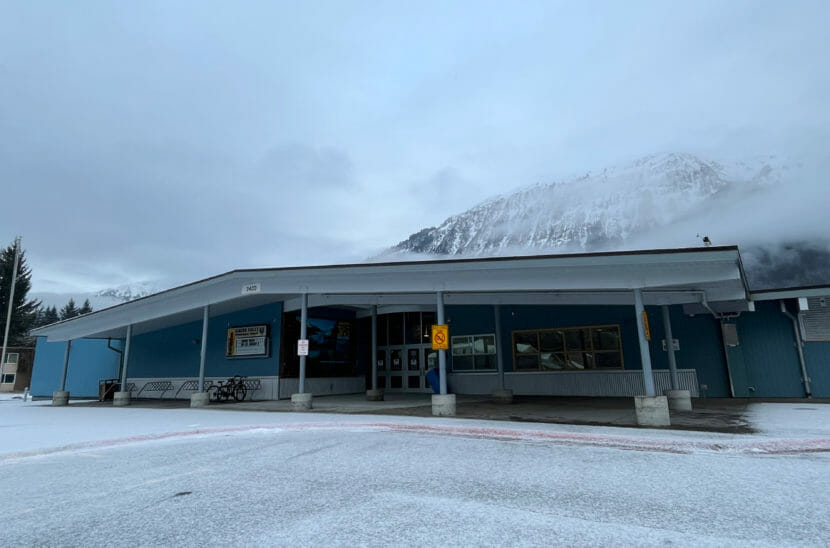
Sít’ Eetí Shaanáx Glacier Valley School on Jan. 11, 2023. (Photo by Katie Anastas/KTOO)
The Juneau School Board will no longer pursue an investigation into the district’s communication about last year’s floor sealant incident.
Last summer, staff mistakenly served students floor sealant instead of milk. At the time, some parents said calls from the school came too late. The school board was considering spending $11,500 on a third-party investigation into the district’s communication about the incident, but at a school board meeting Tuesday night, they decided against it.
Board member Martin Stepetin said previous investigations into the incident itself had been sufficient.
“We have learned a great deal about what we can do to protect ourselves from this happening again, and that’s the most important thing,” he said.
Member Emil Mackey argued that the investigation was still worth pursuing if it could restore families’ trust. He said that while the district’s food vendor, NANA Management Services, made the mistake of delivering the floor sealant to a food warehouse, the district was responsible for communicating with families.
“There may be only a few people out there that still really are concerned about it, but what if there is something to learn that we’re going to miss because we didn’t do this?” he asked.
But Superintendent Bridget Weiss said, judging in part by students’ continued attendance at the RALLY summer school program, trust had been restored.
“We had families in RALLY the very next day, every day for the remainder of the summer,” she said. “That is because this was one incident, not a large series of incidents where there had been challenges and problems.”
Several groups investigated the incident, including the Juneau Police Department, the state Department of Environmental Conservation and NANA. NANA created new shipping and receiving protocols following the investigation.
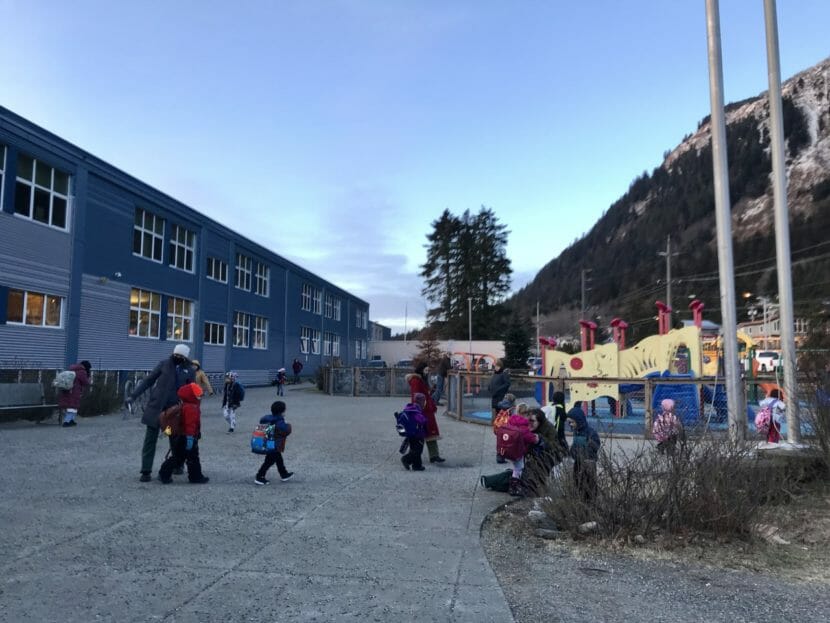
Parents greet their children in front of Harborview Elementary School in Juneau at the end of the school day on Dec. 21, 2022. (Photo by Jennifer Pemberton/KTOO)
The Juneau School District has more than a hundred fewer kindergarteners than expected this year, and birth rate data shows the trend is likely to continue.
The district projected 390 kindergarteners would start this fall. Instead, just 282 did. Cassee Olin, the district’s administrative services director, said district leaders thought enrollment would be closer to pre-pandemic levels this year.
“We figured maybe we’d have more coming in just because the pandemic was lessening,” Olin said. “Things were going back to normal in classrooms. We’re not wearing masks, we’re not doing those kinds of things, so [we thought] families would feel more safe to be back in classrooms and bring their kids back to school.”
Data published by the state this month shows the total number of kindergarten-age students in Juneau – and all of Alaska – will likely continue to go down. Olin said the Juneau School District may have to consider closing or consolidating schools if the trend continues.
“It definitely impacts future planning, and how we want to tailor our education to the needs of the community,” she said. “In the next three or four years, there’s going to be a lot of decisions that need to be made.”
The fertility rate in Alaska has been declining for several years, said state demographer David Howell.
“Around 2010, we were at 2.3 children per woman,” he said. “Now we’ve fallen in Alaska to 1.9 children per woman, which is obviously not enough to replace the existing population. And Juneau has had a lower fertility rate than the state as a whole for a long time.”
Howell said there are many possible reasons behind the decline. In Juneau and other Southeast communities especially, a lack of affordable childcare may cause young couples to decide against having children. Youth outmigration might contribute to a lower total number of births. And the millennials who are still here are getting older.
“Once you get into your mid-30s and on, you see less and less births,” he said. “(Millennials) are really starting to hit those ages where we’ll start to see less births from them.”
The Juneau School District isn’t the only one dealing with lower than expected enrollment. In Anchorage, school administrators have cited birth rate data when discussing possible school closures and other budget cuts.
Howell said it’s too early to tell whether this overall decline is starting to level off in Alaska.
“But as far as the school-age kindergarten population goes, it’s going to go down going forward, just sheerly because of the number of births we’ve had over the last five years,” he said.
Olin hopes declining enrollment in Juneau, Fairbanks, Anchorage and other districts will show the state legislature the importance of increasing public education funding.
The base student allocation, the amount of money per student school districts receive from the state, hasn’t increased substantially in years. Meanwhile, inflation has driven costs up.
“If we don’t have adequate funding, our numbers in enrollment will continue to decline,” Olin said, “because families are going to leave the state of Alaska to find education that is getting funded at the level they need.”
She said enrollment projections for the 2023 to 2024 school year are underway.
Close
Update notification options
Subscribe to notifications
Subscribe
Get notifications about news related to the topics you care about. You can unsubscribe anytime.