Juneau Schools

California school administrator to lead Juneau school district

Mark Miller (Photo by Lisa Phu/KTOO)
Mark Miller
(Photo by Lisa Phu/KTOO)

The Juneau School Board has chosen a school administrator from California to be the next leader of the district.

In an announcement made late Monday night, the board selected Mark Miller for superintendent.

Miller is assistant superintendent of human resources at Hayward Unified School District in California. He described it as a large urban school district with 21,000 students in 32 schools.

Miller said he has experience negotiating contracts and handling tough personnel issues. He’s also been a high school principal and science teacher. He has a Doctorate of Education from the University of La Verne in California.

This will be Miller’s first superintendent position.

Miller was one of three finalists to interview for the job Monday. The other candidates were Angie Lunda, superintendent of the Hoonah School District, and Rick Williams, director of administrative services of Region 10 Education Service Center in Texas.

The school board contracted Iowa-based search firm Ray and Associates, Inc. to conduct the superintendent search. The advertised salary was $162,000. Sixty-five people applied.

Current superintendent Glenn Gelbrich is leaving the district at the end of this month. Miller will start in July.

Four to interview for Juneau school superintendent

The Juneau School District offices. (Photo by Heather Bryant/KTOO)

The Juneau School Board has narrowed the search for the next superintendent to four semifinalists.

They are Daryl Chesley, assistant superintendent of Hanover County Public Schools in Virginia; Angela Lunda, superintendent of Hoonah City Schools here in Southeast; Mark Miller, assistant superintendent of Hayward Unified School District in California; and Rick Williams, director of administrative services in Region 10 Education Service Center in Texas.

Interviews start 8 a.m. Saturday at Thunder Mountain High School. The public is invited to attend and submit written observations of the candidates to the school board.

School district spokesperson Kristin Bartlett says the school board will consider all written comments during deliberations. She says the open interview process allows the community to hear how different candidates answer the same questions.

“While people can get lots of good information in a casual environment like the meet and greet where individuals can talk one on one with candidates, having the interviews open to the public gives people the opportunity to do more of a comparison between candidates,” Bartlett says.

The school board will announce the superintendent finalists Saturday evening and the community can speak with them them at a 3 p.m. meet and greet Sunday at Sandy Beach.

Finalist interviews on Monday are also open to the public.

The school board plans to name the next superintendent for the Juneau School District Monday afternoon and hopes to have that person in place by July 1.

More than 60 people applied for the open position. Current superintendent Glenn Gelbrich is leaving at the end of this month. He joined the district in July 2009, and has said he wants to move closer to family in Oregon.

360 graduate from Juneau high schools over the weekend

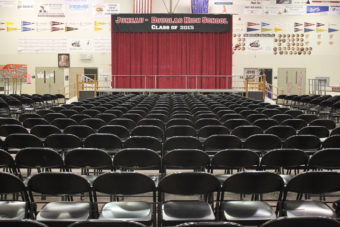
Juneau-Douglas High School seniors entered the gymnasium solemnly on Sunday, accompanied by the march Pomp and Circumstance. But graduation quickly became a lighthearted affair celebrated with selfies, beach balls and confetti.

Student speaker Manuel Guillen told the 164 graduating seniors that when in doubt, do what feels right.

“Now is the time where everything we’ve been taught is going to be tested to the limits.”

The ceremony also was marked with moments of silence for two members of the class of 2014, who passed away in accidents. Jessica Billy died in a vehicle accident in March and Savannah Cayce died in 2012 from injuries in an accident on Auke Lake.

Forty JDHS students finished with a grade point average of 3.5 or higher.

In the Mendenhall Valley, 158 graduated from Thunder Mountain High School, the fifth graduating class since the school opened in 2008.

Twenty-six had a GPA of 3.5 or higher, and three were valedictorians, meaning they had a perfect 4.0, or “A” average for their four years of high.

Valedictorian Jenna Luhrs challenged her classmates to be thankful for what they have, always keep moving forward, and be compassionate along the way.

“Our education thus far has encompassed countless blessings, and I’m not talking about the ability to write in cursive, or the skills required for a book report. I’m referring to the teachers who never gave up on us, the coaches who always believed in us, and our friends and family who continue to support us unconditionally.”

Retired JDHS teacher Clay Good spoke at both graduations, telling the students to live a life that creates meaning.

At TMHS, assistant baseball coach Joe Tompkins recalled the words from the 1977 Fleetwood Mac song “Don’t Stop Thinking about Tomorrow.”

If you stop thinking about tomorrow and dwelling in the past, he said, you will stop living your life.

Before the TMHS graduates received their diplomas, Tompkins warned them to celebrate without alcohol and drugs. He was paralyzed in a 1988 alcohol-related car accident near Auke Bay. Tompkins got a standing ovation from the crowd for his speech.

Graduation ceremonies for Yaakoosgé Daakahídi Alternative High School were held at Centennial Hall earlier in the day, with 38 students earning their diploma.

Juneau School District Superintendent Glenn Gelbrich attended commencement ceremonies for all three Juneau high schools for the last time. Gelbrich has been hired as superintendent for the Kelso, Wash. school district. He has been superintendent in Juneau since 2009.

School district seeks more local funding to reduce cuts

The Juneau School Board is asking the Juneau Assembly to increase funding next year to reduce staffing cuts.

If the Assembly agrees, only a handful of school district jobs will be cut.

The Assembly is budgeting just over $24 million for schools in fiscal year 2015, which is less than the local cap imposed by by state law. Thanks to an increase in state funds, 16 full-time jobs are being restored, including 13 teaching positions. Without the additional money, 30 positions would have been cut.

The state legislature added $150 per student to the allocation that districts get for enrolled students.

Students from the Juneau Charter School participate in a rally on the Capitol steps organized by the Great Alaska Schools coalition, April 4, 2014. (Photo by Skip Gray/Gavel Alaska)

“That just brings in  another $1,300,000 from the state of Alaska,” says David Means, administrative services director for the Juneau School District.

Means has been meeting with the school board this week to help members decide how best to spend the additional funds.

The legislature also split $43 million among school districts throughout the state. The one-time grant can be spent on anything districts want.

“My estimate of our share is $1,500,000,” Means says.

Among other things, the extra state funds also will allow the district to restore a custodian position, purchase a music curriculum, retain some high school activities and reduce class sizes.

The FY 15 budget totals $143 million.

In the last four years, the district has cut nearly 100 employees.

School superintendent search is underway

School District
Juneau School District building

The search for the Juneau School District’s new superintendent has begun. The job opening was posted nationally last week and candidates have until May 21 to apply.

The district contracted Iowa-based search firm Ray and Associates, Inc. for $16,000.

Steve Rasmussen, who’s leading the search, collected input from the community last month and says community members want someone with a collaborative leadership style who puts students first.

“Someone that can built trust in the community. Someone that’s visible. Someone that can work with staff, can work with parents, can be and work with legislators, and work with civic leaders,” Rasmussen says.

Rasmussen expects between 30 and 50 applicants for the job.

The advertised salary is $162,000. The current superintendent’s salary is $155,000 a year. Rasmussen and the school board set the amount after comparing what other superintendents make in Alaska.

He says that figure is negotiable.

“It’s the amount that will attract people to take a look at it. We want quality applicants and it’s also compared with those of the lower 48 states, Rasmussen says.

Ray and Associates will present up to 12 candidates to the school board June 2. The board will pick semi-finalists and conduct in-person interviews June 7. Rasmussen anticipates a community meet and greet with the superintendent finalists June 8.

The cost of bringing candidates to Juneau for interviews is outside the search contract.

Superintendent Glenn Gelbrich is leaving the district at the end of June. He cited personal and private reasons when announcing his resignation in March. Gelbrich joined the Juneau school district in 2009.

Juneau Assembly sets school funding floor

Randy Wanamaker
Assemblyman Randy Wanamaker wants to cut local funding for the Juneau School District next year as the city seeks to deal with an estimated $12 million budget shortfall over the next two years. (Photo by Casey Kelly/KTOO)

The Juneau Assembly on Wednesday voted to provide no less than $24.1 million in local funding to schools next year. That’s the same amount the city gave the Juneau School District this year, but two assembly members argued for a lower amount.

In order to ensure school funding is relatively equal across the state, Alaska limits the amount of local money communities can put toward education. For years, the assembly has given the school district the maximum allowed under state law, known as funding to the cap.

We have a reputation of funding to the cap, of being fully supportive of education. I, for one, want to maintain that level,” said Assemblywoman Kate Troll at special meeting on the topic Wednesday evening.

While the cap is set to go up next year, the city won’t know the exact amount until the Alaska Legislature passes an education funding bill that’s still being debated as part of this year’s extended session.

In the meantime, the assembly is required to let the district know the minimum amount of local funding to be provided. Until the cap is set, City Manager Kim Kiefer and Finance Director Bob Bartholomew recommended setting next year’s minimum at this year’s cap of $24.1 million. Bartholomew said the assembly could adjust the amount later depending on the new cap.

“We’re proposing something that’s slightly below the cap and recommending that that be the floor for funding for this year,” Bartholomew explained “And then you can change it upwards from there if you want, or if the state comes in and there’s a change in how much is required, we have flexibility to adjust to that.”

The city also routinely gives the district money for things like activities and transportation, which are considered to be outside the cap. The administration’s proposed budget would cut that funding by $200,000 next year, a 5 percent reduction.

In light of an estimated $12 million budget shortfall over the next two years, Assemblyman Randy Wanamaker said the district should have to give up more.

This school district has enjoyed the benefit of many, many years of outstanding support from the assembly, because the assembly believed that it could do that at those times,” Wanamaker said. “And I was one of those that helped support it. But I believe it’s time for them to join in the cost reductions that we have to go through.”

Jesse Kiehl
Juneau Assemblyman Jesse Kiehl says cutting local money provided to the Juneau School District would exacerbate already deep cuts the district has made due to stagnant state funding. (Photo by Casey Kelly/KTOO)

Wanamaker proposed setting the minimum funding amount for the district under the cap at $23 million.

Assemblyman Jerry Nankervis said he’d take it down to $12 million, the minimum required under state law. Though he admitted he would never actually vote for that small an amount of school funding.

“But we’re painting ourselves into a corner because we’re obligated to paint ourselves into a corner,” Nankervis said.

Assemblyman Jesse Kiehl pointed out that the school district has been cutting its budget for three or four years as the state’s education funding formula has remained flat.

“And it’s coming out of our kids. It’s coming out of our classrooms,” Kiehl said.

Wanamaker and Nankervis were the only assembly members to vote against the administration’s recommended minimum school contribution.

School Board President Sally Saddler, who attended the meeting, said afterward that the district has cut nearly 100 employees in the last four years. But she said the city also has had to cut.

“So, I don’t want to get into who feels the pain the most, because I think we all feel it together as a community,” Saddler said.

The assembly continues to work on the city’s two-year budget. A public hearing on the proposed city operating budget and the Juneau School District budget will be held next Monday.

Site notifications
Update notification options
Subscribe to notifications