Juneau Schools

After-school program hits it off with Juneau middle school students

Students learn the proper way to hold an archery bow at Dzantik'i Heeni Middle School gymnasium.
Students learn the proper way to hold an archery bow at Dzantik’i Heeni Middle School gymnasium. (Photo by Annie Bartholomew/KTOO)

Juneau middle school students are learning to take photos, shoot arrows and babysit at a time when they would otherwise itch for something to do.

The new Juneau Afterschool Coalition has created an after school program at Floyd Dryden and Dzantik’i Heeni middle schools. The new program is called B.A.M – Body & Mind, Before/After Middle School.

Many middle school students had few alternatives to athletics between the end of their school day and their parents’ workday. A 2001 national YMCA study found youth delinquent activity triples during this time. The Juneau Boys and Girls Club once filled this gap, but that program ended in 2009.

The coalition plans to track how the new activities affect student success in school.

Eleven-year-old Capri Potter picks up her bow and takes aim.

Capri says without archery she’d probably read or watch TV at home.

“Mr. Haas was my old gym teacher and I’ve taken archery from him before and it was really really fun,” Potter says.

The archery students share the Dzantik’i Heeni gym with the wrestling team. Each archer shoots five arrows before heading home.

Six years ago, instructors Dick Fagnant and Dave Haas trained together in the National Archery in the Schools program. After they retired, they started teaching archery after school. Fagnant says, in December sixty-three students signed up for the class, which is capped at 40 people.

“So you have children who may not be successful in football or basketball but by golly their eye-hand coordination are really really keen,” Fagnant says. “So what happens is they find success here and so it’s an opportunity for them to expand their horizons in an activity that they’ll enjoy for perhaps the rest of their lives.”

The Juneau After school Coalition grew out of community concern after federal budget cuts closed the local Boys and Girls Club in 2009. In 2010, 17 organizations joined together to create after-school programs in Juneau middle schools. Elementary and high school students often have more after-school options. A coalition survey indicated only about half of Juneau middle-schoolers had adult supervision after school for up to two days a week.

After school archery instructor Dick Fagnant teaches Dzantik'i Heeni Middle School students how to recognize their dominant eye before using the bow and arrows.
After school archery instructor Dick Fagnant teaches Dzantik’i Heeni Middle School students how to recognize their dominant eye before using the bow and arrows. (Photo by Annie Bartholomew/KTOO)

Juneau Afterschool Coalition Coordinator Betsy Brenneman describes herself as the “go-between” for instructors and organizations. She organizes funding, helps new instructors as they start up a course and does all the publicity.

“And that’s what I’ve been doing for about a year, and we’ve really geared up this school year with the new activities. We had to put a lot of things in place, like an office,” Brenneman says.

The coalition polled students before offering activities to find what subjects would interest them. Brenneman was surprised to find many students wanted cooking classes. She’s looking for instructors to teach a cooking class at Floyd Dryden. Schools also offer babysitting training, photography classes, outdoor adventure games, learner’s permit preparation and junior police academy.

In a Dzantik’i Heeni classroom, Lieutenant Kris Sell uses stuffed animals to show students how police came to be a part of society.

14-year-old Catherine Johnson is participating in an after-school program for the first time. She says she would normally spend the time drawing or studying at home.

“I just wanted to keep myself busy and learn a couple new things. I was interested in what the police do and wanted to learn,” Johnson says.

Officer Sarah Hieb watched Sell’s presentation from the side of the classroom, occasionally piping in during the talk to suggest examples.

“We do a lot of hands-on activities because we know we don’t want to be sitting there like another classroom during school,” Hieb says.

Dzantik'i Heeni Middle School students go through role playing exercises to learn the importance of integrity of police work during the after school Police Academy program.
Dzantik’i Heeni Middle School students go through role playing exercises to learn the importance of integrity of police work during the after school Police Academy program. (Photo by Annie Bartholomew/KTOO)

Heib says the program helps students understand police work. She says students otherwise might only interact with police in stressful situations such as a car crash.

“It gets us into the schools and interacting with the students and letting them know that police officers are approachable, are normal people,” Hieb says.

Brenneman says she will survey students each May to find out what activities they’d like that might help them become more interested in school.

If it can be something that engages them, that they might find a career even, a mentor, somebody in the community, an adult who they connect with,” Brenneman says. “That may spark an interest that gets them more engaged even in school.”

Brenneman will track that engagement to an extent she calls “cutting-edge.” She plans to use a student records database to see whether students improve after attending the activities. If there isn’t an improvement, she says “okay, we won’t do it anymore.”

“We’re pretty sure it will, but we’d like to have somebody – us – figuring that out,” Brenneman says.

Students don’t have to pay to participate. The coalition relies on community groups and individuals for funding. Coalition member Kevin Ritchie says the program needs strong involvement from the school board and assembly. The coalition has raised about $110,000 to date.

Juneau hires new library director; Berg to retire

A Missouri man has been hired as Juneau’s new library director.

Robert Barr is currently Information Services Manager for Johnson County Library in Kansas City.  He will assume the Juneau job next month.

City Manager Kim Kiefer announced Barr’s appointment Thursday.

The city conducted a nationwide search. Kiefer says Barr has been working in libraries for about a decade and is particularly interested in growing and diversifying the value of libraries to the community.

Barr will replace Barbara Berg who is retiring as CBJ library director, a post she has held since 2003.  But her history goes back to city and borough unification.  She moved to Juneau in 1972, when CBJ was taking things over.

“I was the first city employee at the Douglas library after Borough unification when they brought the Douglas library into the system,” Berg says.

In fact, she has worked in libraries or bookstores since her first job in college.  And over the years, she’s seen tremendous changes in technology.

“My first job in a library at Fort Richardson was typing catalog cards and filing them in the card catalog.  Then we went through the era of converting our collections to online and barcoding everything,” she says. “Now the systems keep getting more and more developed until many times in the catalog you can click through and you actually get to the electronic book. You get to the source material from one point so that’s a real change.  But the book is still here, and I firmly believe it’s not going anywhere.”

But Berg says public libraries of the future will not be warehouses of books.

“I think we’re going to move in new directions where there’s more electronic books and the cream of what you want in the physical format,” she says. 

She says the real electronic revolution is the online search.

Mendenhall Valley Library Design. Courtesy Friends of Juneau Public Libraries.

Barbara Berg has been at the forefront of planning for the new Mendenhall Valley library, to be built next year in the Dimond Park area.   She believes the brick and mortar library is an important community gathering center.

“It builds a sense of community when people are sort of separated by their electronic devices at their individual homes or their individual workplaces, not communicating face to face.  The library is a forum; it’s a place in the middle of our town that everyone can use.”


Peace group helps bring Muslim students to Juneau

December 2002 Juneau Empire advertisement and pictures from various JPPJ activities over the years.

As the world enters a new year, the U.S. is still involved in Afghanistan. Most U.S. troops are out of Iraq, but the future of post-war Iraq is very uncertain. According to the United Nations, the civil war in Syria has killed about 60,000 people. The so-call “Arab spring” countries are still unsettled. The hope for peace seems as dim as ever.

A decade ago, as the United States was getting more and more entangled in war in Afghanistan and Iraq, a small group of Juneau residents founded Juneau People for Peace and Justice. The group continues to be a visible and vocal organization dedicated to cultivating the message of peace.

Amy Paige helped bring the group together, because they were “anxious about what was going on in the world.”

There’s no membership and JPPJ has never organized as a non-profit, but the group has met once a week for ten years. While numbers often swell and ebb with world news, the core has worked to ensure that it’s having some impact. Even if it’s one conversation at a time.

In the last two years, JPPJ has sponsored students from the Middle East at Juneau high schools. Rich Moniak hosted a student  last year. He says the next generation “is part of the hope” for peace.

Moniak started coming to JPPJ meetings after his son was deployed to Iraq for the second time. He’s a firm believer in the sense of hope for peace that such groups can bring.

“What I saw in this group was a lot of people working hard for something larger than themselves,” he says.

Over the years, the group has taken out an anti-war newspaper advertisement, signed by more than 1,000 Juneau residents. A peace march across the Douglas Bridge also drew about a thousand people. There have been demonstrations, town meetings, teleconferences with Alaska’s congressional delegation, and letters to other political leaders. But Judith Maier says affiliating with the Kennedy-Lugar Youth Exchange and Study (YES) Program was “one of the most important things we’ve done. Last year we had four young people here from the Middle East and this year there are three.”

Mohammed Qabani, of Israel, is a junior at Thunder Mountain High School.

Maier says she can’t think of a better use of her tax dollars.  The YES program was founded ten years ago after the terrorist attacks on America. It is funded by grants from the U.S. State Department to provide scholarships for students from countries with large Muslim populations.

This year high school juniors Mohammad Qabani and Ayah Tafesh are studying at Thunder Mountain High School. Hadi Kamj, from Lebanon, is spending the school year at Juneau-Douglas High School, and just enrolled in classes at the University of Alaska Southeast.  They live with Juneau families.  All three are of the Muslim faith.

Other than the cold, Qabani, from Israel, says he likes Juneau and has met lots of people who are respectful to his culture. At first he experienced some bullying at school, including one youth who told him “Arabs are terrorism.”

“But when he like sat with me and we had a conversation, he changed his opinion,” Qabani says.

Ayah Tafesh, of Gaza, is a junior at TMHS.

Tafesh is from Gaza. She also has worked one on one with some students. She likens her experience in the U.S. to a mission.

“I like that I’m here to represent my country and people are respectful to me,” she says. “I think that I have a job to give a better point of view about my country, because I think most of the people either don’t know about it or they have a bad point of view about my country.  So I want to present my country and make them change their point of view, maybe.”

As they meet people throughout Juneau, the Muslim students believe they have helped change some minds about their culture. And it’s one way Juneau People for Peace and Justice believe the group has made a difference since the first gathering a decade ago.

[quote]“Never doubt that a small group of thoughtful committed citizens can change the world; indeed it’s the only thing that ever has.”   (Margaret Mead)[/quote]


Juneau School District budget process to begin in January

The Juneau School District’s budget process is set.

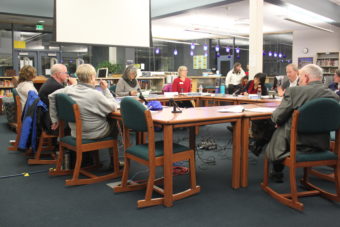
The district’s budget committee will hold seven meetings between January 15th and February 26th before making recommendations to the Board of Education on March 5th.

The budget committee will include 17 voting members this year, up from seven last year. It will consist of one representative from each of the district’s twelve school site councils, three at-large community members, and one representative each from the Juneau Education Association and Juneau Education Support Staff.

All seven school board members also will serve on the committee in a non-voting capacity.

The board will appoint budget committee members at its regular meeting next week (December 11th). Board member Barbara Thurston and one of the public representatives will co-chair the committee.

At a recent school board meeting, Thurston said those appointed to the panel will have to look beyond their school to the district at large.

“We’re also telling members of the community that they’re not there to advocate for their school specifically. They’re there to look at the big picture for all Juneau students,” Thurston said. “Because what’s really going to have to happen in almost every circumstance is they’re going to need to do some votes that are not necessarily the best choice for your particular school.”

There will be two opportunities for public testimony during the process – one on January 22nd and again on February 19th.

All meetings will take place in the library at Dzantik’i Heeni Middle School, except for the last one, which will be held at the Juneau Douglas High School Library.

The school board crafts and approves the final budget, which is submitted to the Juneau Assembly.

JSD Budget Committee Meeting Schedule:

  • 01/15/13 DHMS-Library, 6PM-8PM Description of process; introductory training on budget
  • 01/22/13 DHMS-Library, 6PM-8PM Opportunity for public testimony; discussion of Strategic Plan and District programs; description of state funding; presentation of student count estimates for FY 14.
  • 01/29/13 DHMS-Library, 6PM-8PM Initial presentation of budget; questions from committee
  • 02/06/13 DHMS-Library, 6PM-8PM Budget committee discusses budget
  • 02/12/13 DHMS-Library, 6PM-8PM Budget committee discusses budget
  • 02/19/13 DHMS-Library, 6PM-8PM Opportunity for public testimony; Budget committee discusses budget
  • 02/26/13 DHMS-Library, 6PM-8PM Committee finalizes recommendations and prepares report for presentation to the School Board
  • 03/05/13 JDHS-Library, 6:15 PM Community members present recommendations to Board

Juneau public contributes to One Million Bones Project

The blindfolds taken off revealed the creations Keith Cox and his competitor made. (Photo by Danny Peterson/ KTOO)

About 1,000 ceramic bones were created at a recent UAS Art Open House, where roughly 300 visitors came to make a difference with their artwork.

For every bone made, $1 will be donated to help genocide victims in places like the Democratic Republic of Congo, Burma and Somalia as part of the One Million Bones project. The bone collection is part of an international effort. The bones are to be installed in the spring on the Washington, D.C. National Mall.

Local artist MK McNaughton introduced UAS Art Professor Pedar Dalthorp to the idea.  Dalthorp uses ceramic for the bones because that medium holds up best for installation.

“Some bones in the past, like for some of the initial bone making attempts were, some of them used paper mache or some other materials that aren’t quite as weather proof as ceramics,” Dalthorp said.

Dalthorp organized the UAS event, converting studio spaces in the Soboleff building to accommodate the large crowds of people that for an evening became personally involved in UAS art projects.

Teacher Assistant Kate Laster helped set up. She said events like this can generate important dialogue in Juneau about genocide in other parts of the world.

[quote]“It’s a really great project because it’s a community based thing where we can discuss kind of these unseen people. You know, we’re talking about something that’s very, very much happening now,” said Laster.[/quote]

In addition to building bones, the department also had drawing demonstrations, screen printing, a large-scale deer sculpture, pottery making, and live music by Sammy Burrous.  He played a solo set on acoustic guitar in the oil painting studio that brought a vibrant dimension to the event. His music could be heard throughout the Soboleff building as he crooned his blues standards to the visitors.

Over in the ceramics studio, Keith Cox was blind-folded and had just a couple of minutes to shape a creation out of clay on a pottery wheel using his hands, water, and a sponge during the wheel throw competition. A faculty member judged the pieces on artistic merit.  Though Cox lost the competition, and the sponge, he didn’t walk away empty handed.

[quote]“It was stiff, it was a stiff competition. I went in with a high spirit and a lot of confidence that I was really going to successfully make a, like a vase or something, and I came out with something that my son can still eat cereal out of,” said Cox.[/quote]

Over at the Whitehead building, art student Doris Alcorn was sculpting an impressive life-size deer – out of 500 pounds of clay on a metal frame.  The sculpture will be hollowed out before it’s put into the gas kiln for firing.  Because the piece is so large, the deer is crouching so it fits into the kiln.

Ceramics aren’t the only thing popping out of ovens at the UAS Art Department. A wood-fired pizza kiln provided fresh pizzas throughout the evening. What comes out of that oven is always a student favorite.

“It’s built as a pizza oven and it’s wood-fired so it imparts a little bit of uh, a little extra flavor that you don’t normally get out of a conventional oven,” Dalthorp said.

To keep up with demand, Chef Josh Reder pumped out the pies as quickly as possible.

“These are homemade dough, homemade sauce, then fired over wood.  Not much new technology in the last two-thousand years,”  Reder said.

Laster said the event shows the public a lot of what goes on in the busy UAS Art Department.

[quote]“What I love about the open house is it’s basically bringing in people who don’t know we have a pizza oven, bringing in people who’ve not really come down to Soboleff to actually see the art department and what we do and how much fun we have,”  Laster said.[/quote]

Dalthorp hopes the open house will bring in more students and in turn help them realize their creative and professional potential.

To get involved with the One Million Bones project here in Juneau, contact MK MacNaughton at mk@canvasarts.org. Or visit www.onemillionbones.org.

Breakfast programs to fill RALLY void

Breakfast programs at four Juneau elementary schools will help fill the void left by the upcoming closure of early morning child care programs.

The school district’s RALLY director is working with the parents of 22 youngsters enrolled in the 7 to 8 a.m. sessions at five schools.

Wayne Hixson says it will be hard to replace RALLY for the first half hour, but breakfast programs begin at Mendenhall River, Glacier Valley, Riverbend and Gastineau at 7:30 a.m. School starts at 8 o’clock.

Hixson says there’s been a steady decline in students enrolled in the program since 2003, with a big drop off when Juneau grade schools switched from a
9 a.m. start time to 8 a.m.

“We used to have elementary school starting at 9 a.m. and during that time we had about 160 some kids in the morning program across the district. Then with moving it up to 8 o’clock we see what the fallout is where we 20-some kids in service,” Hixson says.

As previously reported, the RALLY program is designed to pay for itself. But early morning enrollment at each of five schools ranges from two to six kids. Hixson says it takes 12 students for a RALLY session to be cost-effective. Only the downtown Harborview RALLY — which has 16 students — will be saved, because it breaks even.

He says eliminating the first hour at the other schools will help stem the loss.

“Right now we’re hjoping to get to a break-even status. Currently we’re losing about $11,000 a month,” Hixson says.

Hickson says it costs one-point-two million to one-point-three-million dollars a year to operate all the RALLY programs in the district, including summer sessions.

RALLY stands for Recreation, Arts, Learning and Leadership for Youth. It has before and after-school sessions for kindergarten through fifth graders.

No changes will be made in the program until January.

Site notifications
Update notification options
Subscribe to notifications