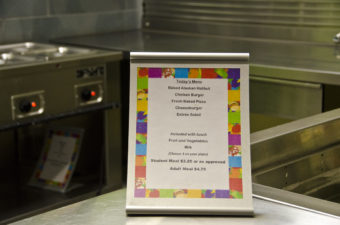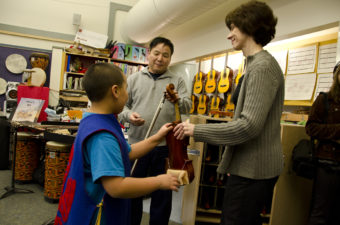
JSD offices (left) were evacuated. Harborview Elementary School was not. Juneau School District offices were evacuated early Wednesday afternoon after an employee opened an envelope containing a suspicious white powder.
Juneau Fire Marshal Dan Jager says the envelope was in the day’s mail that had been delivered to the facility at the corner of 12th and Glacier.
The Capital City Fire and Rescue hazardous-materials team was in the building this afternoon.
“We have the haz-mat team that is inside collecting it for evidence,” Jager says. “We’re going to send that to the state crime lab to verify if the power is anything or not.”
Jager says it will take at least a day or two to get the results from the crime lab in Anchorage. “So our plan from here is to take it, package it, take it to the airport and have it Gold Streaked up, so they get it as soon as possible,” he says.
School district spokeswoman Kristin Bartlett says many employees went home around noon and the rest were evacuated about 2:15 p.m. She says district employees will return to work Thursday morning, but the room where the envelope was opened will stay quarantined until the white powder is identified.
Fire marshal Jager says the Juneau haz-mat team also has been called to Thorne Bay, where a white powder was received in the mail.
A prize-winner author – who says his “life was turned upside down” when his son was diagnosed as mentally ill — will speak in Juneau Thursday night at the University of Alaska Southeast.
Pete Earley is the author of Crazy: A Father’s Search through America’s Mental Health Madness.
Earley says he found it very difficult to get his son help after he was diagnosed as schizophrenic. He says he wrote the book to expose how people with mental illness often end up behind bars when what they need is help, not punishment.
Earley says mental illness should be a community concern.
“You can take people who are homeless, walking along your streets, psychotic, who you consider a nuisance and you can help them get their lives back and improve your community,” he says.
Earley has been brought to Juneau by the local chapter of the National Alliance on Mental Illness, the Alaska Mental Health Trust Authority and UAS. He says he will talk about his personal story as he tried to help his son, who even had run-ins with police.
“I’ll talk about how we’re now depending on the criminal justice system, the jails, to take care of these people and solve these problems and why it’s wrong. You shouldn’t have to go to jail if you have a mental illness in order to get help,” he says.
Pete Earley will speak at 7 p.m., at the UAS Egan Lecture Hall.
Four student ambassadors from Muslim countries will be speaking at University of Alaska Southeast tonight about their stay in the U.S.
The four students are attending Thunder Mountain High School on scholarships provided by the Kennedy-Lugar Youth Exchange and Study Program (YES). They will talk about their culture, share some stories of their Juneau experiences, and discuss their role as student ambassadors for their home countries.
Kaleb McGoey reports from TMHS.
Omar says he has enjoyed his stay in Juneau and feels the experience has been an opportunity for personal growth.
“It’s made a change in my character and my skills, all of this has changed,” he says.
Before he arrived he admits to some preconceived views of the west, shaped by the mass media.
“I knew about the U.S. from the American movies and what we see in the media. If you look at American movies you think they’re (Americans) rich and all living great lives and driving Lamborghinis.”
Omar says when he got here that he thought he would be judged for being from an Arab country and being Muslim.
“I was worried about coming to Alaska, but I was wrong because I have really great family and friends. And the people around me are very open minded,” he says.
Gary Roach, the cooking teacher at Thunder Mountain, says all four students are fitting in very well.
“Omar was good enough to lead classes during extension and lunch on Arabic and Muslim culture, which I attended. He showed me the alphabet.
Omar is from Egypt. He likes sports, has played basketball at TMHS and plans to try out for the baseball team. He hopes to become a member of the Egyptian national rowing team and plans to attend medical school. He’s also teaching Arabic to some Juneau parents, elementary and high school students.
Berçem is from Turkey and says she’s never traveled outside her home country. She has learned most of her English here. She says she likes the American school system better than Turkey, because she gets to choose her classes. She’s played volleyball at TMHS, and is participating in the Model UN program.
Berçem hopes to attend medical school to become a doctor of neurology.
She says one of her biggest challenges here has been the food. With her host family she enjoys Alaska seafood, but at school, “because we don’t have more options, it just makes us fat.”
As for being a student ambassador, Berçem says being Muslim sometimes colors her meetings with new people.
“Some people really acts like rude, but some people acts like they think about us different because they don’t know, and they want to know. So we tell what we think, how we live, how is being a Muslim,” she says.
Rich Moniak and his partner are Berçem’s host parents. He’s also a member of Juneau People for Peace and Justice, which has worked with the YES program to bring the four students to Juneau this year.
YES is funded by U.S. State Department grants. Moniak says since 2003, 300 to 400 Muslim students from 38 countries have come to America to study each year, and “to become integrated with students in the U.S. to share what their life and culture is like, so we can understand it better and they can bring home a better understanding of our culture and our people.”
Muslim Student Ambassadors in Juneau speak at 7 o’clock tonight (Friday, Feb. 17) in the UAS Egan Lecture Hall.
Juneau school kids will get spring break next year. The school board voted Tuesday night to keep the week-long March break.
Public comments have been overwhelmingly against adopting a 2012 /13 calendar that would have done away with the vacation.
Spring break comes just before standardized tests are taken, and some school district officials said students could use the additional 25 hours of instruction. That proposal also had school getting out a week earlier.
But the Southeast Gold Medal Basketball Tournament also generally happens during spring break and it’s played at Juneau-Douglas High School. If school is in session, JDHS physical education classes have to be canceled and experience shows a high number of students are absent during the week-long tournament.
Opponents also argued that spring break is a family-vacation time, it’s used by many high school students to visit colleges, and teachers and kids just need a break.
Assistant Superintendent Laury Scandling said the administration was convinced after reading 160 public comments:
“We received 130 comments in favor of retaining a spring break and 17 comments that favored not having a spring break, and the administration is recommending that calendar Option A be adopted that retains spring break in the third week of March,” Scandling told the board just before the vote.
Bridget Lloyd is the Thunder Mountain High School student representative to the school board. She conducted a survey of TMHS students on the issue.
“Twenty-two students out of 222 said they would like spring break to be canceled and 200 said no,” she said.
The 2012 / 13 academic calendar shows school beginning Monday, August 20th. It ends on Friday, May 24th, and spring break is the third week of March.
The school board is considering a proposal to end the first semester before the winter holiday break in December, rather than January, after students get back from the holidays.
State education funding for local districts won’t be known until the end of the legislative session in April. While the governor’s proposed education budget includes money for rural school construction and college scholarships, the amount districts receive for operations is the same as last year. And that translates to a loss of revenue.
Combined with a reduction in other revenues and increased energy and personnel costs, the Juneau School District is projecting a 5 point 8 million dollar shortfall next year. Sixty-nine positions could be cut.
The goal is to keep the cuts as far away from the classroom as possible. But
Superintendent Glenn Gelbrich (Gel-brick) says the deficit is so severe it could impact students.
“When we’re talking about the kinds of reductions, even though we’re trying to keep them as far away from the classroom as we can, it still impacts how many kids are in a class, it still impacts the degree of support they have, it has the potential to severely impact how many different electives kids have, so (it impacts) the breadth of their learning,” he says. “All of those things that matter to us as parents and us as citizens of Juneau.”
Gelbrich says the largest number of layoffs would come from administration, where six positions could be lost. And when Assistant Superintendent Laury Scandling retires next December, her job would not be filled.
The number of assistant principals at each high school could go down by one. Eleven percent of the support staff could be cut and 7 percent of teachers.
The so called pupil / teacher ratio, or P-T-R, could go up by two.
The district will be working on the budget until March, when it’s due to the city and borough Assembly. School board member Barbara Thurston chairs the budget committee. She says the board’s goal is to keep as many teachers in the classroom as possible.
Thurston says input from the public is very important at this point in the process.
“We’re particularly interested in constructive suggestions,” she says. “All the cuts hurt in some way and we’re aware of that. And if people want to suggest not cutting something that’s been proposed, it’d be really helpful to suggest an alternative. You know, if we don’t cut a couple hundred-thousand dollars here, where can we cut that couple hundred-thousand dollars, or how can we accomplish the goals while spending less money?”
Thurston says Juneau will be among districts across the state planning to lobby the legislature for more funding.
“It’s certainly not our district that’s the only one facing this. It’s a pretty widespread issue this year,” she says.
While the school board will hold public hearings on the budget, members are encouraging written comments. Those comments can be emailed to budgetinput@jsd.k12.ak.us.
Juneau celebrated Martin Luther King Day with a focus on education. Appropriately, the event sponsored by the Juneau Black Awareness Association was held at the University of Alaska Southeast. KTOO intern Danny Peterson was there.
Close
Update notification options
Subscribe to notifications
Subscribe
Get notifications about news related to the topics you care about. You can unsubscribe anytime.