Education

JSD negotiations underway; 2013 spring break in question

The Juneau School district is negotiating two contracts this year, representing the vast majority of district employees.

The Juneau Education Support Staff presented its proposal yesterday (Tuesday), calling for a new three-year contract as well as increases in wages and health benefits.

JESS is represented by the American Federation of Teachers. Spokesman Pete Ford says the 300 members of JESS are the lowest paid in the district. The union is asking for a 15 percent wage increase over three years, beginning with 4 percent in July of this year, 5 percent next year, and 6 percent in 2014.

Ford says the union realizes the district expects to be facing less revenue from the state and could propose options, particularly annual leave.

“We did propose to open those articles in the event we are persuaded that we are really are looking at a bad money situation, to perhaps offset a lack of raises with more benefits in the area of paid time off,” Ford says.

He says the union is also concerned about what he calls the “McDonaldization” of support staff positions. He says members want assurance the district will protect JESS positions “from being reduced in hours, protect our positions from being filled by hourly non-bargaining unit positions, protect our positions from just being eroded as we feel has been happening to some degree over the last several years.”

JESS includes such jobs as administrative and office assistants, classroom aides, technology specialists, and custodial staff. The current contract expires on June 30th.

District Human Resources Director Phil Bedford says the district will present its counter proposal the next time the two sides meet, early next month.

The Juneau teachers’ contract also expires this year. Bedford says bargaining begins January 19th with the Juneau Education Association, which represents more than four hundred teachers.

“We’ve met a couple times to set dates and establish ground rules, but we’ll actually begin negotiations on the 19th,” he says.

Meanwhile, the Juneau school board is considering a proposal to do away with the March spring break next year.

The district calendar for the 2012-13 school year shows two options: eliminating the week-long spring break, which would add 25 hours of instruction prior to the standardized tests students take each spring. That’s option B and it calls for getting out of school a week earlier, on May 17.

Option A includes the traditional spring break, with school ending on May 24.

The proposals can be found at juneaschools.org.

The school board is taking public comments on the options. They can be emailed to calendar@jsd.k12.ak.us. The board will not vote on the proposal until next month.

JDHS Theatre selected for International Fringe Festival

The Juneau Douglas High School Drama Department has been selected to perform next year at the prestigious International Fringe Theatre Festival in Edinburgh, Scotland.

JDHS also has been voted one of the best high school theatre programs in the U.S. by the American High School Theatre Festival.

High school theatre groups must be nominated by a college theatre program to begin the application process. Theatre Department Director Micaela Moore says she doesn’t know who recommended JDHS, but she was notified last September, which began the formal application process. In December a panel of judges from the American High School Theatre Festival selected JDHS to attend the 2013 festival.

Moore says between 20 and 30 “hard working” theatre students will participate.

“You know it needs to be the kids who have been working hard in the department and who are the committed members of our team,” she says.

The JDHS program has a year to prepare and raise funds. Moore estimates it will cost $6,000 per student for travel and the festival.

“Different colleges, different professional groups, and then high schools who have been accepted for this honor, perform their plays every night and they get feedback, I believe, from judges. It’s a two-week program and the kids get to go to a lot of workshops, too,” she says.

Moore doesn’t know yet what play the students will perform. She expects to select a large ensemble where a lot of characters have big parts, but minimal set requirements, because the theatre group will have to ship the set and props.

She says the students will be at the International Fringe Theatre Festival for about two weeks in August 2013. The cost includes air fare, housing, meals, the workshops and some travel in Great Britain that will take the students to professional theatre performances in London.

Moore hopes the theatre students will be able to raise most of the funds from their shows. The next JDHS play is a modern version of Cole Porter’s Kiss Me Kate. It begins February 10th.

Hilary Lindh Season Pass Scholarship winners

Ella Goldstein & Hilary Lindh. Photo by Dave Audet.
Four Juneau youth are the winners of the Hilary Lindh Season Pass Scholarship at Eaglecrest. And this year, the Olympic ski racer was hand to award it.

Since 1992, the ski area board of directors has given four passes each season to Juneau students in recognition of Lindh’s silver medal in the 1992 Albertville Winter Olympics as well her dedication to ski racing.

This year second grader Ella Goldstein, third grader Isaak Avenson, eighth grader Briana Sievenpiper, and freshman Preston Perfors won the pass out of a field of 29 applicants. Each receives a lift ticket and equipment rental on the days they are skiing or snowboarding. Their applications are judged on their academic achievement, competitive spirit and financial need.

Two of the winners were at Eaglecrest on Saturday to receive their pass. This is the first time Lindh has been in Juneau to make the award. She recently moved back to Juneau and can be seen most weekends skiing with her five-year-old daughter at Eaglecrest, where Lindh got her start in ski racing.

Ella Goldstein has been skiing since she was four-years old. She told Lindh she likes jumps and going fast.

“I like the jumps because it’s like you’re flying when you go down,” she said, and “because the wind blows.”

After a long career as a ski racer, Lindh knows exactly the feeling.

“The wind blows in your face,” Lindh said. “It’s a good feeling isn’t it?”

She had some advice for the young skier. “What I’ve been working on with my daughter is getting forward on her skis, so she’s not sitting on her tails, because you have a lot more control of your skis when you’re forward on them.”

Preston Perfors & Hilary Lindh. Photo by Dave Audet.
Preston Perfors recently moved to Juneau from Oklahoma. He’s never been on skis or a snowboard before, but says skateboarding will probably help.

“I can ride like four different types of skate boards so I figured I might have an advantage to it. And I thought it’d just be fun,” he said.

Lindh also had some advice for the snowboard winners.

“I’d just say take advantage of having the pass for the year and get out here. It doesn’t make any difference if it’s raining or frozen or anything else,” she said. “Just get out here and have fun.”

All the winners say they plan to do just that. Ella Goldstein wants to join the Mighty Mite ski racing program. Preston Perfors plans to ski and snowboard at least once a week during the season. Isaak Avenson says he want to improve his snowboarding skills as well as learn to ski. He hopes to bring his whole family to Eaglecrest. Briana Sievenpiper says she just “loves skiing.”

UA to expand emergency training

The University of Alaska Southeast will hire an emergency program manager next year for all three Southeast campuses to coordinate crisis response.

UAS Juneau has had a Campus Community Emergency Response Team since 2010. Hiring a manager for all three campuses is an outgrowth of last year’s mock shooting that tested the team’s response and coordination with capital city first responders.

Since then the groups have continued to train together, including last week at the UAS Recreational /Alaska National Guard Readiness Center.

Rick Forkel is Director or Emergency Management for the statewide university system and organized the class.

“If we train together and exercise together, when and if we have to respond to a significant event it will be a seamless coordination of resources and getting what is needed to the scene,” Forkel says. That allows a quicker recovery from any potential hazard, he says.

The Fairbanks and Anchorage campuses have fire, police and emergency program managers. Headquartered at UAF, Forkel has been working with the Juneau campus response team. He says it’s now time to have boots on the ground in Southeast. The future UAS manager would coordinate emergency response for the Juneau, Sitka and Ketchikan campuses.

Campus teams would work with community responders in each town – like those in the Incident Command System 300 class – who came from Juneau public works, transportation, fire and rescue, and Bartlett Regional Hospital as well as the Alaska National Guard, U.S. Coast Guard, and National Weather Service.

Forkel says coordination and self-sufficiency are crucial, because eight of 15 University of Alaska sites can only be reached by plane or boat.

“Disasters will come and go, people will be hurt and property damaged, but if you have that training in place, it makes a huge positive impact on the outcomes of those events,” Forkel says.

While emergency preparedness is nothing new, CBJ Emergency Programs Manager Tom Mattice says UA’s statewide resources and facilities make it an important partner.

“It’s just really been an exponential way to grow this community preparedness,” he says.

Mattice and others at ICS 300 also train with public safety responders throughout
Southeast Alaska, where there are eight disaster shelters with eight medical caches and eight responder teams ready to deploy to support other communities.

“That’s what we’re trying to build not only at the local level but at the regional and state level,” Mattice says.

University of Alaska Anchorage Police Lt. Ron Swartz is an ICS instructor, certified by the Federal Emergency Management Agency.

He says UA plans to take the training to all 15 campus sites so each one will be ready to respond to any community crisis, whether it’s last month’s storm that hit western Alaska, fire, earthquake, tsunami, or a search for a missing athlete.

UAA and Anchorage responders worked together on the recent search for cross-country runner Marko Cheseto. The 28-year-old Kenyan was missing for three days in the cold and snow. With little to go on, Swartz coordinated a ground and air search. He says it’s a good example of the need for continuous training.

“The training and the coordination had already been practiced in advance. All we had to do was ask them to show up,” he says. “We gave them a task and a set of objectives and they went out and did it.”

A statewide exercise, called Alaska Shield 2012, is scheduled for February. It will be a mock weather event that creates different hazards in each region, ranging from tremendous cold in the Interior to heavy snow then rain and avalanches in Juneau.

Kids learn the lost art of tinkering

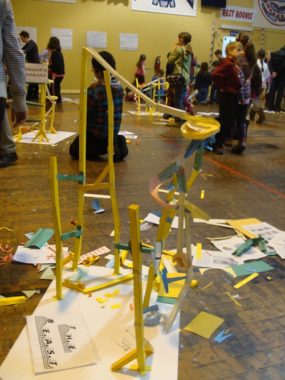
A weekly program of the Juneau Economic Development Council called “The Saturday Thing” aims to help kids rediscover the lost art of tinkering. Casey Kelly has more.

Ethan Madsen is seven years old – almost eight – and a regular at “the Saturday Thing.”

Ethan Madsen (right) and father Andy tinker with stuff at JEDC's Saturday Thing. Click to enlarge. (Photo by Casey Kelly/KTOO)

“I built a rocket. I kind of mess around with recycling and put it together and see what I can build,” he says.

On a recent weekend Madsen is busy building a robotic arm that will be powered by four separate motors.

“The one is for the fingers to open and close, the other is for the wrist, the next is for the elbow joint, and the last is the base motor that will allow it to move,” Madsen explains.

Since September JEDC has offered “the Saturday Thing” every weekend at its STEM Education office. STEM stands for Science Technology Engineering and Math. JEDC

JEDC's Bob Vieth. Click to enlarge. (Photo by Casey Kelly/KTOO)

Education Specialist Bob Vieth says the kids who attend the program are exposed to a little bit of everything.

“We do chemistry we do force and motion, physics, magnetism, electricity, optics, engineering – how things go together – gear ratios, it’s just across the board,” Vieth says.

Every week Vieth comes up with a different scientific concept to explore, but mostly “the Saturday Thing” is opportunity for kids to tinker with things.

“It’s kind of a lost art. And you can learn so much through tinkering. You can learn about how things work, why things work, explore scientific questions, phenomena,” he says.

What is tinkering, exactly? Vieth says it involves building things and taking things apart.

“We’ve got vacuum cleaners for kids to take apart and look at how they work. Kids can take apart computers and look at how they work. Just taking apart stuff is a learning experience in and of itself,” says Vieth.

So what’s the plan for Ethan Madsen’s robotic arm when he’s done building it?

“Mr. Bob he wants to put it in the window and just have it move around, maybe pick up a few things and move them around,” says Madsen.

Ethan’s dad, Andy – an electrical engineer – says “the Saturday Thing” has been a great opportunity for the whole family to experiment, learn and of course tinker.

“He’s learned how to solder down here, and they build rockets, and Bob has a launcher, so we’ve gone next door and launched the rockets,” says Andy Madsen. “My two year old daughter even comes down with us and she sits and works on Legos and so everybody is invited. Nobody is turned away.”

“The Saturday Thing” is free. Because Vieth is the only staff member there, it’s limited to 10 kids per week. Vieth says donations of items for kids to tinker with are always appreciated.

School budget committee wants public input

Juneau’s Board of Education wants to know what the public thinks about school district spending.

“If this is the amount of money we have are we allocating it in the most efficient way to get the best results for kids?” asks School Board President Sally Saddler.

She says the 16-member budget committee needs to hear what the community thinks as it begins to work on the 2013 spending plan.

The budget committee is comprised of the entire school board, plus seven public members and representatives from school unions. Work begins in earnest in January. It will be late April before the district will know how much money to expect from the main funding source, which is the state of Alaska. It’s already clear Juneau will have at least three-million dollars less in revenue next year.

Personnel makes up about 80 percent of district expenses. Bargaining begins in January for new teacher and staff contracts. Saddler says the budget hole puts the district in a difficult spot as it goes into negotiations.

“We can’t ask our faculty and support staff to do more with less. They’ve been doing that over the past few years,” she says. “We had a 4-point-1 million dollar cut last year, the year before we had cuts, and I think we’ve been cutting since I’ve been on the board. So what we want to do is say ‘how can we do things differently’ and get people thinking about ways that it’s not business as usual.”

More information on the school district budget is at www.juneauschools.org. You’ll find the link under Hot Topics.

Site notifications
Update notification options
Subscribe to notifications