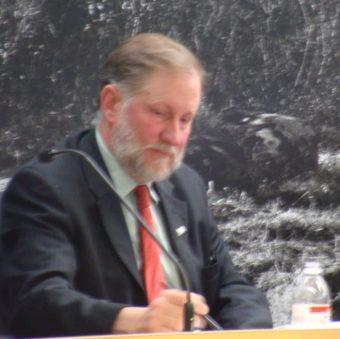
City Attorney John Hartle is retiring June 30th. Photo by Casey Kelly/KTOO.
City Attorney John Hartle is stepping down after 20 years with the City and Borough of Juneau’s Law Department.
Hartle announced his retirement effective June 30th near the end of last night’s Assembly meeting.
“I’ve got my good health. I’ve got a decent retirement. I’ve got my kids to spend time with, and my boat, and my music, and my books to read, and garden to garden. And it’s just time,” he told KTOO.
Hartle has been City Attorney since June 2003. Before that he was Deputy City Attorney and Assistant City Attorney with the CBJ Law Department since 1993.
He says nothing in the job changed to lead to his decision to retire. In fact, he says most days he still enjoys it.
“I hope that’s been obvious to everybody,” he said. “I always say that I never know from one day to the next what I’m going to be working on. I’ve had the opportunity to feel like I’ve helped some people out, done some good things, worked with wonderful people, learned so much.”
City Attorney is one of two positions along with City Manager hired and overseen by the Assembly.
Mayor Merrill Sanford appointed Assembly members Randy Wanamaker, Jesse Kiehl and Loren Jones to a subcommittee to begin the process of recruiting Hartle’s replacement.
City Manager Kim Kiefer says seven positions and more than a dozen programs and services may have to be eliminated or reduced if the Juneau Assembly scales back property taxes.

The cuts would save the city about $1 million in fiscal year 2014, which starts in July. The list includes two school resource police officers, closing the Mt. Jumbo Gym, and reduced hours at public libraries and the Dimond Park Aquatic Facility. North Douglas bus service also would be cut, and the city’s Streets Department would partially substitute salt for synthetic deicer during the winter.
Kiefer says she tried to limit the impact of the potential cuts on the public, but she would prefer not to make any reductions at all.
“I never like to cut services, and that seems to be what we’ve been doing in little pieces for the last few years,” she says. “And we don’t have any more little pieces to cut.”
The proposed reductions came at the request of the Assembly, which last year approved an operating mill rate increase of 0.23 mills to balance the FY14 budget. Now some Assembly members want to reverse that.
The operating mill rate funds general government services, and has been 9.26 mills since fiscal year 2007. Kiefer says keeping the rate flat for the past seven years has already had an impact on services.
“It’s a delay in service compared to not being able to go to Mt. Jumbo Gym for preschool when you want to,” Kiefer says. “So, what’s happened in the past is a different level of service than what we’re seeing now. Now we’re seeing those hard decisions that actually are taking services away.”
The overall mill rate, which also includes debt service on voter approved bonds, has been 10.55 mills for the past two years and under 11 mills since 2007. CBJ Finance Director Bob Bartholomew says it wasn’t uncommon for the overall rate to be above 12 mills from the mid-1990s through about ten years ago.
“In the recent last two decades it’s kind of at a low point,” Bartholomew says.
The Assembly’s preliminary FY14 budget sets the overall mill rate at 10.89 mills. Bartholomew says that’s an increase of $83 per year on a property valued at $250,000 dollars. Put another way:
“If you take .34 mills – the total increase – and you divide it by the 10.55, that’s a 3.2 percent increase,” says Bartholomew. “So, whatever their existing property tax is, this increase would be about 3.2 percent.”
Kiefer presented the list of potential cuts to the Assembly Finance Committee on Wednesday. The committee did not take any action on them.
So far, the manager says the only public comments she’s received were from people urging the city not to cut $50,000 for youth activity grants and $8,000 for youth scholarships.
“I don’t know what the Assembly is hearing at this point,” Kiefer says. “We have an assembly meeting Monday night and one of the items on that agenda is public comment on the CBJ budget. So, it’s an opportunity for people to provide comment to the Assembly about the budget and about these potential reductions.”
The Assembly is in the middle of several weeks of Finance Committee hearings on the FY14 budget. The city faces a nearly $4 million shortfall even if the property tax increase stays in place. That’s because the federal government has halted its Payment in Lieu of Taxes revenue sharing program, and the city’s income from investments is lower than expected.
The Assembly must adopt FY14 budget revisions by June 15th.
Juneau City Manager Kim Kiefer congratulates former Library Director Barbara Berg on her retirement at a CBJ Assembly meeting in early 2013. Photo by Casey Kelly/KTOO.
An independent, third party evaluation of City Manager Kim Kiefer’s performance could cost the City and Borough of Juneau up to $20,000 dollars, according to a consultant who made a pitch to members of the CBJ Assembly on Tuesday.

Almond & Associates is a Seattle-area executive search and assessment firm with experience working for Alaska Native Corporations, including Juneau-based Goldbelt. The company specializes in a management evaluation process called 360-Degree Feedback. The review combines electronic surveys of the employee’s supervisors and co-workers, with in-person interviews by the assessment firm, resulting in a written analysis based on the input received.
Sydney Gorrell – one of three Almond & Associates representatives to speak with the Assembly’s City Manager Evaluation Subcommittee via teleconference on Tuesday – described the benefits of using the 360 process.
“This can be a very positive gift of hearing things that somebody does particularly well,” said Gorrell. “And it also gives an opportunity to really clarify any behavior changes that need to be worked on, focused on, or enhanced in some way.”
The city’s Human Resources department uses 360-Degree Feedback to evaluate department heads. In fact, Kiefer was evaluated using the process while serving as Deputy City Manager in 2011.
In light of a nearly $3 million budget shortfall for the upcoming fiscal year, Mayor Merrill Sanford asked the Almond & Associates team if the city could do part of the evaluation in-house to bring down the cost.
Owner John Almond recommended sticking with a full third-party review.
“People tend not to be as open when 360s are done internally,” Almond said. “That’s why we’ve been hired as an external source to come in and help the organization ferret out, what are the real issues. That’s why an external source is a little bit better than an internal source.”
The city’s Human Resources Director, Mila Cosgrove, was out of town Tuesday and unavailable to comment on Almond’s assertion.
Assembly members’ opinions vary about how to handle Kiefer’s evaluation. As of April 1st, she’s been on the job for a year. She also spent six months as acting City Manager in 2009, while then-Manager Rod Swope took a sabbatical.
Assemblywoman Karen Crane, who sits on the evaluation subcommittee, expressed concern about the interview process proposed by the Almond team.
“In this case we have a person who has nine bosses, and nine sets of expectations,” Crane said. “So my concern in this is that this person is going to get evaluated on nine sets of expectations – and not clear ones at that – and that might color the process in some way.”
Almond said the firm would sit down with the Assembly beforehand to get a clear picture of the goals and expectations it wants to use for the manager’s evaluation.
“You could be absolutely correct, maybe you have eight different expectations,” he said. “But once we start ferreting that out, then it might come back that the issues may be – and I hate to say this – may be more with the leadership of the city versus the manager.”
Crane said if the Assembly chooses to go with a third party evaluation, it will be important for members to talk to the consultants as a group, not as individuals.
“I’d like to have all of our comments on the table, if we’re going to do this, so that there are no hidden agendas, or someone’s evaluated on something that the rest of us do not agree with,” she said.
The manager evaluation subcommittee did not settle on a specific recommendation. Mayor Sanford said the committee will present information on all options at next Monday’s regular meeting, and let the full Assembly vote on how to proceed.
The mayor says cost will be a big factor in his decision.
“Here we are in a budget cutting cycle still, and we’re talking about a number that could be anywhere from $10- to $20,000,” Sanford said. “And maybe we need to not do that quite yet. Maybe in a couple years or something.”
In the recent past, the manager evaluation process was led by former Mayor Bruce Botelho, who served for nine years before term limits forced him from office last fall. Botelho wrote a draft evaluation. Then the full Assembly met in executive session with the manager to discuss it, before directing the mayor to make any changes.
Besides Sanford and Crane, the manager evaluation subcommittee includes Assembly member Carlton Smith, who is in favor of a third-party review. Assemblymen Loren Jones and Jerry Nankervis also attended Tuesday’s meeting, though neither spoke.
The April 1 permit hearing drew a large crowd. (Photo by Rosemarie Alexander/KTOO)
A settlement proposal that could have stopped litigation against the Juneau Planning Commission was never acknowledged by the city.
Juneau Chapter of Veterans for Peace on March 12 proposed the Planning Commission hold an additional hearing on the safety and health aspects of the Juneau Mercantile and Armory facility where semi-automatic, automatic and assault-style weapons will be sold or rented for shooting practice in an underground range.
Veterans for Peace appealed the facility’s permit, and the case was heard by the Juneau Assembly on April 1st. Chapter President Phil Smith says the settlement would have ended the appeal and been an amicable solution.
“They would get their permit and we, the public, would end up with a comprehensive explanation of how that place is going to work,” Smith says.
City Planner Greg Chaney is defending the case for the Planning Commission.
“If we had agreed to that, we would have been admitting that there was something inappropriately done in the past or that the decision was inappropriate. And in both cases we strongly feel that everything was done appropriately,” he says.
The settlement proposal is similar to the veterans’ demands heard by the city Assembly. But they also call for Juneau Mercantile and Armory owners to work with the chapter and CBJ Assembly to convene a task force to address firearms-related public health and safety measures in Juneau.
Chaney says he’s not opposed to a community conversation on gun safety, but it’s outside the purview of the Planning Commission, which can only address land-use issues.
Neither Chaney nor the gun range owners and their attorney responded to the veterans’ offer. Chaney says the settlement came too late in the process and there wasn’t much incentive at that point to try to settle the case. Though he calls the offer “extreme,” he says the lack of response was an oversight.
“We should have responded and I should apologize for that,” Chaney says.
In the settlement offer and at the April 1st hearing, Veterans for Peace argued that too little is known about the security features at the new armory, including background checks, firearms training, instructor qualifications and other safety issues. The Planning Commission record barely addresses these issues, or any comments from local public safety officials, including Juneau police.
Chaney says they were carefully looked at, but city staff deliberately left the information out of the record because it detracts from the land-use issues the Planning Commission is responsible for deciding.
The Juneau Assembly will announce its decision in the case at the end of April. It could remand the case back to the Planning Commission for rehearing, as requested by Veterans for Peace; let the Commission’s permit stand, or require some change in that permit.
The City and Borough of Juneau’s budget for Fiscal Year 2014 would be about 2.5 percent larger than a preliminary version approved last year under a proposal by the city administration.
The CBJ Assembly Finance Committee kicked off a series of hearings on the spending plan Wednesday with an overview by City Manager Kim Kiefer and Finance Director Bob Bartholomew.
Juneau has a biennial budget, meaning the framework for FY 14 – which starts in July – was approved along with this year’s budget a year ago. That plan called for total spending across all city departments at about $322.5 million.
The budget presented to the Finance Committee would total more than $330 million. It now includes more money for capital projects, after city voters approved a sales tax extension and bond package last fall.
The Capital City will see a nearly $1.8 million reduction in federal support, with the expiration of a timber subsidy. But the city will get an increase in revenue from the state, including an $800,000 boost for the Juneau School District’s retirement programs.
Over the next month and a half, the Finance Committee will hold meetings with each city department as well as nonprofits and other programs funded by the city.
The revised budget must be adopted by June 15th.
Close
Update notification options
Subscribe to notifications
Subscribe
Get notifications about news related to the topics you care about. You can unsubscribe anytime.