Local Government

CBJ Assembly OKs recycling talks

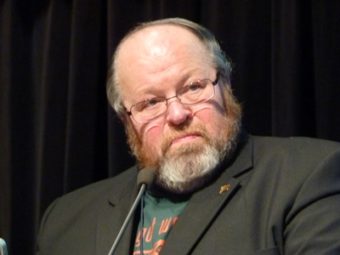
CBJ Public Works Director Kirk Duncan explains the concept for a new Municipal Recycling Facility to the Assembly on Monday. (Photo by Casey Kelly/KTOO)

The City and Borough of Juneau will enter into negotiations with Waste Management for a new recycling facility at the landfill.

The CBJ Assembly this week gave Public Works Director Kirk Duncan the okay to work with the company on the new building. Duncan says the current recycling center is maxed out.

“We have about an 8 percent diversion factor from the landfill,” he says. “We take about 2,400 tons per year in recycling, compared to 31,000 tons going into the landfill.”

Duncan will work with Waste Management to develop a Municipal Recycling Facility – or MRF – that will consolidate three separate city-funded programs. Junk vehicles, hazardous materials, and household products would all be disposed of under the same roof at the landfill.

“We will have a facility, everything will be compacted here, and then it will shipped down to Seattle, where it will be separated at one of three facilities down there and then shipped off to China,” he says.

Right now, Duncan says the city makes a little more than 100-thousand dollars a year off its recycling program. That’s because household materials are separated at the landfill, making them more profitable on the recyclables market.

“Cardboard right now, corrugated cardboard, is about $149 a ton, and we certainly don’t want to mix that in with everything else,” Duncan says. “It’s better economic sense to stay source-separated. But if you want to increase the volume, lengthen the life of the landfill, it makes sense to go co-mingled.”

That’s where Arrow Refuse comes in. The private company holds the Regulatory Commission of Alaska certificate to collect solid waste in Juneau. While recycling is not regulated by the RCA, Arrow’s Managing Partner, Bobby Cox, says the company plans to offer curbside pickup of household recyclables to its customers in the near future. The materials would be dropped off at the recycle center at the landfill.

“We expect that the only cost we’ll have to the consumer will be basically off-setting some of the cost of the container we’ll have to provide,” says Cox. “So we’re looking at a very low rate initially, probably somewhere in the $1.95 range is what we’ve been projecting.”

Arrow and Waste Management recently reached an agreement for a new 10-year tipping fee contract at the landfill that will also cover disposal of recyclables. Cox says the MRF would allow Arrow to collect material from large commercial and government customers.

“The reason we’re not picking up containers of cardboard at the State Office Building or places like that, is because you can’t process that right now with the volumes that we have without changing the facility,” Cox says. “So if you had a different facility, we could go out and effectively start marketing a lot of those source separated materials that we’re not doing right now.”

Duncan says consolidation of recycling services at the MRF shouldn’t increase the city’s costs – about a million dollars a year right now. But income from recyclables could go down. That all depends on the amount of co-mingled material and the price it fetches on the recyclables market.

“A year ago, co-mingled was $110 a ton. Now it’s $49. That’s the volatility in the market,” he says.

In the event of a shortfall, Duncan proposes an increase in the city’s household hazardous waste disposal fee and vehicle registration fee, which pays for junk vehicle disposal. He hopes to have a deal for the MRF negotiated with Waste Management within three months.

Arrow Refuse is waiting for a legal opinion about the type of container it wants to use for its curbside recycling program before releasing details. The city requires garbage containers to be bear proof, but Arrow is hopeful that won’t apply to recycling containers.

Plasma technology can’t handle Juneau’s waste yet

Many Juneau residents would like to see the city invest in technology that could turn solid waste into energy.

More than two years ago the assembly began making inquiries about plasma gasification incinerators, which use super-hot gas and electricity to break down matter, releasing energy and synthetic gas that can be converted to fuel and burned for electricity.

Waste Management – the company that owns Juneau’s landfill – is experimenting with a small plasma gasification plant at its Columbia Ridge landfill in Oregon. But company vice president Dean Kattler says it’s still several years away from being viable for a community like Juneau.

“It’s only 25 tons per day. It’s very, very small. It would not handle the volume that currently comes in today, even in Juneau,” says Kattler. “So, it is that first step, we really look at it as a ten year window before something will probably be commercially viable.”

Kattler says Juneau would likely need at least a 125-ton incinerator, which would make cost an issue. Even the small, 25-ton plant in Oregon cost 18-million dollars, and it took the Oregon Department of Environmental Quality a year longer than expected to permit the thing.

That news was met with disappointment by some Juneau Assembly members.

The city stopped incinerating trash at the landfill about 10 years ago when it became too costly to keep up with maintenance and environmental regulations.

Meanwhile, the sludge incinerator at the Juneau Douglas Treatment Plant has been shuttered for nearly two years. Since then, the city has been paying to have biosolids either dumped in the landfill or shipped down south. A plasma incinerator would not solve the city’s sludge problems, because the technology does not work on wet waste.

City manager candidates meet the public

The CBJ Assembly expects to hire a new city manager by the end of the month. The two finalists took questions from the public Wednesday, followed by an informal reception.

Public feedback is part of the city and borough’s Assessment Center process, used for hiring managers. Far more than interviews, job candidates respond to daily situations and problems they’ll encounter in the job they seek. They face written reports, oral presentations, power points as well as questions from city staff, the Assembly, and Juneau taxpayers.

Just before yesterday’s public presentation, Kim Kiefer and Norman “Buddy” Custard were handed a question: What is your vision to improve and expand the relationship between the general public and city government, and what is the city manager’s role in that?

Kim Kiefer gets questions after Wednesday's presentation.
Kiefer seemed at ease as she entered Assembly chambers with some notes penciled on a yellow pad. She has worked for the city and borough of Juneau for 28 years, managing the Zach Gordon Youth Center, directing the Parks and Recreation Department, serving as deputy city manager since 2005, and as interim manager for six months in 2009 when City Manager Rod Swope took a sabbatical.

She likens the city manager to the chief executive officer of an organization comprised of groups that serve the public. But the list of CBJ services is longer than most cities of 30-thousand people, ranging from fire and police, streets, water and sewer to ownership and operation of several docks and harbors, an airport, a hospital, a ski area, two swimming pools, an ice rink, a football field and track, libraries, a museum…

“We have all of these services that make Juneau function and my job that I see as city manager is to have an umbrella over that so we’re all functioning with the same understanding and same direction of where we’re going to go with that organization,” Kiefer said.

She presented first then left the Assembly Chambers, where the event was held. A visibly nervous Custard was next. He is retiring soon from a 30-year career in the U.S. Coast Guard. This is his second tour in Juneau. He told the audience that he asked the Coast Guard to move him here, because it’s a place he wants to put down roots.

Custard has been commander of four Coast Guard cutters. He said whether it’s running a ship or a city, everything is about relationships, beginning with the department heads who work under the city manager.

Buddy Custard talks with city employees after his Wednesday presentation.

“So it’s taking that energy that they have and then harnessing it and partnering up with the energy of the community and the passion that they have because they’re living in this community and they love this community so how do we merge those two together,” he said. “And I say that’s what the city manager’s job is about.”

If they were hired as city manager both Custard and Kiefer say they if they would reach out to the Juneau community in a variety of ways. Kiefer would start with improving the city website, and put the city calendar on the front page.

“City government is doing so much,” she said.

She would hold neighborhood meetings, reach out to Juneau’s aging population, and find out “what’s the vision for the school district, what’s the vision for JEDC, for the university, chamber of commerce. All those groups are made up of the public,” she said

Custard told his audience that “people are our most important resource. It’s the people that drive the innovation, it’s the people that drive the work, the relationships,” he said. “It’s not about a hierarchal chain of command. It’s about who you know and how well you know them and how you’ve built that trust.”

Custard said if he’s hired as city manager, his first big challenge would be to “reach out and just start to make those connections and to get to where people learn who I am and can trust me.”

Kiefer said her biggest challenge would be “people’s expectations that I know everything when I walk through the door, because I’ve worked for the city for such a long time; and to understand that I’m walking into a job that I haven’t done before.”

Though Kiefer was interim manager for six months, she knew Swope was returning.

“So that’s a different scenario than saying ‘OK, where do you want to take the organization?’ ” she said.

After the public presentation, those listening were asked to rate each candidate on such qualities as professional competence, oral communications, and interaction with the public. Assembly members will consider the public comments as they make their decision.

The Assembly will interview Kiefer and Custard in separate closed-door sessions on Saturday. The goal is to have the new manager hired and working with Swope before he retires at the end of March.

City manager finalists to face public tonight

Juneau residents can see city manager candidates Norman “Buddy” Custard and Kim Kiefer in action tonight (Wednesday) when they take part in a public presentation and reception at City Hall.

Captain Norman "Buddy" Custard. (Photo courtesy US Coast Guard)

The City and Borough Assembly named the two as finalists for the job in December. Kiefer is currently deputy city manager. She held the top position on an interim basis three years ago, when current manager Rod Swope took a six-month sabbatical. Custard is a captain in the US Coast Guard, currently serving as chief of staff for District 17, which is based in Juneau and encompasses all of Alaska.

CBJ Human Resources Director Mila Cosgrove has been helping the Assembly develop the interview process, including tonight’s public meeting.

“They both have different styles and different backgrounds and it’s a chance to get to see them, at least in terms of the public presentation pieces,” Cosgrove says. “And then, more informally, kind of in a meet and a greet type of a situation, there will be the opportunity to interact more casually with both candidates.”

Cosgrove says the topic of the public presentation won’t be revealed until tonight’s meeting begins. That’s to avoid giving either candidate an advantage. She says there will be comment cards for the public to fill out to inform assembly members as they make their final decision.

Besides the reception there will be a formal question and answer period following each candidate’s presentation.

Kim Kiefer (Photo courtesy City and Borough of Juneau)

“They’ll make a short presentation and then if the audience has questions about the content of the presentation or something else they’d like to ask directly, they can also do that,” says Cosgrove.

The Assembly hopes to offer either Custard or Kiefer the manager’s job by the end of the month. Swope retires on March 31st and the goal is to have the new manager on the job for a two-week overlap period.

Besides the public meeting, both candidates have been asked to complete a written assignment and will go through a formal, closed-door interview with the Assembly on Saturday.

The public meeting is tonight from 5 to 8 p.m. in City Hall Assembly Chambers.

City Manager and City Attorney are the only positions hired by the Assembly.

CBJ Assembly to discuss solid waste, SLAM project

The City and Borough of Juneau is finally getting to work on a comprehensive recycling program at the landfill in Lemon Creek, which may lead to curbside recycling in the Capital City.

Landfill operator Waste Management and garbage collection company Arrow Refuse have reached a tentative agreement on a new tipping fee contract. CBJ Public Works Director Kirk Duncan says that allows the city to resume negotiations with Waste Management over the recycling program.

“It looks like Arrow’s going to be taking the refuse to Waste Management for the next 10 years. So, now Waste Management and CBJ can sit down and start negotiating what the new recycling facility looks like and what the costs are going to be and how we’re going to roll household hazardous waste and junk vehicles into the program,” Duncan says.

Right now the city has contracts to offer three separate recycling services: Household products like paper, aluminum and glass can be dropped off at the landfill Tuesday through Saturday; hazardous waste is collected on designated days a handful of times per year; the same goes for junk vehicles.

Duncan says the city spends about a million dollars a year on those services. Bringing them all under the umbrella of Waste Management at the landfill isn’t expected to save any money, but hopefully it will be easier for residents.

“Consolidation, while not saving the city a tremendous amount of money, will make it much more convenient for everybody to use the facility,” says Duncan. “It also allows Arrow – if they wish to pursue this concept and they’ve made certainly overtures to doing this – they want to start doing curbside recycling. So that’s a potential as well.”

Waste Management was selected for the consolidated recycling contract in August. But negotiations with the city were put on hold when Arrow Refuse announced in September a plan to start a curbside recycling program, and barge trash to the Lower 48 instead of dumping it in the landfill. The Regulatory Commission of Alaska rejected that proposal.

Arrow has since filed a new plan with the RCA that does not include curbside recycling. But as KTOO reported in December, the company hopes to add the service in Juneau soon.

Duncan, along with officials from Waste Management and Arrow Refuse, will discuss solid waste issues at tonight’s CBJ Assembly Committee of the Whole meeting.

Also tonight, the assembly will get an update on the State Library Archives and Museums, or SLAM project, from the state’s hired architect.

The meeting starts at 6 o’ clock in City Hall Assembly Chambers.

Site notifications
Update notification options
Subscribe to notifications