The U.S. House has approved a measure that would allow the historic and decommissioned Coast Guard cutter Storis to possibly become a floating memorial and museum in Juneau. Now, the legislation moves on to the U.S. Senate for their consideration.
Congressman Don Young’s office said in an emailed release that the action came Tuesday, along with a measure that authorizes the service’s spending for fiscal years 2012 through 2014. Spending would total $8.49 billion and increase to $8.7 billion over those three years.
That larger funding bill also decommissions the Coast Guard’s two heavy-duty icebreakers. That’s something that Young says came out of frustration of the Administration’s inability to prioritize icebreaking needs and he believes it forces the administration’s hand. Young says he’s introduced a measure that allows the service to lease icebreakers.
The Storis legislation is House Resolution 1220. It was incorporated into House Resolution 2838 that was approved by the U.S. House on Tuesday.
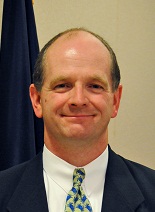
Kip Knudson photo courtesy of SOAThe Parnell Administration has named Kip Knudson as the state’s new director of state and federal relations in Washington D.C.
The 47-year old Knudson, currently the external affairs manager for Tesoro Alaska, will take over from John Katz when he retires at the end of the year. Knudson also worked as a legislative aide, director of marketing for Era Aviation, and deputy commissioner of aviation for the state Department of Transportation
The 68-year old Katz earlier this year announced that he was leaving after nearly 30-years as the director of state and federal relations.
The 10th Circuit Court of Appeals ruling means the controversial decade-old policy, which prevents road construction on certain federal lands, remains in place nationwide.
Wyoming argued that federal agencies violated the 1964 Wilderness Act and the National Environmental Policy Act in implementing the Roadless Rule.
The State of Alaska is currently challenging the rule on two fronts. A lawsuit filed in the District of Columbia argues that the rule itself violated the Alaska National Interest Land Conservation Act and the Tongass Timber Reform Act. Meanwhile, another suit filed with the 9th Circuit Court of Appeals seeks to reverse a lower court ruling that removed an exemption for the Tongass National Forest.
Assistant Alaska Attorney General Tom Lenhart says Friday’s decision won’t stop the state from moving forward with those suits.
“We made some of the same claims that was made by Wyoming. But in addition to that we have ANILCA and we have the Tongass Timber Reform Act, both of which apply only in Alaska,” says Lenhart. “And we feel strongly that the Roadless Rule, in fact, violates both of those federal statutes in Alaska.”
Earthjustice Attorney Tom Waldo says it’s unlikely the D.C. court will overrule the other circuit courts, even when it comes to the Alaska-specific arguments.
“The forest service thoroughly considered the application of those laws when it adopted the Roadless Rule,” says Waldo. “And we’re very confident that for the same reason that the 9th and 10th Circuits have rejected all the other challenges to the Roadless Rule, we think the D.C. court will also reject those Alaska-specific challenges to the Roadless Rule.”
Waldo and Lenhart agree that the 10th Circuit decision shouldn’t have any bearing on the Tongass exemption case, since that’s a separate issue from challenges to the rule as a whole.
Legislation sponsored by Alaska’s Congressional delegation would exempt the entire state from the rule.
The Roadless Rule was implemented in 2001, in the last days of the Clinton Administration. The Obama Administration has defended it.
Alaska Senator Lisa Murkowski says reducing the high cost of energy is the best way to promote economic growth in the state.
But she says the new focus on spending cuts in Washington, D.C. will mean less federal money to help build Alaska’s energy infrastructure.
“Federal support for R & D will continue,” Murkowski says. “But funding to actually help build out the facilities – like the government did when APA built the Snettisham and built the Eklutna hydroelectric projects – not going to come as easily as it has in the past.”
She suggested the State of Alaska, which currently enjoys a budget surplus thanks to oil tax revenues, could make up for some of the decline in federal spending. She also urged private industry to invest in Alaska energy projects.
“The private sector is working on a lot of new technologies that will need to be demonstrated on a smaller scale before expanding into larger markets. So we can be viewed as an opportunity for them,” says Murkowski. “I’ve always said, let us be the pilot projects up here in Alaska. If we can make it pencil out here where our energy costs are higher than anywhere in the country, think about what that demonstrates for the success of the project.”
The seventh annual Rural Energy Conference is going on through Thursday at Juneau’s Centennial Hall.
The number of Alaska post offices being studied for possible closure is down to five – and Douglas is still on the list.
The others are Elmendorf, Fort Wainwright, Eielson and the Anchorage Postal Store. That’s according to a U.S. Postal Service internal study provided to Alaska’s Congressional delegation yesterday (Thursday), and shared with the media.
Originally 36 Alaska post offices were being considered for closure. Twenty-five remote locations were eliminated from consideration almost immediately, and six more came off the list in the last month.
As we reported yesterday (Thursday), three Postal Service officials from Anchorage got an earful from Douglas Post Office customers Wednesday night arguing that the station should stay open.
Alaska District Manager Diane Horbochuk says several factors will determine which offices make the final closure list, including the cost to run each location, access to other post offices, volume, customer demand, and public input.
Communities can appeal if their post office makes the closure list.
Thousands of post offices nationwide are being studied for possible closure by the financially strapped agency, which is facing a 10-billion dollar shortfall.
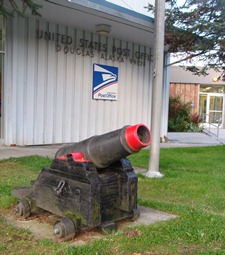
The Douglas Post Office. (Photo by Casey Kelly/KTOO)
Juneau residents turned out in force last night (Wednesday) to urge U.S. Postal Service officials NOT to close the Douglas Post Office.
The branch is on a list with thousands of other post offices nationwide being studied for possible closure by the financially struggling agency. But for the approximately 150 people who packed the Mt. Jumbo Gym Wednesday, it’s more than just a place to pick up mail and send packages. It’s a part of the community.
In fact, Douglas Post Office clerks Lee Kearney and Dean Ruby were grand marshals of the Douglas 4th of July parade last year, as pointed out by John Sandor and several others.
“I would be shocked if there’s another post office in the country whose postal workers served as grand marshals,” said Sandor.
Most of those who testified were Douglas residents, who like the convenience of having a post office nearby. But several said they live on the Juneau side of the bridge, but drive to into Douglas rather than use the federal building station downtown. Jack Cadigan gave three reasons why he prefers Douglas.
“Parking, parking and parking,” Cadigan said. “I counted, perhaps incorrectly, but 13 parking spaces 30 minutes each to service the main post office and the entire federal building – all seven stories and all the other agencies that are there. There’s 15 right down here on Douglas. We can come over here with packages, we can bring them in, we can get them shipped, we can get them mailed. And it’s great.”
Edwin Soto, president of the American Postal Workers Union Local 3323 in Juneau, said seniors, people with disabilities, and businesses in Douglas would take the biggest hit if the post office were to close. He argued the Postal Service’s savings would be modest at best, and said the real reason for the agency’s financial problems is a 2006 postal reform law that requires the U.S.P.S. to prefund future retiree health care benefits.
Juneau residents line up to tell U.S.P.S officials not to close the Douglas Post Office. (Photo by Casey Kelly/KTOO)
Soto called that “an obligation that no other federal agency or private business must bear.”
Diane Horbochuk, U.S. Postal Service District Manager for Alaska, was one of three Anchorage-based U.S.P.S. officials who heard the testimony. She said public input will be just one of the factors taken into consideration as the agency decides which post offices to shutter. Another factor she mentioned was the cost of running each location. If the Postal Service decides to close the Douglas branch, Horbochuk said there would be an opportunity for the community to appeal.
“At this point we have not made that decision,” stressed Horbochuk. “We’re going to go back and look at all our data, take into account the comments and make a decision. If we do make a decision that goes against what the community feels it should be, then you will be given the notice of what to do for what we would call an appeal. And that would be spelled out and we would post that in the post office.”
The Douglas office is one of 11 in Alaska still on the list for possible closure. The list originally included 36 post offices in the state, but 25 rural locations were spared after community groups voiced concerns.
Earlier this week Postmaster General Patrick Donohoe warned Congress that the Postal Service could lose 10-billion dollars in the fiscal year that closes at the end of this month, and the agency is in danger of defaulting as it reaches its borrowing limit.
Close
Update notification options
Subscribe to notifications
Subscribe
Get notifications about news related to the topics you care about. You can unsubscribe anytime.