The Juneau Assembly has scheduled interviews with City Manager finalists Kim Kiefer and Norman “Buddy” Custard.
CBJ Human Resources Director Mila Cosgrove says the process is set to take place the week of January 23rd.
“On Wednesday January 25th, there’ll be an opportunity for the public to come and hear both candidates make a short presentation as well as attend a public reception,” says Cosgrove. “And then on Saturday the 28th, they will meet in closed session with both candidates for more of a traditional interview process.”
Both candidates will also be asked to complete a written exercise. Cosgrove says that component will not be made public, since it’s considered part of the selection materials the assembly will use to choose a new manager.
Current Manager Rod Swope retires on March 31st. Kiefer is his deputy, while Custard is chief of staff for the US Coast Guard’s District 17 in Alaska, which is based in Juneau. The assembly hopes to offer the job to one of them by the end of this month.
City Manager and City Attorney are the only positions hired by the assembly.
Two-million dollars for an Adolescent Mental Health Facility at Bartlett Regional Hospital; 3.1 million for Snow Removal Equipment storage at Juneau Airport; and 2-million for an Aurora Harbor rebuild.
Those are just some of the projects under consideration by the Juneau Assembly for its annual list of state funding requests. City Manager Rod Swope compiled the draft list, which the Assembly Finance Committee will discuss tomorrow (Wednesday).
For the third year in a row, Swope is recommending the assembly ask for 1.3 million dollars to replace the Centennial Hall roof. The legislature has funded the project in the last two capital budgets, but Governor Sean Parnell vetoed it both times. According to an assessment, the 25-years-old roof was in need of immediate replacement in 2009.
The Aurora Harbor rebuild is the only project on the list included in the Governor’s capital budget proposal.
In addition, Swope is recommending the city lobby state officials to fund a proposed extension of North Douglas Highway with a grant to the CBJ. The grant would come from the Department of Commerce, Community and Economic Development. Swope says that would “facilitate flexibility in use of the money” and remove some federal restrictions that would be required if the project is funded through the Department of Transportation.
The Finance Committee meets Wednesday at 5 o’ clock in assembly chambers.
Draft List of Potential State Funding Requests (source: City and Borough of Juneau, City Manager’s Office)
Bartlett Regional Hospital Child and Adolescent Mental Health Facility ($2 million): Provide partial funding for 12 inpatient beds that could provide mental health evaluation and treatment and one to 14-day detoxification for youth with chemical dependency problems. This is a $20 million project. BRH is providing $5 million in matching funds.
Airport Snow Removal Equipment Facility ($3.1 million): Provide partial funding for construction of a snow removal equipment building and airport lighting controls for a new maintenance/storage building. The total project cost is $23.7 million. The Federal Aviation Administration will fund 73% of the total cost and requires a 5% local match.
CBJ Snow Storage Facilities ($2 million): Provide partial funding for construction of snow storage and disposal facilities. As a result of more stringent Environmental Protection Agency/Department of Environmental Conservation regulations discouraging the disposal of snow into marine waters, the CBJ is developing alternative locations for snow storage and disposal. The Juneau Douglas Treatment Plant is being redesigned to allow for storage of snow, as well as a retention pond to capture contaminants from the snow melt. A potential site is located on US Forest Service land near the Mendenhall Glacier. The site is currently going through an environmental assessment review, and if approved would be developed to meet state and federal requirements for snow storage and disposal.
CBJ Chemical Shed ($1.5 million): Provide funding for construction of a chemical storage building. The CBJ has funded the first four phases of a new Public Works facility in Lemon Creek. The fifth phase requires construction of a building to house the dry chemicals that are used on the streets to melt snow and ice.
Centennial Hall Roof Replacement ($1.3 million): Replace the 25-year-old roof on Centennial Hall. In 2009, a roof condition assessment was done and determined the roof is in immediate need of replacement. A new roof, if funded, would be constructed to significantly improve the energy efficiency and R-value of the facility.
Aurora Harbor Rebuild ($2 million): Replace existing moorage facility and harbormaster building, both of which are beyond their design life. The total project cost is $20 million.
Statter Harbor Haul-out Ramp ($1.8 million): Remove and replace existing launch ramp with a haul-out/kayak ramp and boarding float.
Fire Department Mobile Data Terminals ($66,000): Install mobile data terminals in first response fire department apparatus. This would provide dispatch information in real time to responding vehicles and would improve response times, reduce radio traffic to the dispatch center, provide pre-incident plans and maps in the apparatus. The 911 surcharge fund can be used to provide a $5,000 match.
Fire Department Communications Replacement ($375,000): Replace the 911 emergency paging systems in the Juneau, Glacier and Auke Bay fire stations. These systems are beginning to have problems and are beyond their service life. One system no longer has parts available. These systems notify responders in the fire stations of an incoming 911 call.
Police Department Dispatch Software ($122,000): Replace the current outdated dispatch software with an updated system. Acquisition and installation of a new software system would eliminate redundancy, improve accuracy and response times, allow for more detailed documentation, and improve our retention rate for dispatchers.
At the conclusion of its regular meeting last night (Monday), the CBJ Assembly met behind closed doors to further refine the interview process for City Manager finalists Kim Kiefer and Norman “Buddy” Custard.
The Manager Hire Subcommittee reported to the full assembly in executive session on the work it has been doing over the last month. Subcommittee Chair, Assemblyman Carlton Smith gave a brief, generic outline of the group’s progress during the regular meeting.
“The process we’ve recommended would have three primary components,” said Smith. “One would be the assembly interview, the second would be a substantial written component, and then the third would be interaction with the public.”
To avoid tipping its hand to either candidate, the assembly is keeping specific details under wraps until the interviews, which could take place as soon as next week.
Kiefer is the current deputy city manager, while Custard is chief of staff for the U.S. Coast Guard’s District 17, based in Juneau. The assembly chose them as finalists for the city manager job last month (December).
Current Manager Rod Swope is retiring at the end of March. The assembly would like to have his replacement on the job at least two weeks before he leaves.
Quorum is the largest provider of hospital management services in the country, and has been involved in daily operations at Bartlett for more than 20 years.
Under the new contract, the board will hire its own Chief Executive and Chief Financial officers, positions previously employed by Quorum. Past board President Kristen Bomengen says the group felt it was in the best long-term interest of the hospital to have its top-level managers be employed by the local board.
“Our community will have the best control of our own hospital, if we’re able to directly hire and hold our CEO accountable to our board and our community,” Bomengen told the assembly.
Bomengen says the board is close to hiring temporary replacements for Morrow and Hamblin while it conducts a nationwide search for a new CEO, who will be responsible for hiring a new CFO. The board is also in the process of selecting a search firm to help it recruit and select candidates for the top job. Bomengen expects that to take six months.
“First step is to place individuals in the interim positions, and we’ve already identified a number of candidates that are very good potential for those positions, and during this week we expect to complete that process,” Bomengen says.
The Assembly approved the contract with Quorum by a 7 to 1 vote. Assemblyman Randy Wanamaker was the only member to vote against it, saying he didn’t see the need to change the management arrangement.
“The people that served in those capacities were valued members of the community and provided good service for the community,” Wanamaker says. “We only have to look at the quality of care that Bartlett provides to this community and the advancements it’s made through the years, with the assistance of the board and the management teams, to understand that that model has worked. And I see insufficient reason to justify this significant change.”
Services covered under the contract’s “base fee” include: Business and Strategic planning; Operations and Financial Advisory Support; and free tuition for Bartlett managers at training programs offered by Quorum. The contract also gives the hospital access to Quorum’s purchasing network, which helps with obtaining equipment and supplies at special prices.
Bartlett Regional Hospital has an operating budget of nearly $90-million dollars a year. Most of that is funded by patient fees.
Juneau-based research firm McDowell Group will likely begin conducting a survey of Capital City residents’ next week.
The Juneau Assembly commissioned the poll to get public input on municipal spending priorities now that the city is facing a projected 7-million dollar shortfall over the next two years. Casey Kelly has more.
An assembly subcommittee met with McDowell Group researchers this week to wordsmith questions for the survey. Assembly Finance Committee Chair Karen Crane plans to present the final version to the full assembly on Monday.
“We’re hoping to have it available for the assembly to take a look at, although it won’t be up for a vote because it will just be informational,” Crane says.
Eric McDowell – founder and principal owner of the McDowell Group – says the survey will aim to give the assembly information it can use during the budget crafting process.
“The objective is to gather public opinion on both preferences for potential budget cuts by department and other programs, and also to gather public opinion on potential sources of local revenue increase,” says McDowell.
The firm’s researchers will do that by asking survey respondents if they favor cuts to certain departments. They’ll also ask residents which departments should maintain services. Questions about revenue increases will cover sales tax, seasonal sales tax, property tax, as well as user fees.
“Not that anyone, including the assembly, is recommending specific cuts at this point, or specific taxes at this point,” McDowell says. “We certainly don’t want that to be a misunderstanding.”
McDowell says at least one open ended question will be included to get some off-the-cuff comments.
“In case there was a particular thing that they were interested in, or favored, or didn’t like, that wasn’t covered in any of the specific questions,” he says.
McDowell Group plans to interview 400 CBJ residents. That should provide a margin of error of plus or minus 5 percent for a community the size of Juneau.
If there aren’t any snags, McDowell expects the first phone calls next week. He says the survey will take about a week, and by the first of February the firm should be able to produce a report for the assembly.
CBJ Finance Director Craig Duncan says he and City Manager Rod Swope are also awaiting the results.
“Ideally, what’ll happen is that we’ll get this information soon enough to make our final decisions in the budget,” Duncan says. “So, I think it’s going to be factored in as we get near the end of February, first part of March in those final budget decisions.”
Duncan says much of this year’s shortfall is due to projected losses in federal funding. In the past, Juneau has received more than 2-million dollars a year from two federal programs. Secure Rural Schools provides Juneau and other communities with a percentage of US Forest Service timber sales; under Payment in Lieu of Taxes, the government pays some property tax to communities for federal lands. As it stands now, Congress will stop funding Secure Rural Schools, while Payment in Lieu of Taxes will be cut by about a third.
“That’s one of the unknowns we’re working with, because it has to do to some degree with Congress, and Congress seems to be having some difficulties in trying to decide anything lately,” says Duncan.
The other big issue is income from investments. Duncan says the rollercoaster on Wall Street has been especially hard on the city’s bottom line.
“The city has in the past relied fairly heavily on our investment returns,” he says. “And like the whole world right now and all of us who have retirement benefits, the interest rates that you’re receiving are significantly lower than they were just a couple years ago. That really is costing the city several million dollars a year in interest income.”
Duncan says sales tax revenue – down in the past three years due to a decline in cruise ship passengers – is expected to rebound in the next two years. Property tax revenue has remained relatively stable.
Typically the City Manager presents the budget proposal to the assembly by mid-March. The assembly then takes the month of April and part of May to review it. The city charter requires the final version to be approved by June 15th.
The McDowell Group survey is costing the city 10-thousand dollars.
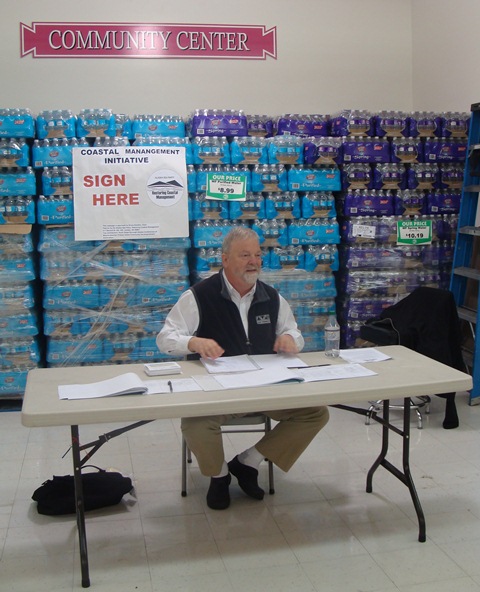
Juneau Mayor Bruce Botelho collects signatures for the Alaska Coastal Management Program initiative. Click to enlarge. (Photo by Casey Kelly/KTOO)
Backers of a citizen’s initiative to re-establish the Alaska Coastal Management Program have unleashed a full-court press to collect nearly 26-thousand signatures needed to put the measure on this year’s statewide ballot.
Juneau Mayor and initiative sponsor Bruce Botelho got into the act at the Alaskan & Proud supermarket Tuesday afternoon. He says volunteers are mobilized in every corner of the state.
“We’re of course trying to collect the required signatures before the legislature convenes, so that we have a chance to have the 2012 legislature deal with the issue,” says Botelho. “And absent that be able to have it on the ballot in August.”
Initiative sponsors are operating under the Alaska Sea Party moniker. Statewide numbers were not available, but as of Tuesday the group had collected about 10-thousand signatures in Anchorage and 11-hundred in Fairbanks, according to Botelho. He didn’t have a count for Juneau, but said interest has been strong.
Many of the petition gatherers, like Botelho, are local government officials. But he says other groups have stepped forward as well.
“Some Alaska Native organizations, fishing organizations, conservation organizations, and just individual volunteers have said ‘We think this is a good program. We should get it back,'” Botelho says.
The Alaska Coastal Management Program provided one-stop state and federal permit coordination for developers seeking to build along Alaska’s coastline. It closed in July after lawmakers failed to reach a deal to reauthorize it last legislative session. The Parnell administration and House Republicans fought efforts to give local communities more of a voice in the program.
Close
Update notification options
Subscribe to notifications
Subscribe
Get notifications about news related to the topics you care about. You can unsubscribe anytime.